Author Archives: Jay

SeaTalk NMEA Bridge

The Raymarine ST 60 Wind instruments can calculate the TrueWind Speed (TWS) and True Wind Angle (TWA) from the apparent wind data (AWS& AWA) and the boat’s speed. 
Unfortunately, they’ll only do this from the speed as measured by apaddlewheel in the water.  This measures theboat's speed through the water and is itself an apparent measurement, as opposed tothe true Speed Over Ground (SOG) that can be obtained from a GPS receiver. 

There is some disagreement among sailors as to whether thetrue or apparent speed should be used for the true wind calculation. 
Frankly, I think those using an apparent speed definition are from oldersources that haven’t fully incorporated the changes that GPS has made tonavigation.  For my boat, I want to usethe SOG in the TWS calculation.  I alsowant to see the SOG displayed on my other Raymarine instruments that are designedfor the paddlewheel.

Opinions true vs. apparent aside, Take Two’s paddlewheel is not accurate and I’vebeen unable to calibrate it.  I think theproblem may be because of water turbulence where it is mounted.  Keeping the paddlewheel in the water all thetime gets it fouled with growth and swapping it in and out with a plug getswater in an otherwise dry bilge.

The solution that works for me is a SeaTalk NMEA Bridgefrom gadgetPool.de.  Its primary purposeis to translate sentences between a standard NMEA instrument network, and Raymarine’sproprietary SeaTalk network.  I don’treally need it for this purpose, but it has a very nice feature to specificallyaddress the speed problem.  When the optionis enabled, the bridge can translate the SOG sentence from the NMEA network intothe SeaTalk sentence from the paddlewheel. 
This effectively tricks the Raymarine instruments into using the GPSspeed. 

I’ve been using it for about a year now and it works well.

Torpedo With Teeth

There are plenty of things to fear in the water, but fortunately I’ve never seen them. The closest I’ve come is a large tiger shark I saw from the deck of my father’s boat when I was younger. My memory could be flawed, but I remember it being about 10 feet. It was certainly a big one. That was on the Gulf side in the Florida Keys, which is relatively shallow water, so it was strange to see such a big shark there. It just goes to show that sharks are everywhere.

Different species have different dispositions. Understanding those can help you interpret the creature’s behavior and determine if it has dangerous intentions. Bull sharks are just mean and will attack for no reason. Tiger sharks are perpetually hungry and not so choosy about what they eat. Great Whites have a bad reputation because of the Jaws movie, but probably only bite humans in cases of mistaken identity. That pretty much covers the man-eaters. We would clear the water immediately if we saw any of those.

Other sharks we take on a case-by-case basis. Nurse sharks are generally harmless if you leave them alone. Most sharks I’ve seen in the water are small and afraid of me. I’m sure the bigger ones are out there, but have no interest in us and stay clear. If we happen to spear a fish, however, that definitely interests them and we’ll move to a new spot.

I teach my kids that barracuda are harmless. They are so common that it would be silly to fear them; you’d never go in the water. I tell the kids barracuda are dumb, don’t see very well, and are just curious about what you’re doing. They seem to just hang in the water a short distance away and watch. They look aggressive, like a torpedo with teeth, but I had not heard of any barracuda attacking people the way sharks sometimes do. Conventional wisdom to avoid trouble with barracuda is to not wear jewelry or anything shiny or sparkly.

So it was a little disconcerting when a 4-foot cuda charged me yesterday. I didn’t see it, but our friend Ken did. I was at the back of the boat handing up my gear and about to get out, when I heard Ken call for everybody to get out. I assumed that he had seen a shark, was being cautious, and that there was no immediate danger. Since we had kids in the water, my first thought was to round them up and bring them in first. But then Ken reiterated more urgently that I should get out immediately. That was all I needed and hopped straight out.

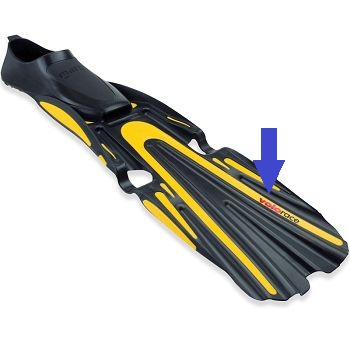
When we had everyone back aboard, he explained that he had seen a large barracuda charge at my fins and it only veered away within inches of striking. Neither of us had seen that kind of behavior before and that’s what led him to get everyone out. Upon examining my fins to see what could be so interesting, I realized that the logo painted on them is somewhat iridescent and shiny. It seems I unknowingly broke Rule #1 for barracuda. Needless to say, I scratched that paint right off.


Raymarine ST 60 Wind Instruments

I added a new instrument display to the boat recently — a repeater for the existing wind instruments.  The master display is outside at the helm station, and I wanted to be able to see this information inside.  There is also a ST 60 CH Wind (close hauled) repeater at the helm that displays the forward wind directions on a larger scale.

It should have been as simple as plugging the new display into the instrument network, and it was, except the analog direction needle was off by about 150 degrees.  Through the course of getting this solved, I learned a few things about these instruments.

The first thing I did was get out the book.  The book talked about “linearising” the instrument to the transducer (wind vane), and then calibrating it to the wind direction, but does not go into a lot of detail about what either of these things mean.  And it says nothing about repeaters.  

I did play with the calibration and noticed that when I changed it, it was changed on all the instruments, not just the one I was calibrating.  So I could make one right, but then the other two would be wrong.  I reset them all to factory defaults, which essentially removes any calibration factor, but that didn’t help.

Since linearizing requires taking the boat out and turning it in circles, and since I couldn’t understand how this would help, I called Raymarine Technical Support.  They confirmed that I really did need to go do the circles without elaborating on what that would actually do.  But since I was at their mercy, I went ahead and did it.  

It was both easy and hard, and utterly useless.  The book says you’re supposed to turn two circles.  In the middle of my first one, the instrument started beeping which is an indication of successful linearization.  How has that not happened before by accident?  Okay, great.  We’re done, right?  Wrong.  Now my master display was wrong, but not the same wrong as the new repeater.  The close hauled repeater, which is not actually connected to the vane, was still right.  Bizarre.  Further attempts to linearize failed.  I turned the instruments off and back on, did lots of circles, thought about it awhile, did more circles.  Nothing.

So I took the boat back in and called Raymarine again.  This time I talked to someone else, who apparently knew more about their products.  Linearizing is nice, but useless in this case.  What this does, I’ve figured out, is synchronize the needle to the vane.  The vane must send a signal when it is straight ahead and linearization must be the process of synchronizing the display to that signal.  Because there is no guarantee that the vane is actually straight relative to the boat, the calibration process allows the user to configure the master instrument to compensate for any physical difference.

None of this was the problem, however.  The tech support guy knew it wasn’t the problem, but he didn’t seem to know what the problem was.  He punted and sent me an internal technical document about how to put the instruments in self-test mode.  He was thinking I’d use the document to determine if the units were defective, but the document contained the solution.  

One of the self-test modes for the ST 60 Wind instrument allows a technician to adjust the display needle for each of the major graduations.  Basically the display says “I’m pointing at X degrees,” and the technician can adjust the needle direction until it actually points there.  

I did this for both the master display and the new repeater and now we’re all set.  It seems the vane was sending the correct direction, and the master was interpreting it correctly and putting the correct signals on the network (since the close hauled display was correct).  The new repeater was somehow “off” internally, and through the course of testing my master display got confused too.  Even though the displays had correct inputs, they had lost track of their needles and could not show it correctly.  

I did some Googling while trying to figure out this problem and did not find much information about “linearising” the wind transducer beyond what is mentioned in the book.  I also don’t see that the ST 60 Analog Instruments Service Manual is available anywhere publicly.  Maybe this will make it easier for others.
The Jims

Aaron loves outboards, and he knows them all.  If he's seen a boat before, he can tell you what it has hanging on the back before you can see it.  He can tell you who is going past in the dark by the sound of the motor.  We first noticed this trait when he was a little guy.  He was into monster trucks then, and could identify all the pickup trucks he saw on the road.  And he loved tools.

We see our jobs as parents as helping the kids follow their natural interests.  We have no expectations that they will grow up to go to college to be doctors and lawyers.  No offense to anyone intended, but we think the world has enough doctors and lawyers.  What we really want for them is to be happy in whatever they choose to do.  And no matter what they do, we want the boys to learn a trade, to have a marketable skill and learn the value of hard work.

There is a father and son team of mechanics here in the anchorage.  We call them The Jims.  They buy broken outboards by the lot, tear them all down, fix what they can and resell them.  They do all this work in the cockpit of their boat.  They very graciously offered to let Aaron come by and watch sometime.  I wanted to go too, and took him over there.   It's something different every day over at the Jims'.  On his first day, Aaron rebuilt his first carburetor.

We go over there most days now.  When Aaron has finished his schoolwork, and I've done enough work to take some time off.  I'm learning, too.  Some days are slower than others and sometimes Aaron loses sight of the big picture.  He was not impressed one day to find them working on a small generator.  That motor had a broken connecting rod and they took the block completely apart to get to it.  It was the coolest thing I'd ever seen.  After just a few weeks over at the Jims' I've learned more about motors than I ever learned from a book.

When our 25 turned up sick, what I'd seen at The Jims' gave me confidence to haul the motor into our cockpit and work on it myself.   I ended up not putting the carburetor back together quite the right way, and I had to limp over to the Jims' for help.  Through the course of tuning the carb and telling them what I'd found elsewhere, we determined that the motor had serious issues.  They thought the problems justified buying a new motor if I could afford it, or they'd help me fix it.  Of course I can afford a new motor.  The dinghy motor is one of our most critical pieces of equipment.  But there are no guarantees that a new motor isn't going to strand you somewhere, either.  In the end, Tanya and I decided that even if with money out of the equation, it is better to have a motor you know than one you don't.  So we're going to try to fix it.  If we can't, or it gets too messy, or it dies on us later, then we'll get a new one.  Probably in a different country where they still sell the good ones.

The Jims are clearly providing a valuable service to us and to Aaron, but it doesn't seem to be a one-way relationship.  They appear to truly appreciate having Aaron around.  Partially I think they enjoy passing on their knowledge and hard-earned experience.  It is rare these days to find a child who respects adults, and is interested in anything but video games.  Sure, he slows them down, but they don't mind.  Every day when we leave they invite us back.  And every morning when Aaron's finishes his schoolwork, he comes to tell me he's ready to go.

Scrubbing Bubbles

I've discovered a product to help keep my head clean. 

That would be the toilet on the boat, of course.  We flush with salt water and there are some unpleasant downsides to that.  We get scale buildup in the bowl and the hoses, and there is an odor which isn't directly attributable to the use of the device.  The scale problem we address periodically with couple good doses of muriatic acid.  That's my type of cleaning, but one must always be aware that what he's flushing is not actually leaving the boat right away.  Pete used to joke that I was going to turn my 50 gallon holding tank into a 50 foot holding tank.  The rest of the problem fell on the housekeeper, which wasn't fair.  It wasn't a clean problem, it was a water problem.

The solution came to me on the magic box during a business trip.  Scrubbing Bubbles Toilet Cleaner Gel.  It is a little gel turd that sticks to the side of the bowl.  The rinse water runs over the gel and carries the scrubby guys all over the inside.  I haven't seen the scrubby guys myself, but they were on the magic box so it must be true.  The gel lasts for about a week and then you put in another one.  We've been using it for about three weeks and the results so far are good.  Toilet looks cleaner, and smells MUCH cleaner.  In actuality it probably isn't, but who cares?  I'm willing to pretend.

Two things have to be considered when using chemicals like these.  First is how they'll react with our plumbing, and our plumbing isn't just pumps and hoses.  We have a septic tank after all, and there are little critters that live in there.  Those critters work on breaking down all the stuff we send them.  If they're alive and well and have lots of air (ironically) there shouldn't be much odor from the tank.  But if we kill them with the wrong chemicals, then its like living with a septic tank in the house.  Having used the Scrubbing Bubbles for three weeks with no apparent change to the tank, we're considering it a success. 

The second concern is what impact the chemicals will have if flushed overboard.  Considering all the other cleaners and detergents we routinely send overboard in our graywater, there probably isn't much additional impact, but it is still a good thing to think about.

Amazon Kindle

We finally bought a Kindle.  Tanya is a book snob a traditionalist, so it was an uphill battle for sure.  She could admit the merits, but refused to believe she could survive reading on a screen instead of paper.

But I'd been watching Eli read Lord of the Rings, his first big book, and boy is it a big one.  Being a young reader, he does better with larger type, but the print in this book was necessarily small.  And partially due to its size and age, the book was not surviving being handled by a 9-year-old — the pages were falling out about as fast as he was reading them.

I saw the Kindle as a solution to this problem and ordered one.  Because you're buying books in a proprietary format it feels like a bigger commitment than just the cost of the device, which is relatively inexpensive.  We also don't have room for stuff we don't use, so every purchase carries the potential repsponsibility of having to store or dispose of the thing.  I'm also an inveterate shopper, especially for gadgets, and try to make double sure that I need a thing before I buy it.  Double again if it's shiny.

We had friends over the day it arrived.  Everyone had heard of the Kindle, but nobody had actaully seen one.  All were amazed by the screen.

Eli took to it like duck on a junebug.  That big paper book went in the trash the next day.  The boat was already lighter.

A few days later, Tanya requested that book she is reading to the kids be acquired in Kindle format.  Another one in the trash.  Kindle wins!

When I converted our music from CDs to MP3s there was no additional cost, so I'm not looking forward to re-buying all of our books on the Kindle.  But if it means getting them off the boat, it will be worth it.  Unfortunately, we have lots of books that aren't available on the Kindle, so it isn't a 100% solution at this point.  But there are a lot of old classics that we don't have and are FREE (as in beer) on the Kindle.

There may yet be another benefit in the works.  Aaron is our techno kid, but doesn't read for pleasure yet, and it is driving him insane that he doesn't get to play with the new toy.

Right now we have seperate books being read by three people on the same device without conflict, but I'm sure eventually we'll be ready for one or two more.

Breeze Booster

Spending the summer at anchor in Florida is only possible with good ventilation.  When the boat is free to swing, it usually orients itself to any available breeze, but that breeze still needs to be captured and forced down into the boat.  This is the role of the ubiquitous windscoop, which is essentially a little spinnaker positioned over a hatch and held up by a halyard.

Some are chambered to capture the breeze from any direction.  This would be ideal if you were tied to a dock or the current were influencing the boat’s heading more than the breeze, which sometimes happens.  My objection to this type is how to close the hatch for rain.  This type has to extend down inside the hatch, or otherwise obstruct the hatch opening, making it impossible to close up without taking down the scoop.    Taking down a windscoop is normally not a big deal.  But doing it in the middle of the night, bleary-eyed and naked, on a wet deck in a strong breeze and cold rain is no fun at all.  And that’s the way it happens.  Every.  Damn.  Time.

So we don’t use that kind.  Instead, we’ve been using the more common single sided variety.  Our hatches face backwards, and these scoops still recommend attachment inside the front edge of the hatch, but we quickly abandoned that for the above reasons.  Instead, we broke down and installed attachment points on the deck outside the hatch so we could simply close the hatch from inside, leaving the scoop in place.  With aft-facing hatches, we can often stay dry with the hatch cracked.  

Our complaints about these type of scoop are that they still require a halyard, the material is quickly destroyed by UV, and they’re too big.  The breezes we frequently get at night are too strong for these big scoops.  And I’m not sure the bigger scoop results in more ventilation anyway.  So I sewed reef points into a pair of them so to make them smaller, and that worked better, but was too much effort.  We considered designing our own out of more durable material, but don’t have that kind of skill or energy.

We chewed through a few Davis brand scoops before trying the West Marine brand, which we like better.  It has sewn loops instead of grommets and feels like sturdier material.  The West scoop hasn’t died yet, but it is still too big, and still needs a halyard.  Poor Sarah doesn’t have a halyard over her hatch.

Then we saw another boat with a small self-supporting scoop over its hatch.  Upon investigation we learned it was called a Breeze Booster.  We ordered one and like it very much.  A little more expensive, but it came with a note recommending 303 Aerospace Protectant to reduce UV damage, so hopefully it will last a little longer.  It still wants to go inside the front edge of the hatch, but it will work fine with our existing deck attachments.  We’ve now ordered a few more and hope this will be a good solution.

Winslow Life Raft

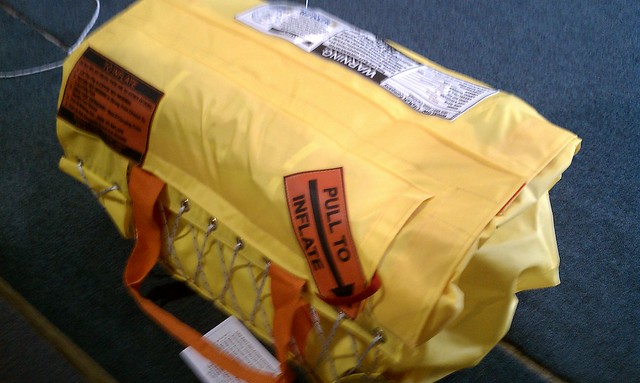
We bought Take Two a new life raft and decided to pick it up at the factory rather than have them ship it to us.  We think it is a good policy for everyone who owns a life raft to see it inflated and have a basic familiarity with it in case it is ever needed in an emergency.  

We applied that logic when we took the whole family to see our previous raft serviced.  Unfortunately it was going to be more expensive to recertify than it would be to buy a new one, so we had it condemned.  That was, of course, before we started shopping and realized that while a life raft could be purchased for less, we wanted the best and that was going to cost a lot more.

We placed the order for our new one at a boat show where several brands of rafts were being displayed.  Our selection of the Winslow was influenced by several factors.  We felt it had the best features and construction, an opinion seconded by Practical Sailor during a test of several competitors.  They were the only rafts at the show that are made to order and constructed entirely in Florida.  And they are unapologetically expensive.

We also liked that the raft’s standard equipment includes a Bible.  While this may seem like a sentimental and irrational reason to like a raft, we saw it as an indication that the company really thinks about what it is like to use their product in a survival situation.  

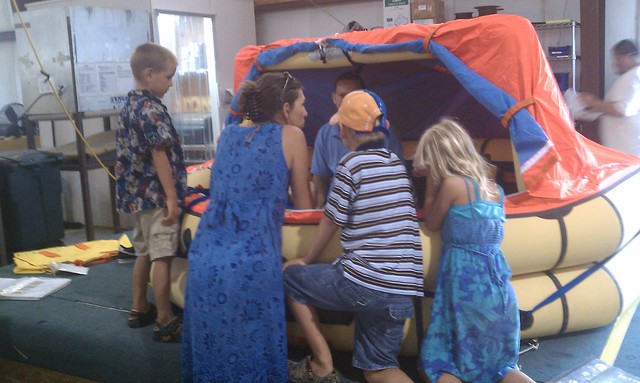
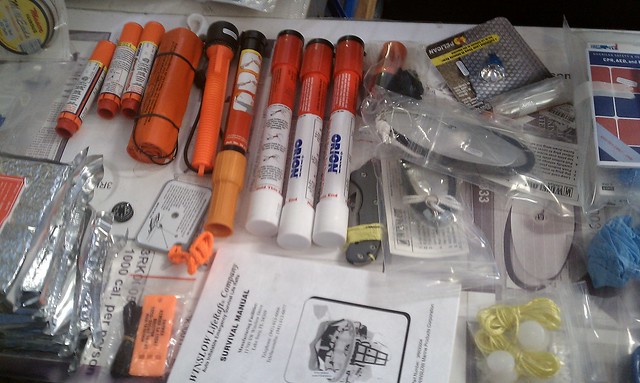
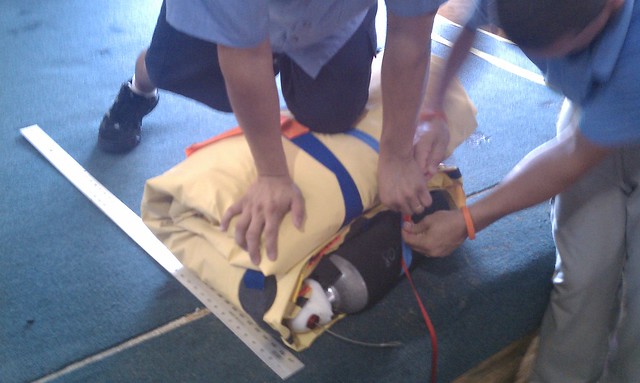
“Picking up the raft” actually evolved into a 2-hour visit during which we toured different stations where other rafts were in various stages of assembly.  Our raft had already been completed and was waiting in a rack for almost a month while we got all our ducks in a row to make the trip.  They knew we were coming, so it was inflated and ready to be packed when we arrived.  We were given an orientation of the raft’s features, we saw the survival pack assembled, and we watched as the raft was packed.  Each step was explained.

Tutorial

Equipment

The packing process includes many quality assurance steps.  While it is mostly done by a single person, at various points the pack is checked by another person, and at certain stages photographs are taken.  Witnessing the process gives confidence that Winslow is serious about the quality of their product, and understands that a defect could have life-or-death consequences.

Rolling Up

Ready

They’re also really nice people.  We were told that they ship about 15 rafts a day, but only 1-2 customers a month come in to see the operation.  We were glad to see it, and also glad that they could see our family.  I think if I were making life rafts, I would appreciate the reminder of who uses them.

Yawn


Hurricanes are tricky things.  In 2004, Category 4 Hurricane Charliewas headed straight for our house in Clearwater when it took an easterly turnovernight.  It decimated a surprised Punta Gorda with its strong northeastquadrant, and the weaker western side barely gave us rain.

A similar thing happened today in Marathon.  The storm went east of theforecasted track and we got the western side, which was pretty muchnon-existent.  It was overcast and drizzled once in the morning, then therest of the day was sunny and calm. 

I won’t attempt to hide that it was a bit of a letdown.  It’s not that I’m an adrenaline junkie orsomething.  I make these plans and havethese ideas about what conditions will be like and how we’ll cope with them,but at this point they remain untested.  Aboxer has to work his way up the ranks gaining experience before he has achance against the champ.  I only hopethat next time I’m not pitted against a much stronger storm.

I partially console myself with the knowledge that I could tell what was happeningas soon as I got up this morning and saw the breeze had backed to the North.  I’ve watched these things closely for manyyears now, have read some books, taken some classes, and feel like I’m gettingto understand them to some degree.

If I were reliant on official sources of information, I would have beentotally clueless about what was currently happening or about to happen.  The VHF chatter from
other boats showed a serious lack of awareness about what the weather was doing.  Local weather radar was the only informationI had access to (which was only possible because I had Internet access) which was compatible with what I was seeing with my eyes.  In fact, several of the National HurricaneCenter’s position reports appeared to contradict what I saw clearly onradar.  I find it frustrating that even within hours of a storm hitting me, I can’t get good information about what kind of weather I’llhave.  Part of it is a prediction problem, but part is also an information delivery problem.

We received several calls and emails today from friends and family inquiringabout how we’re faring in the storm.  Allwere surprised to learn that it was just another day in paradise.

Preparation

Several boats came in this evening to take mooring balls in the harbor.  Additionally, the boats that were tied up along the seawall in the marina canal (for the air conditioning) had to leave and take moorings.  One of our anchored neighbors went and grabbed a ball.  I have not seen anybody leave the harbor for the mangroves, but I'm sure a few boats have come in from the ocean side to tie up in there.

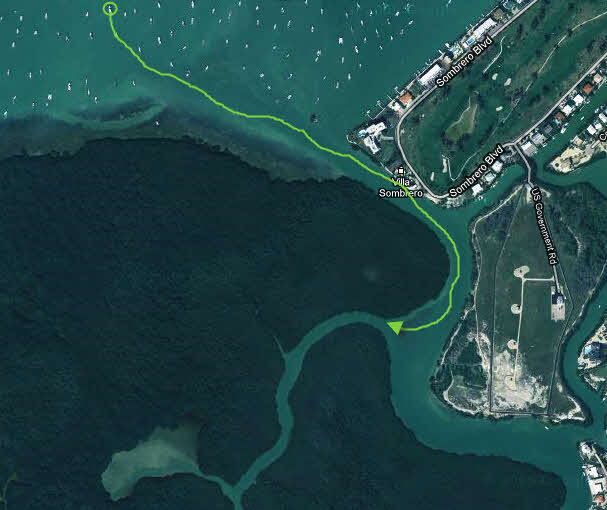
This is the path we'll take if we make a run for the mangroves.

We've seen a few other boats preparing.   Sails wrapped, biminis folded, dodgers removed.  The marina offers to store the dinghies inside their building and many people were taking them up on that.  From where I am I see several dinghies still in the water, trailing behind their vessels, and looking like they'll stay there.  That will be fun to watch.

What we’ve done so far:
•    Get out the storm anchor and spare anchor rode
•    Remove the secondary anchor from its roller to make room for the storm anchor
•    Rig a heavier bridle through the mooring pendant as backup
•    Re-roll the jib tighter on the furler
•    Lift the dinghy higher than normal, and secure it like we’re going offshore
•    Take the drain plug out of the dinghy so it doesn’t fill with rainwater
•    Clear the decks of fishing poles, scooters, buckets and other loose items
•    Get out various lines, shackles, and chafe gear for easy access
•    Get out big fenders and poles for pushing off other boats
•    Take some “before” pictures of the surrounding area

What we’ll do later:
•    Take down the wind scoops we use for ventilation
•    Wrap the spinnaker and spare jib halyards around the furled jib
•    Warm the engines up so they’re ready to go if we need them in a hurry

What I won’t or can’t do:
•    I wish I had a heavier spare anchor rode, but I left it in storage.  Bummer.
•    Take the sails off the boat.  I would for a hurricane.