Author Archives: Jay

FAQ: How much fuel do you use?

Depends on our usage.  The boat carries 200 gallons of diesel.  Between what was in the tanks when I bought her a year ago and what I’ve put in, I think I’ve burned about 100 gallons to date.  In theory, each 29HP propulsion engine burns .75 gal/hr and the 12KW generator about 1.25 gal/hr.  

If we’re taking daysails or overnights from the dock, the generator doesn’t see much use since the batteries will hold us for a couple days  and we’ll recharge when we get back on shore power.  Sailing is generally faster and more enjoyable than motoring, so unless the wind is against us and/or we’re in a tight channel we try to sail whenever we can.  

If we’re on a trip the generator is the primary user since we would get to a place and then stay anchored there for awhile.  On most boats, generator usage is determined solely by power replacement needs but we’re a little different because our oven/stovetop are electric instead of the usual propane.  We have big inverters to provide AC power from the batteries, but heavy loads aren’t practical on battery power.  We try to use the more battery-friendly toaster oven, electric skillet, and electric kettle whenever we can.  If only for charging batteries we could get away with running the generator an hour every other day, but for heavy-duty cooking it runs more irregularly.  Thanksgiving required a 4-hour run.  

After the batteries are charged to 80% capacity their acceptance rate drops, thus the load on the generator drops, and it becomes very inefficient.  It runs a constant 1800RPM to produce power at 60Hz.  If we have to run it for cooking, this is a good time to use the extra capacity for something else like vacuuming the boat or running the air conditioners.  We have a dishwasher but don’t use it.  Instead we’ll be replacing that with a clothes washer/dryer that would be another good free power user.  We would probably be better off with two smaller generators sized to individual appliances instead of the one big one.  Someday we’ll get solar panels that should reduce our need for bulk charging.

I had previously estimated that we could live for a year in conservation-mode on 200 gallons in our current configuration.  That may not be accurate because based on my understanding of our usage I really can’t account for the 100g of usage cited above.  We have propulsion problems and it may be that those engines are wasting fuel.

FAQ: How fast is it?

Fast enough.  8-10 knots is pretty comfortable and a nice cruising speed.  Going over that can be fun for short periods, but it isn't relaxing.  I've been 13 knots in the middle of the night and didn't like it much.  I'm more interested in keeping the boat moving in Florida's typical light air than I am setting speed records.

My information indicates that previous owners have had her up to 18 knots.  Speed stories are sometimes like fish stories, but it does give me an idea of what happened to the first mast.

FAQ: Will the boat lift a hull out of the water?

With enough wind the boat will heel a little bit, but it should never lift a hull.  She weighs about 14 tons and if we did experience enough wind pressure to lift a hull, I expect (and hope) that the mast would break first.  I have no interest in pushing Take Two that hard.  Interestingly, the boat is on her second mast.  I haven't yet determined what happend to the first one.

FAQ: Do the kids have to wear life jackets all the time?

The kids wear life jackets if they want to come out of the boat when we’re underway.  I only require they go below during docking or anchoring or other stressful situations.  Otherwise they can be in the cockpit or go on deck with permission.  They aren’t much into the joy of sailing and usually spend most of their time below reading or playing.  We could be having a glorious sail and they’d be pestering me to stop at a beach so they could swim and catch crabs.

We like the term “free range kids” and take it to mean letting them have a larger degree of freedom than most parents are comfortable with.  I was a free range kid and could be gone from the house all day without my mother giving a thought to the trouble I might be getting into.  And I did get into trouble.  Unfortunately times are different and we have to worry about things our parents didn’t, so we try to create the feeling of freedom without actually letting them too far off the leash.  My seven-year-old can’t operate a computer mouse, but he can free climb our 65-foot mast, is learning to operate the dinghy, and has caught what my information indicates is a record-setting seahorse.

I preface that to say that the kids do occasionally fall in the water.  None have gone off the moving boat, thank God.  Instead they fall off of the stationary dock.  Usually reaching too far for a crab or some other specimen for their observation bucket.  The aforementioned 7-year-old has been in three times (not counting the time I knocked him in on purpose).  The docks float so they don’t fall far, and somebody is always near enough to hear the splash and fish them out if they don’t climb out on their own. 

FAQ: Do you feel cramped living in such a small space?

I estimate the interior living space is about 900 square feet.  If it were a house it would probably feel cramped.  I don’t have headroom over the kitchen sink (dang!) and a few other places, and I frequently have to ask small people to move out of my way in narrow passages.  But it isn’t a house, and by boat standards it has an immense amount of space.  As Tanya has written elsewhere, we have far less "stuff" aboard which is necessary for weight consideration and also helps alot for preserving the spaciousness.

Strangely, we feel more cramped in our house than we do on the boat.  On the boat we can usually see for miles in at least three directions.  Even when we’re tied up at the dock we have an unobstructed view of the sun setting over the water, and we’re constantly aware of the sky, the breeze, and the tide.  At the house when we look out the window we can’t even see a 100 yards before our vision is blocked by houses, trees, or fences, and can only see the sky by walking outside and looking up.


Fish Out Of Water

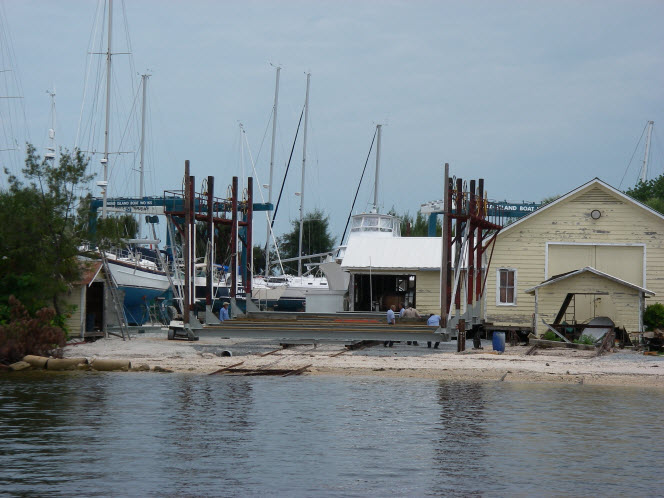
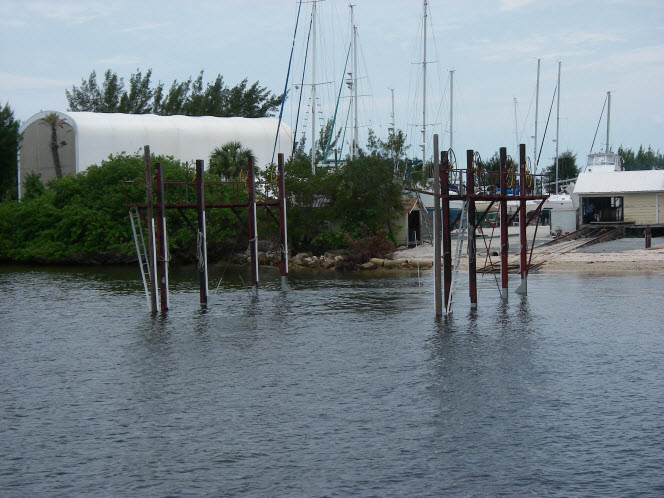
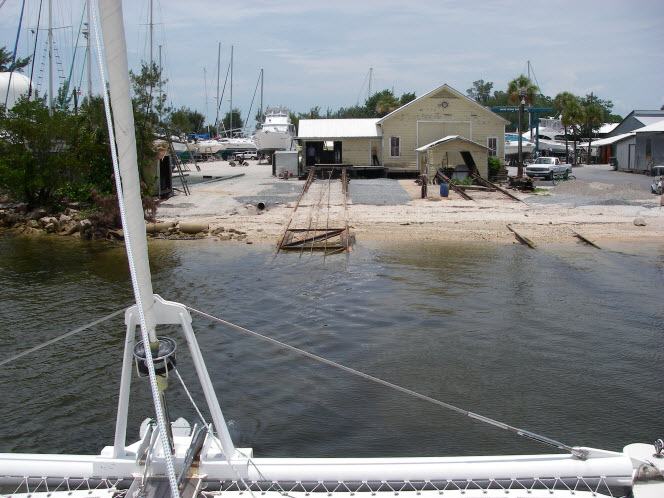
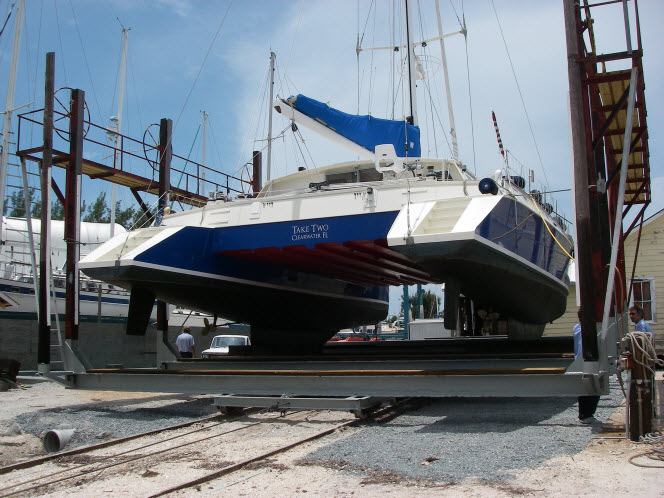
We pulled Take Two out today to do some work below the waterline.  It is always a little bit of an ordeal because of her 26' beam.  On the Florida West Coast our haulout options are few and far between.  The yards here that can handle our width use marine railways instead of lifts.  I'd never seen it done and was a little nervous about the process. 

They use a large sled sitting on rails and controlled by cables from a large winch.

They lower it down the rails and into the water.

The boat is carefully positioned over blocks on the sled.

Then they pull it back up the rails and Voila! we're out.

Dead Letter Box

Website maintainance has never been real high on my list, but it came to my attention today that the email function hasn't been working correctly.  Since we were depending on email notifications for comment moderation, that hasn't been happening.   So the bad news is that if you sent us email through the website during the last year… um, we didn't get it.  Sorry.  But the good news is that now we will.  Hooray! 

Dinghy Dilemmas

I've spent an inordinate amount of time recently thinking about my dinghy situation.  A dinghy is a smaller boat that can be used for going ashore or other short trips where the mother ship is not practical.  If the boat is the house, then the dinghy is the family car.

The dinghy is important to us for a few reasons.  Firstly, our anticipated usage of Take Two does not include marinas.  So the situations when cruising where we would need to use the dinghy to get ashore are expected to vastly outweigh the times when we can simply step down to a dock.  Secondly, we have small explorers very interested in getting off the boat.  A thousand other practical uses come to mind.

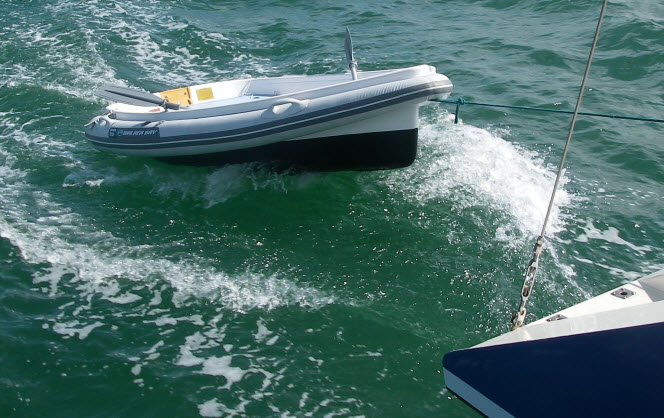
The boat came with a Walker Bay 10 RID with a sailing kit and a 4hp Yamaha 2-stroke.  A nice little boat, but it doesn't satisfy all our needs.  For one, it can't realistically carry the whole family at the same time.  On the plus side, it does have bottom paint and we don't currently have davits so it can be in the water and available for immediate use.  If we want to go somewhere and take it along, then we just tow it behind.

I was thinking we needed something bigger and faster, but storagebecomes an issue.  We wouldn't want to tow a dinghy long distance.  Wewill eventually get davits, but even so, we "only" have 14 feet betweenthe transoms to haul it out which would limit us to about a 12-footplus motor.  I wasn't feeling that 12 feet would be enough, especiallyfor an inflatable where so much interior volume is taken up by thetubes.

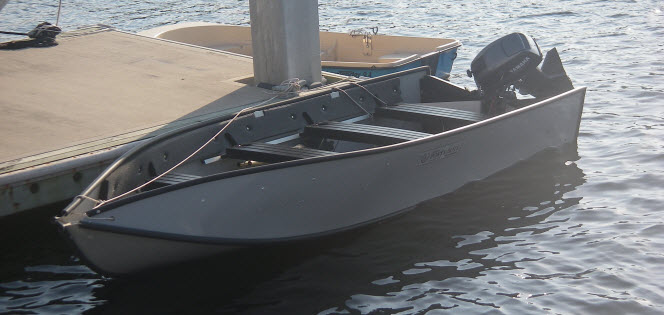
I've been intrigued by the Porta-Bote since seeing one at a boat showseveral years ago.  They're indestructible, have lots of room, and foldup to 4" flat.  When I saw a 14-footer on Craigslist I jumped on it. They look a little goofy, but it is growing on me.  One of my dockmatessaid it looked like a stealth bomber.  Take Two is very angular andaggressive-looking (to me) and I think the Porta-Bote is a goodaesthetic fit.  And it gets me the same type of "Holy crap, you'recrazy!" looks as Take Two does (which I've come to enjoy). 

It doesn't have bottom paint, so it can't be kept in the waterlong-term.  Our marina is pretty bad for growth and it started to getbarnacles after only two weeks.  The current storage solution is tokeep it folded and lashed to the port side lifelines.  The unfoldingprocess is a little arduous (I understand that they loosen up overtime), but we have plenty of foredeck space for doing that.  I'mthinking I can launch and retrieve over the port bow with a smallroller and the clever use of a halyard.  It only weighs 100 pounds soit is pretty easy to move around.

It did not come with a motor, and figuring out what to get is mycurrent dilemma.  It is rated to carry a 83 pound or 9.8hp motor.  Iborrowed Jonathan's 15hp Yamaha 2-stroke (79 pounds).  I determinedthat 15hp was overkill since I couldn't open it all the way before theboat got squirrelly, but having extra power isn't a bad thing,especially since I could see pulling kids on water toys.  I didn'treally care for the weight though, and the mounting bracket was alittle too wide to fit between the transom supports.

My little 4hp is in the shop since it hasn't run in several years.  I'msure it will push the Porta-Bote, but I'm not sure how well.  Is 4hp enough to get it up on a plane?  Probably not.  I don't have any plansto get rid of the Walker Bay or the 4hp, so I think it will make a nice backup motor.  Between the two I should be able to keep one running. How about 8-10hp?  Super Dave has a Yamaha 8 and I'll ask him to borrow it this weekend.

Power is only one part of the equation.   Weight and serviceability are my next biggest concerns.  Weight is bad in general since Take Two is very sensitive to it, but a 20 pound heavier motor isn't likely to make much of a difference to 12-ton catamaran.  But that 20 pounds could make a big difference to the dinghy and to me as I put it on and take it off.  A 8hp 2-stroke is generally about 60 pounds while a 10 is 80. 10s and 15 is usually use the same block and weigh the same, so why would I take a 10 over a 15?  I'm only aware of one manufacturer that made a 60 pound 10 horse (Nissan) and they don't anymore.  So unless I can find a 60 pound 10 horse, the decision is effectively between an 8 anda 15.  I'd like to stay with Yamaha since that is what I already have and would like to reuse spares if possible.

The motor(s) will probably live (eventually) on a bracket on the back of the cockpit and I'll probably rig a block and tackle from the boom to raise and lower it to the dinghy.  The weight wouldn't be a big deal if I did it that way.   But anything related to the back of the boat will get tied up in the hardtop decisions, so that isn't likely to happen soon.  In the meantime, the motor will probably lay on the sidedeck and and get carried down the transom steps to the dinghy.

You'll notice that I'm only considering 2-strokes.   In fact, they're being phased out for the more environmentally-friendly 4-stroke.  Iwon't go into the technical differences, but for my purposes the differences are: 4-strokes are quieter, use less fuel, and have cleaner emissions; they have oil in the crankcase instead of mixing it into the fuel which is simpler, but means they must remain upright or the oil will spill; and they are heavier.  But what is most important to me isthat 4-strokes are more complicated to service.  A perfect analogy is how cars went from carburetors to electronic fuel injection and now nobody can work on their own cars anymore.  I want to be able to fixthe motor myself and if I can't, find a mechanic who can.  I think I'll have much better chances of that happening in Pogo-Pingi, South Pacific with a 2-stroke.

Eye Candy

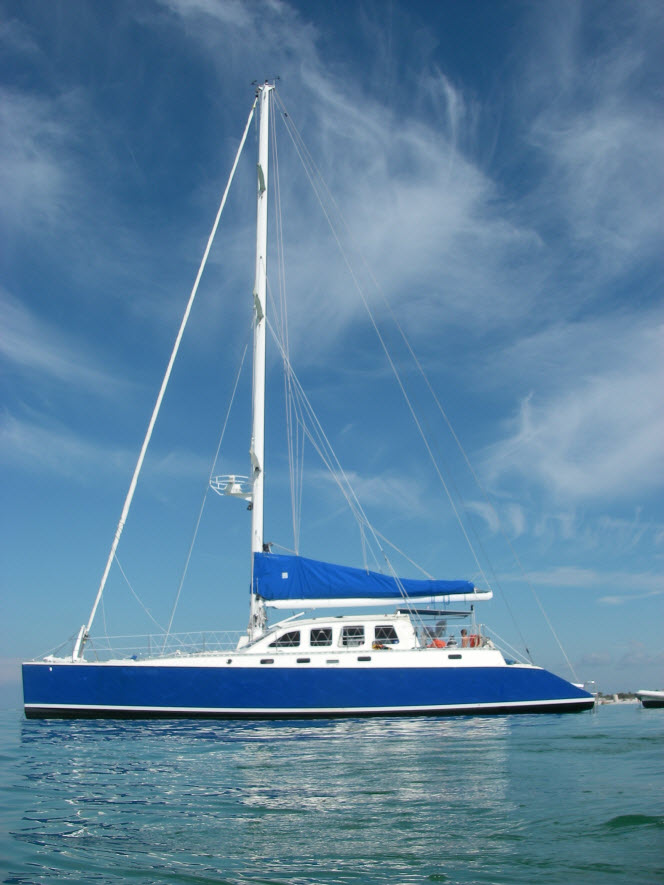
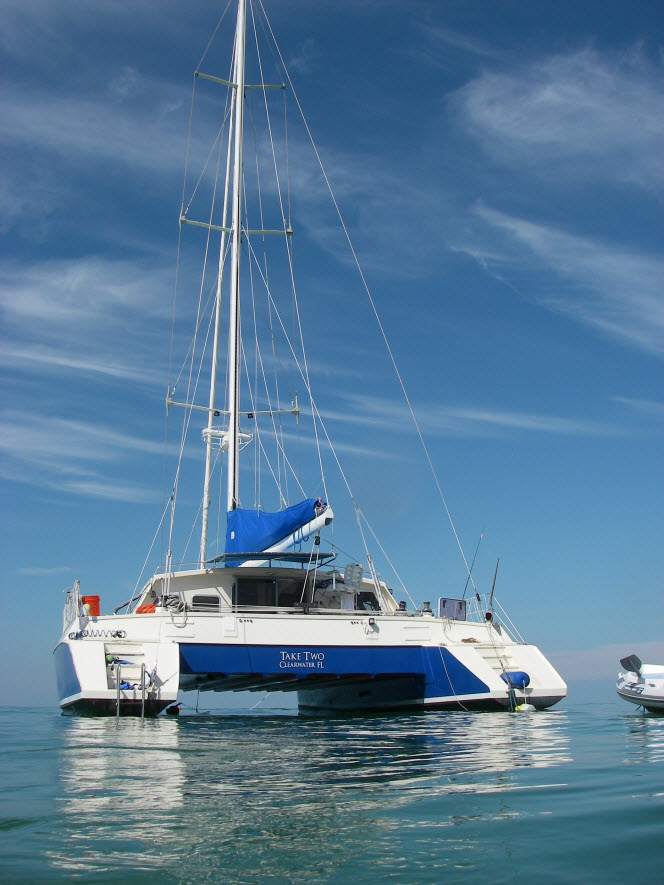
Some nice pictures of the boat from our trip to Egmont Key a few weeks ago.  Kudos to Tanya for the swimming photography.


Chitty Chitty Bang Bang


I finally got a mechanic down to the boat last week.  I’ve been meaning to do this since before Ibought the boat, but never got around to it. 
I knew the news would be bad.  Dothey ever give good news?

[more]

The port engine is very hard to start.  It has to be cranked for 60-120 seconds (notcontinuously) before it will fire.  Whenit does, it only runs on one cylinder and understandably very rough.  After it has warmed up for a few minutes, theother cylinders will start to fire, after which it is fine and will run allday.

A diesel engine is pretty simple.  It doesn’t have spark plugs, but insteadrelies on the air in the cylinder being heated by compression and a fine sprayof fuel being injected into the cylinder at the right time to cause combustion.  Simple, but precise.  The piston has to fit perfectly in thecylinder to create the compression, and the fuel has to be sprayed at theperfect time, in the perfect pattern, and under very high pressure.

I have managed to put together a few pieces of the boat’sstory.  The engines were commissioned inNovember 2000 by a mechanic in Sarasota. 
This was interesting because I didn’t know the boat had ever been inthis area.  I have a logbook that starts ayear later in November 2001, in Fort Lauderdale, when the engines have 145hours on them.  The logbook containsseveral entries that indicate that the port engine had problems even then.  It mentions some “blow by” and that theengine was accidentally run with the raw water intake closed, causing it tooverheat.

The overheating back then could very likely be root cause ofmy problems today.  When metal gets hotit gets soft and expands.  Getting softcan lead to deformation, and expansion within the small tolerances of acylinder can lead to increased friction and wear (which leads to more heat andmore friction until your engine seizes). 
Overheating is not conducive for maintaining compression inside theengine. 

The “blow by” he notes is a compression problem, but isrelated to the rings at the top of the cylinder not fitting correctly andallowing gas to escape.  It is usually arelatively easy fix and not a long-term problem.

Generally, the first thing a mechanic wants to know when heencounters a diesel that won’t fire is if there is compression.  This can be done by removing the glow plugs (littleelectrodes that pre-heat the air in the cylinder for easier starting), fittinga pressure gauge, and cranking it.  It ishard to say what pressure is good and what is bad, but the cylinders should allbe about the same.  It is definitely bad whenyou have one cylinder that is 50% higher than the others, and that cylinderworks when the others don’t.  Alas, thisis the case.

It is a pretty safe bet that what is going on inside theengine is that the engine has to be turned over (either by the starter, or by the“good” cylinder) until the pistons heat up from enough friction to expand and thepressure rises enough to allow combustion. 
While the engine is turning over, the injectors are dumping fuel intothe cylinders, which washes away the lubricating oil.  This increases the friction and helps thecylinders to heat up and thus fire earlier, but it also causes wear and thestarting problem will get worse and worse until someday the engine just won’tstart.

What is the solution? 
Well, the piston has to be made to fit perfectly in the cylinder.  The cylinder therefore has to be bored larger(probably half a millimeter) and fitted with larger pistons, or the cylinderhas to be sleeved and re-bored to the original spec and the pistons replaced.  Of course this can’t be done in the boat so theengine has be removed and re-installed, adding about two days of labor.  Ballpark estimate: $4,000.

Now, this isn’t all that terrible in boat-money terms.  Where it gets complicated is when youconsider that after spending the four grand, I’ll still have a pair of tiredold 30 horsepower engines that really probably should have been 40s or 50s tobegin with.  The real question here is doI want to take this boat long-distance with these engines?  Ballpark estimate for two new 40HP engines andmatched propellers: $40,000.

The mechanic that did this compression test for me was thesame guy who commissioned the engines in 2000. 
I did that on purpose.  He helpedme collect some of the pieces of the history puzzle.  Also, he wrote in his 2000 report that theboat motored at 9 knots.  Now, I’ve spentsome time on this boat and the only time I’ve seen 9 knots is with a nicebreeze and a big sail.  The best I’veseen under power is about 5.5.  I wantedto meet the man who said this boat went 9 knots on these engines.  He verified that it did indeed happen andnoted that the engines did not achieve anywhere near their rated RPMs.

As I’ve alluded to before, there are many factors toconsider when trying to maximize boat speed and minimize fuel consumption.  The boat’s shape and weight areconstants.  The engine manufacturerconsiders the RPM a constant.  The gearratio is a constant.  There areenvironmental considerations such as temperature, wind, and sea state, but themain variable is the propeller.  Whatdiameter, how many blades, what blade pitch? 
Apparently, it is possible to pitch the propellers such that the boatcan go 9 knots, but the engines can’t turn them at the speed the manufacturersays is ideal.  How bad this is, I don’tknow.  I also note that however the propswere pitched then, and however they are now, the engines do run faster, butstill don’t get what the manufacturer considers “cruising speed”.

The boat has fancy feathering propellers that orientthemselves to the water when sailing to reduce drag.  They have adjustable pitch, but unfortunatelythe boat has to be pulled out to make the adjustment.  Pulling this boat out is not something you docasually.  I know that the propellerswere removed and sent off to be serviced by the manufacturer sometime after thecommissioning.  Whether the pitch was thesame when the propellers were returned I don’t know, but this seems the mostlikely point at which the pitch would have been changed, perhaps inadvertently.

All stuff to consider. 
In the meantime we plan to run the port engine as-is.  We found that all the glow plugs were dead(probably from a tricky control panel switch that keeps them on unnecessarily)so those are being replaced.  They reallyaren’t necessary in this climate, but anything that can raise the temperaturein the cylinders is a good thing.  Sincewe already had the injectors out, we figured it wouldn’t hurt either to havethem cleaned on the chance that a bad spray pattern was inhibiting combustion.  When that is all done and the engine is backtogether I’ll have to find another mechanic to come take it all apart again andgive me a second opinion before I consider going any further.

Update 11/03/08

After reassembling the engine with the new glow plugs and the rebuilt injectors it starts amazingly well.  Like immediately.  It still runs unevenly when it is cold, and it seems to not warm up as quickly, probably due to the water getting colder, but at least I don't have to crank it nearly as much.  The mechanic's bill was $1,500 and while I'm not pleased with some of his billing practices, I think it was money well spent.  The starboard engine has now begun starting sluggishly and probably needs the same treatment.  I'll be doing that one myself.