Author Archives: Jay

Trying to Reason with the Hurricane Season

Props to Jimmy Buffett.

The last 24 hours have been spent in semi-frantic preparation for Fay.  The forecasts have been a bit erratic on this one, leading us to sometimes expect a Category 2 hurricane off Tampa, and sometimes a tropical storm further south and passing inland. It is looking like the latter for the moment.

It is really surprising to me for how large these storms are and how slowly they move, how quickly the situation can change.  An air of uncertainty always exists leading up to a hurricane. People wonder if they should prepare and how much.  If you wait to be sure, it will be too late since the weather starts getting bad long before the storm arrives.You almost need to be ready to either leave the state for everyforecasted storm, or to ride out a Category 5.  By the time you knowthe storm will be a Category 5 and that it has a reasonable chance ofhitting your area, the roads will be so clogged with people that youwon't be able to leave.  Your only choice then is to stay home or go to a shelter.

One must prepare with the mentality that it is better to do too much than too little.  It is a little disappointing to work so hard in preparation, feel you're in pretty good shape, and then have nothing happen.  I can understand how a few misses can make you lackadaisical, but nonchalance could also be deadly. 

Having prepared the house several times, it is almost a no-brainer now.  We've experienced the stress and last-minute scrambe for supplies and it isn't pleasant.  Since then we've hardened the house pretty well and live in a more prepared state.

You can't do this very well with a boat.  Boats are difficult to be usable and storm-ready at the same time.  As for any object in coastal water, "safe" is a very relative word.  The best thing you can do for a boat is pull it out of the water, take it inland, and anchor it to the ground.  And that only makes it about as safe as a mobile home.

This is the first time I've prepped Take Two, so I probably spent much more time than needed.  Much of the time was spent considering how much to do and how to do it.  But now that I've done it once, the next time it should go quicker.  I think I've prepared as much as I practically can.  I can only think of a few more things to do, but the cost-benefit is not attractive.  I pretensioned the awning, but did not remove the fabric from the frame.  I put out about a dozen lines, but not an anchor.  I could have run chain to the seawall instead of rope.  I took the jib off the furler, but only lashed the main to the boom instead of taking it off too. The next step on the preparation scale would include removing anything from the boat that I wouldn't like to see thoroughly immersed in salt water.

I feel that I'm in good shape for a Category 2 and have a fair chance for a Category 3.  There isn't much you can do to prepare for anything stronger.  The boat will survive or it won't.

The whole exercise did point out some weaknesses in my gear.  Faced with storm conditions, I really wish I had not procrastinated on replacing the fenders.  On our pier end the boat is not tied off to anything on the port side, but now she's in a safer slip where I can tie off both sides and I realize that I'm not at all happy about one of my cleats.  The fenders are ordered now, but rebedding the cleat will be a bigger job.

The docks have been awash in storm stories these last few days.  Hopefully there won't be any new ones. 

Getting the Shaft

As previously mentioned, we lost the port prop shaft during the delivery trip.  This occurred when we reversed the propeller to spin off some sea grass that had accumulated and was slowing us down.  Fortunately, the zinc nut on the shaft could not pass through the strut and the shaft stayed under the boat, but the end of it was inside the stern tube and could not be accessed from inside the boat.  This morning I had a diver down to the boat and he pushed the shaft back in for me.

One of the mysteries about the shaft problem was where the shaft key went.  This is a piece of 5/16" square rod that fits into grooves cut into the shaft and the coupling to keep the former from turning inside the latter.  The key should have been somewhere in the bilge, but it wasn't.  Improbably, it emerged from the shaft seal along with the shaft.  I had assumed that the last mechanic to pull the shaft put it back without the key.  I had gone through the trouble to take the starboard shaft out of its coupling and have that key duplicated.  Oh well, now I have a spare and the starboard side got new bolts and set screws in the bargain.

Getting these couplings apart was a bit of an adventure.  Being of light displacement, our boat's bilge is much shallower than that of a typical sailboat, but it has all the same stuff crammed into it.  Combining the tight quarters with some very stubborn bolts, the job looked impossible for many hours.  When confronted with this type of problem I usually end up at Home Depot staring at the tools I don't have and imagining how they could be employed.  In this case I bought about $150 worth (no such thing as too many tools!), but the answer lay in the $12 pipe wrench.  The first attempt with the pipe wrench failed for my lack of understanding how it works (well, have you ever used one?).  I think I would have nailed it on the first try with a chain wrench, but HD doesn't sell those.  Success came when I discovered that the pipe wrench's teeth are angled so that it only works in one direction.  You learn something every day.

Once I had it apart, I took it all over to General Propeller and they supplied me with a new shaft key and new set screws.  These set screws were drilled, so they can be wired and hopefully we can avoid this little exercise in the future.  One oddity was that all the set screws (two on each coupling) were 10mm, but one of the screws on the port coupling was 1/2.  Looks like maybe somebody couldn't get the screw out and ended up retapping it.  But the dimple on the shaft that the screw fits into wasn't any bigger.  I wonder if this could have contributed to the shaft slipping out.

The shaft seal itself was in bad shape and leaked heavily after the shaft was back in.  Fortunately, I had proactively purchased a spare on eBay and could replace it.  It had probably worn out and begun leaking during the delivery but wasn't noticed.  Turns out these seals are water lubricated and are supposed to be "burped" when the boat is put back in the water to avoid an airlock in the seal.  Even though it has a Volvo Penta part number (828416) stamped right on it, Volvo doesn't have any record of the part.  I've read elsewhere that this was equivalent to #828422, but this is for a 30mm shaft and mine is 32mm.  I'll keep an eye out for the 416's and buy any I find, but I should probably get a 422 just in case.

The port shaft seal is additionally challenged since it has to make up for an alignment issue on that side.  The way it has been explained to me, the stern tube and the strut are not aligned with each other, making it impossible to align the engine with both.  The correct solution is to rebore the stern tube, but that sounds like as much fun as getting a tooth pulled.  The more expedient remedy is to align the engine to limit the wear on the cutless bearings and accept the fact that they'll wear faster than usual.  With the misalignment the tolerances are so tight that the normal vibration of the engine transmitted to the shaft causes it to knock against the stern tube at some speeds which is not a pleasant sound.  Pretty much sounds like a hammer banging on the bottom of the boat.

Once everything was back together, I ran the engine at the dock for awhile, revving it up in forward and reverse.  Everything stayed together, but I didn't have the nerve to stress it in hard reverse.

The diver told me that I had barnacles growing on my propellers.  This was a surprise since I'd just had them treated with Propspeed.  I knew Propspeed wasn't an antifoulant, but didn't know that the barnacles could still adhere.  He said that if I ran my propellers periodically they would come off pretty easily in the wash.

Transfer Switch

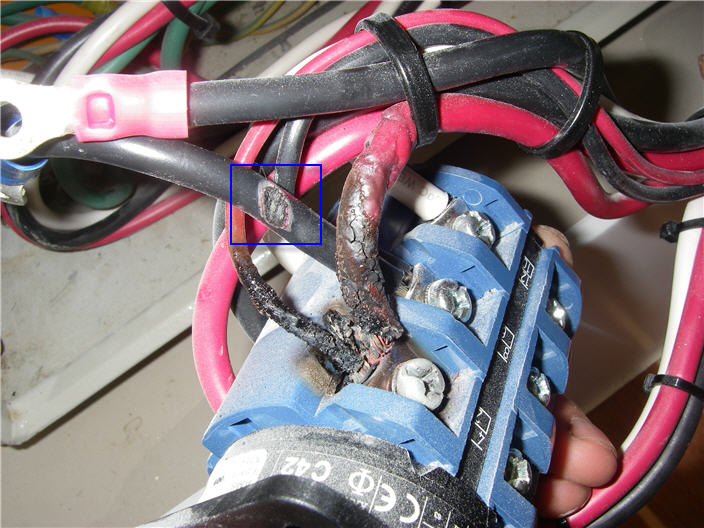
We had a small electrical problem a couple weeks ago.  While making breakfast and running the airconditioner one morning, we got one of the conductors in or 220V wiring hotenough to melt through the insulation and short against the otherconductor.  This caused our 50A shorepower breaker to trip.  That put an abrupt end to the air conditioning, battery charging, and pancakes.

The wires in question are 8 AWG and more than adequate forcarrying 50A at 110V.  I’ve seen thestove pull an impressive amount of power, but the breaker should have trippedlong before any wiring was damaged.  Ifour breaker failed to trip for some reason, there is another 50A breaker on thedock that would have.

Where the short occurred was immediately after the transferswitch that selects between shore power and generator, and I later discoveredthat the switch itself would no longer turn. 
Did the switch fail internally and cause the problem, or did a badwiring connection cause the heat buildup and melt something inside the switch?  I’m betting on the latter, since I discoveredsome corrosion in the connection.

The switch itself is a Kraus & Naimer C42 A212 and notthe kind of thing you can walk into a local store and pick up.  But I felt fortunate that the first call Imade to a marine electronics shop yielded the part in inventory.  It was in my hand two days and $275 later.

Replacing the switch and burned wire was unremarkable exceptfor the mechanical challenges of crimping 8 AWG.  Most crimpers only go down to 10 AWG.  I bought an uninsulated barrel and a crimperthat could handle 8, 6, 4, and 2 AWG. 
After crimping, I covered the splice with heat shrink tubing.   I did not put any type of dielectric grease onthe connection,  but I’m wondering if Ishould have given the corrosion.

In the current setup, the boat’s 220V ammeter only measuresthe black conductor the circuit.  I wonderif it would be advantageous to install a second ammeter for the red conductor.

The Delivery

Buying a boat in Ft Lauderdale presented certain logisticalproblems.  How do you prepare andtransport a boat that you know very little about from a remote location?  I made many lists, drove down for manyweekends, and employed a lot of wishful thinking.  As it turned out, the wishful thinking wasn’tquite enough.

There were multiple lists with items including getting a headworking, cleaning the fuel, replacing an exhaust hose, measuring the mast, findinga captain, planning the route, buying gear, buying linens, buying food… lots ofbuying.

I envisioned a 5-day trip, stopping each night.  Some days would be longer than others sincegood places to spend the night don’t occur regularly along the way.  The longest day I planned was 10 hours basedon the expectation of being able to motor at 8 or 9 knots.  There was some doubt about whether we’d beable to break through the Keys chain, or if we’d have to go all the way aroundKey West due to our mast height being higher than the standard intracoastalbridges.

A licensed captain was required by the insurancecompany.  Insuring the boat was by farthe most difficult and frustrating part of the purchase process.  I feel competent to handle the boat, but itis understandable that an underwriter may not share my confidence.  A captain was not unwelcome, however, and I’msatisfied with how it turned out.  My dadwent along, so we had a crew of three.

The first surprise came seconds after leaving the dock.  No steering. 
The boat has hydraulic steering and apparently a large amount of thefluid had leaked out and been replaced with air.  This may have had something to do with theriver currents pushing on the rudders while she was at the dock.  I know it was okay when the boat was out ofthe water and I heard no complaints from the broker when he moved her from theyard back to her dock.  At any event, wewere now travelling down a winding river lined by boats and crossed by bridgeswith a stiff following current, and were unable to use our rudders.  Fortunately, we have two engines which can beused very effectively to maneuver the boat. 
With one forward and the other reversed, she can spin like a tank.

I relinquished the helm to the captain immediately, hopinghe could do a better job keeping us from hitting something.  He didn’t hit anything, but my pre-departurejitters mounted to full-blown anxiety a few times as the boat clearly was notunder control.  After navigating the mostdifficult part of the river under a constant state of tension, we stopped at a fueldock before entering Port Everglades. 
Adding hydraulic fluid and spinning the wheel back and forth bled thesystem and the steering didn’t give any more trouble for the rest of the trip.

The captain directed some criticism at me during thisepisode, and I’m still not sure whether he blamed me for the steering problem,or for letting him take the helm, or both. 
I recall that he stepped in as soon as I discovered the steering problembut before I went for the engine controls. 
It could not have been long because we only had 100 feet before we wouldbe swept into another boat.  Would I havegone for the engines in time?  I thinkso.  I think I probably could havemaneuvered out of the river with the engines, too.  But he wanted the helm, and I was happy togive it to him.

It is interesting to me how I can be deferential andunassuming in some situations, quietly accepting criticism that I think isunwarranted, even being yelled at during moments of tension with noresentments.  But in other situations, particularlyprofessional situations, I can be aggressive and territorial, harboring agrudge against the slightest affront to my ego. 
I’m not sure what the difference is. 
In all cases I expect a quiet competence of myself, but sometimes Idemand individual recognition despite the overall outcome, and in others I linkmy satisfaction with the result and ignore criticism.  I don’t see my giving the wheel to thecaptain and not challenging his declaration that he was disappointed in me asany weakness on my part.  A job needed toget done and he seemed the most qualified to do it.  Isn’t that a good thing?

The next disappointment came as we entered the Atlantic andthrottled up to cruising speed.  Mylow-end estimate of 8 knots under power was off by a bit.  With a 20-knot headwind and the accompanyingchop, 4 knots was more achievable.  Theboat is underpowered for my tastes. 

Boat speed under power is a complex relationship of hullshape, engine torque and rotational speed, and propeller size and pitch.  I don’t understand the relationship wellenough to say that the boat needs bigger engines to improve her boat speed.  They don’t seem to labor, and they achievepretty close to their wide open throttle revolutions, which may indicate thatthey can bear larger propellers.  At thesame time, with their placement in the hulls, I can easily see that the enginesmay have been selected for their physical size more than their horsepower.  A similar sized boat that I’m familiar withhas twin 60hp engines and is clearly overpowered.  But as most will agree, power is a safetyfeature, and I think my twin 30hp Volvos are at the wrong end of the range.

It was a long day of motoring into the wind and waves toreach our first night’s destination at the southern end of Biscayne Bay.  Going into the bay was my decision and I madeit somewhat unilaterally.  We haddiscussed it, but the captain would have been happy to push on through day andnight, and my dad was concerned about being able to get out through the shallowpasses at the bottom of the bay.  I wastired and demoralized from the slow bashing in the Atlantic and just wanted toget into some sheltered water.  We founda quiet spot to anchor near Pumpkin Key. 
Everyone was tired and the planned meal did not materialize.

The next morning we motored out through Angelfish Pass verynicely.  The boat draws 4 feet and we didsee some fours on the depth sounder, particularly on the Atlantic side of thepass, but I think the depth is calibrated from the transponder, not from thewaterline, so the four foot readings were probably closer to six feet.  There are some good-sized boats docked in adevelopment inside the pass, so the channel is probably privately maintained.

The morning was uneventful as we motored south in HawkChannel between the Keys and the barrier reefs offshore.  The wind had clocked southwest overnight andcontinued move west throughout the day in order to stay on our nose as we camearound the bottom of Florida.  Our nextwaypoint was Snake Creek which is the only opening bridge in the Keys chain.

Snake Creek does not seem to be a common route for sailboatstransiting the Keys.  Nobody I talked tohad heard of it.  This may be because thechannel is somewhat shallow and the fixed spans at Channel Five and Marathonare conveniently nearby.  The spans areout of consideration for me because they’re only 65 feet and my mast is68.  I wasn’t sure about Snake Creekeither, because it has overhead cables and we couldn’t find a publishedheight.  We called the Coast Guard, thebridge tender, and the power company, but nobody knew.  In the end, we got right up to the cable andstopped.  From our perspective it wasimpossible to tell, but there was a guy on the bridge and he let us know byhand signals that we had plenty of room. 
In retrospect, if we were that unsure, we should have sent someone upthe mast.

The Gulf side of Snake Creek is shallow.  We saw fours again, but didn’t touch.

We transited Snake Creek at about 2pm and our next goodstopping point was Naples, about 12 hours away. 
The timing was awkward and we never seriously discussed stopping tospend the night in the Keys.   Inretrospect, I wish we had, because by not stopping we put ourselves out of syncwith our anchorages and kept ourselves out of sync with the wind.  Had we stopped, the wind would have clockedaround to the NE that evening and given us nice sailing the next day.

The Florida Bay was pretty stirred up with lots of sand andsea grass suspended in the water.  Afterawhile we noticed that the engines weren’t making the same RPMs that they hadbeen.  We worried about this for awhile,thinking we might have clogged fuel filters, until we hit on the idea ofbacking down to try clearing grass off the props.  It worked, but soon afterward the starboardengine overheated.  We shut it down,emptied the strainer, then restarted it and changed the port strainer.  Before long, the starboard side overheatedagain and this time the strainer was empty. 
It was night by now, the engine was smoking because it was hot, and itwas hard to tell if there was enough water in the exhaust.  Hanging under the boat with a flashlightbreathing the exhaust seemed to be my job. 
We shut the starboard engine down to rest for awhile.

The autopilot has a handy feature that allows it to followthe wind.  This enables us to trim thesails as we like them and then sail a wind angle that suits our trim instead ofa specific course.  This had been workingfine, but with the starboard engine shut down and the boat having a bit ofweather helm, our port rudder control was a little sluggish and we got tacked afew times when the autopilot couldn’t keep us off the wind.  Stupidly, we had been sailing with the frontwindows open.  During one of these accidentaltacks a jib sheet wrapped around the port window and ripped it off, leaving shatteredglass inside the boat and on deck.

Probably around midnight we went through another backingdown procedure to clear the port propeller, and something went wrong.  The engine raced.  The captain seemed to know what this meantand told me to go check the prop shaft. 
I thought he was crazy, but dutifully went to check.  Imagine my surprise when there was no shaftin the stern tube and water was coming into the boat.  I reported this and we began the holeplugging exercise.  Having water comingin your boat is never a good situation, but I had the plugs and the tools to takecare of it, so all in all, I think it went pretty well. 

With both engines out of commission now, and the wind stillout of the north-northwest, we were sailing pretty much west, giving up theadvantage we gained by cutting through at Snake Creek.  Stopping for the night was out of thequestion.  It was at this stage that Isuccumbed to seasickness.

I’ve always battled with mal de mer and it wins most of thetime.  Intellectually, I think it is largelya psychological phenomenon, but that hasn’t helped me much.  It always seems to be multiple conditionsthat collude to defeat me.  Was itexhaustion from several days of preparation and lack of sleep that weakened me?  Was it that cigar I had after dinner, or thediesel fumes?  Working below on theengines certainly didn’t help, and it being night there was no horizon toorient myself against.  And theaftereffects of stress can be enough to make a person nauseous on dryland.  Whatever it was, it was blessedlyshort, and I was back to normal in about 12 hours.

We had a great sail overnight in the wrong direction and bymorning we were about 40 miles off Marco Island.  Not a great place to be with no engines.  The captain went over the side to investigateour port shaft.  It was still therethankfully.  The zinc anode stopped itfrom sliding through the strut.  It justneeded to be pushed back in.  He tied itoff in case it managed to break free. 
Why he didn’t try to push it back in, I don’t know.  I think I had suspended independent thoughtby this point.

The wind died around mid-morning and we started thestarboard engine to see how it was feeling. 
It started getting hot and we shut it back down.   We talked about what the problem could be,but didn’t do much.  The captain wentover the side to inspect the intake, but it was clear.   We discussed the possibility that the intakehose was clogged, but didn’t take it off to look.

We spent all day sailing slowly back toward the coast.  We discussed putting in somewhere forrepairs, but decided that as long as the wind held, we would try for Bradenton.  It did, and so we did.

Shortly after nightfall, the wind clocked around to theeast, allowing us to tack and resume heading north.  It built until I decided that it was prudentto reef and we went right to the second reef.   
It continued to build until we had gusts to 35 knots.   It was a beautiful clear night, but colderthan any of us had packed for.  We wereclose enough inshore that the seas were relatively light for the wind strength.

The captain called for relief at about 4am and I went ondeck to relieve him.  It seemed that theautopilot was having trouble controlling the boat and he had been hand-steeringfor the last couple hours and was now exhausted.  As I took the wheel he told me that he hadbeen trying to keep within 40 degrees of the desired course and to be carefulof a gybe because we would lose the rig. 
This was not at all acceptable to me and I decided we would take themain down.  We rolled the jib and shewent right up into the wind very nicely. 
The drop went just as smoothly as the reef.  We unrolled the full jib and made a nice 9knots with the autopilot steering.

We were off Englewood when dawn broke clear and chilly.  The breeze slackened and we put ourdouble-reefed main back up, shaking out the reef by late morning.  The breeze continued to clock until we had itoff our starboard quarter.  I put up thespinnaker for a little while, but my crew was not as enthusiastic about it, soit was short-lived.

We started to see other boats off Sarasota.  The solitude of the previous couple days hadmade us lazy and we were not keeping a proper watch.  I went on deck at one point just in time tosee an anchored boat with a diver down flag bob down the side less than 6 feetaway.  I think that shook us all alittle.

We made it through Southwest Passage into Tampa Bay around 2pm.  The captain called a friend to bring his fishing boat out to us, and he towed us in to the dock.  Docking was relatively uneventful and the delivery crew dispersed by 5pm on the fourth day.  None of the five planned dinners had been eaten.  
The Beginning

As you’ve probably heard if you’re reading this, we finallybought a boat.  I should say anotherboat, since we still own the first one, but this is THE boat – a 48-footcatamaran.  If you know us, you’ve heardus talk about this for some time.  Infact, we’re about 3.5 years into our 5 year plan, and the idea predates theplan.  You may think we’re 18 monthsearly, but we’re actually right on schedule because the plan is not just to owna boat, but to live aboard and cruise extensively.  And in our more candid moments, you may haveheard us mention circumnavigation.  Theboat is capable, whether we are remains to be seen.

So where should I start? 
The beginning?  Where isthat?  This is not one of those simpleideas that can suddenly issue forth from the subconscious fully formed.  This is a culmination of our lifeexperiences.  It is the practicalapplication or our ideals and philosophies of life.  It is the embodiment of our faith.  It is what we were made for.  It is a journey that had no beginning and likelyhas no end.  This is who we are.  At least we think it is. 
As you’ll see, we’re still trying to figure thewhole thing out.

Buying a boat is never a good financial decision.  They’re expensive to buy, expensive to own,and hard to sell.  But we’re trying tobuy something else, and hopefully it will prove much more valuable.  And what is money good for anyway if not tochase your dreams?

If you’ve never tried it, moving from the path of easyaffluence to that of hard work and simple living doesn’t come naturally.  Folks are usually striving in the otherdirection.  Both are probably equallydifficult.  Being “successful” andachieving “the American dream” are always upwards on the scale.  Sitting here, I can’t think of a singleperson who has been recognized as successful for going the otherdirection.  To most readers, the idea isprobably preposterous.  Okay, it might bepreposterous to all of them, but I trust some might at least have a sense forwhat I’m driving at.

So, what’s wrong with us? 
Beats me.  Seriously, I knowbetter than attempt to articulate that in one sitting.  Bear with me, and it’ll trickle out on itsown.  Suffice it to say that this dreamis an amalgamation of many different ideas and desires.  Some of which we may not even completelyunderstand.

So let’s begin with the boat.

I found the boat while searching through listings on theInternet, as I am wont to do, or was.  Iwas looking for catamarans in Florida between 44 and 50 feet.  The length being what I thought we couldhandle and could also handle us, Florida being where I live.  Obviously, there are more boats beyondFlorida, but I had the sense, nay, the expectation, that the boat would findme, not vice versa, and I was in Florida. 
There are many, and I pored through them methodically.  Some I’d seen listed for years and would skipthese out of habit.  Some I would skipover due to some combination of age, designer, or price.  Some piqued my interest enough for me to readthe listing, and then were discarded upon failure of some aspect of myanalysis.  Many were interesting, but alleventually failed.

When I first saw her listing, I was struck by the number ofthings about the design that were done correctly.  Engines in the middle of the hulls.  More fuel than water, both also in the middleof the hulls.  Watertight crash boxesforward.  Triple-spreader rig with innerforestay and running backstays. 
Sacrificial keels.  Very narrowhulls with acceptable bridgedeck clearance (one can never really have enough).  I can count on one hand the number ofproduction designs that have some of these aspects, and none that haveall.  This of course was a custom boat.

A custom boat is one where a client contracts a designer tobuild a boat to meet his specifications. 
The client is usually very experienced, has lots of money, and knowswell what he wants.  Through a series ofdiscussions, the designer learns what the client is looking for and the two workout a design that meets the client’s desires and his compromises (since a boatis nothing if not a study in compromise). 
The design is then taken to a builder, and eventually a single boat ismade.

A production boat on the other hand is built speculatively,attempting to capture a large segment of the marketplace.  There are marketing people involved, doingresearch to determine what features sell best. 
While a custom boat is designed to satisfy one highly experiencedperson, a production boat is designed to satisfy a thousand people.  Then they are mass produced, with thenecessary emphasis on controlling costs to maximize profit.  You may well imagine that the results can beless than ideal.

In addition to the design, she had the right gear.  Generator, watermaker, hot water heater,large battery bank with stacked inverters, full instrumentation with hydraulicautopilot, forward looking sonar, EPIRB, liferaft, etc.  This was serious stuff for a serious boat.

But saying the right things in the listing is notenough.  She was built in 1991 and timeis hard on boats.  Pictures are thequickest way to get a rough estimate for a boat’s overall condition.  Inexplicably, and very suspiciously, herlisting had very few pictures and they were of dubious quality.  While interesting, the listing did notidentify the boat as a serious prospect.

I’m pretty choosy.  Itake these decisions very seriously.  Upto this point I had actually called a broker and gone to look at exactly oneboat, and that was over a year prior.   The story of Katie Rose will have to be toldanother time, but the short version is that while we agonized over thedecision, someone else snuck in and bought her in the span of a weekend.

This new boat continued to rattle around in my thoughts foranother week or so.  I found myselflooking at the listing again, and this time I followed a link to the broker’swebsite.  The broker had his own listingfor the boat there, which was the same as the one I had seen, except that this onehad pictures.  Glorious pictures.  This boat was in good shape.

I went home that night and told T that I had found theboat.  Knowing full well the gravity ofthe statement, she asked if I was sure. 
I claimed 90% confidence, which was somewhat remarkable for never havingset foot on her.  It was time to call thebroker.

Thus began a long and frustrating process that hasultimately ended with us owning the boat. 
It was four months from offer to closing and we experienced manyemotions throughout: fear, anxiety, longing, etc.  But in retrospect I think I can say thatdoubt never played a significant role. 
Some may think that a contradiction, but one can have fear about what heis about to do and yet have full confidence that it is the right thing.  Is it risky?
 
Yes.  Is it foolish?  Perhaps. 
Will it change us forever?  I hopeso.