Author Archives: Tanya

Overnight to Biscayne Bay

Making a passage is like hitting the “pause” button on my life. It’s very hard to write in my Day-Timer: “sit in the cockpit and do nothing.” But sometimes that’s really what I should do. Feel the sun on my face, the wind in my hair, the weight of a child on my lap. Relax the rules that keep me sane during my quotidian life because this is not my quotidian life. Even rough passages, which are not very pleasant, have a way of making one sit still and appreciate life (large waves will do that). Overnight passages have the feel of a holiday—a holiday that you dread and anticipate at the same time. The passage we just made from Ft. Pierce to Biscayne Bay was in many ways typical of our other overnight passages. Here’s a peek into our life afloat:


9 AM A friend from the Keys texts us (again) wondering where we are and why we’re freezing our butts off in Ft. Pierce instead of heading south to hang out with them.

10 AM I abandon the attempt to make a big Sunday breakfast and feed everyone granola instead as Jay and I discuss using the weather window to head south.

11 AM  Having decided to “just do it” we figure out what’s on the short list to prepare for departure. I will head to the library to drop off books, to a friend’s house to say good-bye and drop something off from my kids to hers and to the store for last-minute provisions. Jay will prep the boat for travel.

3 PM Hours later, I return with said provisions and we eat a late lunch, unpack groceries and run the engines.

4 PM We get fuel and water and do a pump-out at the marina. This always takes longer than we think it will. Debate ensues about whether we should go now or have a burger at the marina restaurant and wait until morning. We decide to use inertia and just go (“a boat tied to a dock stays tied to a dock; a boat in motion stays in motion). Good friends come down to see us off; it’s so nice to have someone to wave to (though we'll miss them before we're even out of the marina).

5 PM We head out the Ft. Pierce inlet, not into, but away from, a beautiful sunset. We make no commitments to really go until we see how the inlet looks.  A blessing: the tide is running out and the seas are calm, the winds fair. We head south, hugging the coast to stay out of the north-flowing Gulf-Stream. We say a prayer of thanks and ask for safe travel. Then we toss Oreos into the sea and say, “May these be the last cookies we toss on this voyage!”  (See previous post “Traveling Traditions.”)

6 PM We hang out in the cockpit and do nothing. Rachel falls asleep in my lap.

7 PM I make a quick dinner of tomato soup, goldfish crackers and applesauce and set up the kids’ traditional passage movie: The Swiss Family Robinson.

8 PM The wind is out of the southwest, but we can close-haul. We unfurl the jib and boost our speed, motor-sailing at about 6 knots. At this rate, we will not reach the entrance to Hawke Channel for 14 hours. A long, but calm trip. More wind would mean a quick trip, but also rougher waters. No one tosses cookies—YAY!

9 PM  Moonrise: a beautiful orange pumpkin-shaped waning gibbous, perfect for a night sail. Jay plans our course and plots waypoints for Larry and Otto (a.k.a. Lowrance chart-plotter and autopilot) and heads to bed to get some sleep. I make a pot of coffee and get ready for my night watch. Kids eat Christmas candy and finish their movie. Rachel goes to her cabin, and the older boys head to theirs. Sam opts to sleep in the salon, and Sarah insists on bundling up and sleeping in the cockpit. No rules on passages.

10 PM Motor-sailing. I’m the only one up, enjoying my coffee, my snacks, my book and my choice of music. My favorite part of passage-making, even with the fluky wind (sheet in, ease out, furl, unfurl) and the nerve-wracking lights—is that a sailboat? A big ship? A beacon? No, an incoming airplane. It keeps me awake.

2 AM Jay comes upstairs to investigate the flapping sound (me furling the jib). He makes us roast beef sandwiches. I make a cup of hot cocoa and go back to the “hot seat.” Jay goes back to bed for another hour. (Long night watches mean we feel more rested the next day. We used to do three hours on/three hours off, but it leaves us feeling ragged, especially if we have multiple days at sea. We now do six-on/six-off at night and take turns napping during the day.)

3 AM  Jay comes on watch and I go down below for some much-needed sleep. I was beginning to nod off in the captain’s chair despite the cold wind in my face. I set snooze alarms for myself at this time of night so that I will look up every 10 minutes in case I’m reading with my eyes closed.

7 AM Snuggle-time with Rachel. She informs me that the waves are not scary. They are just rocking her gently.

8 AM I get up and make a pot of tea and instant oatmeal for anyone who wants something quick and warm. We sit in the cockpit and do nothing. We’re approaching shipping channels at Port Everglades so we’re keeping a close watch.

9 AM  Jay goes down below to nap. Everyone else reads or does nothing. Aaron, Sarah, and Sam split sunflower seeds and spit shells overboard, a favorite activity while sailing. Cleaning up sunflower seed shells off the side of the boat is a not-so-favorite activity when we get where we’re going.

10 AM Eli takes a watch so I can go make egg-and-ham-and-cheese sandwiches for hungry people.

11 AM Jay comes upstairs to eat something and take the wheel. We pass Port-of-Miami uneventfully. We sit in the cockpit and eat animal crackers. I notice Rachel yawning so we go down in my cabin and read books until we fall asleep.

12 PM The kids play electric guitar (Rocksmith).

1 PM I come upstairs with Rachel to make some lunch. The kids are still playing the guitar. We’re sailing along nicely, and thinking of heading into Biscayne Bay since we don’t motor in Hawk's Channel at night (too many crab pots). I make a snacky-lunch of hummus and veggies, olives, apples and peanut butter, and tortilla chips and crackers for dipping. Everyone loves this kind of lunch, and we only eat like this on a passage.

2 PM We motor into Biscayne Bay and play Farkle in the cockpit (a dice game to which the crew of Sea Hunt IV introduced us last year—thanks!).

3 PM Still motoring and doing nothing. We pass stilt houses and see people canoeing and paddle-boarding. Kids play guitar again. I play a memory/matching game with Rachel.

4 PM I make the kids put down the guitar and they play LEGOs on the dining table instead while I go out on the foredeck for some late-afternoon yoga. I discover that while I cannot do “Tree Pose” on land, I manage to balance on one foot without wobbling on the deck of a moving boat. Hmmm.

5 PM We pick a place to anchor for the night and I start dinner. The kids fish off the back of the boat.

6 PM The sun sets a fiery orange and we open a bottle of wine. We eat a dinner of pasta carbonara, broccoli, and garlic bread. Everyone is in a good mood, laughing and talking.

7 PM We look at The Stars book (by H.A. Rey) and I come up with a star-gazing challenge: who can find the Great Hexagon of bright stars in the Eastern sky? (The stars are Sirius in the constellation Canis Major, Procyon in Canis Minor, Pollux in Gemini, Capella in Auriga, Aldebaran in Taurus, and Rigel in Orion.) We find it, but cannot see the Milky Way because of light pollution from Miami. 

8 PM I read Wind in the Willows aloud and then the kids go to bed.

9 PM  I do dishes and head to bed for a peaceful night’s sleep on the calm waters of quiet Biscayne Bay. The rest of the trip falls into the "Island Hopping" category, so the long part is over.
FAQ: Do you ever get cabin fever?

Do we ever! And boy do we get crabby. People always express amazement that we have chosen to live in a small space with five kids. “How do you do it?” they ask, rhetorically. I try to answer honestly: “Not very well, I’m afraid. It’s been raining for three days straight and we’ll be lucky to survive.”

The irony of living on a boat is that although the living space is technically small, it seems huge: we have the whole outdoors at our fingertips: islands to explore by dinghy, kayaks to take into back waters, an open expanse of sea and sky, the cockpit or foredeck in nice weather, and sometimes a dock and shoreside places to go. But when it rains or gets cold, as it has done a lot recently, the world shrinks to a 15 x 12 x 6-foot room, and seven people fill that space pretty quickly. Jay sits at his computer at the desk, I am usually in the galley, Rachel is playing on the floor, and the big kids are doing school or playing games at the table. If we need to retreat down into the hulls, there’s more space and privacy to be had, but for some reason, we all congregate in the main salon and proceed to step on each other’s’ toes and nerves.

In order to stave off boredom and keep ourselves cheerful, we roll up the rug and play Twister. We read aloud. We play board (bored?) games, long ones like Monopoly and Risk. We watch movies. We bake things. But sometimes, we just bicker and glare at each other and get annoyed. We say things like, “I understand it’s been three days since you ran around. But you have to sit down and be quiet anyway.”

If we get desperate to get off the boat, we put on foulies and brave the elements. Last week, for example, we took the waterproof backpack to the library to get some books. It seemed simple enough. The forecast called for “light rain.” HA! While we were at the library it rained buckets and buckets—ten inches in just a few hours. We watched cars stall as they tried to leave the downtown area, which had turned into a grid of canals. There were Class III rapids outside the library front doors as the rainwater headed for the Indian River Lagoon. So we waited for the downfall to lessen, for some of the water to drain off. We waited a long time, fruitlessly. In the end, we rolled up our pant-legs, carried Rachel (so she wouldn’t be swept away) and waded out to our car. We got out of there with no problems, but we were cold and wet when we got back to the boat. The silver lining was that once we changed clothes, there was a pile of really good books to go through, a whole afternoon’s entertainment. And at least it wasn’t snowing.

Finally, when all else fails, we compromise our old-fashioned values and resort to playing video games. Sometimes we even let the children play, too. I know it’s perfectly normal for kids nowadays to stare at tiny moving figures on a screen for hours on end, exercising little else but their thumbs, but we have never aspired to be normal. We typically view our computers as tools, to be used for learning or working. The kids are allowed to use computers for Rosetta stone, BBC’s Dance Mat Typing, computer programming, LEGO Digital Designer, math and spelling games, Rocksmith guitar lessons, and research for writing or art projects. When the work is done, the kids can earn a few minutes (and I mean a very few) on Coolmathgames.com or Microsoft’s Combat Flight Simulator. But on rainy days, or long, cold weekends, we relax the rules. I know it isn’t going to turn them into zombies (right away), but I really hate to see their little staring faces lit by the creepy bluish light. They cluster around the flickering screen like cavemen around the fire. Our intention is to develop their appetites for more enriching and social activities, but when we’re all packed in like sardines for days on end, what we really want is a little peace and quiet.

Why is it SO Hard to Leave the Dock?

Jay has attempted to write on this topic, but he said it was too hard. I thought I’d give it a go, but it means admitting a few painful things, so bear with me.

Reasons we like to travel (or, why we sold a house and bought a boat):

• The freedom and independence
• Openness to new experiences, people, and places
• The simplicity of traveling with a family inside your home
• It’s fun, beautiful, and satisfying
• We learn new things
• It’s less expensive than life on shore or connected to a dock
• Love of Change

Why we like living in a marina (or, why it’s so hard to leave the dock):

• Comfort: nice laundry room, hot showers, convenience of a car
• Good friends on shore
• We like the town we’re in
• Sometimes we need a place to “sit tight” so we can work uninterruptedly
• Illusion of safety from bad weather or mishap
• The boat needs fixing, and is never “ready”
• Aversion to Change

So what’s wrong with us?

A guy stopped by in his dinghy one day and commented on our boat. He had been cruising with his family and thought we had a good thing going, but couldn’t figure out why we were sitting at a marina when we could, ostensibly, be cruising in the Caribbean somewhere. We ourselves feel frustrated that it has taken so long to do the things for which we bought the boat in the first place. Sometimes we don’t travel because our original goals were unrealistic—whether it’s because we still need to be working, or because the boat needs more than we thought it would, or because we have more children than we ever dreamed we’d travel with. Other times, we just get stuck (call it inertia). Like after Rachel was born; we just grew comfortable and could not get ourselves to untie the boat, even though we were physically ready to leave and had places we wanted to go. It may be due to circumstances beyond our control. We’ve been trying to leave Ft. Pierce to go to the Keys for a few weeks now. We’ve done all our last-minute projects, provisioned the boat, done the last load of laundry, checked the systems, waited for weather, and said good-bye to our friends. But at the last moment, we decided to call ahead and found out that there’s no mooring ball available right now. And sometimes, it’s just plain hard because we choose not to do things the easy way. Making something as simple as, say, a PBJ, involves grinding grain to make bread, pureéing peanuts for peanut butter, and picking berries to make jam. Trip planning takes on a whole new dimension for people like us.

We always feel a sense of elation when we break loose, but it comes with a simultaneous feeling of fear and pressure. When we try to leave and have to rethink, postpone, or abort, Jay and I respond differently. Jay feels a sense of relief, because living in a familiar place feels safe and comfortable, whereas sailing in the ocean leaves one feeling out of control and vulnerable. I, however, feel an overwhelming sense of disappointment which dredges up feelings of failure that come from some primal place which defies logic. He heaves a sigh and I start crying. I immediately feel like we’re never leaving, like the whole point of living on a boat is to go somewhere, and like all my preparation has been for naught. He argues logically (thank God) that we are already successful, that we’re raising our family the way we always wanted to, and that the travel is a bonus. Plus, he reminds me, we like it here; that’s why we’ve stayed so long. Of course, he’s right, and it takes me less time to realize it each time, but I still can’t seem to control my immediate emotional response, and it brings him down.  It’s totally ridiculous—I really wish we could just have a good laugh about it and say, “Oh, well, we’ll try again later.” It makes me wonder if maybe we don’t have what it takes to cross oceans. That’s the sort of thing you don’t find out until you’re in the middle of it. Or maybe we still are learning how to work as a team, how to be patient, and how to “go with the flow.” In any case, the other thing about us is that we’re damned stubborn, so we won’t be giving up on Take Two or the traveling life anytime soon.

Top of the Hill

“In his heart, a man plans his way, but the Lord directs his steps.” –-King Solomon

If forty is over the hill, then today marks the metaphorical summit of my life. I find that thought both comforting and terrifying. How happy I am to have awakened this beautiful morning to sunshine and calm breezes over blue water, to pelicans diving for fish right outside my bedroom window, to a sweet little girl who came blanky-in-hand to snuggle, to children who were sweeping the main cabin clean as a special surprise for me, and to a husband who makes a great cup of coffee (to make up for the pelicans and toddler waking me way too early). Some good friends made dinner and a birthday treat for me last night, and I struggled to think of a wish as I blew out my candles. Sure, there are things on my “bucket list,” goals I have not yet accomplished, places I still want to go, but, on the whole, I have everything I have ever wanted and I am so thankful for each of my thirty nine years.

At the same time, there is no guarantee that I will get to slide down the other side of the hill—and what a slide it will be, especially if the illusion of time passing faster and faster proves true (where
did all those years go?)  The terrifying part of staring down at the slope ahead is that have no idea what the terrain looks like. I had the sense of making a controlled ascent, though I now see very clearly that much of the good in my life is serendipity and not according to my plan. In fact, the older I get, the more I realize that I have no idea what is good for me, that even my desires change, and that trying to control things is what limits joy and contentment. I can honestly say that if today were the last day of my life, I would look back without regret, but what I want more than anything else is to keep learning new things, to live more fearlessly, and to plumb the depths of love, so that whatever the years ahead hold I will be able to say the same thing at the bottom that I say here at the top: life is sweet and God is good.

Tanya

Migratory Birds

We are feeling left out of the annual migration of boats. We watched in October as the long lazy Florida summer ended with the first cool, dry days, and on the north wind the snowbirds began to blow in. We are on the east coast, along the Intracoastal waterway, connecting the frozen north to the balmy south, and in one of the last civilized stops before long passages to the islands and their turquoise waters. In previous years we have joined other boats as they crossed the Gulf Stream, but we never fly in formation, so we’re not really part of the flock. We’ve often commented that we sometimes feel alone—the rare family in a sea of child-free couples, but we’re also alone because we don’t do what everybody else is doing.

This is not necessarily by choice, really, because who wouldn’t want to head off into the sunrise for tropical adventures as the temperatures begin to drop? But the stage of life in which we find ourselves dictates when and where we travel, and whom we seek for company. That, and we own a twenty-plus-year-old boat that we are still refurbishing.

We live at a popular marina, and see lots of boats coming and going. We often see familiar boat names, ones we’ve heard on the VHF in the Bahamas or seen in Boot Key Harbor. And the ports of call look familiar too: Ontario, Quebec, Maryland, Delaware, and Virginia are common. The Chesapeake-to-Bahamas migration is a popular one, with the same folks traveling the same routes, sometimes for a dozen years or more.

Sometimes a friend unexpectedly comes into the marina, like Bob on Pandora, whom we met last year in the Abacos with his wife Brenda. We ran out onto the dock waving and shouting, and got to spend some time with him while he was here. Not unlike birds, cruisers form a small and close-knit community, and you never know when or where you’re going to meet up again with an old friend, but you inevitably will.

Other times, we watch as boats come in battered by wind and waves and bad weather, like broken-winged birds, jibs shredded, engines dead, pumps running. This is always a heart-rending sight, regardless of the circumstances, and a lesson to never let your guard down where the sea is concerned.

November has passed and it’s past time to be heading south. I’ve seen all the tee-shirts on the docks displaying the places boats have been on their migrations: St. Maarten, Abaco, Barbados, Grenada. Places to which I wouldn’t mind being en route. Sometimes I long to be free to fly with the others, but staying longer has offered other opportunities, like deeper friendships with locals, social activities with other children, overland expeditions, ease of finding food and boat parts, a place to work and to work on the boat. This is the trade-off: we don’t sail on a schedule, so we’re free to stay as long as we’d like and to go only when we’re ready, but sometimes we are left behind when the flock moves on.

Gift from the Sea: A Book Review

I was recently introduced to a treasure of a book by Anne Morrow Lindbergh, Gift from the Sea. It’s one of those small volumes you might find on the bedside table in a guest room, nice to look at and slim enough you could read it through in a few hours. But looks can be deceiving; it would be a mistake to dismiss it for its size.

My first impression of the book, which consists of a series of life lessons for women using seashells as metaphors, was that it was going to be a bit sappy and sentimental. But by the second chapter, I began to see the beauty of Morrow’s well-written comparisons, and I began to pay attention more closely.

Anne Morrow Lindbergh was a busy lady: besides being the wife of Charles Lindbergh, the famous flyer, she was a mother to five children, a writer, an environmentalist and a world traveler. But she was never too busy to take a step back and reflect. Both she and Charles were in the habit of taking vacations, both together and alone, and they liked islands and beaches.

This book was written while Anne was on one of these small getaways, and she found the simplicity she craved in the patterns of life one develops on an island. Every day held a little work, a little rest, and something to stimulate the body and mind—and time, plenty of time, to enjoy some refreshing solitude. I recognized it immediately—it’s the way I feel when we’re sailing instead of living at a dock somewhere, plugged into a “land life.” When we’re living “on the hook,” as we say, in an anchorage, life is reduced to answering a few questions: What’s the weather like? What should we eat? What boat chores need to be done? What should we do when the work is done? There’s no running around like headless chickens. I spend a lot of time with the kids, but also find time to just enjoy a sunrise, an afternoon kayaking, or a sunset drink it the cockpit with Jay. And when we have neighbors aboard, there’s time for leisurely conversation, no feeling of being rushed because there’s nowhere else we have to be.

Morrow writes: “Here on this island I have had space. Paradoxically, in this limited area, space has been forced upon me. The geographical boundaries, the physical limitations, the restrictions on communication, have enforced a natural selectivity. There are not too many activities or things or people, and each one, I find, is significant, set apart in the frame of sufficient time and space.”

Just as Anne discovered, we’ve learned that life finds a nice equilibrium when you are living simply, and closely with the natural rhythms of sunlight and seasons. She talks about finding that simplicity and balance, shedding the unnecessary, both in the outward patterns, but also in the inward spaces. Living life with grace, with an inner stillness, will help when we find ourselves, as we inevitably will, busy again with childrearing, working, cooking, cleaning, volunteering, and caretaking. Stepping away can help reset the priorities, so that going forward, we can make choices that keep us from feeling fractured and frazzled.

She uses the shells she finds on her morning walks to illustrate the various facets of a woman’s life. The characteristics of each shell are looked at closely and analogically—each one representing a phase in life or in a relationship. My favorite chapters were those that illustrated the stages in a marriage. When the relationship is new, she posits, it is like a Double-Sunrise shell, two people in love, a perfect, unclouded union. As life changes for a couple, and they begin a family, the relationship shifts into one of teamwork and functionality, not unlike an oyster shell. It’s not necessarily pretty, but it is efficient at growing and changing to meet the demands of its environment! Jay and I are knee-deep in the oyster beds at this point, so I wasn’t sure where she was going to go next. I had always thought that after the kids left, we would simply go back to being who we were before we had children. Not necessarily so, according to Mrs. Lindbergh. I found her illustration of the possibilities of the empty-nest stage to be so compelling, so exciting, that I actually can’t wait to see what the future holds. It completely inspires me to live and love well now, in this time where we work so often in separate spheres, so that we will come into the post-child-bearing years ready to be something entirely new, having come fully into our own, but also reaching new depths of inter-dependence.

Being a beach-lover and shell-picker myself, I found this book to be so refreshing and eye-opening that I will probably never look at a beach or a shell in the same way. I feel more than ever inspired to live fully in each day, and to seek contentment in the now.  If you’re looking for a gift to give a mother, sister, daughter or friend, I would heartily recommend Gift from the Sea for a woman at any age and stage of life.

FAQ: What advice can you share with dreamers?

Not surprisingly, we get questions from people all the time, asking us how to get started on a sailing dream. Sometimes the questions are from people who have never sailed in their lives, and often they are from families, people who want to break free from the “system” but are not sure how to do it.

We like to think of ourselves as part of the welcoming committee for people looking to live aboard and cruise with large families. We think this is a great lifestyle and an achievable dream for many. But it’s not for everyone. There are certain traits necessary to get—and keep—the ball rolling. And an ability to sail is not necessarily a prerequisite; anyone can learn to sail, but not everyone can live in a tight space with their spouse and numerous progeny and cope with frequent breakages, unpredictable weather, discomfort, and constantly changing plans. These are challenges about which we have tried to write with honesty and good humor, but they are indeed challenges, and there are moments when Jay and I feel completely inadequate and wonder why we thought we could do this with five children.

If you’re contemplating sailing away with your family, there are ways to find out if you are ready to take on an adventure of this magnitude. There are baby steps to take now, and giant leaps when you’re ready. Of course, the advice we offer here is experiential, well-reasoned, and logical, but sometimes the most successful adventurers are those who defy logic, and just go out there and do it, those who ignore advice like mine.

That said, we would still argue that there are common traits we find in fellow cruisers and live-aboard sailors which make them successful. Someone once told me that the test for boat ownership is a willingness to take all one’s money and stuff it down the shower drain and turn on the water. Now that we own a boat, I would say that’s not far from the truth. Aside from holding less tightly to one’s material goods, three things must be present in order to leave a land life (whether for a short time or for the long haul), and start a sailing adventure: the simultaneous abilities to dream big and to take small steps toward an end goal, and the ability to push past the inevitable obstacles.

If you are reading this post, you’re probably already dreaming big. (That, or you’re somehow related to us, and for following us faithfully, we thank you.) There are two kinds of dreams: the night kind, with fuzzy edges and images that are hard to remember, vague and undeniably romantic; and the day kind, a crisper, clearer picture formed by your conscious mind. Dreaming only of sunsets and clear water and a fish on the line isn’t enough. You have to have a really good mental picture of what your live-aboard life might look like—a sort of snapshot that you can come back to and stare at when all looks bleak and impossible.

After you have your idea and have somehow gotten your spouse and family on the same page (their support and enthusiasm are of critical importance), you have to then take your mental snapshot and draw a flow chart on the back. What are the steps you have to take to get closer to sailing away? Things to consider are finances (Are you free from debt? Can you work while you travel? How much will this cost? What will you do with your house and belongings?); comfort with discomfort (Can you live without air conditioning and long, hot showers? Would you mind hand washing dishes and clothes? Who in your family gets seasick?); and skills (Do you know basic first aid? Can you sail? Do all your kids swim well? Can you fix things? Will you homeschool?). Sometimes the answers are unknowable until you’re in the thick of it, but in most cases, you can begin to alter course degree by degree, trying new things (taking a sailing class, going on a long family vacation in an RV, not using the dishwasher, downsizing to save money for the boat) and making small decisions that will get you closer to your goal, like setting a deadline and making a yearly plan (then sticking to it, or your dream will never make it out of La-la Land).

Lastly, hold tenaciously to your dream and your plan. Ignore nay-sayers, even if they are in your own family, look for people who share your passion and learn from them, and recognize the obstacles to your success and surmount them. Read lots of inspiring stories, and stories of survival. Things will indeed stand in your way, and leaving a normal life will be harder than you think, but you must be more persistent than your circumstances.

I would be remiss if I did not mention that through all of our phases—from castle in the clouds to the reality of living aboard at the dock to island hopping in the Bahamas, we have prayed for guidance. Many times our faith has gotten us past our fears and sometimes wisdom granted has saved us from foolish mistakes. We have prayed for friends and our lives have been filled with fellowship we might not otherwise have found. We have been filled with gratitude for safe arrivals, natural beauty, unexplainable “coincidences,” and good health. All the advice in the world is no substitute for an earnest and humble prayer.


Other suggestions for the dreamers out there:

• Read Cruising World magazine, anything by Lin and Larry Pardy, and Tom Neale’s All in the Same Boat. Read Voyage of the Northern Magic to get an inspirational story of a Canadian family that circumnavigated the globe with almost no experience.

• Go to boat shows—we like the Strictly Sail Shows. Crawl around on different boats. Meet real people who do what you want to do. Buy a signed copy of a sailor’s book.

• Watch inspiring family movies like The Astronaut Farmer or episodes of Paul and Cheryl Shard’s Distant Shores.

• Take a crewed charter vacation on a sailboat before taking any life-altering steps. It will offer invaluable insight about whether or not you will love living on a boat and may even raise questions you haven’t yet thought to ask.

• Make a five-year plan if you’re starting from scratch. That’s about the right amount of time for learning, saving, practicing, shopping, and downsizing.

• Write about your experiences as a way to document the changes you go through, keep a record of good memories, and inspire yourself if you get discouraged. Maybe it will be inspiring to someone else someday and the whole thing will come full circle. Funny how that happens…

T.G.F.F.

“The fruit of the spirit is love, joy, peace, patience, goodness, kindness, gentleness, faithfulness, and self-control…” –from the Apostle Paul’s Letter to the Galatians


Our travels over the last month took us hundreds of miles both north and south, east and west. We are home now, back to abnormal life, and I have had some time to think about the lovely and generous people we stayed with and visited while the boat was hauled out. I am finding it hard to write about the supportive and loving people in my life, because there aren’t enough of the right kinds of words. If only I could get these beautiful friends all in the same room—what fun! But part of my joy is getting to visit one everywhere I go. Who gets to have a close friend in every city? Why am I so fortunate? It is a gift for which I struggle to express thanks.

In listing their names and why I love them (for thank-you notes that may not actually make it into the mail…sorry), I realized that their attributes taken together mirror the above quote. As friends feed the spirit, it makes sense that they would embody these words. At the risk of sounding like an academy award-winner, I would like to thank the following girlfriends by name, in the order in which I met them on our trip, for teaching me important life lessons and for showing me depth in each of these areas:

My sister-in-law, Robin—courage and hope
My aunt, Barbara—hospitality and faithfulness
My cousin, Heidi—perseverance and faith
Ellen—kindness and faithfulness
Julie B.—gentleness and peace
Amy—love, joy and teamwork
Sadie—selfless love and thoughtfulness
Marina—goodness, faith, and perseverance
Kim—love to the nth degree, joy
Tracy—faithfulness and self-control, the pursuit of excellence
Tarin—prayerfulness, goodness, and joy
Julie Z.—love of life, optimism, and spontaneity
Kristin—enthusiasm and perseverance
Josie—patience and hopefulness

There are others, of course, too many to name here. Becca, for example, supported me on the phone in an anxious moment and told me to keep driving west (to California) so she could give me a hug. That’s love. Sometimes we have to settle for compassion and prayer, but that goes a long way. Some of these friends I have known my whole adult life, others I have just met. But they (and their precious families) walk with me through all the trials and triumphs of married life and motherhood. Thank God for friends!

Home at Last

The weary travelers are home from their wanderings. The stories are too many to tell, but could I write them all, they would involve things like circus bears, midnight lobstering, a baby sloth, a daring rescue, a daughter's tea party, a last-minute phone call that saved the day, wine and chocolate,  new boat friends we met while neither family was on their boat, running out of gas, and late-night attempts to solve all the world's problems. I am so incredibly grateful to the loving people in our lives who made us feel welcome in their homes that I will have to write about that later when my heart is less full and I can get my head around it. I feel simultaneously elated at being back on the water and awed by all there is to do on the boat, but, really, there is no place like home.  

This message was brought to you by Starbuck's Coffee, with additional thanks to the author's father-in-law for a certain Starbuck's gift card, for their part in keeping the author alive on Florida's highways and making it possible for her to function after late-night talks and long nights in strange beds.

When Your Home is Also a Vehicle

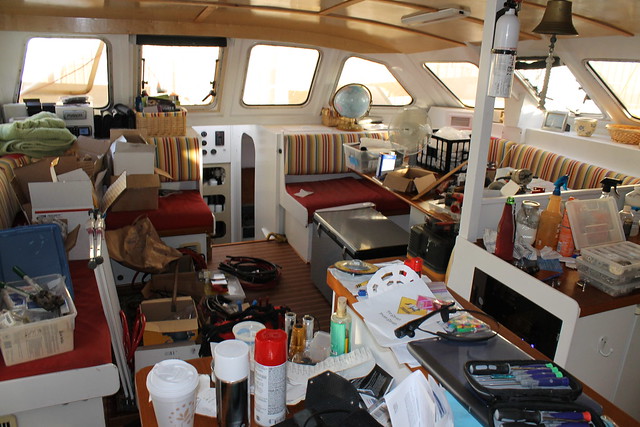
One of the realities of a haul-out is the mess—inside and out—that comes from dismantling things and emptying storage areas and bringing in parts and tools for the work that needs to be done. Also there’s the dirt that comes in from the boat-yard itself, which is an alarming mix of paint dust, dangerous chemical residues, salt, and dirt. Even if they let us live aboard while the boat is in the yard, I would not want to.

I normally think of our home as being a cozy, self-contained, orderly kind of place—even if everything isn’t in its place, everything has a place and a purpose. If we have not achieved the simplicity we idealized in our youth, we’ve come awfully close. And one of the things that makes life simple is that we travel in our home. Everything we need for a fulfilling life fits in or on our 48 x 26-foot vessel. The line between “house” and “boat” is indistinguishably thin. Because the engines aren’t separate from the living space, the current project makes the boat uninhabitable and her crew vagabonds.

I peek in every now and then to see the progress, but to be truthful, I feel a little overwhelmed when I climb up the ladder to the transom and step inside. I take a deep breath and tell myself that all this detritus will be re-stowed or removed, the boat-yard dust will be scrubbed away, our boat will go back in the water, a faster, more reliable version of her former self, and our home will go back to containing the organized chaos that is our life aboard. Though I know that this is just a temporary state, at the moment, I wish I had a pair of ruby slippers so I could just go home.

Chaos