Author Archives: Tanya

Newfound Harbor


Tonight we find ourselves in a place called Newfound Harbor, about half-way between Key West and our next destination, Boot Key Harbor (near Marathon).  It is just a quiet place to anchor for the night, but I am once again amazed at the starlight out here, away from the lights of civilization.
 
I made an attempt last year to memorize Psalm 19, partly because it is a lovely poem from the Bible, and also because I need the spiritual reminder of  the last lines, which read, “Let the words of my mouth and the meditation of my heart be acceptable in your sight, O Lord, my Rock and my Redeemer.” But the first lines of the Psalm are thus:
 
   The heavens declare the glory of God;
       the skies proclaim the work of his hands.
   Day after day they pour forth speech;
       night after night they display knowledge.
   There is no speech or language
       where their voice is not heard.
   Their voice goes out into all the earth,
       their words to the ends of the world.
 
Now, I know if my friend Howard reads this, astronomer that he is, he will think that’s just drivel, especially since it’s poetry, written to make simple things confusing. But we have this in common: a crick in the neck from staring and staring and staring at the sky. On the night sail to the Tortugas, I couldn’t get enough. I have a little red flashlight, a star chart and a great pair of binoculars, and I used them to find all sorts of things I’ve never been able to see before. There was no land anywhere, no light pollution, just the glowing band of the Milky Way like I’ve never seen it before. Perhaps Howard and I are awed for different reasons but even when we do not speak the same metaphysical language, the stars still speak to both of us.
 
Unfortunately, unless there’s a massive blackout, or one likes to go camping in Vermont or out to sea, the average person is not going to get to hear the voices of all the stars explaining what glory is because they’ve been drowned out by Edison’s wonderful invention. I hope Howard and Kristin get to take their daughters (given starry names, of course—Mira, Stella, and Lyra) out to the desert someday and follow their dreams as we have pursued ours, with this in common: to go where one can see—and hear—the stars without interruption.  It is a worthy pursuit and I wish them well.

Cheeseburger in Paradise

Arrival in Key West meant two things: plugging into dock power (air conditioning!) and lounging poolside with cocktails. I should feel guilty—tough adventurers don’t need A/C and swimming pools. But by the second drink (a Bahama Mama in honor of Vicki, who made me my first one), I forgot all about feeling guilty. We kept looking at each other and saying sarcastically, “This is SO terrible! What a hard life!”

While my clothes magically washed themselves in a machine, I sat around and ate the French fries from Jay’s burger platter and watched the kids swim under the waterfall at the far end of the pool. The same amount of laundry took me three days to wash by hand last week! The lesson: it’s hard to appreciate your life if you’ve never been uncomfortable. We always took cool air and hamburgers and washing machines and swimming pools for granted, but now they bring us unimaginable pleasure. Life is sweet and keeps getting sweeter!

Dry Tortugas

First stop: Garden Key, Dry Tortugas. These lovely little islands take their name from the sea turtles who flock here year round, some to live all their days in this 100-acre National Park, nesting and getting fat on sea grass and their favorite delicacy, lobster. The islands are dry—having no fresh water other than that caught in rainstorms or made in desalinators. Garden Key (so named because they tried fruitlessly to plant a garden here) is home to Fort Jefferson, a two-story, red-brick hexagon built in the 1800s to guard warships in its deep anchorage and protect shipping lanes between the Atlantic and Gulf of Mexico. It was ill-fated; built on sand, the cisterns cracked and ruined fresh water supplies.  The rifle-cannon, invented around the time the fort was built, rendered it obsolete before it was even completed. It was sometimes used as a prison, its most famous prisoner being Dr. Samuel Mudd, the conspiratorial physician who assisted assassin John Wilkes Booth after he shot Lincoln.

The kids had a great time roaming around the fort; it’s a great place for young imaginations. They were also the proud recipients of Junior Ranger badges, thanks to the thorough examination given by Ranger Tree Gottshall. Other highlights of the trip included snorkeling in clear coral-filled waters, exploring a sunken Windjammer by dinghy, and swimming with sharks and barracudas. Eli and Aaron especially took to snorkeling like, well, fish to water, with Sam and Sarah tagging along not far behind. All in all, it was a great introduction to a cruising lifestyle for everyone. We learned this week that it can be hot and unpleasant, and that there’s a lot of hard work that has to be done, but that the rewards are well worth the discomforts.

Tomorrow we head to the Marquesas to stop over before heading to Key West.

Setting Sail

Leaving was anticlimactic, as is so often the case with monumental occasions in my life.  I usually don’t feel the emotional impact until later, and then it is prolonged. For a year after Jay and I got married, I still woke up next to him incredulous every morning.  After four years of long-distance dating, maybe I had gotten used to the seeming impossibility of my ambitions. Maybe that’s why, even out of sight of land with fathoms of water under our twin keels, I can sit here in the rocking cabin and calmly say, “We set sail today.”

There was no going away party at the dock this weekend to celebrate the long-awaited departure of the “Robinsons.” No fanfare, no pomp—we simply untied the dock lines and left, as if we were going for a day sail.  Of course, it is understood that we are only going away for a couple of weeks. But I know better. A couple of weeks and a massive oil spill heading this way could well stretch into a couple of months and a trip to the other side of the Gulf Stream.  It may not, but life is funny like that. One moment you live in the suburbs and the next you find yourself cruising along at eight knots in azure seas. Of course it doesn’t always happen that fast, but looking back, it certainly feels like a big change in a short period of time.  And if we are back in a couple of weeks, we will be different people who return. A two-hundred mile trip offshore with an overnight sail—out of communication range—represents the next step for us as a cruising family.


Diane Stuemer is My Hero

The house is sold, the storage unit is full of old photo albums and baby books, Salvation Army came last Friday to pick up what was left in the house, the boat’s major systems have all been overhauled and I am exhausted. It has been one year since our successful experiment, a month of living aboard that confirmed that we were ready to make the move. That’s one year of paring everything down to nearly-bare minimum. That’s enough time to sort through things slowly, and to make the move without a lot of extra stress.

It wasn’t like that when the Stuemers moved aboard. About the time that Jay and I were graduating from college and getting married, a young Canadian family who had sailed their little boat on the Ottowa River just a few times decided to buy a cruising sailboat, renovate her, move aboard and sail around the world. Once they made up their minds, Herbert and Diane Stuemer put their plan into place with mind-blowing rapidity, selling a business and renting their house, renovating the boat and planning a shake-down cruise down the Eastern Seaboard. No poking along at a snail’s pace, waiting for everything to be “just right.”

And they made it. It took six years for this intrepid family of five to use the four winds to sail across three oceans and through two canals to make one enormous circumnavigation of our globe. But that is not what makes Diane Stuemer my hero. She was a mother of three lucky boys—boys who left a “normal” life to be homeschooled in the world’s classroom. She was a writer who lovingly documented all of their travels, adventures and mishaps in such a confiding way that she befriends you as you read. She was a wife who supported her husband’s wild dream and went along on the ride of her life. She lived her life to the full.  This is not what makes her my hero, though I do admire her for these things.

More than this, Diane Stuemer was a light in dark places. Northern Magic left in her wake a chain of friendships all over the world, and Diane tried to make a positive impact wherever she went. It is not good enough to simply leave a “clean wake,” in my opinion, to leave a place nice for others or to leave no impact at all. It is one of my life’s goals—and one that I am instilling in my children—that you must leave a place better than you find it.  If we go to the park in the afternoon, we pick up trash we find in the grass. If we play at the pool, we pick up pool toys that other children left lying around. And, on a much grander scale, this is what the Stuemers did. Their compassion for others led them to make choices that positively affected the places they went and the people they met. They made a few mistakes along the way and about those well-intentioned mistakes they were transparent and humble. 

Even if we don’t make it halfway as far as the Northern Magic, I will feel that the journey is a success if my children learn those two simple, but life-transforming lessons: leave the world a better place than you find it. Admit when you make a mistake and learn from it.

About six months after her book, The Voyage of the Northern Magic was published, cancer took Diane’s life. Thankfully, she had made memories with her family to last a lifetime, and she had not wasted her short time on this earth.  I miss her—when I feel lonely for the companionship of another woman who understands the myriad frustrations of living on a boat with rambunctious children and a man who has too many tools, I pick up her book and laugh a little. I wish I could call her up and have her tell me not to worry about the things I worry about, that it will all come out right in the end, and that we’re on the right track. For inspiring us to make the journey that started more than two years ago, and for leaving the world a better place than she found it, Diane Stuemer is my hero.

If you want to read about the adventures of the Stuemer family, join Diane on a trek across the globe in
The Voyage of the Northern Magic: A Family Odyssey.
 

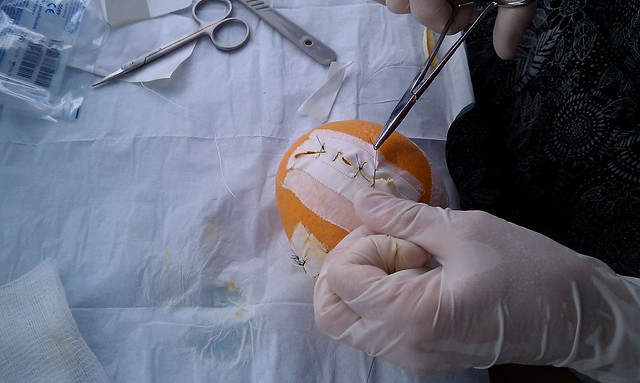
Stitching Oranges

Here is how an orange and child are alike:

They both have skin and flesh.
They both have convex surfaces.
They can both be cut pretty badly.
They can both be stitched up.

Here is how they differ:

Oranges do not scream or wiggle.
Oranges do not bleed bright red blood.
I do not have an emotional attachment to an orange.
If I fail to stitch up the orange correctly, there are no long-term consequences.

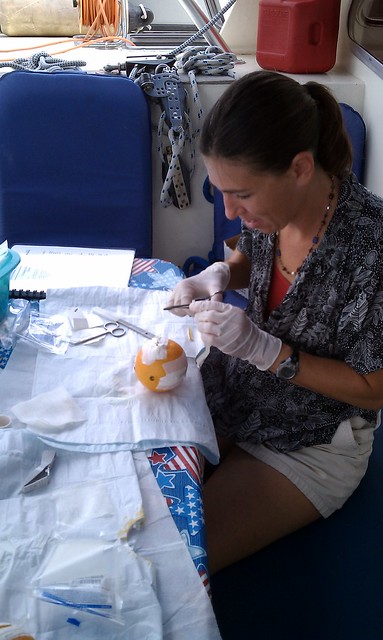
Stitching Oranges

Jay and I just finished a two-day marine medicine seminar which covered most of the first aid skills we will need if (when) mishaps happen aboard our boat when out at sea. We should be able to take care of pretty much anything—with the right tools, knowledge of how to use them, and someone on the other end of the satellite phone telling us what to do next!

It should be reassuring to our parents (our children’s grandparents) that we are trying to round out our sailing education with classes teaching us how to deal with medical emergencies. I can tell you, though, that thinking about all the things that could happen is not very reassuring to me!

Incidentally, at the end of the orange rind experience, I came to the conclusion that stitches are a last resort—skin glue and medical staples are the way to go for a laceration!  A special thanks to Jeff Hazzard of Medi-Test and a fellow cruiser in SSCA for a great weekend of learning. 

Suture Practice

Stormy Weather

Thunderstorms never freaked me out before. In fact, many nights I have gotten up to comfort a scared child during a thunderstorm and we ended up looking out of the window together with the kind of excitement one feels on the fourth of July during a fireworks show. There’s nothing better than a Florida thunderstorm for entertainment value (unless, like my husband, you consider hurricanes entertaining).  But when you live on a boat with a 68’ mast, lightning becomes a worrisome thing. 

Last night’s storms caused thousands of power outages and some minor damage—wind, rain and lightning-related. We were at a relatively safe and familiar anchorage, and we didn’t lose power (since we’re not on the grid), but it was the loudness, the closeness of the weather that scared me. It was the kind of lightning that you see even when your eyes are closed, and that sets the children’s Firefly toothbrushes to flashing. We couldn’t see the boat anchored next to us for the sheets of wind-blown rain.

Jay and I sat in the lightning-lit salon and wondered if we were going to have to don our foul weather gear and re-anchor. Thankfully, the anchor, at the end of 75 feet of chain, held well.  This was the first real storm we’ve seen on the boat.  Normally, we’re sitting comfortably tied to a dock, knowing the storm will pass, and that at least there are other tall things nearby that might channel the lightning if it strikes. But it feels different in an anchorage, with the boat moving around a Iot more, and 20 knots of breeze feels like 30 out on the open water. I wouldn’t have wanted to be at sea in a storm like that.

Storms at sea.

This thought makes me shudder a bit. Until the children are older, we will always be “short handed” (meaning less than four able crewmen). One person has to be at the helm while the other is navigating, or is off-watch on a long passage. Otto (a.k.a. Autopilot) does a good job steering so we don’t have to actually man the wheel, but one person still has to be outdoors, keeping a lookout, following a course, adjusting the sails, making sure we don’t run aground, or, worse, run into another ship. Somebody is going to get wet, cold and tired, and maybe seasick at the same time.

We will sail conservatively and wait for weather windows, but we will certainly be caught in a few nasty squalls, at least.  We may even go out in wet and windy weather on purpose, to get practice. But as of this moment, we are still untried and untested. I have always felt completely unworthy of this life. From the sidelines, I always admired cruising women who opted for a life of adventure, who were able to rough it and face danger with composure. I’m a wimp, really.  But if I felt worthy or ready, it would be sure sign that I’m not.

Dawn of a New Galley

Take Two has entered a new phase as a family cruising vessel. The boat was charmingly simple, with a one-fuel system, when we bought it. One fuel means 200 gallons of diesel to run everything—engines and generator, for propulsion and electrical appliances, including a 17-year-old BOSCH oven and ceramic cook-top. We liked the one-fuel system, but it required a lot of generator run-time, which is noisy, and the wear and tear on the electrical system ultimately means expensive battery replacement every couple years. Most cruisers espouse two views about energy use: there should be some redundancy in case of failure, and greener is better. If the generator fails, how would we cook? And why not use the sun to keep our food cool and make fresh water?

After agonizing over the details, we decided to make a fundamental change to Take Two and make her more sustainable and energy-efficient. A welder is working on an archway/bimini (i.e. cockpit shade) where we will mount solar panels and hoist the new inflatable dinghy out of the water. Jay heroically removed the ancient, noisy and heat-belching BOSCH and installed a brand-new four-burner propane oven/stove. Only boat people will appreciate this, but this is not a marine unit with an oven too tiny to make lasagna—I can get two 15” cookie sheets in there, or simultaneously bake four loaves of bread. It works beautifully and we christened her with my sister-in-law’s best cookie recipe: coconut-chocolate chip-almond-oatmeal cookies. It is a happy day for this galley slave, I can tell you that much!

Friends Old and New

I was reminded this week as I got together with an old friend, or rather, a friend from the old neighborhood, how good it is to have true fellowship with someone. This is a person (you know who you are!) who sees me as I am and likes me anyway, with whom I can rant, cry, laugh, pray, troubleshoot and commiserate. We don’t always agree, but we do always speak the truth in love. Although this kind of thick-or-thin friendship seems to be a rare and beautiful thing, in God’s kingdom it is in no short supply. I have always found a friend in the places I have moved—at least one, true, loyal and kindred spirit with whom to share the journey. How is this possible? If you count the number of times I have moved in my life, it is surprising that I always find this person, and find her so soon after moving. I can no longer think it a coincidence.

We were bemoaning the physical distance between us. An hour’s drive is prohibitive when you have young children. We often meet in the middle (both physically and metaphorically), but although distance makes the heart grow fonder, it doesn’t do much for keeping in touch day-to-day. We really miss each other, and our kids are suffering withdrawal from their playmates as well. It’s hard to find a good thing and then leave it behind, and maybe harder to find a good thing and have it leave you behind. We were each committed to praying that the other would find fellowship on the new path on which she finds herself.

The very next day, the next day I tell you, I met the new friend. A Gulfstar 53 sailboat with a live-aboard family with four home-schooled boys moved in almost directly in front of us on the next dock over. We had heard rumors that a family was coming in, but we didn’t dare hope for one so like ours. As it turns out, Vicki’s strategy when they move to a new place (they’ve lived aboard for five years), is to pray that God would send her a friend. Both her prayer and mine were answered in less than 24 hours!  I had so longed for a boat-mom friend, so much that I didn’t realize it until I met Vicki. I actually cried during the first meeting! (How embarrassing!)

Since their arrival, we have had time to do “church” together on the weekends, go on a dinghy outing, take the kids to the park and start to show them all of our favorite local spots. They, in turn, have given us quiet moments (a rarity here) when all the kids “went next door” and reminded us why we like living this way so much while encouraging us to keep pressing forward (“you have no idea what fun awaits you!”). Their kids are well-behaved, imaginative, articulate and well-matched to ours—playmates from the first moment they met.  I am too happy and thankful to properly express my exuberance. I hope I don’t scare them off with my enthusiasm…

This all reminds me to remind you to ask. Just ask. Sometimes the answer is no—after all, His grace is sufficient for us. But it pleases a loving God to show us love in a personal way, sometimes through the people He sends our way. I will definitely be following Vicki’s example as we come to new places and asking for a friend. But whatever it is that you lack—ask Him first. And then expect the implausible and maybe even impossible.

Waiting for a Window

“Why are we still here?” We asked ourselves. “It’s in the sixties today in the Bahamas. Should we have kept going after Thanksgiving?”

Our ducks are not all in a row, it seems. The house sits empty, repairs underway but no sign in the yard. On the boat, several major projects are in progress. The propane stove/oven is on order, and the batteries have to be replaced. The water-maker is being repaired and Jay is, at this very moment, in the bowels of the ship cleaning out bilges and fuel tanks. 

But the cold weather that came—and stayed—made us long for points further south. Part of the reason we live in Florida is because we hate cold weather. We have no longing for the high latitudes, and will feel perfectly satisfied sticking to the tropics. The arctic blast that hit us caught us off-guard. I rushed out to buy more down blankets. Nights that dipped below freezing and left frost on the dock and ice on our transoms made sleeping difficult, even with the space heater running and hats on.  That was January, and February hasn’t been much better.

We stayed on the boat during the cold snap because it was the right thing to do. Our house has almost nothing left in it, kids’ beds among the things given away. Packing up and moving out of our home, unless there is a hurricane coming and we can’t get out of its way, isn’t really an option. We camped out upstairs for several days because it was just too chilly to go down into the hulls, where it hovered around water temperature, 50˚. It was fun in its own way, though I have a new appreciation for the term “cabin fever.”  We are able to wait things out because we know it’s temporary. If we can’t hack a week of cold, how will we survive a storm at sea? Or a week of rain? 

Cruisers talk of waiting for a weather window—a time when conditions are favorable for leaving an anchorage to make a passage. We are waiting for a window of sorts, a time when we can leave the house in the good hands of a realtor and have the boat ready to leave the dock. After moving aboard, that is the next logical step. It is just wrong to keep this boat tied up all the time. We are doing this so that we can be out there, not stuck at the dock. It is easy to say “Find a stopping point, set a date and go!” But it is harder to discern readiness and act accordingly. The boat must be safe and main systems operable. The people may never be really ready to go on an adventure, but they should also have done their homework. We want to be safe and have a smooth transition to cruising full-time, which is why people wait for a window in the first place. At the same time, a quest for safety and comfort works against efforts to leave!

The bottom line: we will wait for the right time, and we will know when that time comes. We always do. It’s a little like falling in love. How will you know when you’ve met the person you will spend your life with? You just know. It may take work and patience to persevere after the fact, but you’ll recognize the right thing when it comes. We are not in a big rush—that would be foolhardy, but we are not dragging our heels, either. Our family strongly believes in waiting for God’s timing, so that is what we will do. And in the meantime, we will bundle up and be thankful for whatever weather we’re having, because it could always be worse!