Author Archives: Tanya

Lessons in Contentment or Daily Life at the Dock

Barnacles and crabs make strange noises at night. It sounds like someone is popping bubble wrap all night long next to my bed, which is smaller and harder than I’m used to, not to mention that I’m sleeping on the “wrong” side—opposite from the bed at home, where I have slept at Jay’s left side for nearly 11 years. Occasionally, Sam tumbles out of his bunk and I have to respond to cries of confusion if he wakes during the fall (sometimes he sleeps through it and we find him asleep on the cushion on the floor!). I have almost knocked myself unconscious numerous times in small passages in such middle-of-the-night maneuvers. Morning comes too soon. While cooking breakfast one morning, the power failed and I was left with soggy bacon and a bowl of pancake batter. Yum. When it rains, the “roof” leaks. Right over the beds, of course—where else? The afternoons are sweltering, and even with the (praise be to God!) air conditioning on, the salon is warm, the galley warmer. The fridge and freezer, combined, are smaller than my refrigerator space at home. The front burners on the aged stovetop don’t seem to operate at any other setting than “HIGH.”  The head (strange name for a toilet, eh?) smells like rotting sea life and you have to manually pump sea water in and sewage out to a holding tank, which gets pumped out once a week. And even in our calm, sheltered marina on the Manatee River, the whole place is always moving.
I hope it doesn’t sound like I’m complaining. These are simply some of the things I’ve had to get used to as we have begun to spend weekends on the boat at the dock. Jay is currently repairing the port prop shaft (which connects the engine to the propeller), so we haven’t actually gone anywhere yet, but I am so grateful for this time to “practice” living aboard.  We can learn the rules and routines in a relatively safe environment.  We are close enough to home that we can bail if we need to, but also near local amenities like the marina swimming pool and the Bradenton Public Library so that there’s somewhere to go if we just want to get off the boat for short spells. We are attached to shore power and water, which means the comforts of unlimited (cold) showers and (mostly cold) air conditioning. It’s like learning to live aboard with training wheels—the change variables are blessedly limited. Even so, it takes some adjustment in outlook and attitude to get used to this new way of life.

This is the adventure we have craved, so we are joyfully learning to adapt to changing circumstances. There is no greater analogy to life than sailing—a vessel in a fluid environment with the wind constantly shifting, currents and tides, things you can’t see lurking beneath—the whole operation demands flexibility, vigilance and a good attitude, and not a little humility!  I gave the children some peanut butter bread and went to the neighbor’s motor yacht to cook the pancakes on the fateful morning of the electrical meltdown. When it rains, we set out the pots and bowls and towels and try to keep the baby from rearranging our carefully devised drip-catching system. When it’s hot, we sweat like the human body was designed to do and drink water and stay in the shade and rest. I’m learning how to cook again with different pots and pans, different stove and oven, different ingredients because of limited refrigeration, and lack of gadgets. In essence, we’re learning that we really don’t need that much to be happy.  I can even live without my (gasp!) precious Vita-Mix.  We spent three nights aboard this past weekend, and by the third night, I fell asleep quickly and slept soundly (and so did Sam). As we get things organized and cleaned, it’s starting to feel like home. The children are learning to entertain themselves while we busy ourselves with projects, and to adapt without complaint.  It’s not always smooth sailing (pardon the pun), but we’re getting there, little by little.

Then there are the beautiful things to get used to which I neglected to mention: falling asleep with a hatch open and a cool breeze blowing in and the moon and stars overhead. Waking up to bird calls. Breakfasting outdoors on the waterfront. Washing dishes with a 360˚ view—palm trees, the swaying masts of sailboats in the marina, the sunshine on the water, the clouds, the sky, the train bridge. Sea life at our doorstep: jellyfish, crabs, fish of all shapes and sizes—the kids spend hours in the cockpit looking over the coaming into the water. In the late afternoon, after the rain, a refreshing breeze blows. In the evening, we climb onto our “roof” and watch the red sun sink into the sea and light the clouds on fire. When the children are in bed, Jay and I get a cup of tea, or glass of wine, or cold beverage, as the mood strikes us, and sit up on deck, talking and laughing and listening to the live music from a nearby restaurant drifting over the water to us on our private, floating paradise. 

We wonder what our parents will think when they come to visit us at our new home. Will they wonder what kind of man provides such a small, leaky, dirty, broken-down home for his family (in some places, the boat is literally held together by string and duct tape)? Or will they see it as I do: a perfectly simple, self-contained, cozy, exotic living space with an incredible view?  I venture to say that some wives (including me just a few short years ago) would complain about the inconveniences which I am learning are part of the quirky charms of living aboard.  Now when I hear people complain about not having enough space and needing to move to a bigger house, I laugh! What do we really need space for? We have four cabins with full beds and two quarter berths, so there’s room to spare. Since we spend all our time in the cabins unconscious, they don’t need to be big. Our salon is spacious enough, the table easily seating eight, with a separate sitting area and space for kids to play on the floor. The galley is adjacent, so when I am cooking or cleaning or baking (which is a lot of the time), I am a part of the action. The cockpit is enclosed, which makes it relatively safe, and seats six to eight. The deck is just enormous—open and uncluttered, wide and comfortable. And the yard—it never needs mowing!

It’s true that one’s outlook changes everything (call me Pollyanna). Learning to take every day as it comes is an art. Beginning to see all of life as an adventure is essential to a vibrant and passionate existence. Slowing down is good for us, and living simply, though it may actually entail harder work, is more rewarding than living an easy, convenient life. Certainly, this way of life is not for everyone, but everyone can benefit from the lessons it is teaching us.

Tireless Optimism

Things are breaking faster than we can fix them at this point. You might think we would be daunted as we are just setting out on this adventure, but that is not the case. Of course, part of any adventure is flirtation with danger and willingness to confront the unknown.  (As in, “What will break next? Who knows?”) That takes a bit of pluck, not to mention a hearty dose of optimism.

I’m what you might call an apocalyptic optimist, with an outlook that goes something like this: the world is going to hell in a hand-basket, but in the meantime, I’m sure everything will be just fine!  I can also be a bit moody, swinging between the extremes: from “this is so exciting!” to “this is the stupidest thing we have ever done!” (I often experience the two simultaneously which makes me feel really crazy.) My husband is very steady—things are what they are, and will continue to be that way so there’s no reason to get excited.  That means, in my opinion, he can’t truly enjoy something, but then he is somewhat impervious to disappointment.  Not that he doesn’t get frustrated sometimes, only that he doesn’t freak out. I, however, do freak out—freak out happy, freak out scared, freak out mad, take your pick. 

So when things break, Jay calmly looks at it as an opportunity to learn something new, like plumbing or electrical engineering. That’s his brand of optimism. I, on the other hand, will feel like freaking out, but attempt to talk myself out of it by playing Pollyanna and finding something to be grateful for. Like, “At least it broke now, while we’re tied to a dock only an hour from our house and not in the South Pacific!” I said as much to one of our G-dock neighbors who was privy to our electrical troubles this past weekend. He said, “Boy, you sure see the glass half-full, huh?” And a few moments later, “You’re gonna need a LOT of that glass-half-full…” I think he’s right. Keeping our attitudes in check and keeping our sense of humor and sense of adventure is going to be our key to survival—both here at the dock and when we actually leave someday. We’ll have to have the kind of optimism that says, “All this trouble is worth it!”

Of course, for those of us who believe that all things work together for the good of those who love God and are in sync with His plan (loose paraphrase of Romans 8:28), there is no choice but optimism. It doesn’t matter if we go broke fixing this boat, or if we are hot, tired, hungry, or in trouble—all of that, all the hardship will ultimately be for our good. We’re not doing this because we thought it would be easy.  And God doesn’t really care about our comfort as much as He does our character. So it may be hard and uncomfortable and we may experience growing (or shrinking) pains as we try this new mode of living, but, in the end, according to the written guarantee above, it will all be worth it.   There might even be some pleasant surprises to enjoy along the way! I’m feeling optimistic.

Baby Comes Home

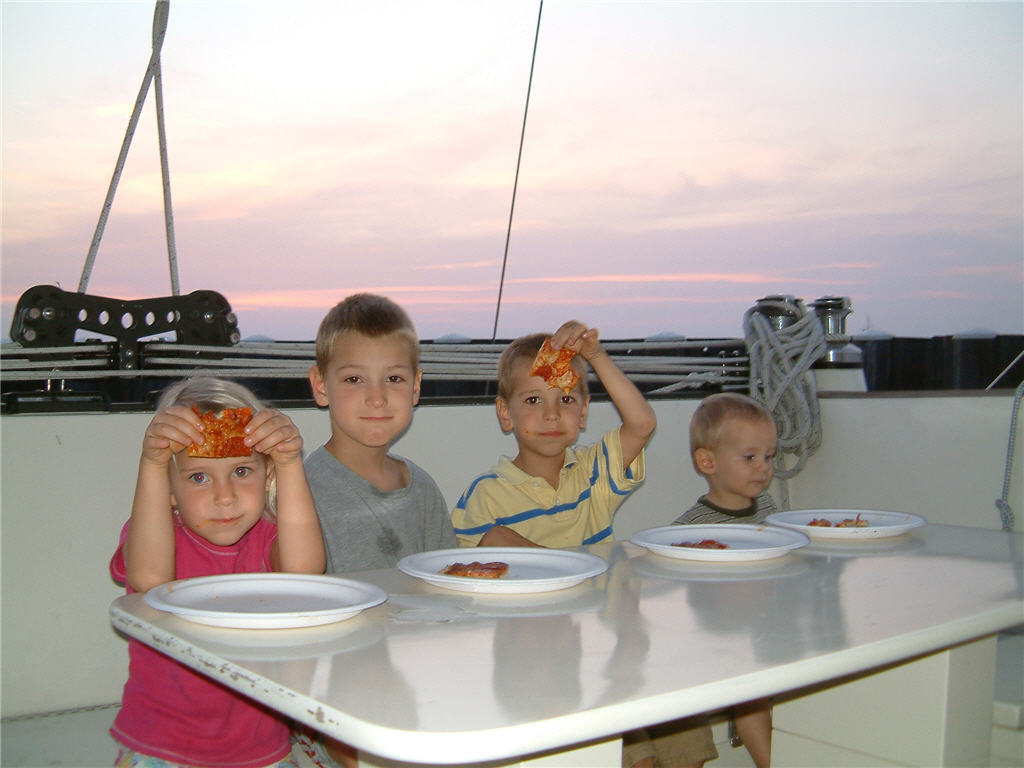
Jay brought our new baby home on Wednesday night. She was a little worse for the wear, but she sure does look good sitting at the dock. We cleaned her off and out and spent the night on Thursday. I watched the sun go down over the heads of the four children sitting in the cockpit having their first dinner on the boat.  We fell asleep to mysterious new sounds. We woke to the calls of water birds and to cool, moist air on our faces from the open hatches. I did my first day of boat-schooling and we divvied up boat chores. I mopped my galley and salon and hosed down the cockpit. In short, I was happy as a clam. I felt more at home on the boat than I do at home.

When Eli, Aaron, Sarah, and Sam got on the boat for the first time (they hadn’t laid eyes on it since December when we first looked at it) they were bouncing off the walls with excitement. This is the rundown on the boat tour Jay subsequently gave the kids: “This is the engine kill switch. Don’t touch it.  This is a fire extinguisher. Don’t touch it. This is a sea cock. Don’t touch it. See these switches? And these buttons? Don’t touch them.” And so forth, and so on. The children looked a little confused; they had the mistaken notion that this thing was their new toy. But the rules that are so important for an orderly household now become even more important in the floating house, in some cases for safety and survival. They seemed to catch on pretty quickly.

I have spent so much time imagining what it will be like—the daily life, at least—that actually doing it seemed easy and natural. What will be strange will be waking up to make pancakes on a Saturday morning and finding that the view has changed since yesterday. I can’t really imagine what the voyaging and exploring will be like, so I just don’t spend any time thinking about it.  But when Jay talks about romping around on the island and sending Eli up a tree for a coconut, I get a little thrill of excitement. What will it be like? If our first day aboard is any indicator, it’s going to be better than we imagined.

Fear and Regret

"Twenty years from now, you will be more disappointed by the things you didn't do than by the ones you did do. So throw off the bow lines. Sail away from the safe harbor. Catch the trade winds in your sails. Explore. Dream. Discover" — Mark Twain


I think this is my new personal motto. When people first hear about the dream we are pursuing, namely, to move our family of six aboard a large catamaran and maybe sail away someday, the first thing they ask is, “aren’t you afraid?” Afraid? Of course we’re afraid.  Afraid of storms, seasickness, shipwreck, sharks, piracy, conflict, running aground, our own ineptitude, untimely breakages, isolation, going broke, death, the unknown. I am afraid of the things that will scare me that I don’t even know about yet. I don’t even know how to sail. I have no business dreaming this dream. I have been moored in the safe harbor so long that my mooring line is encrusted with comfort and has become one with the mooring itself. I’m not going anywhere without something breaking off and causing some damage.

Alright. So what? Let it break off; it’ll only hurt for awhile. (Aha!) Those are the words that purchase freedom and welcome adventure, a life replete with excitement and risk of danger. In any case, we’ve decided that there are things worse than fear. Like regret. We’ve been afraid before. Like on our wedding day. The day we closed on our first house. The day we went to the hospital to have our first child. The day we moved to Florida. But if we had not done those things, actually gotten married, taken on the responsibilities of a home and a family, made big and scary decisions, if we had stayed in the safe harbor and never filled our sails with wind—what would be the point of our lives? The weight of regret would surely have crushed us by now.

We are, on the eve of “the point of no return” on this boat deal, alternately giving each other the pep talk. You can do this, we tell each other. It’s crazy, but we can do it anyway. We will, too. Just watch us. And if we do manage to do it, to actually acquire this worthy vessel, sail it around the peninsula and successfully dock it, take it for short cruises, learn to live with her and with each other, and to ultimately go exploring, it won’t be because we deserved it, nor because we were prepared, and it most certainly won’t be because we were unafraid, rather it will be despite those things.  We have decided to really live, or die trying.

Sea Change

“Full fathom five thy father lies.
Of his bones are coral made.
Those are pearls that were his eyes.
Nothing of him that doth fade
But doth suffer a sea change
Into something rich and strange…”

—Ariel in The Tempest by William Shakespeare

We are in the process of making some big and scary life decisions. It’s harder than I thought. I like to believe I am a dandelion: blow me in any direction and I’ll thrive wherever I land. To be perfectly honest, I’ve become rather comfortable—no, spoiled—in my current circumstances. I was raised in a house where little was stable: feast or famine finances, moves every couple of years that meant changing houses, neighborhoods, cities, states, or even countries. I got used to adapting to new schools, new environs, new friends. But what I have treasured in my stable and happy adulthood is how stable and happy it is!  I married my high school sweetheart and we settled into a wonderful, predictable life together. Despite adding a few “surprises” to our family and an interstate move a few years ago, it has been relatively smooth sailing, and our lives have become increasingly more comfortable and happy. So why would we abandon our safe and cozy life? Yet that is just what we propose: we’ll sell or give away ninety percent of our belongings and move our four young children aboard a large catamaran and maybe sail around the world. No big deal, right?

Somewhere between calling the yacht broker and signing on the dotted line, I got cold feet. I suddenly decided I didn’t want to trade words like “safe” and “boring” for “risk” and “adventure.” My whole being cried out in fear of losing the comfy-cozy shell it’s built around itself to insulate it from pain and hardship.  I like things the way I like them. Though I hate to admit it, I like to be in control. I want what I don’t want. I want to live a wild, free, unfettered life—as long as I can control it. But the sea cannot be tamed. This is the thing that simultaneously attracts and repels us, and will slowly do its work on our safe and easy existence and transform it into a self-sufficient, exciting journey.

But just like in Ariel’s haunting song, this sea change doesn’t happen without death first.  And so, in order to move forward despite my fear, I had to die. And I may have to do so again a hundred times. I thought the adventure starts when we bring the boat home—or, rather, the home to the boat—and we set sail. Who knew that it took so much courage just to initiate the process? Not I. As I wrestled with panic, the desire to bolt in the other direction, I realized I would need courage just to say “yes, I’ll try it.”

The night I first died, I called a friend who lovingly coaxed me away from the edge. I hung up the phone, prayed through the anxiety, and finally fell asleep. I awoke the next morning—imagine my surprise—resurrected! The sun shone, the dew sparkled, the birds sang, and my heart with them. What do I really need in this world, anyway? The trappings I was so afraid to lose had lost their luster overnight and I was ready to leave the nest and fly away.

I have begun to realize that the very thing I thought I hated about my childhood is the very thing that will serve me best in a future life afloat: in a word, the ability to adapt. I wasn’t in control then, and I’m not now. How like my Father, the Sovereign King! In charge of all circumstances, He uses the things we hate, the things in our past we run away from, our pain, our shame, even our sin—and changes it into something useful in his kingdom! That is the crucifixion and resurrection, reenacted daily in the lives of his followers everywhere. It’s a terrible and glorious process: our flesh, put to death, is transformed into something “rich and strange.”