Category Archives: General

From the Archives: Free Range Kids

Some poor misguided person called me “laid back” today. She was watching my kids play in the pool and commented about how relaxed I seemed, considering that my four-year-old daredevil did a flip a little too close to the edge (he was summarily scolded and given a time out). Truth be told, I am one of the most high-strung, perfectionistic, controlling people I know. My poor children will be lucky to survive my over-achiever approach to mothering and home-schooling. That’s the truth.

Perhaps what she saw as “laid back” was actually an intentional stifling of my natural instinct to protect at all costs. I realize that children cannot grow up unless you give them some space in which to do so, but giving them that space requires a willingness to look the other way when they are doing something risky. I stop things that are downright dangerous or disobedient, but probably allow a lot more than most parents these days. This discussion reminds me of an old blog entry I wrote but never posted. And so I give you, from the archives, my two cents’ worth on parenting.

Free Range Kids (July 31, 2010)

Lenore Skenazy, the New York Sun columnist who coined the phrase “free range kids,” allowed her 9-year-old son to find his way home from the city on the subway, and then wrote about it. Her column sparked a controversy that deeply divided two camps: those who said “you should go to jail” and those who countered “you should receive a medal.” I’ll give you one chance to guess which response we choose.

The controversy hints at an important underlying question: is the world inherently more dangerous now than it was a couple of generations ago, when children were sent out in the morning and called in for supper? Or are parents just more neurotic than they used to be? Even when I was a kid in the 70s, we walked to school, the older children looking after the younger ones, and kids were allowed to roam in the woods and in their neighborhoods, largely unsupervised and parents didn’t worry the way they do now. An older person I know said he thought that the world was more dangerous—child molesters at one time were locked up for life, or were put to death, so maybe there are more of those types running around, imaginations fueled by internet filth. Of course, parents can now look at an online database and find out where the registered sex offenders live, so maybe an increase in information sharing makes us more paranoid, too. I realize that this is only one of the many dangers that threaten children, but whether they face more of them or we are more protective (or both), children in our demographic are raised differently now than they were—their lives are more scheduled and they enjoy less free time to explore and discover their own limitations. Or worse, they are so badly spoiled that their potential is lost or wasted.

My oldest son, Eli, went with my brother and his kids to a cousin’s baseball game not too long ago. Preoccupied with the game, my brother didn’t realize that the crowd that was gathering under the lamp post was staring at his nephew, who had shinnied to the top, the way he does a coconut palm or the mast of our boat. I probably should have scolded him, but actually I felt rather proud of his climbing prowess. People are always surprised and often dismayed by what our children can do. When Sam, our youngest son, was 2, he would dive for coins in the swimming pool at our marina. Inevitably, someone always freaked out and thought a baby was drowning. They looked at me incredulously when I reassured them that my toddler was just fine—then he would come up with a handful of nickels and pennies. Our daughter Sarah has many times shocked folks in an anchorage with her aerial acrobatics wearing a climbing harness to swing around the rigging.  Aaron, our second son, rebuilt a carburetor on an outboard motor at 7, and got his Florida boater’s license at 8, which makes him independent in the dinghy. I mention these things not to boast about the children, because I don’t think they are unusually gifted, though I do admire them. I think they are doing what all children would do if they were allowed the time and freedom to explore their interests and try daring deeds.

[flickr: 5399744648]

Without the hindrances of tyrannical school and sports schedules, TV, video games, iPods or other gadgets, our children have been allowed to pursue various activities, to be bored occasionally and have to use their imaginations to entertain themselves, and to try stunts that make onlookers gasp. They have, in short, been allowed to find out for themselves what it is they’re made of. That used to be one of the main goals of child-rearing, but it seems that quality is now rare. What we do have in abundance now is the “helicopter” parent, who hovers at the periphery waiting to zoom in and help solve whatever problem they see, real or imaginary.

Busy parents have traded good training for micro-managing. Ironically, we are very protective of our kids (some would argue over-protective)—we guard closely what they eat, who they play with, what they learn, and what they watch, things which affect their health and character development. We set high standards, scold, spank, and offer rewards for good behavior, although those things are considered old-fashioned. Based on children that we observe in public, we think most parents have gone to one of two extremes: allowing too much freedom and not enough guidance, or providing so much guidance that their children feel smothered. What results is children who rebel: either to get the attention they desire from permissive parents, or to get the freedom they need from overbearing ones. Ideally, we’d all find that delicate balance between making children safer through rules and training and still leaving them some wiggle-room to test themselves and grow.

What we want for our children is for them to have a realistic picture of both the dangers and joys of life; smothered kids are neither prepared to face evil nor are they able to appreciate true freedom, and spoiled kids use their unlimited freedom to harm themselves and others. We also want our kids to know themselves and waste as few years of their short lives as possible trying to figure out what they want to do with their time on planet Earth. We want them to actually grow up—take risks and fall flat on their faces, get up again and learn from the experience—to become interesting and skilled and independent. We want them to have earned enough confidence that they will someday follow their dreams. Living the way we do is conducive to achieving these goals, though we recognize that there are no guarantees and it will be years before we see the fruit of our labors. In fact, it will take nothing short of a miracle—and fortunately, we still believe in those.
McBaby vs. Certified Organic Baby

I promised details about Rachel’s birth for those who want to read them. WARNING: this essay contains a description of natural childbirth, so if you can’t handle it, don’t read it.

Rachel is two weeks old today, and the most pleasant baby we’ve had. I don’t know how much truth there is to the theory that the kind of birth experience a baby has affects his or her personality for life (it certainly affects the mother's willingness to have more children), but Rachel would support the theory that the more peaceful the birth, the more peaceful the baby. Of course, it doesn’t hurt that we’ve done this four times before, and we’re more relaxed. I am certain that the mother’s feelings during pregnancy and after birth are reflected in the baby’s disposition. All I can say about that is, “Poor Eli.” No wonder our first kid is so keyed-up.

The previous four children were born without drugs and with minimal intervention, under the care of a midwife, but in a hospital setting. There is a time and place for medical attention, for medication, and for “meddling.” Natural, uncomplicated birth is not it. It took me a few babies to realize I do not need to be in a hospital, just relatively near one in case of emergency. I have a history of late babies and long, slow labors. Once I figured out that it takes my body a really long time to prepare itself for the last phase of labor, I just stayed at home until it was time, or, in a couple of cases, allowed the midwife to start an induction using Cervidil (to ripen the cervix), but I never actually needed a Pitocin (IV) induction. I’ve also condoned various interventions to speed things up: stripping membranes, breaking my water, enemas—you name it and we’ve tried it. But I’ve never had an epidural (no needles in my spine, thank you very much) and don’t mind suffering a little to bring a child into the world. In fact, I would say that the suffering is proportionate to the elation one feels afterward.

But this time, I wanted something different. Having a baby in the hospital is like going to McDonald’s at lunch time. A hospital is a place of busy-ness—people running around in scrubs, officiously doing their duties and following protocols. The L&D room is needed for the next customer, so taking 24 hours to have a baby makes one a nuisance. Also, the nurses are used to 90% of women wanting to be drugged immediately, and then they rest comfortably hooked up to a monitor that can be seen remotely at the nurse’s station down the hall. These moms require very little. The mom going natural is always asking for things or refusing things, and some nurses feel rather put out. And when it’s time to actually have the baby, the busy-ness increases: a team of strangers in green swarm into your room and turn on bright lights and start unpacking mysterious packages. The end of the bed breaks away and when that wee thing comes into the world, it is a shock of lights, noise and air conditioning. They are whisked away to a corner of the room to be poked and cleaned and checked. No wonder they scream their little heads off.

As we have gotten more organic and natural in everything we do, it makes sense that this assembly-line approach to birthing babies would become less acceptable to me. When I found Rosemary Birthing Home (www.rosemarybirthing.com) in Sarasota, I knew that aside from having a birth on the boat with an island midwife—we’re not quite there yet—this would be the best option for a peaceful, natural birth for our fifth child. I mean, my midwife’s name is Harmony for heaven’s sake! We were right. There was no rush, no sense that we were a burden, no unnecessary meddling.  Instead of McDonald’s at lunch time, it was like going to a friend’s for a home-cooked dinner and staying to open another bottle of wine. The birth was no shorter than normal, but aside from my water having broken (which starts a 24-hour intervention clock ticking) the experience was so much more relaxing. Labor in the courtyard, in the tub, in the shower, in the rocking chair, in the kitchen, in the garden, on the boardwalk along Sarasota Bay—no one was telling me what to do or how to do it. Not that we didn’t try to speed things up a bit—I went to the acupuncturist, tried herbs and homeopathy, even drank a Castor oil smoothie. The difference for Jay was marked, too. He hates hospitals, and was a little wigged out after Sarah's arrival (at 9 1/2 lbs. she was hard to get out). He bowed out of Sam’s arrival, leaving it to a team of girlfriends instead. But he was more comfortable in the homey atmosphere at Rosemary and was on hand when Rachel arrived, just outside the door. Even Sarah, at seven, felt comfortable and was there to see her sister’s birth.

In the end, Harmony gave me the extra time I needed to have the kind of birth I wanted to have (we were close to having to transfer to Sarasota Memorial), and when Rachel finally decided to show up, she came fast. So fast, in fact, that I didn’t even make it to the birthing tub and had her in the shower, where I had been laboring for the pain relief of pressurized hot water. When I picked her up for the first time, she wasn’t crying. She was quiet and alert, looking around and wondering where she was. We spent the first couple of hours of her life just looking at each other, holding her in the warm water of my (undefiled) birthing tub, nursing, and generally basking in the post-childbirth glow. (Man, those hormones are like a really good drug.) We had Rachel the night of May 2nd, and at midnight, we broke out the chocolate cake and candles and celebrated Sarah’s 7th birthday on May 3rd! I had plenty of time to rest and recover (Harmony herself made my breakfast the next morning after Jay had gone with Sarah to pick up the boys) before heading out to my mother-in-law’s. It was, aside from the part of childbirth I’m already forgetting about, a totally pleasant experience. I will never have another McBaby again (if I have another at all). I never cease to feel amazed at the miracle of new life—thanks be to God for answering all our prayers for a smooth delivery and a healthy baby!

[flickr: 5701513671]

Pictured (l-r) Priscilla, the apprentice midwife, Tarin, friend and birth coach, me and Rachel, and Harmony, midwife

Farewell to the Kiwis

One of the joys of our adventurous lifestyle is meeting new and interesting people. That usually occurs in the local Laundromat. I met Roe, Emma and Owen just after their arrival at the marina. They had come through a bit of nasty weather and landed at our peaceful doorstep with a lot of laundry. The laundry room here is air conditioned, and thus conducive to long conversations while folding clothes.


We have a soft spot in our hearts for people who ditch Normal and live dangerously. These three “Kiwis” as we dubbed them—although only Owen is a native of New Zealand—are just that. Owen, owner and captain of s/v Dulcinea, is an experienced sailor, but Roe (pronounced “Roo”) and Emma are just along for the wild ride. They’re still on the part of the learning curve where you call the specialized gear on a boat “that thing-a-ma-jigger.” But they’re learning fast, and they can keep an eye on the horizon, GPS and the autopilot. What else do you need from crew?


[flickr: 5714431193]

They became friends partly because our children lack age-appropriate playmates in the marina and rely on adults that still act like children to toss them into the pool and other such nonsense. But in the times I caught up with them sans children, we had long conversations about life on planet earth, maps, tectonic plates, racism, religion, politics, child-rearing, and other more serious topics. It’s so refreshing to get another perspective on America; sometimes we can’t see ourselves unless we step back and see the reflection from another perspective. I hope the time we spent together was mutually beneficial.


Today, after a couple of false starts, the three Kiwis and a spare crewmember sailed off into the horizon. They are headed toward Mexico at the moment, but ultimately home to New Zealand via the Panama Canal. We will be following their progress at www.milkrun.co.nz and living vicariously as they cross the great Pacific with their gnome Gary in tow. We will all miss their company, but perhaps the children more than anyone. Good playmates are few and far between. 


[flickr: 5714404155]

To Owen, Emma and Roe: we wish you fair winds and following seas. We’ll be praying for your safety at sea and look forward to watching the documentary that will make you all millionaires!  Maybe we’ll see you in New Zealand someday…

Happy Mother’s Day

We brought Rachel home this week to the boat on Thursday, and she took her first dinghy ride today (we visited friends on our old dock). We are happily settling into a “new normal” and the children have welcomed the new sibling with ease and grace. All are eager to help and think that baby sneezes are about the funniest thing they’ve ever seen. Who doesn’t? She definitely adds a sweetness to our home—and is such a calm and peaceful baby. Maybe we will have a low-key kid yet. There’s always hope.

[flickr: 5702090122]

There are a few moms I’d like to thank this week for making it happen. Many thanks go to my mom, for giving birth to me and, consequently, her grandchildren—what a miracle that inside the tiny body of a baby girl is not one, but potentially two generations. Also, Mom came up for a quick visit and gave me a lift home to the boat. To my mother-in-law, who made my “babymoon” possible. We escaped to the quiet and peaceful environs of her house to recuperate and enjoy snuggling, learning to nurse and sleep at night, resting, visiting with old friends, and luxuriating in long baths (a rare treat). Also, she had been to the store and bought all of my favorite foods. To my good friends, Susan, Tarin and Vicki, who spent a long 24 hours waiting for Rachel to show up. They provided companionship and support when I needed it, and I couldn’t ask for a better group of women to pray a baby into this world! To my midwife Harmony, a mom herself, who went above and beyond the call of duty and let me labor the way I needed to in a relaxed environment, and even cooked me breakfast the morning after. To my sisters, Sascha, Tennille, and Robin, who are right there with me in the trenches of motherhood, slogging through all the difficulties from diapering to disciplining. To my favorite grandma, Pearl, who passed away several years ago, and gave my daughter a good name-sake. To all the moms in my life: I love you all and wish you a very happy Mother’s Day.

Seamless Transition

It’s hard to believe we’ve been back at the dock for a month now. I must say that it hasn’t been a hard one, either. The comforts of land life mitigate the losses of beauty and freedom inherent to cruising. Of course we miss seeing the sunrise and sunset over a clear horizon, the quiet of an anchorage, the daily treks to the beach for “recess” and a hundred other small things that make cruising such a pleasure. But being able to step off the boat (eight months pregnant, mind you) and drive an air-conditioned vehicle to Publix to load up on relatively-inexpensive organic food somehow makes up for it. We have enjoyed visits with all the family that we haven’t seen since last spring and almost got caught up with all our friends. When it gets hot on the boat in the afternoons, I take the children to the local Planetarium or the Public Library across the street (insert sigh of happiness here). Plus there are our favorite local hangouts that give the chef a night off, which she seems to need more and more as the due date approaches.

That said, there are some subtle changes that make me pause in my reflections. Why, for example, do we suddenly live by a clock-imposed schedule instead of a natural schedule? We used to be up (and down) with the sun, eat when we were hungry and never feel guilty if we were “late” for some daily activity. All of a sudden, we are staying up late, waking up late, and feeling some kind of pressure about it, especially after daylight savings kicked in and made everything an hour “late.” Really, who cares if breakfast is at 8:30 or 9:30? All the normal things are happening in the normal order, but that clock suddenly has the power to make me feel stressed out. I barely even looked at the clock when we were cruising.

And then, last night, it started raining cats and dogs in the middle of the night and I woke up feeling confused. It took me a few dazed moments to realize that that booming sound was thunder, and the sparkles on the window were raindrops, and that the wind was causing us to actually move in our slip. That got me thinking, when is the last time we looked at a weather forecast? We used to live and die by them.

While doing the dishes the other night, it occurred to me that we take a lot of other things for granted, too, like unlimited hot water. At anchor, I would never have wasted the amount of water doing dishes that I do now, because it comes straight out of a hose from the city water supply. I should still conserve water, but I really don’t.  And who has even looked at the battery monitor lately, let alone run the generator or kept an eye on the solar output?  All discussions about wind generators have been replaced by consultations on carpentry and upholstery. We are really getting soft. When we got hot this weekend, Jay even turned on the air-conditioner. We are officially living in a “dockominium,” insulated from the raw realities of wind and weather, the awareness of our dependence on water and power, and the sometimes frustrating experiences of daily survival. The transition to living at the dock may have been easy, but less seamless than it might seem.

Delicate Condition

Part of the charm—and the challenge—of our family is that we really don’t let anyone tell us what we should or should not do. With children, we expect immediate obedience (often for their own safety) but allow them to ask “why?” later. They also attempt difficult things and daring feats that other kids might not because someone is always telling them that they shouldn’t. Jay and I have our own rebellious streak. Without it, we would never have made it this far. The unsolicited advice we receive includes things like how we should not have five children (far too many in this day and age), and how we should not sell our house in this market, but we should be building our careers and retirement savings and not gallivanting around the planet in a boat blowing those resources.

The same goes for advice on pregnancy. Everyone has an opinion about what is appropriate behavior for a woman in my “delicate condition.” Someone stopped me in Georgetown and said they were happy to see that my being pregnant didn’t stop me from cruising. He was just trying to be nice, so I refrained from using the comeback that came to mind—that I was glad that his being old didn’t stop him!  Other activities I have been either stared at or scolded for include loading groceries into the dinghy, kayaking, hiking, snorkeling, riding my bike, sitting on a picnic table, moving a lawn chair and having half of a glass of wine.

Anyone who knows me knows there’s not much delicate about me. It doesn’t mean I don’t have limitations, or that I don’t occasionally pay for that can-do attitude. But I feel great. I have even been known to say that I like being pregnant. I can think of nothing better than this lifestyle for growing healthy babies: we eat almost everything from scratch, get plenty of sunshine and fresh air, exercise even when we’re not trying to, and generally pursue happiness and harmony. Some people just can’t handle it and feel the need to put a stop to such reckless joy. Good thing we know how to ignore good intentions.

Homeward Bound

February 20, 2011

If you can imagine the perfect day after being gone from home for a long time, that was my day yesterday. We reunited with good friends at the House of Pancakes in Marathon, spent the morning with them, then went out for pizza at our favorite local joint, the Hurricane. Jay and the kids went back to play and do laundry at our friends’ house while I headed to Publix. I nearly wept to see cantaloupes 2/$3.00, not to mention fresh berries! I didn’t even try to control myself. While we’re traveling, I try to keep everyone happy and comfortable, so I filled all requests, from animal crackers to Haagen-Dazs ice-cream bars. I even bought a couple of boxes of Kraft Mac-n-Cheese (gasp!). We can go back to our home-made, organic diet in a couple of days. It was a fun day.

After living in France for half a year during college, I know about reverse culture shock. I appreciate certain things about my homeland because I’ve been away from it, and I am likewise appalled by certain things, whether I’ve been away or not. We already know what we will miss about cruising, and what we will appreciate before we go “back out.” There’s nothing like a life of self-deprivation to make you really thankful.

Over the last few weeks as we’ve made our plans to return to Florida, I began talking to the kids about what’s coming next. Every time I mentioned the prospect of coming “home” they corrected me—“you are home!”  I guess we have really convinced them that this boat, and where their family is, is home. I had a hard time explaining what I meant by “home,” chiefly because I mean different things by it. That made me reflect on what that word really means.

In returning “home” from the Bahamas, I meant to our homeland, the U.S. “Home” in Florida for me means friends and family, the Gulf Coast where Jay and I grew up together, and even “home” to the marina where we kept our boat for two years. Yet, coming to Marathon felt like a homecoming, too. We lived there for six months, getting our feet wet, so to speak, in the cruising lifestyle. Our friends there make it feel like “home” to us. In a previous blog I talked about always feeling homesick for somewhere. They say that home is where the heart is, so if we leave a little piece of our hearts everywhere we go, then we are also always at home. That’s no small comfort in a world where so many feel disconnected.

Welcome to Planet Earth

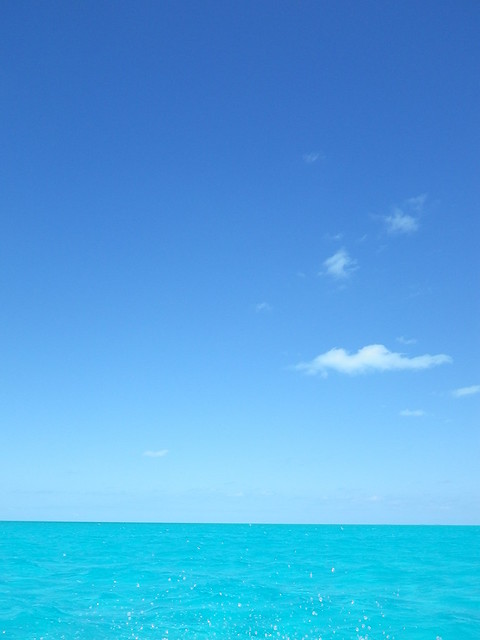
What is planet Earth like? Imagine for a moment what it would be like to come here from another galaxy for the first time. All the movies about extraterrestrial landings here are about Martian invasions of New York City or rendez-vous in the desert. Sure, we have mountains and valleys, vast plains and deserts, huge rainforests and swamps, continents and islands. But most of planet Earth looks like the view out my galley window for the last two days. Liquid water for hundreds of miles in all directions.

Blue

I’ve begun to think it likely that if anyone ever did come here to investigate, they would arrive somewhere in the middle of an ocean and get the impression that the planet is a vast wet wasteland. Or, better, they would make the acquaintance of dolphins or whales and never even see a human city.

There are folks who never leave their hometowns, people who have never seen a beach, much less open ocean. There are scientists who know more about outer space than about what’s below the surface of 75% of their home planet. As for this sailor, I don’t think you can say that you’ve seen what the Earth is like unless you’ve been out here in the middle of liquid nowhere. It’s an immense, eerie, beautiful, mercurial world, and a very humbling experience to explore it.

The Scenic Route or The Fine Art of Doing Nothing

This has been the most boring passage we have ever made, and I mean that in the most positive way possible. (Our kids are not actually allowed to use that word—they actually think that boring is the “b—“ word.) But the opposite, “exciting,” we had on the first day out of Georgetown and none of us wants that kind of excitement again any time soon. At the moment, we are motoring at about 4.5 knots across a glassy Gulf of Mexico about 20 miles from the entrance to Tampa Bay. It’s so smooth I can’t tell the difference between the reflected starlight and the phosphorescent sparkles in the water.

Just out of Key West yesterday morning, a motor yacht passed us at a shocking speed and left us rocking in its wake. Jay and I laughed about his gas bill, as we sailed gently (for free) with spinnaker flying. Jay said they’d probably be in Sarasota in time for lunch. Here we are, still at it, a day and a half later, and I’m thinking there’s something to be said for just getting there. Of course, that guy didn’t get to see the spectacular vermilion moon rise last night, or hear the dolphins puffing and blowing around the boat at four this morning, and he definitely did not have time to play Scrabble, Dominoes, Number Factory, the Allowance Game and Candyland with four charming children. Not to mention baking cookies and doing art projects. We’re definitely taking the slow, scenic route, and there are advantages to that as well.

Typically, travel days represent a break from regular routines—the kids know they can expect around-the-clock snacks and a break from schoolwork and most chores. But the last 36 hours have been so calm and, well, boring, we really could have done all the regular things. I’ve never arrived after being at sea with the dishes done and the cabin tidied and even swept. It’s kind of nice to be coming into port without the usual chaos.

So, what is passage-making like? We get this question all the time. If it’s turbulent, then I try to prepare ahead—plenty of ready food like nuts and fruit and cheese and crackers Usually at least one of us feels the effects of mal de mer and spends most of the time lying around. I, thankfully, rarely succumb even to queasiness, so that explains why I take more night watches. For some reason, the disorientation of darkness irritates Jay’s symptoms, but I find it to be pleasant, even when the boat is moving a lot. But really, unless something exciting is happening (like reefing the mainsail in the rain in 20 knots of wind), passage-making is really boring.

For grown-ups this is not really a problem. Jay and I, swapping shifts at night, are tired during the day, so we alternate between reading, napping, and snacking. The older boys usually keep themselves busy with Lego creations and reading, but occasionally get in trouble for boyish mischief. It is hard to be cooped up in a boat with your family for days on end, so I can understand it, but it doesn’t really make it less annoying. They like to play “boat soccer” a game that uses the companionways down into the hulls as goals and has several convoluted rules and intricate scoring, but that usually ends in arguing, and we have to confiscate the ball. Sarah occupies herself well, and sometimes Sam, too, but they seem to need more attention and guidance to stay busy. So I read aloud, and we play lots of games and put on movies and pop popcorn.

What I have come to realize is that although I dread the long passages—the fatigue inherent with only getting cat-naps and the challenge of keeping everyone comfortable and busy—I also look forward to them, and really appreciate the sense of our own self-sufficiency and the accomplishment of covering all those miles.  Sure, you could hop on an airplane and be in Georgetown, Bahamas tomorrow, and it took us ten days to cover the same distance. But where’s the fun in that?

The Blessing of a Broken Shackle

“Now it is a strange thing, but things that are good to have and days that are good to spend are soon told about, and not much to listen to; while things that are uncomfortable, palpitating, and even gruesome, may make a good tale, and take a deal of telling anyway.” –from J.R.R. Tolkien’s The Hobbit

We seem to be having no shortage of adventures on this trip back to Florida. I thought it might be too much to ask that we would have as uneventful a trip home as we did on the way to the Bahamas in the fall. But, of course, nice days do not make for very good stories.

Today’s adventure involved three mishaps: a broken shackle, a brand-new jib halyard made five feet too short, and damage to the top of the jib. We were headed straight for New Providence, our jumping off point for the leg across the Gulf Stream, sailing along nicely, when a loud noise and sudden flapping got our attention. I thought the jib sheet had broken, or that the jib itself had blown. Quickly we realized that it was actually the top of the jib that was hanging limp; our minds jumped to the conclusion that the brand-new, $500 jib halyard (which we replaced for this trip) had broken.

We got the sail down as quickly as possible, diverted to a quiet anchorage off of Wardrick Wells, and sent Eli up the mast. Upon further inspection, it appeared that it was actually a piece of faulty hardware that had snapped, and Eli was able to bring the halyard down with ease. A little too much ease, it appears, because the end of the halyard disappeared like a rabbit into its hole! Where was that stopper knot they teach you in sailing school? It turns out that the halyard is just a tad too short, and without the figure-8 knot in place, it just goes bye-bye. To top it all off, so to speak, the top of the jib where it slides into the roller-furling track was beginning to suffer some damage, and looked as if it might tear all the way down the sail without some attention.

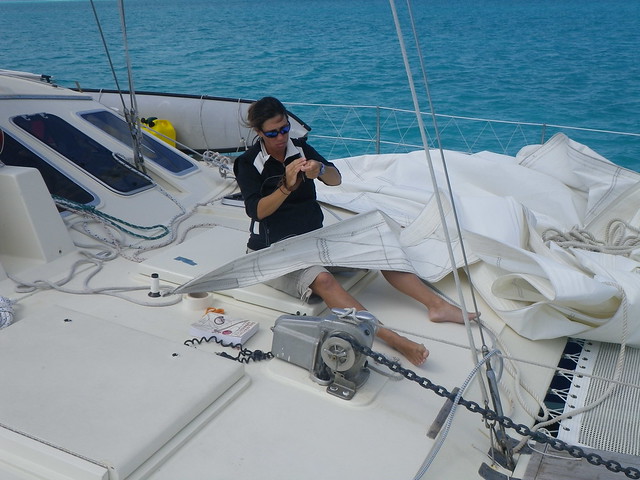
If you’re going to be stuck somewhere making repairs, I can’t think of a nicer place to be than Emerald Rock on a sunny day. As Jay fed the kids and rummaged for a spare shackle the right size, I sat on the foredeck with sail tape and needle and thread repairing the head of the sail. I don’t know if I did it “right,” but it was, all the same, a very satisfying job, and it made me feel like a real sailor. I hope it holds until we can get the jib to a loft, and I hope the sailmaker doesn’t laugh at my awkward stitches! Jay then used the spare jib halyard, which was damaged recently due to over-use as the kids’ swinging halyard, to run the new one back up inside the mast. With new hardware in place, halyard running smoothly (complete with stopper knot), and sail repaired, we hoisted the jib in a stiff breeze—putting that repair to the test—and furled it as quickly as possible. It was just after noon, so we weighed anchor and pressed on toward home.

Seamstress

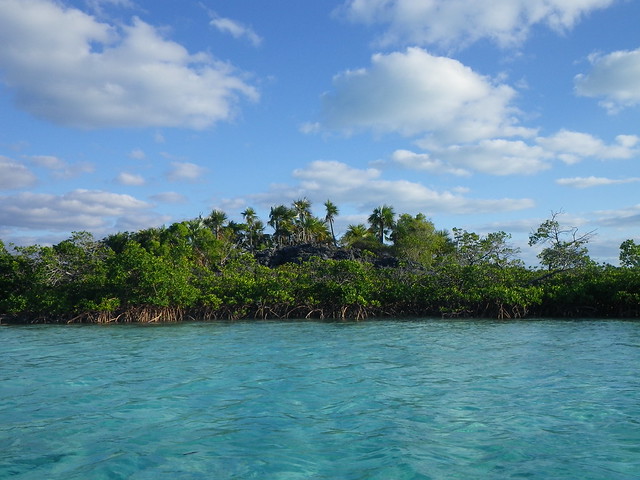
The upshot of this diversion is that we stopped about forty miles short of our goal for the day, and anchored at the southern tip of Shroud Cay. This is someplace I had wanted to go kayaking when I had read about it in the guide book, but we had passed it by on our way South. It’s in the Exumas Land and Sea Park, and is a far lovelier a place than any of us imagined. I was picturing the miles of mangrove estuary and intertwining creeks as they would appear in Florida—cool, dark, murky places, but this was mangrove forest at its most beautiful—clear aquamarine water in wide, easily navigable ribbons leading to snowy ocean beaches on the other side of the Cay. I could easily spend a week here with my kayak and never get bored. We took the dinghy and went on an Explore, thoroughly enjoying ourselves.

Shroud Cay

As we returned to the boat, the sun was preparing itself for bed and the waxing moon was just waking up for the night watch. With a glass of wine in hand, Jay and I toasted our “last day in paradise” as the sun went down in fiery glory. I felt so happy to be alive—to be soaking up days like these to remember years down the road. And when I thought about why were so lucky to be here, I realized we owed the pleasure of this happy ending to our three-month cruise in the Bahamas to a broken shackle. Isn’t life funny?