Category Archives: Recipes

Marathon to Tampa Bay

February 19

Our day of rest in Marathon was amazingly recuperative.  Despite the marked lack of anchorages on the ocean side of the Keys, we managed to find a tiny little place we could tuck into and enjoy a couple nights of peace.  Our standards for anchorages are also much lower than they used to be.  Basically, if the waves are less than 2 feet and the boat lays into them, we’re good with it.

We gave very little notice that we were coming.  Well, as little as possible for people with a satellite tracker posting their position to a website every 20 minutes.  When we knew there would be a stop in Marathon, we called friends and made plans for breakfast.   They’re the custodians of our truck, so we had the use of that for the day, and they very graciously allowed us use of their laundry machines, for all of which we are immensely grateful.

There were two other coincidental reunions with Marathon friends.  For one of them, we were driving down the Overseas Highway when the backseat suddenly exploded with shouts of “Cameron!” as the kids spotted a good friend riding his bike.  Grownups and kids each got to chat and play for a few hours and had a thoroughly good time.  Then it was lunch at The Hurricane with pizza and beer, something I’d been thinking about for months.

Tanya took a therapeutic trip to Publix (something she’d been thinking about for months) and did herself proud.  She restocked us on Belgian beer and even got a little Kalik, just because she could and it was cheaper than in the Bahamas.

Getting it all home was another matter, though.  The boat was 2 miles upwind from the dock.  It was the longest, wettest, most miserable dinghy ride to date.  We were so loaded with groceries and clean laundry that we couldn’t even get on a plane to end the misery sooner.  Sam expressed it for all of us when about halfway he just started to cry.  Despite being cold and wet, we got our goodies home with minimal loss.

February 20

Not much happened as we moved from Marathon to Key West.  We sailed for awhile and then motored when we couldn’t do that anymore.  We wanted to arrive before sunset since we weren’t all that confident about finding a place to anchor.  All my previous trips to Key West have been to a marina.

We did our fuel calculations in earnest since Key West was our last planned stop, we had 180 miles left to Tampa, and the forecast was looking very light.  I think we have 30 gallons left in the tanks and another 8 in jugs.  That would allow us to motor about 50 hours and we should be able to make the trip in less than 40 on one engine.  So I’m declaring us good on fuel.

There are no fish between Marathon and Key West.

February 21

It is indeed light today.  The forecasted 10-15 is looking more like 6-8 from where I’m sitting.  We’re under spinnaker only and it is so flat we can actually carry it, though we’re only moving at less than 3 knots.  This is the first time we haven’t fired up an engine in light air on this trip.

We’re resigned to one night underway on this leg.  It would be nice to avoid a second, but it is so peaceful we’re content for the moment.  We’ll have plenty of time to motor later.  

Tanya didn’t handle our last overnight as well as she expected to and usually does.  Between getting kicked all night and having to get up several times, she doesn’t rest very well even on a good night.  Having to stand the 3-6am watch just kills her for the next day.

A while later…

Our enjoyment of sailing wore off quickly as the breeze got softer, the day got hotter, and our ETA stretched out farther.  We don't motor well in the best conditions, which these were.  Yet we could barely make 4 knots on one engine at RPMs where we usually get 5.  

I dove under the boat to make sure we weren’t dragging anything and the props were reasonably clean.  We weren’t, and they were, though I did find a small bit of poly rope on the port propeller from that float we hit in the Keys.  The hulls, however, have a pretty uniform coating of slime, which must be our problem.  I’m not willing to do anything about that.  For starters, the water temp is somewhere in the 60’s.  That’s too cold for me, even with a wetsuit primed with warm water.  Secondly, I’m a chicken about getting in the water when I can’t see the bottom.  Getting that knot back would shave 8 hours off of the trip, but spending 2 hours in the water to clean the bottom is just not going to happen.

I can’t push the boat harder because the fuel calculations are based on a fixed RPM.  Today was supposed to be a sailing day, but we started motoring much sooner than expected.  We’re going to be on fumes when we arrive, but I still expect to make it.  I have enough in reserve to get us to a fuel dock if I’m wrong.

February 22

It was a long boring day of motoring.  We put a sail up for awhile, but it didn’t help much.

We arrived at Tampa Bay after midnight and in fog.  The channel itself wasn’t a concern, but the crab pots were impossible to see.  I just had to risk it and got lucky.  

We’re not heading to our normal anchorage in the river since I don’t feel confident maneuvering around other boats with only radar.  We’re heading to a spot outside the river that should be empty, and hopefully where nobody will run us down in the fog.  We’ll move to the marina in the morning.

Feels good to be here.
New Providence to Marathon, FL

February 17

I’d been regretting my gripe about perfect days yesterday.  Yesterday really was a beautiful day, and the whole spinnaker fiasco was probably my fault.  Today, however, really was perfect.

We left New Providence around 7am.  It was light and rolly until we got away from the island, then something like ENE 15-18 settled in.  There was a north swell that we didn’t get rid of for a couple hours, which had the kids grumpy and lethargic.  Eventually we set the spinnaker and had a great downhill day.

It was about 40 miles from New Providence to the Northwest Channel.  We put some lures out as we approached the banks, since I figured that was the best place to find the fish, and the presence of sportfishing boats seemed to concur.  Nada.  The lines stayed out onto the banks and I caught my smallest barracuda to date — not even 2 feet.  He went for a lure about half his size.  Typical barracuda.

There were no confirmed whale sightings as we crossed the Tongue of the Ocean, but Sarah saw something that was likely a pilot or beaked whale.  She said it was bigger than a porpoise and had a very blunt nose.

The spinnaker started getting a little high maintenance as we bore off for a 50 mile leg to the South Riding Rocks.  It seems happiest with the wind around 120 apparent, and we can get it as high as 90.  150 is about the deepest we can carry it, though.  At least without constant adjustment for wind shifts and Otto’s steering.

Otto has been giving a lot of trouble lately.  This is not good since he is a crucial member of the crew.  His best trick is to silently switch from Auto to Standby mode.  We had a nice accidental jibe today because he took a nap at the wheel.  We’ve decided he’s narcoleptic.  The primary job of the person on watch is to keep him company and make sure he stays awake.

We took the spinnaker down at dusk and decided to go with just a main.  After an hour or so we put a reef in.  After the accidental jibe Tanya was a little shy about sailing deep on her watch, so we ended up a little north of our line to the Rocks and had to put in a couple (intentional) jibes at the end to clear them.

From the Rocks it’s 50-something miles to Florida.  I was hoping for a full moon for this crossing and we nailed it.  I don’t particularly like sailing at night and moonlight helps a lot.  I don’t know exactly how far the crossing is because we’re not there yet and I’m not sure where we’ll end up.  The stream is really making itself felt.  I don’t want to fight it, and the breeze is about E 17-21, so I’m heading 275.  The GPS shows us going about 285 over the ground.  If it keeps up, we’ll end up about 10 miles north of our waypoint.  

February 18

It was a pretty uneventful night, which is exactly the way we like it.  Tanya had to contend with one cruise ship.  It crossed about a 1-mile ahead of us by her estimate.  That’s a little close.

The wind stayed E 17-21 and we stayed with a single-reefed main.  It was slow, but predictable.  The course deviation did keep up and even increased for awhile, and we did end up well north of our waypoint.  This was somewhat expected, and the reason we chose to a longer, but more southerly route from the South Riding Rocks, rather than Bimini or Cat Cay.  The Rocks were also much easier to negotiate at night.

On the midnight-3am watch I got disgusted and started jiggling Otto’s wiring.  I found a loose one and he appears to be cured.  By the time we get home we can be sure.  It will be nice to scratch a large and expensive project off the summer list.

As the sun rose, we could see and smell Florida (yes, from upwind).  The water was noticeably less clear, and there were seabirds plying the waves.   There were also hundreds of what I initially thought were plastic water bottles floating on the water.  If I passed one within 50 feet or so, I could see that it wasn’t really a bottle, but had a ridge on it, like a sail or fin.  It wasn’t until later in the day when I pointed one out to the kids that I learned they were in fact Portuguese man o’ war.

Other things that remind us we’re in Florida are actual, honest-to-god navigation channels.  With all the markers too!  And big sportfish boats that buzz right by sailboats thowing the biggest wakes possible in those channels.  And crab and lobster fishermen that think marked channels are a great place to put their pots.

The crab pot situation in Florida is something I’ll never understand.  They’re a hazard.  Navigating a marked channel in Florida requires more diligence than an unmarked one in the Bahamas, and it is highly unwise to run a boat at night in the Keys.  I hit two pots in broad daylight.  One I hit with my port propeller and broke up the float.  Another I snagged with my starboard rudder.  This has happened to us several times.  The pots drag along in our wake until I cut them loose with a knife.  I’ve gotten off easy (so far); poor Niels wrapped one around a propeller, tore up his transmission, and had to spend a week in the Marathon Boat Yard.

We crossed the reef into Hawk Channel and began a long day of working down the Keys.  We stopped near Marathon and will take a day’s rest, then continue to Key West and finally head north for Tampa Bay.  Crossing to Florida only represents the halfway point of our trip from a distance standpoint, but we already feel home.

Black Point to New Providence

February 14

Picking up from my last post, we did leave Black Point and continue north.  But not before getting boarded by the Royal Bahamian Defense Force for a check of our cruising permit.  They were nice guys, but I’m always a little bit nervous during these encounters.  They did ask if we have any weapons and asked several times how many kids we had, possibly having lost count.  Tanya sent them away with Valentine’s cookies hot out of the oven.

We anchored near Pipe Cay around sunset.  Our plan the next day was to make 70 miles to New Providence, where we’d stage for the last 140 miles to Florida.

At bedtime we discovered that one of our cats had been seasick… in the bed.  It wasn’t a pleasant discovery.  After all the water we took down the hatches the other day, we’re running low on clean sheets.

February 15

We can only imagine the entertainment we must be providing for the armchair skippers watching our SPOT track.

We left Pipe Cay at sunrise this morning and headed off toward New Providence.  Winds were about 14-18 from the NNE, but a couple sustained gusts to 20 obliged me to put a reef in the main.  

An hour or two into what was looking to be a 10 hour day, we lost luff tension in the jib.  Initially I assumed the halyard broke, which really ticked me off because it’s practically brand new, and wasn’t cheap.  No matter, I figured we’d just switch to the spare halyard.  We luffed up and dropped the jib.

The sail came down without any difficulty.  The webbing at the head was still intact.  There was a little damage along the first few inches of luff tape, but it didn’t seem like a big deal.  Still, something didn’t seem right.  It wasn’t until I was getting the spare halyard ready and looked aloft that I realized the top swivel of the roller furler was still at the top of the mast.  So much for going to New Providence today.

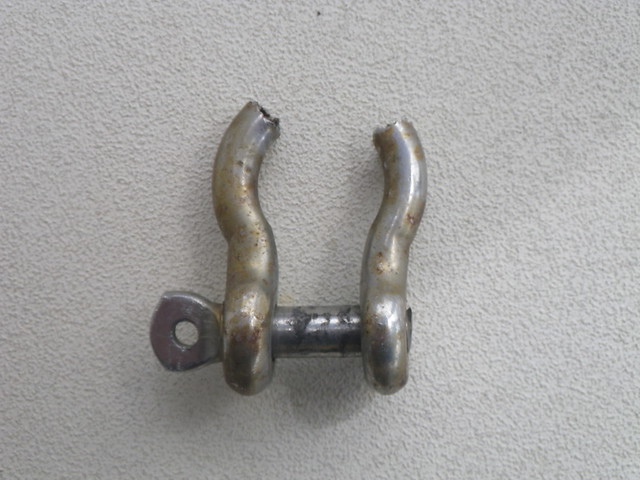
We were going to have to send someone up the mast to get that swivel, and we needed sheltered water for that.  So we turned around and headed to Warderick Wells.  Eli did the honors.  The swivel came down without difficulty.  I expected to find a twisty shackle with the pin backed out or possibly broken.  Instead I found a 3/8” stainless bow shackle.  It wasn’t just broken: there was a section missing from the bow. 

Shackle

There were no markings on this shackle, but others that size I have onboard are marked 1 TON WLL (working load limit).  I don’t think we put anywhere near a ton of pressure on it, I think it was just a piece of junk and probably failed from crevice corrosion.  I usually throw unmarked shackles away.  I had no idea one was holding up my jib.  Shame on me, but it would have been nice if my rigger had mentioned it.

Tanya didn’t like the looks of the luff tape and set about repairing it.

In the excitement with the broken shackle, nobody noticed the tail of the jib halyard slip up inside the mast.  Tanya had the idea to go ahead and pull the primary halyard out and replace the old secondary with the better line.  I’m sure my rigger can reeve a new secondary halyard, but it’s a tricky thing to do with the mast up.  I’m developing a list of things to do when the mast gets pulled next.  In the meantime, the kids have lost their swing.  They probably weren’t going to be doing much of that in the marina anyway.

With the jib back on the furler, we got back underway with the intent to get further north up the Exumas for jumping off to New Providence the next day.  

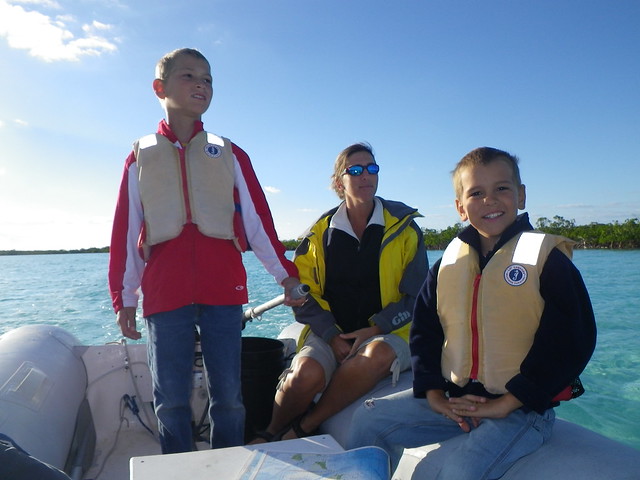
We ended up at Shroud Cay for the night.  We missed this one on the way down.  Warderick Wells is really the only part of the Exuma Land and Sea Park we’d seen.  But every part we have seen has been amazingly beautiful, and Shroud was no exception.  The interior is a kayaker’s paradise, much to Tanya’s chagrin since we didn’t have time for her to go explore.  We all went by dinghy instead and still managed to enjoy it.

Dinghy Captain

It should be a broad reach, and only about 40 miles tomorrow, so hopefully an easy day.

February 16

Today was a beautiful day for crossing over to New Providence.  Conditions were about NE 14-18 in the morning and gradually softened to about ENE 10-15.  It was a little brisk for the spinnaker to start, so we sailed above our course with the jib for about the first half, expecting the wind to clock and moderate.  It did and we bore off to set the chute.  

This is family blog, so I can’t accurately describe what the sail did or any of my thoughts on the matter.  Basically it wrapped itself around anything it could.  I could not get it up or down.  We tacked, we gybed, I shouted curses.  The mess just got bigger.  Eventually I was able to drag it down, not caring if it tore, and stuff it down a hatch.  I waited awhile for my temper to cool and strength return to my upper body, and then began the chore of untangling the sail and repacking it in its sock.

We were doing okay without the spinnaker, but I needed to show it who was boss.  I was also counting on using it the next day.  The relaunch went much smoother and we carried it all the way to New Providence.

We just can’t seem to get a perfect day on this trip.

George Town to Black Point

February 12, 2011

Repeat after me: don’t play with cold fronts, don’t play with cold fronts …

We left George Town in the morning with the stated intention of getting out ahead of the cold front due in the afternoon.  The front would arrive with strong NNE winds, and the breeze would fill from the E in its wake.  This would make exiting George Town, travelling 40 miles NW up the coast in the Exuma Sound, and re-entering through a cut very uncomfortable.  Meanwhile post-frontal conditions would be ripe for a run to Florida.

I’ve stated that we can only predict the weather about 4-5 days with any certainty, and we could not see far enough ahead to sit in GT long enough for conditions to abate there, and still expect good conditions all the way to FL.  We’re eager to get home and hated the idea of losing this window.  When the morning forecast showed the front arriving later than previously expected and extending into the next day, we suddenly realized we were going to lose a day of our good forecast AND get hammered on the first leg.  In the space of about 10 minutes, we decided to go.  

Our bottom had not been cleaned in a few weeks, and I had planned to do that.  I also wanted to take our last load of trash ashore, get some ice for all the fish we were going to catch, and run some other minor errands and boat chores.  All were optional, and I opted to skip them.

It was a beautiful day; flat calm with about 5 knots from the NNE.  We can’t reasonably sail in less than 8 knots and the angle was a little tight, so we left an engine on.  I could feel the dirty bottom and props and estimated we were down about a knot of boat speed.  We did some fishing with three lures out, but only caught one barracuda.  We were happy with our decision to go.

The wind gradually built up to 10 knots, but went farther north, making it harder to use.  Around our half way point, the GPS was showing a 4:30pm arrival at Big Farmers Cut, but I wasn’t confident we could keep up our 6 knots that long.  The front would arrive earlier than the forecast as we travelled north to meet it.  I was not concerned about the front itself at this point, though I probably should have been.  What was on my mind was the cut, and that we would arrive in the middle of an ebb tide.

When we were going south on our way to George Town, we left through Galliot Cut (right next to Big Farmers) on an ebb tide and a light onshore breeze.  The effects of wind against tide on that day were mild, but still pronounced, and the current carried us through it.  This day we could have up to 25 knots opposing the flow and we’d have to fight our way into it.  It was not going to be fun, and possibly even dangerous.  Once we got to the cut, if we didn’t like it, we would have no options except to wait offshore until the current slacked near 8pm. Yuck.

Or, we could turn around and take the Square Rock Cut, which we had just passed.  It was a longer route since we would have to go around the large Galliot Bank on the inside, but that appeared to be the only downside.  The tide was currently slack, so the cut would not be a problem.  We expected the inside route to offer protection from wind and waves from the front.  We would have to motor upwind for about 10 miles, but did not expect that to be a problem.  So we turned around and headed for Square Rock.

It was about 2pm when we entered Square Rock Cut.  There were a couple boats anchored inside.  It occurred to me to join them, but I dismissed the thought.  It was still early and I had my mind set on getting up to Little Farmers Cay.  It would be dark when we arrived, but we were familiar with the area and didn’t see that as a problem.  We continued on, travelling south, then west, then northwest as we rounded the back side of Galliot Bank in about 10 feet of water.

The front arrived at about 4pm and the wind built quickly from 15 to 20 knots.  We had put a preventative reef in the main, so were not overpowered from a sail perspective.  The 20 knots turned into a sustained 25 and we rolled up a little jib.  We were moving at about 8-9 knots at this point.

The waves coming off that bank were quite surprising and we were bashing into them pretty hard.  Large amounts of heavy spray, and occasionally partial waves were washing along the decks.  At one point I was standing at the cockpit door and saw a wave come up from between the hulls and over the salon windows.  It came across the cabintop and heavy water dumped on me at the door.  In retrospect, we should have put another reef in the main, or otherwise slowed down.  We were being too hard on the boat, inside and out.  This went on for about an hour.

At some point I realized the trampolines were becoming detached from the boat.  I ventured forward to investigate and saw that the catwalk out to our crossbeam was also broken from the force on the trampolines.  We started the engines, but could not put them in gear because of all the lines in the water, and it was too dangerous to go on deck to get them.  In the ensuing chaos, we accidentally tacked the boat.  

Silence.  It was like everything stopped.  We were hove to and it was wonderful.  We were drifting at about 2 knots, I’m not sure which direction, but didn’t care since the wind was from off the bank.  I went forward and cut away the lines holding the trampolines, and hauled the tramps and the catwalk wreckage aboard.  While I was forward doing that, the port engine stopped.

With the foredeck cleared, we got back underway, now with the starboard engine, a second reef in the main, and no jib.  I went to look at the port engine and realized pretty quickly that the bowl of the fuel filter was full of water.  That meant the pickup was immersed in water at the bottom of the fuel tank.  I checked the gauge, and sure enough, we had about 5 gallons more “fuel” than we should.  It wasn’t going to be a quick or an easy fix.  

With only one engine, we weren’t going to be able to motor into this wind for the 10 miles to Little Farmers.  We needed to hunker down and regroup.  It was finally clear that we should have stopped in the vicinity of Square Rock.  So we picked a spot about an hour behind us where we could tuck up close enough to land where we could anchor comfortably, and once again turned around.

Sailing in 5-6 feet of very choppy water, in the dark, was a little bit nerve-racking.  We eventually dropped the main and just motored.  We found that we could not motor upwind at all.  The boat would slow to the point where the rudders stalled and we fell off, for some reason always to port.  With only our starboard engine, it was hopeless to bring the nose back up to the wind and we had to gybe around.  We did this three times, each time getting closer to some rocks marked “position approximate” on the chart, before we learned not to go upwind and instead just motor with the wind about 30 degrees to port.  With such limited maneuverability we couldn’t get to an ideal spot, and we were getting more and more nervous about the depth.  So eventually we decided we were close enough and just dropped the hook.   Putting the bridle on the anchor chain without the trampolines or catwalk took a little doing, but once done we settled down quite comfortably.

A quick dinner was made and the kids went to bed.  It was 9:45pm.

February 13, 2011

We rested today and waited for the cold front to pass.  We also cleaned up and got everything shipshape again (at least as much as it was before).

The catwalk is destroyed.  It was a box section and only the top layer and one side remains intact.  It can’t support any weight at all.  Neither of the trampolines was damaged and I have retied them to each other underneath the catwalk remnant.  Between the time when the catwalk broke and I discovered it, it was hanging in the water, and with each wave it was bashing the front and bottom of the bridgedeck.  I can’t see any serious damage, but I haven’t looked under the boat yet.

I pumped all the fuel from the port tank over to starboard and then opened port and cleaned the remaining water out.  That transfer pump sure comes in handy.  Then I pumped half of the fuel back, drained the water out of the Racor filter, primed the engine, and… it wouldn’t start.  The filter has a little ball that floats on water and shuts the fuel supply before the engine gets water, so that shouldn’t be the problem.  I’ve starved the engine of fuel a few times before due to plugged vents, but have never had any trouble getting it started again.  This time I had to bleed the fuel system, but eventually got it running again.

Our fuel and water fill ports are recessed below the deck for some reason.  The compartment drains, but not fast enough to cope with the water we were taking on deck.  We need a better hatch over the compartment to prevent water getting in that fast.  Since our water fill is in the same place, our port fresh water tank was also contaminated with salt water.  Unfortunately, that can’t be fixed as easily and we are the proud owners of 80 gallons of brackish water.  We probably won’t try to rinse and reuse the tank until we get to a dock with a hose.  Fresh water is too preciously made.

The interior was a mess.  We had lots of water come in through hatches that weren’t dogged tight, as well as things that were precariously stacked and fell down.  Our confidence in our stability allows us to get away with some bad storage practices… for awhile anyway.  But the boatbuilder bears some blame too.  The catches he put on the galley drawers were not enough to keep them from flying out.

February 14, 2011

Back on that horse cowboy.  

Conditions today are a clear sky with NE 14-18 and occasional gusts to 20.  We had to psych ourselves into picking up the anchor this morning.  We started with a just a reefed main, and gradually added the jib until confidence was fully restored.  Thankfully, the wave machine isn’t on today.  What a difference 10 knots makes.

Thinking back to our decision to leave Saturday, if we had not escaped George Town when we did, we would have been stuck there Sunday too, and just left (maybe) today.  It would have been a raucous day in the Exuma Sound and we probably would have ducked into the first cut and stopped, perhaps even at Square Rock, and perhaps with rage conditions at the cuts.  As it is, we’re now past the Galliot Bank and making an easy 6-8 knots toward Black Point.  We’ll stop there briefly to unload trash, update our weather forecast, and post this.  Then we’ll pick back up and keep moving north. 

Despite our missteps and wounds, I’m feeling pretty happy with our progress.

Lessons from Adversity, Part II

“It’s all very well to read about sorrows and imagine yourself living through them heroically, but it’s not so nice when you really come to have them, is it?” –from L.M. Montgomery’s Anne of Green Gables

I have read lots of books about disasters at sea—call it research, if you will. I always wonder, “How would I handle a similar circumstance?” I’ve come to the conclusion that you can’t really know until you’re in the thick of it. I’ve also read the Little House series of books to the kids (by Laura Ingalls Wilder) about the survival of a pioneer family, and often hoped I would handle adversity like Ma, who weathers everything with composure.

I’m sure Jay will give the blow-by-blow of our little encounter with Mother Nature recently, so I will spare you the details. We learned a lot, though, from our miserable few hours. One thing I learned was that I only freak out about small things. When it comes to the moment when panic might be expected, I was actually very calm. I owe this to two things: prayer (that is, faith that we’re being looked after), and the need to reassure my children. While waves washed over the top of our main cabin and everything around us tossed and turned (including the contents of all our drawers and cupboards), I sat and read Beatrix Potter’s timeless stories loud enough to cover the sound of wind and waves. It really helped the kids stay calm and happy. I confess that I wondered when and how it would all end, but while we were in it, I decided to make the best of it, and hope that we’d find a safe and quiet place to recuperate. We did.

Another thing I learned was that Jay and I can do this, even with four (or five) children. Even in unpleasant conditions. I am not good at snap decisions, like if Jay asks me to look at the chart and find us a safe place to anchor, or if he hands me the wheel without explicit instructions and then heads up on deck. But I am good for a second opinion, and I’m good at preparing ahead of time, and I can follow instructions and provide endless snacks and drinks and dry clothes to wet and tired crew. Jay can stand for hours in cold and salt and wet, enduring the ills of seasickness or adrenaline overload, making decisions that are difficult because the outcome is hard to predict. He’s never gotten us into a mess he can’t get us out of. And, I must say, he can be humble, like when he apologized to all of us for heading into bad weather instead of stopping earlier. He is a good captain, in short, and I am good at supporting him in the role of first mate.

The kids, in their turn, are good at entertaining themselves on travel days, are sympathetic when they see us stressed or struggling, and don’t complain when conditions are rough—they just lie around quietly and wait for us to fix things. If I someone gets cut or hurt in some way, they are quick to run for first aid supplies, and are not bad at caretaking. The older ones help the younger, and when called upon, they are good assistants to us as well. Suffering something difficult together really reveals not only your weaknesses, but also your strengths, and I am proud of how far this family has come in learning to operate as a team.

We are also learning to trust our boat more and more. Of course, if you’re never in unpleasant conditions, you don’t really test the boat at all, and despite our stated goals to do so, we never seek out these conditions. But we figured eventually they would find us, and we would find out what this boat can do. We are learning how strong she is structurally, how well her systems work, for the most part, and what a good and comfortable home she makes for us. We are also learning her weaknesses, and what things we can do to ameliorate them. One last thing we learned: she heaves to just fine (that’s a mono-hull trick where you can use a sail and the rudder to basically stop the boat), and it’s a great way to buy a few minutes’ respite and figure out what to do next. As long as you’re not going to drift into anything, you could even use this tactic to get a few hours’ sleep if you were really worn out from a long storm, or waiting for daylight to enter an unfamiliar harbor. 

We are making a nice recovery—fixing broken things, de-salinating and drying out, cleaning up and re-organizing. It feels good to be anchored and not moving, just resting up for the next leg of the trip. I am glad we learned the things we did while we were in the middle of the storm, but, all the same, I hope we don’t need to heave to again anytime soon.

Lessons from Adversity, Part I

I got stranded in the dinghy (again), but this time I was not able to help myself, and the stupid motor bit me. That would be code for “electric shock.” I don’t take it too personally, though, because it bit Jay, too, when he tried later to figure out what was wrong. I also had trouble with the tilt and trim, which malfunctioned and prevented me from getting the propeller far enough in the water to get forward propulsion. Add that to the fact that I was in the middle of helping a friend, who couldn’t get her motor started. I would have at least towed her back to her boat except I couldn’t help myself! We were sort of drifting along together, me, Carla, and six children, trying to figure out what we should do next. Someone putting by helped us out (thanks, Jerry from Kumbaya)—he got my motor down far enough to go forward and towed Carla home. Had Jay had his VHF on, there’s not much he could have done, short of coming to help out by kayak (yeah, right) or telling me to just row home. Carla’s husband was out fishing, so he wasn’t there to help either.

Now I understand about being independent and self-sufficient. But sometimes you just need help. I’m seven months pregnant, for goodness’ sake—I don’t possess the physical prowess necessary for wrestling with the Merc 25. Jay didn’t exactly scold me for my helplessness, but he did express his desire that the adversity teach me something, preferably that each episode would build my confidence and competence in trouble-shooting. HA! I will not repeat the whole conversation (mostly because you don’t want to hear my irrational and emotional ranting), but suffice it to say that what I have learned is to a) never go too far from the boat or from someone who can help me; b) make sure Take Two’s radio is on and set to the same channel as the handheld unit I always have with me so that the Main Troubleshooter is available to talk me through problems; and c) get our little motor-head Aaron up to speed as quickly as possible so he can fix the damn thing.

The fact is that I am as likely to learn outboard engine repair as Jay is to learn herbal remedies to fix the kids’ various ailments. We ascribe to the “divide and conquer” way of life, and although we always have spares of everything, there are no spare family members. We each have vital roles to play and we can’t really do each other’s jobs with ease. Some cross-training is desirable, of course, or else Jay couldn’t travel for work and I’d never have a moment to myself. But the self-sufficiency we have attained is based on inter-dependency; we are able to help ourselves as a family unit because we can help each other. This teamwork is sometimes put to the test, but you can read about that in another entry…

Underway

We've decided to take advantage of the calm before the next front to leave Elizabeth Harbor and get up into the Exuma chain.  We'll weather the front there and then have the prevailing easterlies behind us as we head west.   We don't know yet how hard we'll push, so our arrival date isn't known.  The Where Are We? page will show our position.

Life of Adventure

A lot of preparation for this trip wasn’t actually related to the boat.  We had a landlife that needed to be put in stasis.  We had everything possible automatically billed either to a credit card or the checking account, forwarded the mail, forwarded the phones, but we (I) did screw up in one regard, and that was Tanya’s van.  Basically we abandoned it.

The plan had been to sell it.  Lyle, our Man-in-Bradenton, was going to handle that for us.  But then Tanya got knocked up and that threw everything into confusion.  The van was our only vehicle that had enough seatbelts for the whole family-to-be, and we were no longer sure we should sell it.  So it is still sitting where we left it 9 months ago.

Two people tried to kill me right before we left Bradenton.  One when I was driving the truck (nice try), and then another when I was in the van.  Some people may consider that a wakeup call to their mortality, but I’m ahead of that game, so all I learned was that I didn’t like State Farm as my insurance company.  Right after they denied my claim on the van (Tanya has a predilection for backing into things, and the van had some previous damage), they sent me a bill to renew the policy.  I filed that under bullshit and promptly forgot about it.

I think I lamented in another post the cost of having things shipped into the Bahamas.  Ordinarily we have a mail package sent to us about once a month, but it never seemed worthwhile to have a mail package sent to us here.  Our mail service estimated it would cost a couple hundred bucks for them to send us all the (mostly) crap they’ve received for us.  So we didn’t receive any notice of the impending bureaucratic nightmare.

Fast forward a few months and I happened to be looking in the bullshit file.  Uh oh.  I called State Farm, and sure enough, the van's policy was ancient history.  Even better, in Florida the insurance companies report policy lapses to the DMV, who assuredly does something nasty to the owner’s driver’s license.  Thankfully, the van belongs to Tanya and not me.

Lyle reports that the van is right where we left it 9 months ago, which is pretty funny considering it is right across the street from the police department.  It has no insurance, the tags have expired, and I can’t renew them online without physically showing proof of insurance.  For all I know, there could be a bench warrant for poor Tanya.

Did State Farm call or email before the policy expired?  No, they did not.

There may be other problems waiting for us that we don’t even know about.  This is a life of adventure.

Lessons Learned

We’ve talked about it before: our philosophy is to do everything in small increments, making progress one little “baby step” at a time.  We like goals, milestones, checkpoints, and measurable results.  We might be a little bit weird that way.  We also like being totally within our comfort zone.

We moved aboard the boat in the following progression: one night aboard, weekends aboard, a month aboard, then living aboard full time at the dock.  When we knew how to live on the boat, we left the dock and hung on a mooring ball in Marathon for 5 months.  Weaned of the dock, we were ready for a cruise and left Florida for three months in the Bahamas.  At each step we made progress in a one particular area so that we were completely at ease for the next step.  

Sometimes we make mistakes, or something unexpected happens to shake things up, but otherwise our day-to-day existence is pretty normal.  It is certainly different than if we lived ashore, but to us it has the same sense of normalcy.  While we may not notice it all the time, and we probably wouldn’t have described our goals in any such terms, that kind of normalcy in itself is a major success.  This is our life, and it works.

Much of the reason for our return to Florida is to gain perspective on our time away, compare the reality to our expectations, reset the expectations that weren't met, and make any necessary changes before setting out again.  We already have a pretty good list of lessons learned and hope to address them directly in individual posts.

The Fountain of Youth

Jay and I have been trying to solve the mystery of George Town ever since we arrived here. Why does everyone flock here to Elizabeth Harbour every year? They are expecting nearly 400 boats during the peak, Regatta time in early March. And many of the folks here have been here every year for the last decade, or more. Because Jay and I are people who like to explore new places and rarely retread the same paths, this mystifies us.

So we’ve been here for ten days or so, and quietly observed, and have discovered a thing or two.  First, most of the people here come from Northern climes. There are some Florida boats, but even that region has been cold (for those who live on a boat) the last couple of years. So the warm weather is a big draw for sure. We are right at the line of the Tropic of Cancer, so this is technically a tropical paradise. Second, the summer-camp atmosphere lends itself well to people enjoying a second youth. Most of the people we see are our parents’ age, but you’d never know it from the way they act. They’re kayaking, windsurfing, snorkeling, spearfishing, playing volleyball and doing yoga on the beach. Every day. Plus there are basket-weaving classes, Bocce Ball, Regatta committees, choir practice, art classes, dances, poker games, and other social events too numerous to name.

For as freely as we live, with homeschooling and self-employment, our lives still revolve around the necessary routines of mealtimes, laundry, schoolwork, bread-winning and bread-baking, and bed times for small children. We aren’t exactly footloose and fancy-free. So we go to the beach every afternoon after the work is done, but so far I haven’t felt compelled to join a pick-up volleyball game, though I do love the game. Really, I just want to sit with my feet in the sand and read my book. Maybe it’s the pregnancy, or maybe because my energy ebbs by 4 o’clock, but I feel a bit of role reversal. The Sixty-Somethings are out at the bar until the wee hours and Jay and I collapse shortly after the children go to bed.

I was, at first, a bit critical of people who keep coming back to the same place year after year (yawn) but, who knows, maybe after we’ve tired of always looking for a new place, we will look back on this place fondly, or some other like it, and want to call it home for part of every year. By the time our chicks have fledged, we will be looking for that second wind, and hopefully we will find the Fountain of Youth that the cruisers who come to George Town seem to have discovered.