Category Archives: Recipes

The Jims

Aaron loves outboards, and he knows them all.  If he's seen a boat before, he can tell you what it has hanging on the back before you can see it.  He can tell you who is going past in the dark by the sound of the motor.  We first noticed this trait when he was a little guy.  He was into monster trucks then, and could identify all the pickup trucks he saw on the road.  And he loved tools.

We see our jobs as parents as helping the kids follow their natural interests.  We have no expectations that they will grow up to go to college to be doctors and lawyers.  No offense to anyone intended, but we think the world has enough doctors and lawyers.  What we really want for them is to be happy in whatever they choose to do.  And no matter what they do, we want the boys to learn a trade, to have a marketable skill and learn the value of hard work.

There is a father and son team of mechanics here in the anchorage.  We call them The Jims.  They buy broken outboards by the lot, tear them all down, fix what they can and resell them.  They do all this work in the cockpit of their boat.  They very graciously offered to let Aaron come by and watch sometime.  I wanted to go too, and took him over there.   It's something different every day over at the Jims'.  On his first day, Aaron rebuilt his first carburetor.

We go over there most days now.  When Aaron has finished his schoolwork, and I've done enough work to take some time off.  I'm learning, too.  Some days are slower than others and sometimes Aaron loses sight of the big picture.  He was not impressed one day to find them working on a small generator.  That motor had a broken connecting rod and they took the block completely apart to get to it.  It was the coolest thing I'd ever seen.  After just a few weeks over at the Jims' I've learned more about motors than I ever learned from a book.

When our 25 turned up sick, what I'd seen at The Jims' gave me confidence to haul the motor into our cockpit and work on it myself.   I ended up not putting the carburetor back together quite the right way, and I had to limp over to the Jims' for help.  Through the course of tuning the carb and telling them what I'd found elsewhere, we determined that the motor had serious issues.  They thought the problems justified buying a new motor if I could afford it, or they'd help me fix it.  Of course I can afford a new motor.  The dinghy motor is one of our most critical pieces of equipment.  But there are no guarantees that a new motor isn't going to strand you somewhere, either.  In the end, Tanya and I decided that even if with money out of the equation, it is better to have a motor you know than one you don't.  So we're going to try to fix it.  If we can't, or it gets too messy, or it dies on us later, then we'll get a new one.  Probably in a different country where they still sell the good ones.

The Jims are clearly providing a valuable service to us and to Aaron, but it doesn't seem to be a one-way relationship.  They appear to truly appreciate having Aaron around.  Partially I think they enjoy passing on their knowledge and hard-earned experience.  It is rare these days to find a child who respects adults, and is interested in anything but video games.  Sure, he slows them down, but they don't mind.  Every day when we leave they invite us back.  And every morning when Aaron's finishes his schoolwork, he comes to tell me he's ready to go.
Winslow Life Raft

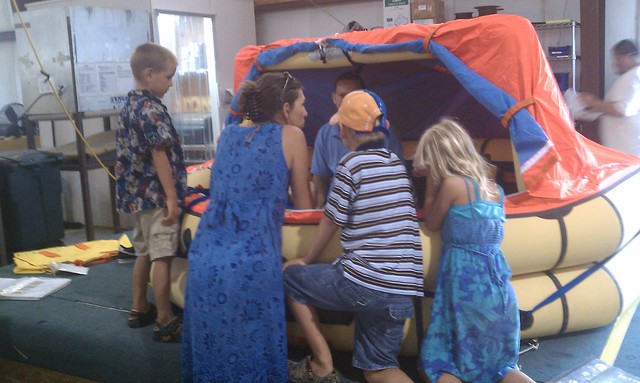
We bought Take Two a new life raft and decided to pick it up at the factory rather than have them ship it to us.  We think it is a good policy for everyone who owns a life raft to see it inflated and have a basic familiarity with it in case it is ever needed in an emergency.  

We applied that logic when we took the whole family to see our previous raft serviced.  Unfortunately it was going to be more expensive to recertify than it would be to buy a new one, so we had it condemned.  That was, of course, before we started shopping and realized that while a life raft could be purchased for less, we wanted the best and that was going to cost a lot more.

We placed the order for our new one at a boat show where several brands of rafts were being displayed.  Our selection of the Winslow was influenced by several factors.  We felt it had the best features and construction, an opinion seconded by Practical Sailor during a test of several competitors.  They were the only rafts at the show that are made to order and constructed entirely in Florida.  And they are unapologetically expensive.

We also liked that the raft’s standard equipment includes a Bible.  While this may seem like a sentimental and irrational reason to like a raft, we saw it as an indication that the company really thinks about what it is like to use their product in a survival situation.  

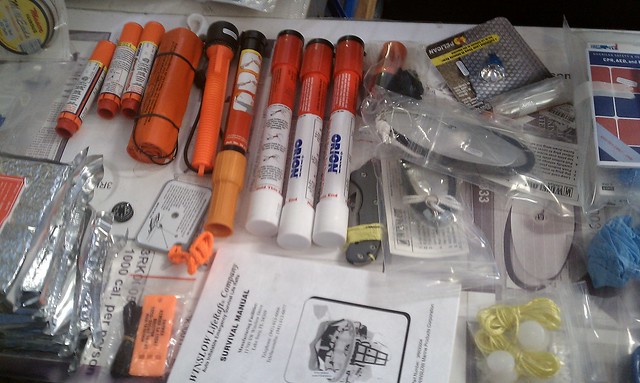
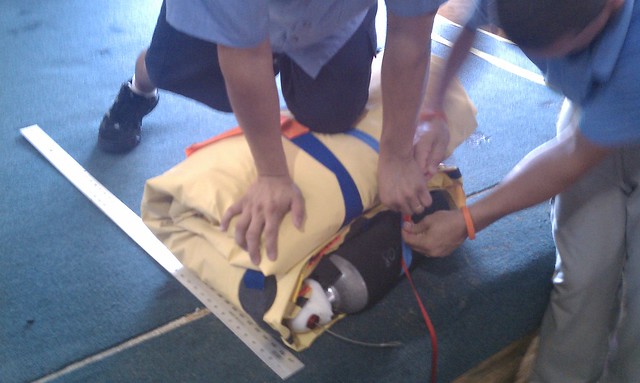
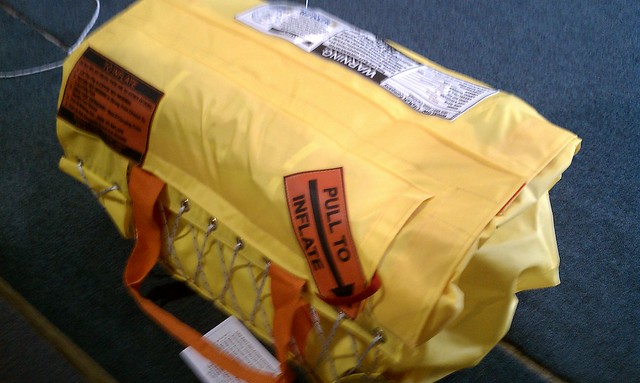
“Picking up the raft” actually evolved into a 2-hour visit during which we toured different stations where other rafts were in various stages of assembly.  Our raft had already been completed and was waiting in a rack for almost a month while we got all our ducks in a row to make the trip.  They knew we were coming, so it was inflated and ready to be packed when we arrived.  We were given an orientation of the raft’s features, we saw the survival pack assembled, and we watched as the raft was packed.  Each step was explained.

Tutorial

Equipment

The packing process includes many quality assurance steps.  While it is mostly done by a single person, at various points the pack is checked by another person, and at certain stages photographs are taken.  Witnessing the process gives confidence that Winslow is serious about the quality of their product, and understands that a defect could have life-or-death consequences.

Rolling Up

Ready

They’re also really nice people.  We were told that they ship about 15 rafts a day, but only 1-2 customers a month come in to see the operation.  We were glad to see it, and also glad that they could see our family.  I think if I were making life rafts, I would appreciate the reminder of who uses them.

Yawn


Hurricanes are tricky things.  In 2004, Category 4 Hurricane Charliewas headed straight for our house in Clearwater when it took an easterly turnovernight.  It decimated a surprised Punta Gorda with its strong northeastquadrant, and the weaker western side barely gave us rain.

A similar thing happened today in Marathon.  The storm went east of theforecasted track and we got the western side, which was pretty muchnon-existent.  It was overcast and drizzled once in the morning, then therest of the day was sunny and calm. 

I won’t attempt to hide that it was a bit of a letdown.  It’s not that I’m an adrenaline junkie orsomething.  I make these plans and havethese ideas about what conditions will be like and how we’ll cope with them,but at this point they remain untested.  Aboxer has to work his way up the ranks gaining experience before he has achance against the champ.  I only hopethat next time I’m not pitted against a much stronger storm.

I partially console myself with the knowledge that I could tell what was happeningas soon as I got up this morning and saw the breeze had backed to the North.  I’ve watched these things closely for manyyears now, have read some books, taken some classes, and feel like I’m gettingto understand them to some degree.

If I were reliant on official sources of information, I would have beentotally clueless about what was currently happening or about to happen.  The VHF chatter from
other boats showed a serious lack of awareness about what the weather was doing.  Local weather radar was the only informationI had access to (which was only possible because I had Internet access) which was compatible with what I was seeing with my eyes.  In fact, several of the National HurricaneCenter’s position reports appeared to contradict what I saw clearly onradar.  I find it frustrating that even within hours of a storm hitting me, I can’t get good information about what kind of weather I’llhave.  Part of it is a prediction problem, but part is also an information delivery problem.

We received several calls and emails today from friends and family inquiringabout how we’re faring in the storm.  Allwere surprised to learn that it was just another day in paradise.

Preparation

Several boats came in this evening to take mooring balls in the harbor.  Additionally, the boats that were tied up along the seawall in the marina canal (for the air conditioning) had to leave and take moorings.  One of our anchored neighbors went and grabbed a ball.  I have not seen anybody leave the harbor for the mangroves, but I'm sure a few boats have come in from the ocean side to tie up in there.

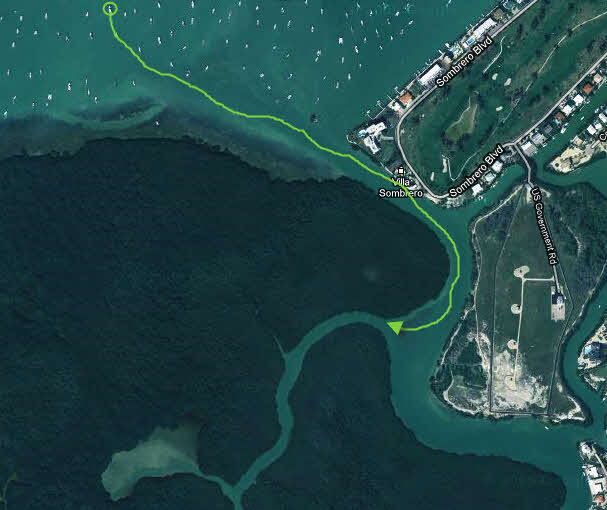
This is the path we'll take if we make a run for the mangroves.

We've seen a few other boats preparing.   Sails wrapped, biminis folded, dodgers removed.  The marina offers to store the dinghies inside their building and many people were taking them up on that.  From where I am I see several dinghies still in the water, trailing behind their vessels, and looking like they'll stay there.  That will be fun to watch.

What we’ve done so far:
•    Get out the storm anchor and spare anchor rode
•    Remove the secondary anchor from its roller to make room for the storm anchor
•    Rig a heavier bridle through the mooring pendant as backup
•    Re-roll the jib tighter on the furler
•    Lift the dinghy higher than normal, and secure it like we’re going offshore
•    Take the drain plug out of the dinghy so it doesn’t fill with rainwater
•    Clear the decks of fishing poles, scooters, buckets and other loose items
•    Get out various lines, shackles, and chafe gear for easy access
•    Get out big fenders and poles for pushing off other boats
•    Take some “before” pictures of the surrounding area

What we’ll do later:
•    Take down the wind scoops we use for ventilation
•    Wrap the spinnaker and spare jib halyards around the furled jib
•    Warm the engines up so they’re ready to go if we need them in a hurry

What I won’t or can’t do:
•    I wish I had a heavier spare anchor rode, but I left it in storage.  Bummer.
•    Take the sails off the boat.  I would for a hurricane.
 

Tropical Storm Bonnie

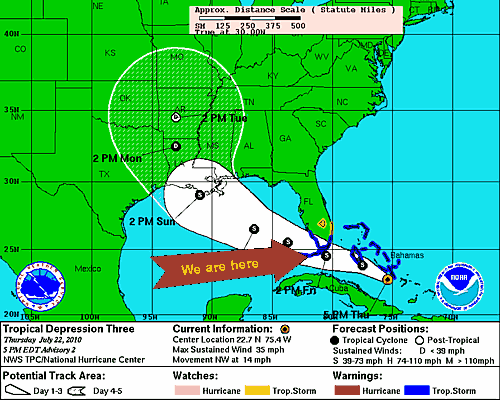
It looks like we’re about to get our first tropical storm.

I don’t have any concerns about our safety.  We’re in a well protected harbor and I’m pretty confident that the moorings are strong enough and well-maintained.  In fact, I’m a little bit excited.  Hurricane experience is hard-won and this will be a nice little introduction.  This will help us know what to expect and evaluate our exposure to future storms.

I do have a misgiving about the way we’re secured to the mooring.  The harbormaster and I have a little disagreement about the best way to moor my boat.  We’ve been doing it his way to keep things friendly and while the weather was mild, but his silly rules won’t be on my list of concerns when it starts to deteriorate tomorrow.

At this point it is just a tropical depression.  It was expected to become a tropical storm for the 5pm forecast, but the hurricane hunter didn’t find that it had strengthened enough.  It is still expected, though.  Slow development is fine with me since it reduces the chance that it could turn into a hurricane overnight.  The dockside prognosticators are predicting 50-60 knots, but I’m skeptical it will be that high.  We’ll have the instruments on to watch the wind speed.

What we have most to fear is other boats.  The boats on moorings have people aboard and are generally well looked after, but other boats are anchored, and many of these are neglected.  Either could break free, but think I we have more to fear from the anchored boats.  There aren’t very many boats around us, but most of the ones that are fall into this latter category.  I don’t think the wind speeds will be anywhere near strong enough that we’d have to worry about flying debris from the surrounding houses.

If we did have a problem in the harbor, there is a nice mangrove creek nearby that we should be able to get into without much trouble.  Tying into mangroves is a proven tactic for securing a boat for a storm.  They grow along twisting channels that don’t allow waves to build, and their root systems are very strong.

My secondary concern after the wind is about the water quality.  With all the rain that is sure to come, there will be a massive amount of runoff.  This tends to carry all kinds of trash that can clog our raw water strainers, and possibly chemicals that could damage our water maker, or otherwise compromise our ability to make water.  Most bacteria are larger than aqueous salt, so the water maker will remove them, but pesticides and other chemicals will pass through.

Folding Bike


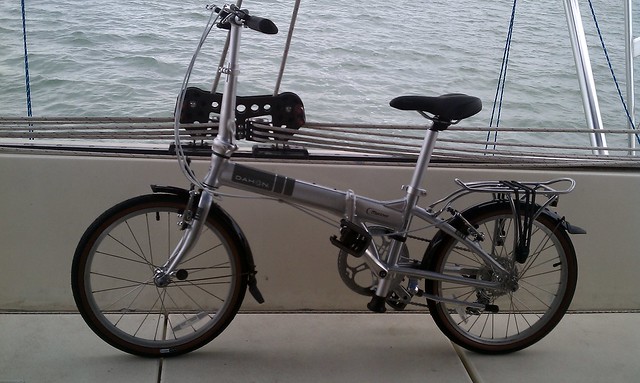
For the first post with the new way of embedding pictures, Iwill introduce our latest purchase: the Dahon folding bicycle.

Bike

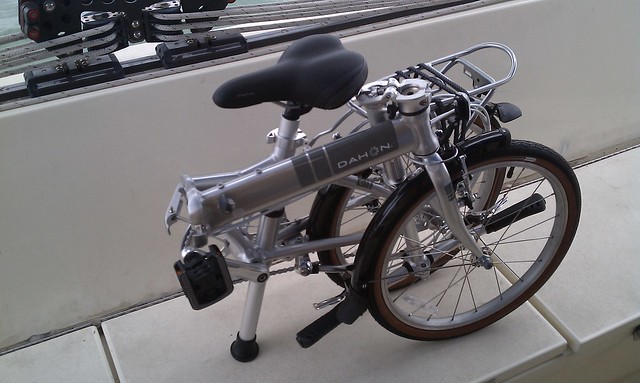
As the name would imply, the bike folds for easier storageand transportation to shore.

Bike, folded

We’re very excited about this bike.  Aside from folding, this also happens to be areally nice bike.  From reading theirmarketing, it appears that most of Dahon’s market is city folk who ride to workand carry their bikes onto subways and elevators.  Secondly are really, really committed bikeriders who need one they can take with them wherever they go.  People on boats appear to be an afterthoughtand though they make many different models, ours it the only one specificallymarketed for mariners.  Hence it iscalled the Dahon Mariner D7 (it has 7 speeds).

Our excitement is also because this bike significantlyenhances our range ashore.  This wassomething we never appreciated when we had two vehicles waiting at the end ofthe dock.  My trips to West Marine, HomeDepot, and ACE Hardware were almost daily when my transportation was atruck.  When it is my feet I seem to goless often and buy less.

The cargo carrying capacity currently consists of a milkcrate strapped to the back.  A foldingtrailer is a possibility if our needs prove greater.

The bike is ostensibly Tanya’s, since she is ourGalley Officer, and the one that has to make the 1-mile provisioning trek tothe store when we run low on beer.  Shemade a trial run to the local K-mart yesterday and I barely got the dinghy backto the boat before she was calling to be picked up at the dock.  The kids all have folding Razor scooters, so ona family trip I’ll be the only one without wheels.  We’ll have to wait and see if another bikemakes sense.  We haven’t even figured outwhere we’ll put this one yet.

Pictures

Getting pictures on the blog has always been a bit of a challenge, and therefore hasn’t happened with any regularity.  The editor tired of the situation and cracked down on the technical staff to make it better.  Hopefully the situation is now improved and following us here will be more visually interesting.

The main change is a move to Flickr for the image hosting.  I didn’t exactly make an extensive evaluation of the options, so there may be significant downsides to this, but for now it seems to be working.

You’ve probably noticed the photos in the sidebar.  This will always show our most recently uploaded photos.  Additionally, the same photos can now be easily embedded in the blog posts themselves to supplement the content.

Probably the biggest advantage to using Flickr is that we have phones and cameras that can upload pictures there directly.  So, in theory anyway, a picture could be in the sidebar gallery within seconds of being taken, with nobody having to sit down at a computer to do it.  All of the recent pictures over there now were taken from my phone and transferred wirelessly.  

The only currently known downside to Flickr is the image quality.  Regardless of the image we capture and transfer, Flickr reduces it to their standard size.  This is actually a partial benefit since part of the previous picture posting routine was to do this reduction manually.  However, we are now scaling them up slightly for display in the blog posts, so there is a bit of loss going on.  Ironically, if you click on the photo, it will actually display smaller when it reloads from the Flickr website in its native size.  We’ll have to see how this works out in practice.

There will probably be a burst of new pictures added soon as Tanya goes through her camera and uploads older photos.  Some of the previous posts that were intended to have pictures at the time, but required technical assistance, may now get them.

Leatherman

I’m hard on tools, so when somebody offers an aggressive warranty I’m there.  Actually taking advantage of the warranty is another matter, though.  Usually I’m too busy, or forget, or the tool gets lost after falling out of service, or maybe I feel guilty about the blatant abuse I gave the tool to break it. 

So I was very impressed with myself when I sent in three Leatherman tools for replacement last week (Yes, when one broke I bought two more).  I was even more impressed with Leatherman when three replacements arrived yesterday.  Say what you will about the quality of their tools (and I have), but they stand behind them.

Depth Perception

Apparently, I have a habit of dropping my glasses in the drink.  The main problem is that I like to hook them on the collar of my shirt.  But they aren’t secure there, and if I bend over they slip off and the next thing I hear is the splash.

Now this doesn't happen in crystal clear tropical beach kind of water, only in dirty murky water with who-knows-what on the bottom.  I’m no fan of murky water, and the last thing I want to do is get in it and search around down there.

So the first time I dropped my glasses, about two years ago, I said “Oh well” and bought a new pair.  A new pair was about $400.  Then when it happened again last year, I called a diver to have the bottom of the boat cleaned and mentioned, “Oh, by the way, could you look for a pair of glasses right about here”?  He found them with no problem and I got the bottom cleaned for about $80.  Good deal.

We place a big emphasis in this life of ours on taking care of ourselves.  I won’t always be able to whip out my credit card, or call on someone else to help. I have spare glasses, but I also try harder not to drop them in the first place, and take more responsibility when I do. 

So when I dropped them again a couple weeks ago I sighed and said, “Aaron, get my mask and fins”.

Sailing Around a Hurricane

Something interesting turned up during my research of Take Two.  Her original owner's name was David Brockman and I believe he commissioned her construction and had some degree of input on the design.  (David, if you're out there, please get in touch!)  I found an account that he wrote
here of sailing Take Two around Category 2 hurricane Marilyn in 1995.  They say a boat is safest at sea during a storm…

David writes:

Anchored in Charlotte Amalie on St. Thomas with hurricane "Marilyn" fast approaching (she traveled from Barbados to southeast of St. Croix in just 24 hours) the question of what to do in the little time available arose!

To cripple a perfectly safe seagoing vessel by tying her into the mangroves of a hurricane hole with a dozen lines and anchors, as we did for hurricane "Luis" just over a week before … and hoping the storm wouldn't come too close — just didn't appeal to us any longer. We have seen the damage that can result from just one vessel coming loose in a hurricane hole, not to mention the damage resulting from "Luis" in Antigua and St. Maarten.

Our catamaran "Take Two" can cruise at about 10 Knots (12 mph) and with a top speed of about 18 Knots (21 mph). She is faster than the average hurricane, so this time we decided to sail around the storm!

Armed with a short wave radio to receive the position of the storm at all times, we sailed south in front of her. "Marilyn" was heading northwest. On the northwest hemisphere the winds blow counter clockwise around the eye of a hurricane, so theoretically one can go for a "nice" downwind sail all the way around without getting too close to the dangerous center.

And it worked! On Sept. 15, at 11 am we were at the same latitude as Marilyn, just 78 miles west of her center. The seas were high (we didn't even try to estimate their height), but the wind speed didn't go over 30 Knots… a good sailing wind for "Take Two". Everything is down hill now… we've made it… we thought.

As the wind came around we changed course as well. The seas were confused by the change in the wind direction and the winds became stronger and stronger. With 55 Knots of wind and sailing 15 Knots under a heavily reefed Genoa we waited for the next update from the Hurricane Center in Miami.

This gave us the clue: "Marilyn" had slowed down significantly while she whipped St. Croix and St. Thomas, and we were actually catching up with her! This was the first time we had ever wanted Take Two to slow down. More reefing didn't help at all and in torrential rain.

Fatigued from being in the storm for 30 hours, we remembered the old tales of sailors — who used to "heave to" in a hurricane. We decided to try this maneuver and experienced sudden quietness, as if somebody had turned off the storm. We were drifting sideways at about 2 Knots riding softly over the long high waves and old swells. After having slept for about 5 hours, the wind speed had fallen to a comfortable 25 Knots, the sun rose, the seas were still high, but the breaking crests were no more.

Having circumnavigated "Marilyn" we sailed home, expecting the worst, but were glad to discover that the crew charted fleet had survived Marilyn without any major damage and all of our friends were safe and sound aboard their yachts.