Category Archives: Recipes

Thankful List

I have much to be thankful for, large and small. Mentally, I make lists like this pretty often. If I feel grumpy, or have some real complaint, I find something to be thankful for and it usually fixes my wagon.  Although cliché, it is an appropriate time of year to actually write down the thankful list.

Item #1: I write afloat in Charlotte Harbor for our First Annual Turkey Day Cruise.  This is a popular spot this time of year. Some folks come every year—Jay’s parents, for example. They’re in transit to meet us, assuming their engine woes have been resolved, in time for Thanksgiving. I have a turkey and all the trimmings, the kids made holiday decorations, and all that is missing is family. On the one hand, it is strange to be here and not be going to my family’s or be at home preparing for visitors. On the other hand, this is the first Thanksgiving we will be able to spend with Jay’s dad, since they’re always on a cruise during the fourth Thursday of November. The fact that we are here in peaceful Pelican Bay off of Cayo Costa State Park is near-miraculous for at least a couple of reasons.  I mean, we sailed here, in a gorgeous breeze, in our boat. And we didn’t run aground or break anything major. There are sunrises and sunsets to write home about
every day. It still seems like a dream. (That was dumb. It is a dream. Our dream. And we’re in the middle of it. Don’t wake me.)

Item #2: We have water. That may not seem like much. And it doesn’t exactly come gushing out of the tap, and showers are buckets of warmish water you pour over your head by the cupful. But for a few hours, it looked like we wouldn’t have any. And nothing can rain on a parade more than not having water. Or, rather, having nothing but salty. (Water, water, every where, nor any drop to drink…) Jay, in his infinite cleverness, figured out what was wrong with the water maker and got it going again.  Have I mentioned that there is no one with whom I would rather sail around the world? He is definitely on the thankful list.

Item #3: Jay bought me a Dyna-Jet wringer just in time for our trip. Most women would be insulted, but I was thrilled. It made the laundry so much easier this week.  Washing has to be done at least twice this trip, and takes about six hours, not counting drying time (which depends on wind and sun). I just love that thing.

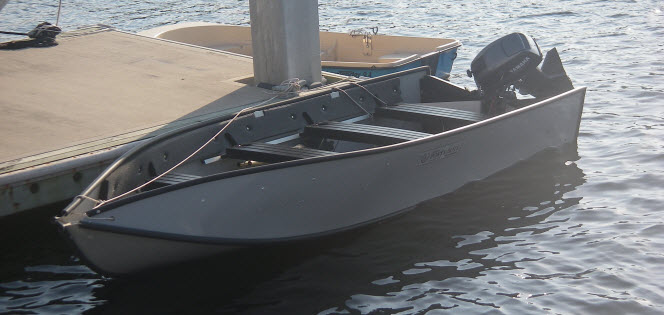
Item #4: The Dead Guys. This may seem a bit irreverent, but I really am thankful. Every time we take the kids on a fishing expedition or go exploring on the islands around here, we owe it to the unfulfilled dreams of two guys. The Porta-Bote, or Stretch Limo as I jokingly call it (after a small mishap a few weeks ago put it to the test), was to be strapped to the RV of one of the guys, and he and his wife were going to travel across this great land of ours and unfold the boat periodically to fish or explore waterways. His widow listed the 14’ boat on Craig’s list and it was still in the box when we went to pick it up. The 8hp motor Jay got for it has a similar story. It’s several years old, but was hardly used. Although I feel a bit sad about their unfulfilled dreams, there is no better way to honor The Dead Guys than to enjoy the heck out of the things they left behind and recognize them for their contribution to our dream. On a side note, The Dead Guys also remind us to be thankful that we are able to do this now, since tomorrow is not guaranteed.

Item #5: The chance to live like a pioneer.  We look around us, and even the folks anchored near us aren’t really like us. I know there are other people out there with little kids who live on boats, make their own bread and do laundry by hand, but so far we only know one other family, and they moved back to land a couple years ago. The kids’ chores at home are a bit disconnected from reality, but here they are learning that there is a direct link between doing their chores and contributing to the family’s well-being. If you don’t help grind the grain, there won’t be any bread, and if you don’t help with laundry, where are clean clothes going to come from? This is one of our goals in becoming more self-sufficient—that our children would learn true responsibility, and have a sense of satisfaction as they see how their contribution is real and valued.

While we still have many luxuries aboard TakeTwo, I am beginning to appreciate what pioneer women went through in America’s early days. I am also appreciating, though not yet missing, the comforts of home.  How very seldom I was thankful for the little things that make life easier and more pleasant, and how quick to complain if I didn’t get what I wanted at the moment I wanted it.  I’m a more grateful person because of this strange and good floating life. Happy Thanksgiving.

Laundry Haiku

Out of the corner of my eye
A child running—
Ah! Just pajama pants on the line.


The port side of our boat looks like it is strung with Tibetan prayer flags—towels praying for fair winds and a sunny afternoon. After her house burned down and she had to carry the laundry for a family of seven to and from a laundromat, my friend Tina told us all to be thankful for our washers and dryers.  If I may boast for a moment, I did a large load of whites today by hand, so I guess we should now be thankful for laundromats. Believe it or not, it was fun. At least the first hour, after which my back began complain about the unfamiliar strain. To further stretch credibility, I actually enjoy everything more when I choose to do it by hand. The examples are too many to name, but my favorite household tasks are, in order of pleasure derived:  kneading bread, home-schooling the kids, and doing the dishes.

My classmate Alexander Lee began a movement during our years at Middlebury which turned into the non-profit Project Laundry List (laundrylist.org). At the time, I thought the whole thing a bit fruity. (It started with some pants hanging in a tree by the dining hall.) He said we could reduce the electrical demand on the grid so much by hanging our laundry instead of using our dryers that we could render nuclear power unnecessary. It sounded good, but who wants to hang their wash in a dorm room? And later on, it just seemed impractical: I mean, really, am I going to hang six-to-eight loads of laundry in my backyard—especially when it rains every afternoon in South Florida for six months? Never-mind about those pioneer women with ten children. Now the cloth diapers I hung. And yes, it did give me a Zen-ish peace to hang wet diapers in the cool morning air. It gave me an opportunity to actually breathe and relax and be “in the moment.” But the wash for six people? Project Laundry List exists not only as an environmental movement, but also as an advocacy group to ensure that people are allowed to hang their laundry if they wish. It’s a free country (or was), but these days you can face hefty fines for hanging laundry in the wrong place!  

My, how things change: faced with the choice of going back home to do laundry or staying one more day at a pleasant anchorage, I opted to break out the Wonder Wash (hand-crank agitator) and buy some more time at sea. Our time-limiting factors are: fresh water (we hold +/-200 gallons), food (the boat is only provisioned for long weekends), and clothing. We carry enough fuel (for engines and power generation) to last at least six months, so that doesn’t factor in. After about three days, the fresh food gets used up, the water runs low, and the clothes are all dirty. But we were having a nice time, and Jay didn’t have any pressing work at home, so why not stay another day? That simply requires creative menu planning, breaking out the watermaker/desalinator (Yay! It works!) and, you got it, washing laundry by hand. Strangely enough, it is not only rewarding, but also comforting to see the small shirts and shorts and undies hanging on the lifelines. It makes me thankful for the one large and four little people in my care. We don’t have any neighbors, so there’s no one complaining. I have decided that while it would be nice to have a compact electric washer on the boat long-term, for now I can easily use the Wonder Wash to agitate the soapy clothes, a five-gallon bucket for rinsing, and a roller for wringing (that’s now on my birthday list), and the lovely fall-and-winter breezes for drying. It’s a fun family activity that affords some much needed one-on-one time for me and one of the children. Eli used the Wonder Wash for awhile, Aaron rinsed and squeezed, Sarah hung, and even the youngest got into the act and helped with clothespins.

In our old neighborhood, I once saw a Mexican woman washing laundry the old-country way: using a bucket and a rock in the front yard. That struck me as out-of-place in suburban Atlanta, something that said “property values are about to plummet.” I never considered that she knew no other way to do laundry. It may arguably be a better way. Hey, maybe she even liked it.

Dinghy Dilemmas

I've spent an inordinate amount of time recently thinking about my dinghy situation.  A dinghy is a smaller boat that can be used for going ashore or other short trips where the mother ship is not practical.  If the boat is the house, then the dinghy is the family car.

The dinghy is important to us for a few reasons.  Firstly, our anticipated usage of Take Two does not include marinas.  So the situations when cruising where we would need to use the dinghy to get ashore are expected to vastly outweigh the times when we can simply step down to a dock.  Secondly, we have small explorers very interested in getting off the boat.  A thousand other practical uses come to mind.

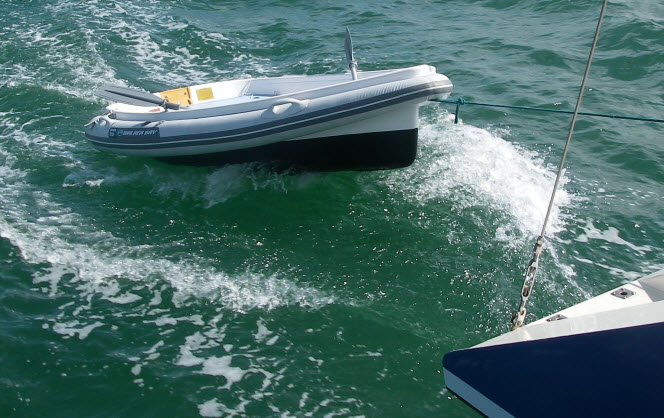
The boat came with a Walker Bay 10 RID with a sailing kit and a 4hp Yamaha 2-stroke.  A nice little boat, but it doesn't satisfy all our needs.  For one, it can't realistically carry the whole family at the same time.  On the plus side, it does have bottom paint and we don't currently have davits so it can be in the water and available for immediate use.  If we want to go somewhere and take it along, then we just tow it behind.

I was thinking we needed something bigger and faster, but storagebecomes an issue.  We wouldn't want to tow a dinghy long distance.  Wewill eventually get davits, but even so, we "only" have 14 feet betweenthe transoms to haul it out which would limit us to about a 12-footplus motor.  I wasn't feeling that 12 feet would be enough, especiallyfor an inflatable where so much interior volume is taken up by thetubes.

I've been intrigued by the Porta-Bote since seeing one at a boat showseveral years ago.  They're indestructible, have lots of room, and foldup to 4" flat.  When I saw a 14-footer on Craigslist I jumped on it. They look a little goofy, but it is growing on me.  One of my dockmatessaid it looked like a stealth bomber.  Take Two is very angular andaggressive-looking (to me) and I think the Porta-Bote is a goodaesthetic fit.  And it gets me the same type of "Holy crap, you'recrazy!" looks as Take Two does (which I've come to enjoy). 

It doesn't have bottom paint, so it can't be kept in the waterlong-term.  Our marina is pretty bad for growth and it started to getbarnacles after only two weeks.  The current storage solution is tokeep it folded and lashed to the port side lifelines.  The unfoldingprocess is a little arduous (I understand that they loosen up overtime), but we have plenty of foredeck space for doing that.  I'mthinking I can launch and retrieve over the port bow with a smallroller and the clever use of a halyard.  It only weighs 100 pounds soit is pretty easy to move around.

It did not come with a motor, and figuring out what to get is mycurrent dilemma.  It is rated to carry a 83 pound or 9.8hp motor.  Iborrowed Jonathan's 15hp Yamaha 2-stroke (79 pounds).  I determinedthat 15hp was overkill since I couldn't open it all the way before theboat got squirrelly, but having extra power isn't a bad thing,especially since I could see pulling kids on water toys.  I didn'treally care for the weight though, and the mounting bracket was alittle too wide to fit between the transom supports.

My little 4hp is in the shop since it hasn't run in several years.  I'msure it will push the Porta-Bote, but I'm not sure how well.  Is 4hp enough to get it up on a plane?  Probably not.  I don't have any plansto get rid of the Walker Bay or the 4hp, so I think it will make a nice backup motor.  Between the two I should be able to keep one running. How about 8-10hp?  Super Dave has a Yamaha 8 and I'll ask him to borrow it this weekend.

Power is only one part of the equation.   Weight and serviceability are my next biggest concerns.  Weight is bad in general since Take Two is very sensitive to it, but a 20 pound heavier motor isn't likely to make much of a difference to 12-ton catamaran.  But that 20 pounds could make a big difference to the dinghy and to me as I put it on and take it off.  A 8hp 2-stroke is generally about 60 pounds while a 10 is 80. 10s and 15 is usually use the same block and weigh the same, so why would I take a 10 over a 15?  I'm only aware of one manufacturer that made a 60 pound 10 horse (Nissan) and they don't anymore.  So unless I can find a 60 pound 10 horse, the decision is effectively between an 8 anda 15.  I'd like to stay with Yamaha since that is what I already have and would like to reuse spares if possible.

The motor(s) will probably live (eventually) on a bracket on the back of the cockpit and I'll probably rig a block and tackle from the boom to raise and lower it to the dinghy.  The weight wouldn't be a big deal if I did it that way.   But anything related to the back of the boat will get tied up in the hardtop decisions, so that isn't likely to happen soon.  In the meantime, the motor will probably lay on the sidedeck and and get carried down the transom steps to the dinghy.

You'll notice that I'm only considering 2-strokes.   In fact, they're being phased out for the more environmentally-friendly 4-stroke.  Iwon't go into the technical differences, but for my purposes the differences are: 4-strokes are quieter, use less fuel, and have cleaner emissions; they have oil in the crankcase instead of mixing it into the fuel which is simpler, but means they must remain upright or the oil will spill; and they are heavier.  But what is most important to me isthat 4-strokes are more complicated to service.  A perfect analogy is how cars went from carburetors to electronic fuel injection and now nobody can work on their own cars anymore.  I want to be able to fixthe motor myself and if I can't, find a mechanic who can.  I think I'll have much better chances of that happening in Pogo-Pingi, South Pacific with a 2-stroke.

Eye Candy

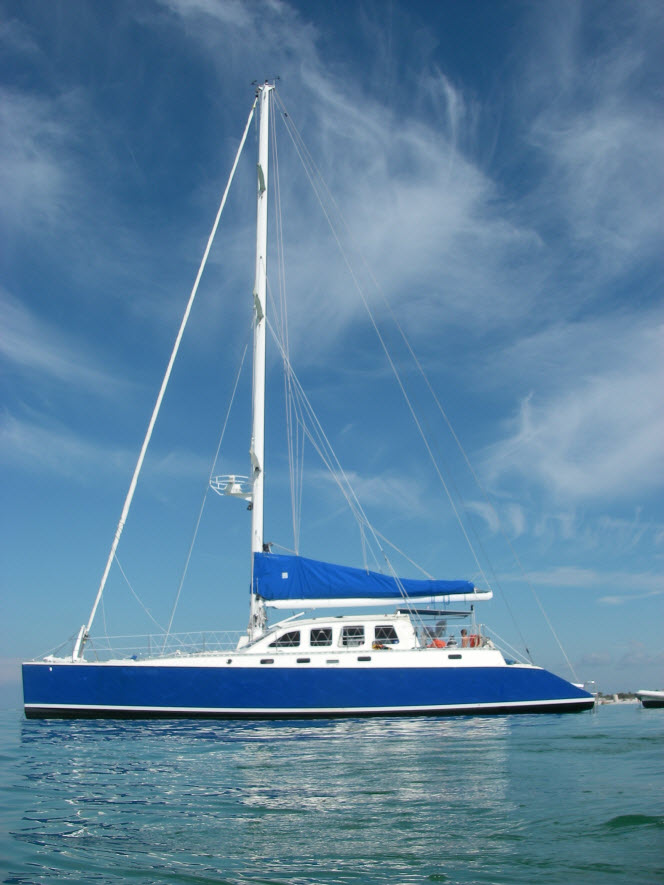
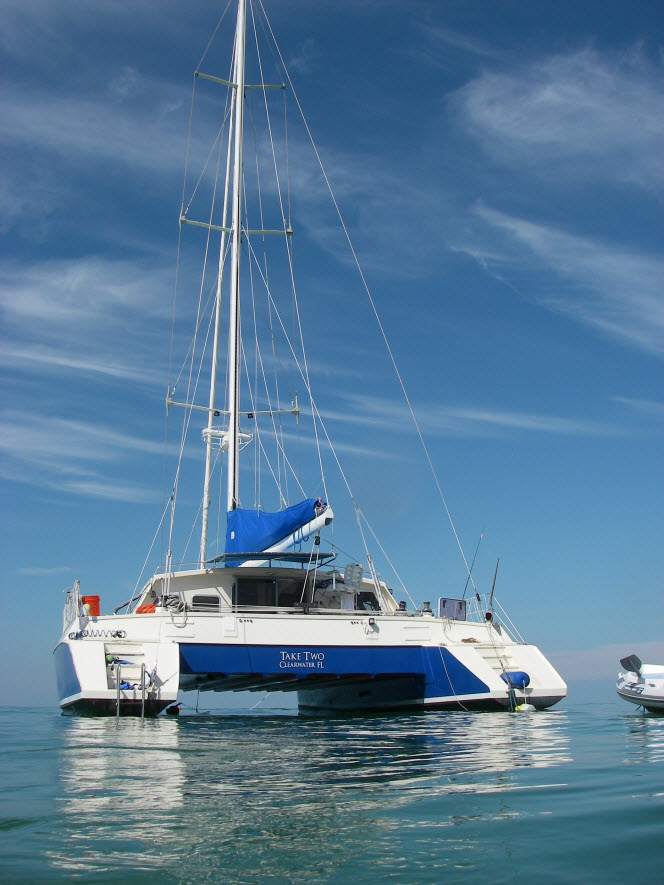
Some nice pictures of the boat from our trip to Egmont Key a few weeks ago.  Kudos to Tanya for the swimming photography.


Landsick

I discovered at the end of last weekend that I get landsick.  That’s correct: landsick. Jay, on the other hand gets seasick. So far, he’s done fine, but I feel absolutely nauseous. It’s at its worst on Sunday nights when we get back from the boat, and doing the dishes exacerbates my condition. Normally, when I do dishes, I look out at the water and sky and sometimes see small people bouncing around on the foredeck or fishing, periodically peeping in at me. The horizon stays still, but everything else is moving. When I get home, I just can’t get my bearings. I plunge my hands into the water, look out of the window at our back yard and nothing will stop moving, including the horizon.  I actually had to go lie down last Sunday afternoon. Jay and I had a good laugh about it.

I guess I’m landsick in other ways too. As much as I appreciate my warm, high-pressure shower (now more than ever), and having space to move and breathe and spread out, I would rather be sailing. I am never more at ease than when the sail goes up, or we drop the hook to spend the night somewhere, or wake up in the middle of the night and see the stars overhead through an open hatch and feel the boat rocking me back to sleep. Last December, when we went to look at Take Two, I got a few minutes kid-free to go peeking into nooks and crannies by myself. I was the only one of our search party to actually lie in one of the bunks. After about five minutes of lying there considering the future possibilities, I said to myself, “A person could get tired of their house moving all the time.” Never did I consider that a person could get tired of their house feeling like it was moving, and prefer the actually moving house.

Does this mean I am ready to go overboard and abandon land? I don’t know. Can one be ready for that sort of thing? All I know is that I love being on the water, near the water, and in the water. I love sea birds, stars, small, deserted islands, being with my family, and sitting with Jay on the foredeck in the moonlight. When I’m at home, I think constantly of being back on the boat, and when I’m on the boat I finally feel at home.

Our First Trip to Egmont Key

One morning we left our house in Clearwater and drove to Bradenton. We went to our marina and had a bagel breakfast on our boat. After breakfast, we sailed to Egmont Key. Egmont Key lies at the entrance of Tampa Bay just a little way from Fort De Soto.

We had just a little time after we anchored and before dinner to fish. I cast my line with a shrimp on the hook and I put a bell instead of a bobber on, so I would hear the bell ring if I caught a fish. My brother did too. So we sat down at dinner. My dad blessed the food and we all ate.

After dinner we could see that the stars were amazing. We went on the foredeck and lay down so we could look up. We saw three satellites and I saw one shooting star. My mom saw three and my dad saw four. We were so far from the city lights that we could even see the Milky Way, our own galaxy.

At about nine o’ clock, after a long look at the stars, it was time to go to bed. Just as we were getting up, a loud bell went off and it was my pole. Because I was fishing with no bobber, Dad was sure that I had caught a catfish. At first I said, “I have nothing!” But then, I felt the strong tug at my pole. I said, “I need help.” Dad said, “Nope—you reel it in!” Finally, the fish came up and because it was so dark, no one could see anything. Dad turned on the spotlight and there, beside the transom, was a beautiful-looking, foot-long, young shark. I hauled him in and Dad had to de-hook him. Yes, indeed, you’ve got it—he did have a mouthful of teeth! Everyone got to pet him and then we all watched him swim back to his home in the sea.

The next day, we had an expedition on Egmont Key to see what it was like. We all got in the dinghy and rowed to the beach. We took a long walk and found some neat shells. The most fun part of it all was getting to see the fort from the Spanish American War. It was built in 1900. All that was left was a two-story building with a maze of dark rooms, hallways, and stairs. We also saw towers, foundations for other buildings and original brick roads. On the way back, there on the road was a gopher tortoise!

We went back to our boat and went swimming in the Gulf of Mexico. The water was shallow, and we put on our masks, fins, and snorkels and then went snorkeling. I saw a crab scuttle across the bottom and then push itself under the sand. Dad scrubbed the bottom of the boat. Mom set a second anchor. Aaron and Sarah swam for awhile and then got out. Sam sat on the swim ladder and splashed.

That afternoon, we left Egmont and sailed back to the marina. We stayed the night at the dock, had breakfast the next morning, and left. It was the best sailing trip that I have ever been on.

Perfect Timing

The old adage holds true: Timing is everything. I believe that even the right dream, or right person, or right place can be wrong if they come to you at the wrong time. 

I read in my devotions this morning about Moses, who sensed early in his life God calling him to right the wrongs done against his people. So he acted rashly on righteous impulses and killed an Egyptian who was beating a Hebrew slave. He then fled and spent forty years herding sheep in the desert. Was the calling wrong? Clearly not, as he eventually led a couple million people out of slavery. When the call came the second time, he had been humbled, and only when he felt unworthy was he truly ready.

It is true for us, too, I see now. Ten years ago, I got a glimpse of what a sailing life might entail and my heart was set aglow.  Two years ago, Katie Rose, the boat we almost bought, sailed away, and with it, my dreams of living aboard. I was sure we had let our destiny float off without us. We obviously weren’t ready. When Jay came home last December and said, “I found the boat,” he caught me off-guard. When we decided to do it, I was petrified. But the timing was right.

We’ve been dockside for four months. We were fixing, learning, acclimating. And only now has the time come to begin doing the thing of which we’ve been dreaming. It’s our time for firsts: first sail out of the Manatee River, first reefing in strong wind, first time dropping the anchor, first night “on the hook”, first leaps off the bow and swims through “the tunnel,” first expedition to an island, first edible fish caught. It’s just like I thought it was going to be. The kids are loving it, and Jay and I are still sitting on a moonlit deck after they go to bed incredulous that we actually did it. I admit to feeling impatient sometimes, but I now see the wisdom in waiting, in going slowly and taking it one step at a time.  

In a larger sense, the timing is right, too: many of the people who live their dreams of cruising do so after raising a family, after successful careers, after most of their time and energy have been poured into a land-life. The people who sailed away on Katie Rose were old and pudgy. Although that sounds critical, I myself will be old and pudgy before too long and that is exactly my point. In some ways it’s harder to do this now, to take a risk when we have small children, when our income goes mostly toward house payments and grocery bills. But in many ways it is easier: presumably we have a lot of time and energy left, the children will benefit from a simpler, more adventurous life, and we are young enough that we still feel almost invincible but not so young that we don’t recognize and try to avoid danger. And with times being uncertain, learning to live more self-sufficiently doesn’t sound so bad, either.

I think I understand just a bit of what Moses felt when he heard the call.  When I first stepped aboard Katie Rose, I heard a quiet voice saying, “this is your future home.” It was almost audible—my heart was pounding and I felt a little clammy. But my immediate response was, “No way!”  Since we didn’t end up living aboard that particular boat, did I miss or misunderstand the call?  I think not; I just wasn’t ready.  Am I now?  Are we humbled enough by the daunting task ahead of us to be truly ready? All we have are a dream, a boat, a willingness to work, and a belief that Someone bigger than us has a bigger plan.

I close with the second stanza of a favorite poem, Sea Fever by John Masefield:

I must go down to the seas again, for the call of the running tide
Is a wild call and a clear call that may not be denied;
And all I ask is a windy day with the white clouds flying,
And the flung spray and the blown spume, and the sea-gulls crying.


Good Enough

I wrestle again with an old monster. I could euphemistically call it ambition, or even perfectionism, but more honestly I must name it Fear of Failure. Jay came to console me ringside during a long and troubled night when sometimes I was winning and sometimes the monster, and said something to the effect of “You’re failing at things no one else is even trying.”  Hmm.  Anyone else to whom I confess these fears often says the same thing my mother said when I came home from school crying because I got a 90% instead of 100% on a test: “Cut yourself some slack!”

I know exactly what brought the monster on. I probably invited it in and held the door for it. I’m feeling a bit overwhelmed trying to now take care of two homes when I was struggling before to take care of one. We are spending about half of our time and energy on the boat. We live there Friday through Sunday, and spend part of Monday unpacking and catching up. So I have three full days to plan and shop for the week’s meals, make phone calls or run errands, school the children, clean the house, do 6-8 loads of laundry, bake the bread, catch up on any missed sleep from tiring weekends…need I go on?  It’s exhausting just to make the list. 

So some things have to slide. Even though I know this, I allowed the scenery to accuse me. A pile of half-finished homeschool projects on the dining room table whispered, “Failure!”  The message light on the phone blinks, “Failure!” The To-Do List called out “Failure!” from the magnet on the refrigerator. Someone groaned when I told them what was for dinner and I heard, “Failure!” (Failure to cook pleasing meals and to raise children who don’t complain!)  Am I a failure at all the things I love and desire to be: a wife, a mother, a sister, a friend, a writer, a teacher?

A metaphor presented itself at midnight, as I tried to wind down for bed. I went to take a shower, realized the bathroom was disgusting and grabbed my spray-bottle and scrubbing pad. But it doesn’t matter how hard I work on that shower, it never looks clean when I’m done—it needs a tile guy, not a housewife. So even the mildew from the corners murmurs, “Failure!”  Once I realized that I was listening to inanimate objects accuse me, it should have been cause for laughter and set me free. Or at least sent me off to bed to sleep it off. But that burning question remained, “When is it good enough?”  Or maybe, really, “When will I be good enough?”

This fear of failure does not keep me from trying new things; it just keeps me from enjoying them. I am the oldest in my family, and some psychologists think that has something to do with it. For my also-first-born husband, it keeps him from trying things at which he doesn’t think he’ll be successful. In our first-born child, it manifests itself as intense frustration. Whatever our birth-order, most of us at one time or another set these unreasonable expectations, and respond to them as our personalities dictate.

The problem with these expectations is, of course, that it sets us up for disappointment. We are always looking at something and feeling like it’s just not good enough.  And maybe it’s not.  Where did this ambition come from? It’s like that homesickness of which I have written before. If we all feel like things should be perfect, that something is amiss, isn’t it possible that perfection exists and we were made to live in that state? I’m certainly not there now!

It turns out that I’m just like the mildewed shower: I don’t need a good scrubbing, I need a savior. The whole point of Christianity, as I understand it, isn’t just that Jesus came to take the punishment humanity deserved, but that He lived the perfect life we all want to live, the one required by a perfectly good God. He lived it for us. So I can say, “I am not good enough,” and because I identify myself with His Son, God can say, “That’s okay. I accept you anyway.” And the hope for someday is that He’s going to set it all right again. All the first-borns will breathe a sigh of relief.

In the meantime, we must wrestle.  I have to remind myself that, for now, it is good enough. I can’t scrub the shower all night. At some point, I have to go to bed and put a clean bathroom into perspective after a good night’s sleep. For our transition to living on the boat, this is the year when things slide, whether I like it or not.  A good friend reminded me that we are living our dream, which is already more than most people achieve. I knew it would cost something, and the frustration I am feeling just happens to be one of those costs.

Joy and Longing

“If I find in myself a desire which no experience in this world can satisfy, the most probable explanation is that I was made for another world. If none of my earthly pleasures satisfy it, that does not prove that the universe is a fraud. Probably earthly pleasures were never meant to satisfy it, but only to arouse it, to suggest the real thing.”     –Clive Staples Lewis*


I have felt it on a cold, starry night on a lonely mountaintop in Vermont. I have felt it in a ferny, mossy valley where the light comes through the trees in shades of green. I have felt it walking through a hayfield at sunset. But most often I have felt it on or near the water. It is a feeling of indescribable freedom, something so beautiful that it hurts, something that makes me feel very small, but very alive.  I am sure that you have felt it too. C.S. Lewis would call it joy, and define it as “a single, unendurable sense of desire and loss.” **

I felt it on Friday, as we raised the main for the first time and sailed out of the Manatee River toward the Bay and the world beyond. It was a short, but glorious afternoon in a beautiful breeze. The moment when the engine shut off and the boat mysteriously continued to glide forward through the water and all I could hear was the wind, the water, and the call of sea birds was nothing short of magical. It is why I want to do this for the rest of my life.

About ten years ago, Jay and I spent a week sailing with his folks on his Dad’s catamaran. It was a great trip, down to the Dry Tortugas and over to Key West and back to Naples. It was the first time I’d spent that kind of time on a boat. It was neat just to play at living aboard, but the last day of the trip was the most memorable. As is often the case, it started as a mistake, turned into a malfunction, and ended as serendipity. I clumsily bumped into an external fuel tank fitting which broke and caused the engine to quit, and then when it started up again, it wouldn’t go forward (pre-existing transmission troubles exacerbated by my oops), and we were forced to sail home all night long. I sat up in the quiet cockpit, staring in amazement at more stars than I had ever seen and the glowing green trail of phosphorescent creatures stirred up by our hulls passing noiselessly through the water. It was pure joy; I was hooked. I wanted it to last forever.

Lewis says, “all joy reminds. It is never a possession, always a desire for something longer ago or further away or still about to be.” ** And so we pine. Even in the most perfect moment, it is felt as a pang. It is where longing and having are one. As deeply satisfying as it was to sail our boat for the first time, a thing for which we have longed for many years, present in the joy was that sense that there is more and greater out there, that this is just a tiny taste. Perhaps we will always feel that way. Perhaps that is the way it is supposed to be—a kind of homesickness for a home we have not yet known.


* From Mere Christianity, McMillan, 1943
** From Surprised by Joy, Harcourt, 1955

Limited Resources

I think everyone should spend a week or two on a boat. We should all be better stewards of limited resources and learn to live a little more simply, and I can’t think of a better way to force yourself to do this than living in the self-contained, self-sufficient environment of a boat. All the services you are used to in a house in a typical American neighborhood exist as a system on a boat, but instead of things like water or sewage magically appearing and disappearing, you are now (sometimes painfully) aware of where they come from and go to and how much of them there is or isn’t.  It sure has made me more appreciative of my land life! Here are a few things that come to mind…

Electricity: Unless you’re plugged in at a dock, you either have to make it (generator fueled by dead dinosaurs) or catch it (solar panels, wind generator). Those appliances at home with lights and indicators that stay on all the time are a no-no on a boat, where every amp and volt count. I don’t really understand our electrical system, but I do know that I want warm food, and if we have to budget energy to get warm food, I’m willing to learn to be less wasteful. A small example from our boat: the electric stove has a ceramic cook-top that holds heat for a long time, so after I cook something, I fill the teakettle with water and set it on the warm burner. This covers a potentially hazardous hot spot and uses heat that would otherwise be wasted because I will now have warm water for doing the dishes.

Water: Speaking of water…our humongous boat holds 200 gallons of fresh water in its tanks, but there are six people using it. When cruising long-term, we will have a rain-water catching system to supplement water taken on at port or made with the water-maker (which uses precious electricity). Warm showers are now a luxury, as they require the use of a generator. However, a solar shower (basically a black bag of water that the sun heats up) should help some, especially in the tropics. Here’s how to shower with minimal water usage: undress; turn on water long enough to wet yourself down; turn off water; soap up; rinse off; repeat for hair. Also, how clean do you need to be? Hair really only needs washing twice a week, and sponge baths do when a full shower is too cold or difficult. To conserve further, laundry and dishes can be washed in salt water and rinsed with fresh. We just don’t realize how much water we use in a house, but on a boat, using too much could cost you precious drinking water. Incidentally, we have a good gravity-fed, countertop purifier so we don’t have to rely on bottled water for good-tasting drinking water.

Sewage: At home, you flush the toilet and all unmentionables are magically whisked away, never to be seen again. The routine on a boat is a bit different. Depending on the kind of toilet you have, usually you have to pump the potty full of sea water, then pump the poo out of the potty.  When offshore, most cruisers pump the poo overboard to rejoin the “circle of life.” But near the shore, at anchor or at a marina, the poo goes into a holding tank. If you’re in a civilized place, they will have a pump-out station, where a long suction hose sucks the poo out of the tank and it rejoins the water cycle in the city sewage treatment plant. This, by the way, is less pleasant than changing a diaper—it’s like changing your whole family’s diaper once a week.  In this area, one cannot conserve unless one chooses not to eat and therefore not to create poo. But one does become appreciative of living in a place where sewage is piped out of one’s house and processed odorlessly somewhere else. Think of this the next time you flush and just be happy.

Food: Our family has an elaborate plan for storing food for long voyages and times of shortage. It includes vacuum-packing whole grains for grinding in small batches for bread and breakfast cereal, storing canned goods and dried foods, freezing what we can, and catching fish. It means we eat simply and we teach our children not to complain but to just be thankful for what we have. Pickiness is simply not an option. Waste is to be avoided at all costs. We have manual backups for all electrical equipment, so if the generator fails and we can’t use the stove/oven, we have two portable grills—a propane and a charcoal (the “Cobb”). I guess if all else fails, there’s always sushi…

Trash: I always feel guilty after hauling my large black can to the street at home, but now I feel tired after hauling a large black bag all the way to the end of the dock to the can there. I’m not so worried about the recycling part (which is not as practical as it is marketed), but we really can do more about the reduce and re-use part. I use things in bulk which does reduce packaging, but we still fill a big bag each weekend. What to do at sea? Biodegradables are often tossed overboard, but plastic? Never!  So, no plastic bottles or baggies. I use and reuse glass mason jars for pretty much everything. And cotton towels replace paper. The baby wears cloth diapers. I carry canvas bags to shop. I feel like we’re doing our part, but we still create trash. And as a culture, it’s a little shocking to think of the volume…Without the big truck carting it to an unseen location, I’m definitely more aware of waste.

Stuff: I mentioned that I like to have a manual backup for all things electric. And this stuff has to last—we are in a stage of life now where we would rather spend more for something sturdy that will last than to pay less for something that will have to be replaced ten times in the same time period. The market in our country is based on the principles of perceived and planned obsolescence, something we fight strongly against. I’ll wear a pair of shoes to death, even if they went out of style five years ago. (My clothes are still stuck in the eighties, but they’re coming around again.) And we try to avoid things “Made in China” because they are destined too soon for the landfill. At a marine flea market last Saturday, I saw a refurbished Singer sewing machine made sixty years ago and converted to hand crank. It sewed through six layers of canvas like it was butter. I don’t have an immediate need for this thing, so I didn’t buy it (yet), but it epitomizes this principle I’m talking about. A boat is a very compact, efficient place. Because you can carry so little, everything has to have verifiable usefulness. I am both dreading and looking forward to the purging necessary to move our family of six out of a 2000-square-foot house onto a 48-foot boat. But I’m learning how much stuff I can do without and how much easier it is to care for a smaller house with less stuff.

Money: Never mind. We are all aware that this is limited. Whenever something breaks and we have to pay to buy parts to fix it, Jay says, what's the money for anyway? We were afraid if we saved it all for later, later would never come, or we would be too old to enjoy it. So we've decided use it now, give some away when the opportunity presents itself, and try to save a little for later. In any case, we refuse to worry about it.

Time: This, of course, cannot be purchased, and even if you save it, it doesn’t spend very well later.  We all try to cram too much activity into small chunks of it because the days, and our lives, for that matter, are just too short. But we are rethinking this way of life. Everything slows down when we get down to the boat. I stop looking at my watch. We wake up with the sun, eat when we get hungry, sleep when we get tired, and are generally more in tune with natural rhythms. This is the first year in my life when I am not signed up for anything, no commitments besides teaching my children and learning to live on a boat. It’s so freeing to say “No” to everything, even if for just a season. Part of the reason we are doing this is because life is short. But instead of trying to cram more in, we are actually trying to cram less in and enjoy that less more. I recognize this is not going to be an extended vacation—the work is very real—but present are the aspects of vacations that we love: no need to be anywhere at a specified time, and extra time to savor the people we love, the natural beauty around us, and worthwhile things for which we usually don’t make enough time (like books, music, laughter, games, art, etc.) Of all the limited resources of which I have become more aware, time is the greatest. I contemplate my priorities, worry less about staying on a set schedule, and enjoy life more. If the horizon is clear, the children sit with me on the coach roof at sunset looking for the green flash at the moment the sun sinks. It doesn’t matter if it’s eight o’clock or nine. If I were to put them to bed “on time” we would miss it. Every day is a gift, not to be wasted worrying or stewing. Weigh anchor and sail away for a week or two and you’ll see what I mean.