Category Archives: Recipes

The Man with the Plan

Eighteen years ago, a boat builder in the Netherlands began work on a custom-designed wooden vessel. Every detail had been thoroughly planned and considered and she would be both fast and comfortable, with plenty of storage space, yet attractive, with sleek lines, uncluttered decks and a spacious interior. Though built in a northern clime, she would probably spend her life in the Caribbean, taking couples on sailing vacations in the islands. 

At about the same time, several thousand miles to the southwest, a boy met a girl in a high school English class. He had grown up sailing on his Dad’s catamaran and dreamed of sailing into the blue someday. She, though born in the mountains, was a water person, feeling most at home on a beach looking out toward the endless expanse of blue and green.

So begins the tale—our tale—of two converging lines that led us to this point in time, sitting on the deck of our water-home, sharing a drink on a breezy August evening. I pondered those lines a bit and realized that our life looks less like geometry and more like two streams that meander toward the same river, replete with twists and turns, dams and falls.

Somewhere along the way, you may hear someone say, “God is sovereign.”  That means different things to different people. It usually means, “God is in control,” but for some, that makes God a tyrant, pre-determining doom for the masses of unbelieving pagans, or, at the very least, a God that allows a lot of suffering. For me, it hints at a parental guidance undaunted by childish disobedience. Somehow, no matter how much I may try to screw it up, the loving Father will make it all come out right in the end. Not that I won’t suffer along the way, but that the suffering (sometimes at my own hand, sometimes at others’) will produce something good.  I have done nothing to merit this particular favor, merely asked to be called His child by identifying with His Son, and sought His advice and desired to live life His way. (Admittedly easier said than done.)

Looking back at the course of my life, it is easy to see the convergence of unwarranted serendipitous circumstances (I call it grace, but some call it luck, and others fate). This begs the question, “How did this happen?” Were these truly coincidences? I tend to think not; like random mutations, accidents are generally not beneficial. Was it design? And if so, who designed the course of my life? I believe in free will—I made lots and lots of small decisions that altered my course immeasurably. But there is something at work that I cannot explain.

We did not buy Katie Rose. She was a fifty-five-foot solid glass monohull that presented herself to us very appealingly, despite the work necessary to make her livable.  We delayed making the final decision because we were afraid to take the plunge and follow our dream, and someone else bought her: free will. But there was an unseen Plan there not to be thwarted. For the next six months, we had to live on our boat savings while Jay was unemployed. A year later, when Jay found Take Two, we had built our savings, and our courage, up again some. But when we finally decided to buy the boat, we reached an impasse with the owner about repairs that needed to be done before we were willing to finalize the deal. The owner was unwilling to spend another cent on the boat he had been trying to unload for a couple of years and considered a great deal. That’s free will. But sovereignty—God making a way despite human activity—that would be the rock pile near the channel the owner hit on the sea trial, which gouged the keels and  forced him to haul out for repairs and acquiesce to our most pressing demands. We felt pretty confident when it all worked out that it was supposed to.

Two teenagers in love somehow survived four years of long-distance dating and philosophical obstacles and married. They somehow simultaneously arrived at the conclusion that life on the water would be great and began to share a dream that would materialize this year, eighteen years after they met. Just like our boat, which seems like it was designed for our family, the direction of our lives appears to be clearly marked out. Detours, yes; setbacks, of course, but a path that causes us to trust in an unseen designer. How did that Dutchman know what we would need in a boat? Why didn’t anyone else want her while we dawdled and dilly-dallied? Trust is funny. You can’t know anything, not really. But looking back at the evidence on this gracious path makes us able to walk forward into the unknown more confidently.  Free will is in the walking, but the confidence comes from following the directions of a sovereign Planner.

Available

I can tell we’ve become more flexible. We used to plan out our entire lives and now I can’t even tell you what we’re doing tomorrow. Or in five minutes, for that matter. Jay says, “Be ready to head to the boat,” and the kids pack a bag and put their shoes on and stand on the rug by the front door. I ring the ship’s bell and all hands are suddenly on deck, ready for a meal or further instructions. Jay says, “Stand ready with the boat hook to grab the spring line,” and everything goes like clockwork.

When we packed up yesterday for our weekly trip to Bradenton, I didn’t know if we were staying for the day or the whole weekend. So I packed extra clothes and food, just in case. Up until the last moment, I thought we were going to eat dinner and head home. Then we ended up staying the night, and got to try out our new coffee percolator the next morning. Last weekend, I canceled plans to drive my sister to Naples so I could take a “now or never” weekend sailing class on docking, anchoring and man-overboard maneuvers. This kind of loosey-goosey, fly-by-the-seat-of-your-pants kind of life would have driven me mad before, but now it just makes me laugh. It’s the first time in my life I am not signed up for anything, leading anything or teaching anything (besides homeschool!). No commitments beyond being committed to learning to sail and live aboard this worthy vessel.

It reminds me of our move to Florida. We had laid carefully-timed plans: Sarah would be born at the end of April, Jay would fly to Tampa for a job interview, and we would close on our house and move at the end of May.  But the job fell through, the buyer fell through, and Sarah was late. We had almost made a local move the previous January, but both felt misgivings and backed out. That left the door open for a move to Florida, but then that didn’t seem to be working out either. What were we supposed to do? We asked God for guidance and ended up more confused than before. So we threw up our hands, said, “Whatever,” and waited. God worked out the details better than we ever could have through a series of carefully-orchestrated coincidences. When we moved, it was God who moved us; not our plan, but His. All He required of us was to be available to go or stay as He worked it out.

When moving the boat this evening from her hurricane slip back to the dock end, I stood at the ready, boat hook in hand, and waited for Jay’s guidance. We ended up grabbing the bow line instead of the spring line amidships as planned, but I was ready and waiting, so it went smoothly. I think that is what God is asking of us. To be free is to be ready and available, patiently waiting for whatever comes next. Sometimes at a moment’s notice, the vista changes and we must be open to that, since we can’t see the Big Picture.

Part of this readiness is freeing ourselves from obligations (debt, schedules and commitments, stuff, etc.) and the other part is pure flexibility—being ready to change our plans mid-stream without whining and trying to get our own way. For us that means being surrendered to doing things God’s way and making space for Him to work. We must build in margins—financial, time, energy, and otherwise.  Jay and I realize we can’t just “go” at the word because we owe debt, own a house and have not settled all our land business. It behooves us to do that as quickly as possible because if God says, “Now!” and we aren’t ready, the plan will not go off without a hitch. It would be like trying to pull out of a boat slip with dock lines still attached.

But that wisdom is not just for us. All of us can be made more available—more attuned to the purpose of our existence. We all have something that holds us back—often our own desire for control and security. In order to open ourselves to a more rewarding and fulfilling life, we have to let go of that control and grasping for safety, for sameness, and embrace uncertainty.

How I Caught My First Fish

I was fishing off the back of the boat with salami on a hook. I was talking to Daddy when I turned around and looked at the pole. It was bending so I went down to the first step and grabbed it. Eli came out with the blue net. I reeled in my first catfish and Eli grabbed it with the net. We used teamwork to catch my first fish. My next goal is to catch lunch or dinner one day!

Trying to Reason with the Hurricane Season

Props to Jimmy Buffett.

The last 24 hours have been spent in semi-frantic preparation for Fay.  The forecasts have been a bit erratic on this one, leading us to sometimes expect a Category 2 hurricane off Tampa, and sometimes a tropical storm further south and passing inland. It is looking like the latter for the moment.

It is really surprising to me for how large these storms are and how slowly they move, how quickly the situation can change.  An air of uncertainty always exists leading up to a hurricane. People wonder if they should prepare and how much.  If you wait to be sure, it will be too late since the weather starts getting bad long before the storm arrives.You almost need to be ready to either leave the state for everyforecasted storm, or to ride out a Category 5.  By the time you knowthe storm will be a Category 5 and that it has a reasonable chance ofhitting your area, the roads will be so clogged with people that youwon't be able to leave.  Your only choice then is to stay home or go to a shelter.

One must prepare with the mentality that it is better to do too much than too little.  It is a little disappointing to work so hard in preparation, feel you're in pretty good shape, and then have nothing happen.  I can understand how a few misses can make you lackadaisical, but nonchalance could also be deadly. 

Having prepared the house several times, it is almost a no-brainer now.  We've experienced the stress and last-minute scrambe for supplies and it isn't pleasant.  Since then we've hardened the house pretty well and live in a more prepared state.

You can't do this very well with a boat.  Boats are difficult to be usable and storm-ready at the same time.  As for any object in coastal water, "safe" is a very relative word.  The best thing you can do for a boat is pull it out of the water, take it inland, and anchor it to the ground.  And that only makes it about as safe as a mobile home.

This is the first time I've prepped Take Two, so I probably spent much more time than needed.  Much of the time was spent considering how much to do and how to do it.  But now that I've done it once, the next time it should go quicker.  I think I've prepared as much as I practically can.  I can only think of a few more things to do, but the cost-benefit is not attractive.  I pretensioned the awning, but did not remove the fabric from the frame.  I put out about a dozen lines, but not an anchor.  I could have run chain to the seawall instead of rope.  I took the jib off the furler, but only lashed the main to the boom instead of taking it off too. The next step on the preparation scale would include removing anything from the boat that I wouldn't like to see thoroughly immersed in salt water.

I feel that I'm in good shape for a Category 2 and have a fair chance for a Category 3.  There isn't much you can do to prepare for anything stronger.  The boat will survive or it won't.

The whole exercise did point out some weaknesses in my gear.  Faced with storm conditions, I really wish I had not procrastinated on replacing the fenders.  On our pier end the boat is not tied off to anything on the port side, but now she's in a safer slip where I can tie off both sides and I realize that I'm not at all happy about one of my cleats.  The fenders are ordered now, but rebedding the cleat will be a bigger job.

The docks have been awash in storm stories these last few days.  Hopefully there won't be any new ones. 

Recovering Gracefully

When Jay and I were dating, back in high school, we used to have this thing we called “recovering gracefully.” It happened when we were on a date and the Ben and Jerry’s shop would be closed when we got there, or we planned to go to the beach and it started raining on the way there. Would the date be ruined, or could we recover gracefully and come up with—and implement—a “plan B” quickly and without ruffled feathers?  That, indeed, is the question.

I like change, for the most part. I admit that I am not a furniture-re-arranger-type, and that once I think things are “perfect” I don’t mess with them any more. But on the whole, I like to try new things, meet new people, and go new places. Unfortunately, I don’t change gears quickly if I am not the one who planned the change!  When things go wrong, I am more likely to be found standing in the rain, as I was today, shouting, “What do you mean you left the duffle bag at home?!”

There have been multiple opportunities presented to our family lately to practice recovering gracefully. The pancake incident is one, as told in an earlier essay. Last weekend, I baked two loaves of bread on Friday morning, to last for the weekend. I didn’t remember about bringing them until we were on the boat and I was unloading groceries. I made an ugly scene, not unlike our four-year-old daughter when she can’t find her favorite stuffed animal. I did recover and managed to bake a fresh loaf on the boat, but I can hardly claim gracefulness.  Then on Saturday morning, I went for a sail in the dingy, a ten-foot Walker Bay with a floatation collar, oars and a sail kit. It was lots of fun once the wind picked up and I got to really practice filling my sail with wind and tacking and jibing, but the wind changed on the way back to the boat and it did not “blow me right back home” as Jay had promised.  I was forced to row, which was made more difficult by the broken oarlocks, the boom, which kept hitting me in the head, and the rudder, which I did not know how to remove. Never mind about my deflated mood and the feeling of panic as I tried to avoid being swept out to sea! (That may be a small exaggeration. I would merely have been swept out into the Manatee River, which does eventually end up in the sea.)  It was humiliating to say the least, as folks were standing on the dock watching me struggle. I am not sure if I recovered gracefully, but I did not completely lose my sense of humor, and I did get home.

This afternoon, realizing that we did not have our duffle bag containing all the clothes we packed for the weekend, it seemed for a few moments like the end of the world.  Jay’s response to my exasperated shouts were, “Then fix it.” 
“I can’t,” I shouted back.
“Then stop hollering about it and come on.” 
That did it. I snapped out of it and from then on, I began to recover gracefully.  Ideally, I would begin the recovery the moment I realize something was amiss instead of freaking out first and apologizing later.  When we leave for a vacation, or a weekend away, the response to “I keep feeling like I’ve forgotten something,” is “Do you have your wallet?” There’s almost nothing I have forgotten that was not at least temporarily replaceable.  And so it was today, that as I walked in the rain down the dock toward the boat, I remembered that there was an outlet store right next to the grocery store, and I could easily replace two changes of clothes for several people at a small cost, and buy groceries at the same time, killing two birds with one stone. I also took stock of the things we didn’t forget and began to be thankful. My recovery could have been quicker, but you might still call it graceful, because grace also means offering another, though undeserved, chance.

I am glad we are given these “opportunities” frequently, because it keeps us on our toes. And we are learning the antidote to disappointment and frustration: thankfulness and joy. What is an adventure if it is not encountering the unexpected? That is both for good and ill. True, the pleasant surprises are easier to handle, but if one can learn to recover gracefully, there is good in even the most unpleasant ones as well.

Patience

It goes without saying, but I’m a writer so I’ll say it anyway: owning a boat is a continual lesson in patience.  Jay and I have been dreaming of “sailing away” for about fifteen years, so we’ve had to be patient. Granted, until we almost bought Katie Rose a year and a half ago, it was all just talk. (That’s another story for another time.) Then we took the plunge with Take Two and we are now in year four of a five year plan, but haven’t actually gone anywhere yet. So we shouldn’t be surprised that things take longer than we expected. In fact, that things take longer is actually a blessing, since things are also harder than expected. We have the cushion of time to absorb the shock of drastic change.

Being an all-or-nothing type has its disadvantages. When we talked about making the dream happen, I wanted to sell the house and move aboard in one fell swoop, but now I see the benefit of going slowly. I’m like a bull in a china cabinet; things usually get broken when I’m in a hurry. Jay is careful and cautious, tending toward inaction rather than rash action. In this case, we balance each other nicely: I get excited and light the fire, and he is wise and makes it a controlled burn. The downside is that I can’t stand limbo. It just requires so much…patience.  I am now taking care of two households when I was barely managing one before.  So I work twice as hard so that things can be one-half as orderly!  When I am at home, I can’t wait to get down to the boat, and when we’re at the boat I am thinking about what needs to be done at home. And then there’s the question of daily necessities: do you get duplicates of everything, or carry everything back and forth? We are learning what we can live without.

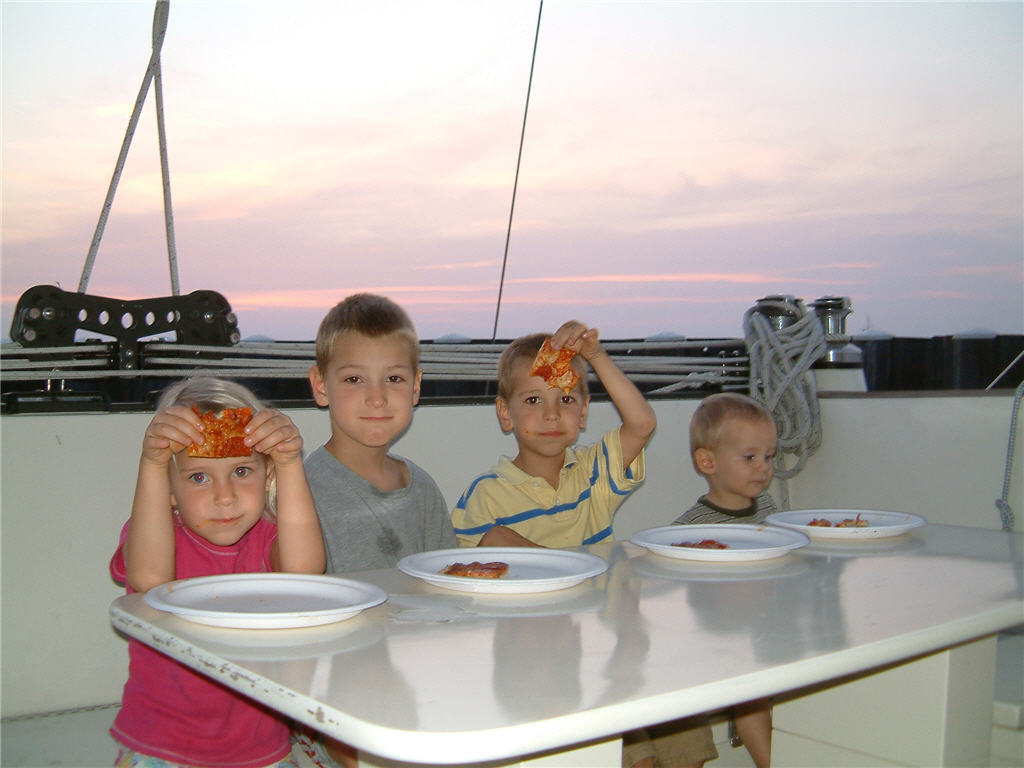
It’s now been six months since we started this journey. I use that word loosely since we haven’t sailed Take Two anywhere yet. And it might take another six months for us to be ready to go anywhere beyond our backyard. Not only does the boat need work, but we do too. Nonetheless, there’s been a lot of progress since she was delivered from Fort Lauderdale two months ago. For starters, spending every weekend aboard has made us feel comfortable and “at home” in a completely foreign environment.  Also, we have cleaned out every nook and cranny and sorted all the junk we found hiding there, so that we now sit about four inches higher than the old water line! Jay has repaired both engines, the water pumps, the electrical system, the hydraulic steering system, the A/C, the dingy and taken on countless other projects. I have altered meal plans at the spur of the moment and managed to feed everyone before the grouchies set in, baked a loaf of bread, pizza, and cookies in my ancient, though trusty Bosch oven, entertained cooped-up children on a rainy weekend without turning on any electrical devices (we set up a mini-bowling alley with plastic cups and the baby’s ball), and taken sailing classes to increase my confidence at the helm.

The kids have also made strides toward adapting to this life aboard, probably with greater ease and grace than we have—the boys help with all kinds of projects, for the most part without a word of complaint, Sarah helps keep Sam busy, and their behavior has been exceptional, so much so that people stop me on the docks in the marina to tell me how great the kids are. We see a lot of growth in their confidence, their ability to meet new people of any age and engage in conversation, and their willingness to “go with the flow” when things are unpredictable. Many of our concerns have been eased as we see the children enjoying our time at the dock. We keep busy with boat chores, reading, visiting the museum and planetarium (which is within walking distance), and swimming at the pool. The public library is across the street from our dock and downtown Bradenton offers a small-town main street feel, so there are plenty of things nearby to occupy us if the boat gets too crowded or people start getting antsy.  

In fact, aside from trying to figure out how to keep a one-and-a-half-year-old busy but out of trouble and moments of “can we go home now?” (each of us has had one), we’re feeling pretty comfortable here. Some of that is just getting used to things and some of it is adjusting our expectations. Either way, feeling comfortable is a sign to me that it’s time to get going. Or maybe that’s just me feeling impatient again…

Lessons in Contentment or Daily Life at the Dock

Barnacles and crabs make strange noises at night. It sounds like someone is popping bubble wrap all night long next to my bed, which is smaller and harder than I’m used to, not to mention that I’m sleeping on the “wrong” side—opposite from the bed at home, where I have slept at Jay’s left side for nearly 11 years. Occasionally, Sam tumbles out of his bunk and I have to respond to cries of confusion if he wakes during the fall (sometimes he sleeps through it and we find him asleep on the cushion on the floor!). I have almost knocked myself unconscious numerous times in small passages in such middle-of-the-night maneuvers. Morning comes too soon. While cooking breakfast one morning, the power failed and I was left with soggy bacon and a bowl of pancake batter. Yum. When it rains, the “roof” leaks. Right over the beds, of course—where else? The afternoons are sweltering, and even with the (praise be to God!) air conditioning on, the salon is warm, the galley warmer. The fridge and freezer, combined, are smaller than my refrigerator space at home. The front burners on the aged stovetop don’t seem to operate at any other setting than “HIGH.”  The head (strange name for a toilet, eh?) smells like rotting sea life and you have to manually pump sea water in and sewage out to a holding tank, which gets pumped out once a week. And even in our calm, sheltered marina on the Manatee River, the whole place is always moving.

I hope it doesn’t sound like I’m complaining. These are simply some of the things I’ve had to get used to as we have begun to spend weekends on the boat at the dock. Jay is currently repairing the port prop shaft (which connects the engine to the propeller), so we haven’t actually gone anywhere yet, but I am so grateful for this time to “practice” living aboard.  We can learn the rules and routines in a relatively safe environment.  We are close enough to home that we can bail if we need to, but also near local amenities like the marina swimming pool and the Bradenton Public Library so that there’s somewhere to go if we just want to get off the boat for short spells. We are attached to shore power and water, which means the comforts of unlimited (cold) showers and (mostly cold) air conditioning. It’s like learning to live aboard with training wheels—the change variables are blessedly limited. Even so, it takes some adjustment in outlook and attitude to get used to this new way of life.

This is the adventure we have craved, so we are joyfully learning to adapt to changing circumstances. There is no greater analogy to life than sailing—a vessel in a fluid environment with the wind constantly shifting, currents and tides, things you can’t see lurking beneath—the whole operation demands flexibility, vigilance and a good attitude, and not a little humility!  I gave the children some peanut butter bread and went to the neighbor’s motor yacht to cook the pancakes on the fateful morning of the electrical meltdown. When it rains, we set out the pots and bowls and towels and try to keep the baby from rearranging our carefully devised drip-catching system. When it’s hot, we sweat like the human body was designed to do and drink water and stay in the shade and rest. I’m learning how to cook again with different pots and pans, different stove and oven, different ingredients because of limited refrigeration, and lack of gadgets. In essence, we’re learning that we really don’t need that much to be happy.  I can even live without my (gasp!) precious Vita-Mix.  We spent three nights aboard this past weekend, and by the third night, I fell asleep quickly and slept soundly (and so did Sam). As we get things organized and cleaned, it’s starting to feel like home. The children are learning to entertain themselves while we busy ourselves with projects, and to adapt without complaint.  It’s not always smooth sailing (pardon the pun), but we’re getting there, little by little.

Then there are the beautiful things to get used to which I neglected to mention: falling asleep with a hatch open and a cool breeze blowing in and the moon and stars overhead. Waking up to bird calls. Breakfasting outdoors on the waterfront. Washing dishes with a 360˚ view—palm trees, the swaying masts of sailboats in the marina, the sunshine on the water, the clouds, the sky, the train bridge. Sea life at our doorstep: jellyfish, crabs, fish of all shapes and sizes—the kids spend hours in the cockpit looking over the coaming into the water. In the late afternoon, after the rain, a refreshing breeze blows. In the evening, we climb onto our “roof” and watch the red sun sink into the sea and light the clouds on fire. When the children are in bed, Jay and I get a cup of tea, or glass of wine, or cold beverage, as the mood strikes us, and sit up on deck, talking and laughing and listening to the live music from a nearby restaurant drifting over the water to us on our private, floating paradise. 

We wonder what our parents will think when they come to visit us at our new home. Will they wonder what kind of man provides such a small, leaky, dirty, broken-down home for his family (in some places, the boat is literally held together by string and duct tape)? Or will they see it as I do: a perfectly simple, self-contained, cozy, exotic living space with an incredible view?  I venture to say that some wives (including me just a few short years ago) would complain about the inconveniences which I am learning are part of the quirky charms of living aboard.  Now when I hear people complain about not having enough space and needing to move to a bigger house, I laugh! What do we really need space for? We have four cabins with full beds and two quarter berths, so there’s room to spare. Since we spend all our time in the cabins unconscious, they don’t need to be big. Our salon is spacious enough, the table easily seating eight, with a separate sitting area and space for kids to play on the floor. The galley is adjacent, so when I am cooking or cleaning or baking (which is a lot of the time), I am a part of the action. The cockpit is enclosed, which makes it relatively safe, and seats six to eight. The deck is just enormous—open and uncluttered, wide and comfortable. And the yard—it never needs mowing!

It’s true that one’s outlook changes everything (call me Pollyanna). Learning to take every day as it comes is an art. Beginning to see all of life as an adventure is essential to a vibrant and passionate existence. Slowing down is good for us, and living simply, though it may actually entail harder work, is more rewarding than living an easy, convenient life. Certainly, this way of life is not for everyone, but everyone can benefit from the lessons it is teaching us.

The Delivery

Buying a boat in Ft Lauderdale presented certain logisticalproblems.  How do you prepare andtransport a boat that you know very little about from a remote location?  I made many lists, drove down for manyweekends, and employed a lot of wishful thinking.  As it turned out, the wishful thinking wasn’tquite enough.

There were multiple lists with items including getting a headworking, cleaning the fuel, replacing an exhaust hose, measuring the mast, findinga captain, planning the route, buying gear, buying linens, buying food… lots ofbuying.

I envisioned a 5-day trip, stopping each night.  Some days would be longer than others sincegood places to spend the night don’t occur regularly along the way.  The longest day I planned was 10 hours basedon the expectation of being able to motor at 8 or 9 knots.  There was some doubt about whether we’d beable to break through the Keys chain, or if we’d have to go all the way aroundKey West due to our mast height being higher than the standard intracoastalbridges.

A licensed captain was required by the insurancecompany.  Insuring the boat was by farthe most difficult and frustrating part of the purchase process.  I feel competent to handle the boat, but itis understandable that an underwriter may not share my confidence.  A captain was not unwelcome, however, and I’msatisfied with how it turned out.  My dadwent along, so we had a crew of three.

The first surprise came seconds after leaving the dock.  No steering. 
The boat has hydraulic steering and apparently a large amount of thefluid had leaked out and been replaced with air.  This may have had something to do with theriver currents pushing on the rudders while she was at the dock.  I know it was okay when the boat was out ofthe water and I heard no complaints from the broker when he moved her from theyard back to her dock.  At any event, wewere now travelling down a winding river lined by boats and crossed by bridgeswith a stiff following current, and were unable to use our rudders.  Fortunately, we have two engines which can beused very effectively to maneuver the boat. 
With one forward and the other reversed, she can spin like a tank.

I relinquished the helm to the captain immediately, hopinghe could do a better job keeping us from hitting something.  He didn’t hit anything, but my pre-departurejitters mounted to full-blown anxiety a few times as the boat clearly was notunder control.  After navigating the mostdifficult part of the river under a constant state of tension, we stopped at a fueldock before entering Port Everglades. 
Adding hydraulic fluid and spinning the wheel back and forth bled thesystem and the steering didn’t give any more trouble for the rest of the trip.

The captain directed some criticism at me during thisepisode, and I’m still not sure whether he blamed me for the steering problem,or for letting him take the helm, or both. 
I recall that he stepped in as soon as I discovered the steering problembut before I went for the engine controls. 
It could not have been long because we only had 100 feet before we wouldbe swept into another boat.  Would I havegone for the engines in time?  I thinkso.  I think I probably could havemaneuvered out of the river with the engines, too.  But he wanted the helm, and I was happy togive it to him.

It is interesting to me how I can be deferential andunassuming in some situations, quietly accepting criticism that I think isunwarranted, even being yelled at during moments of tension with noresentments.  But in other situations, particularlyprofessional situations, I can be aggressive and territorial, harboring agrudge against the slightest affront to my ego. 
I’m not sure what the difference is. 
In all cases I expect a quiet competence of myself, but sometimes Idemand individual recognition despite the overall outcome, and in others I linkmy satisfaction with the result and ignore criticism.  I don’t see my giving the wheel to thecaptain and not challenging his declaration that he was disappointed in me asany weakness on my part.  A job needed toget done and he seemed the most qualified to do it.  Isn’t that a good thing?

The next disappointment came as we entered the Atlantic andthrottled up to cruising speed.  Mylow-end estimate of 8 knots under power was off by a bit.  With a 20-knot headwind and the accompanyingchop, 4 knots was more achievable.  Theboat is underpowered for my tastes. 

Boat speed under power is a complex relationship of hullshape, engine torque and rotational speed, and propeller size and pitch.  I don’t understand the relationship wellenough to say that the boat needs bigger engines to improve her boat speed.  They don’t seem to labor, and they achievepretty close to their wide open throttle revolutions, which may indicate thatthey can bear larger propellers.  At thesame time, with their placement in the hulls, I can easily see that the enginesmay have been selected for their physical size more than their horsepower.  A similar sized boat that I’m familiar withhas twin 60hp engines and is clearly overpowered.  But as most will agree, power is a safetyfeature, and I think my twin 30hp Volvos are at the wrong end of the range.

It was a long day of motoring into the wind and waves toreach our first night’s destination at the southern end of Biscayne Bay.  Going into the bay was my decision and I madeit somewhat unilaterally.  We haddiscussed it, but the captain would have been happy to push on through day andnight, and my dad was concerned about being able to get out through the shallowpasses at the bottom of the bay.  I wastired and demoralized from the slow bashing in the Atlantic and just wanted toget into some sheltered water.  We founda quiet spot to anchor near Pumpkin Key. 
Everyone was tired and the planned meal did not materialize.

The next morning we motored out through Angelfish Pass verynicely.  The boat draws 4 feet and we didsee some fours on the depth sounder, particularly on the Atlantic side of thepass, but I think the depth is calibrated from the transponder, not from thewaterline, so the four foot readings were probably closer to six feet.  There are some good-sized boats docked in adevelopment inside the pass, so the channel is probably privately maintained.

The morning was uneventful as we motored south in HawkChannel between the Keys and the barrier reefs offshore.  The wind had clocked southwest overnight andcontinued move west throughout the day in order to stay on our nose as we camearound the bottom of Florida.  Our nextwaypoint was Snake Creek which is the only opening bridge in the Keys chain.

Snake Creek does not seem to be a common route for sailboatstransiting the Keys.  Nobody I talked tohad heard of it.  This may be because thechannel is somewhat shallow and the fixed spans at Channel Five and Marathonare conveniently nearby.  The spans areout of consideration for me because they’re only 65 feet and my mast is68.  I wasn’t sure about Snake Creekeither, because it has overhead cables and we couldn’t find a publishedheight.  We called the Coast Guard, thebridge tender, and the power company, but nobody knew.  In the end, we got right up to the cable andstopped.  From our perspective it wasimpossible to tell, but there was a guy on the bridge and he let us know byhand signals that we had plenty of room. 
In retrospect, if we were that unsure, we should have sent someone upthe mast.

The Gulf side of Snake Creek is shallow.  We saw fours again, but didn’t touch.

We transited Snake Creek at about 2pm and our next goodstopping point was Naples, about 12 hours away. 
The timing was awkward and we never seriously discussed stopping tospend the night in the Keys.   Inretrospect, I wish we had, because by not stopping we put ourselves out of syncwith our anchorages and kept ourselves out of sync with the wind.  Had we stopped, the wind would have clockedaround to the NE that evening and given us nice sailing the next day.

The Florida Bay was pretty stirred up with lots of sand andsea grass suspended in the water.  Afterawhile we noticed that the engines weren’t making the same RPMs that they hadbeen.  We worried about this for awhile,thinking we might have clogged fuel filters, until we hit on the idea ofbacking down to try clearing grass off the props.  It worked, but soon afterward the starboardengine overheated.  We shut it down,emptied the strainer, then restarted it and changed the port strainer.  Before long, the starboard side overheatedagain and this time the strainer was empty. 
It was night by now, the engine was smoking because it was hot, and itwas hard to tell if there was enough water in the exhaust.  Hanging under the boat with a flashlightbreathing the exhaust seemed to be my job. 
We shut the starboard engine down to rest for awhile.

The autopilot has a handy feature that allows it to followthe wind.  This enables us to trim thesails as we like them and then sail a wind angle that suits our trim instead ofa specific course.  This had been workingfine, but with the starboard engine shut down and the boat having a bit ofweather helm, our port rudder control was a little sluggish and we got tacked afew times when the autopilot couldn’t keep us off the wind.  Stupidly, we had been sailing with the frontwindows open.  During one of these accidentaltacks a jib sheet wrapped around the port window and ripped it off, leaving shatteredglass inside the boat and on deck.

Probably around midnight we went through another backingdown procedure to clear the port propeller, and something went wrong.  The engine raced.  The captain seemed to know what this meantand told me to go check the prop shaft. 
I thought he was crazy, but dutifully went to check.  Imagine my surprise when there was no shaftin the stern tube and water was coming into the boat.  I reported this and we began the holeplugging exercise.  Having water comingin your boat is never a good situation, but I had the plugs and the tools to takecare of it, so all in all, I think it went pretty well. 

With both engines out of commission now, and the wind stillout of the north-northwest, we were sailing pretty much west, giving up theadvantage we gained by cutting through at Snake Creek.  Stopping for the night was out of thequestion.  It was at this stage that Isuccumbed to seasickness.

I’ve always battled with mal de mer and it wins most of thetime.  Intellectually, I think it is largelya psychological phenomenon, but that hasn’t helped me much.  It always seems to be multiple conditionsthat collude to defeat me.  Was itexhaustion from several days of preparation and lack of sleep that weakened me?  Was it that cigar I had after dinner, or thediesel fumes?  Working below on theengines certainly didn’t help, and it being night there was no horizon toorient myself against.  And theaftereffects of stress can be enough to make a person nauseous on dryland.  Whatever it was, it was blessedlyshort, and I was back to normal in about 12 hours.

We had a great sail overnight in the wrong direction and bymorning we were about 40 miles off Marco Island.  Not a great place to be with no engines.  The captain went over the side to investigateour port shaft.  It was still therethankfully.  The zinc anode stopped itfrom sliding through the strut.  It justneeded to be pushed back in.  He tied itoff in case it managed to break free. 
Why he didn’t try to push it back in, I don’t know.  I think I had suspended independent thoughtby this point.

The wind died around mid-morning and we started thestarboard engine to see how it was feeling. 
It started getting hot and we shut it back down.   We talked about what the problem could be,but didn’t do much.  The captain wentover the side to inspect the intake, but it was clear.   We discussed the possibility that the intakehose was clogged, but didn’t take it off to look.

We spent all day sailing slowly back toward the coast.  We discussed putting in somewhere forrepairs, but decided that as long as the wind held, we would try for Bradenton.  It did, and so we did.

Shortly after nightfall, the wind clocked around to theeast, allowing us to tack and resume heading north.  It built until I decided that it was prudentto reef and we went right to the second reef.   
It continued to build until we had gusts to 35 knots.   It was a beautiful clear night, but colderthan any of us had packed for.  We wereclose enough inshore that the seas were relatively light for the wind strength.

The captain called for relief at about 4am and I went ondeck to relieve him.  It seemed that theautopilot was having trouble controlling the boat and he had been hand-steeringfor the last couple hours and was now exhausted.  As I took the wheel he told me that he hadbeen trying to keep within 40 degrees of the desired course and to be carefulof a gybe because we would lose the rig. 
This was not at all acceptable to me and I decided we would take themain down.  We rolled the jib and shewent right up into the wind very nicely. 
The drop went just as smoothly as the reef.  We unrolled the full jib and made a nice 9knots with the autopilot steering.

We were off Englewood when dawn broke clear and chilly.  The breeze slackened and we put ourdouble-reefed main back up, shaking out the reef by late morning.  The breeze continued to clock until we had itoff our starboard quarter.  I put up thespinnaker for a little while, but my crew was not as enthusiastic about it, soit was short-lived.

We started to see other boats off Sarasota.  The solitude of the previous couple days hadmade us lazy and we were not keeping a proper watch.  I went on deck at one point just in time tosee an anchored boat with a diver down flag bob down the side less than 6 feetaway.  I think that shook us all alittle.

We made it through Southwest Passage into Tampa Bay around 2pm.  The captain called a friend to bring his fishing boat out to us, and he towed us in to the dock.  Docking was relatively uneventful and the delivery crew dispersed by 5pm on the fourth day.  None of the five planned dinners had been eaten.  
Tireless Optimism

Things are breaking faster than we can fix them at this point. You might think we would be daunted as we are just setting out on this adventure, but that is not the case. Of course, part of any adventure is flirtation with danger and willingness to confront the unknown.  (As in, “What will break next? Who knows?”) That takes a bit of pluck, not to mention a hearty dose of optimism.

I’m what you might call an apocalyptic optimist, with an outlook that goes something like this: the world is going to hell in a hand-basket, but in the meantime, I’m sure everything will be just fine!  I can also be a bit moody, swinging between the extremes: from “this is so exciting!” to “this is the stupidest thing we have ever done!” (I often experience the two simultaneously which makes me feel really crazy.) My husband is very steady—things are what they are, and will continue to be that way so there’s no reason to get excited.  That means, in my opinion, he can’t truly enjoy something, but then he is somewhat impervious to disappointment.  Not that he doesn’t get frustrated sometimes, only that he doesn’t freak out. I, however, do freak out—freak out happy, freak out scared, freak out mad, take your pick. 

So when things break, Jay calmly looks at it as an opportunity to learn something new, like plumbing or electrical engineering. That’s his brand of optimism. I, on the other hand, will feel like freaking out, but attempt to talk myself out of it by playing Pollyanna and finding something to be grateful for. Like, “At least it broke now, while we’re tied to a dock only an hour from our house and not in the South Pacific!” I said as much to one of our G-dock neighbors who was privy to our electrical troubles this past weekend. He said, “Boy, you sure see the glass half-full, huh?” And a few moments later, “You’re gonna need a LOT of that glass-half-full…” I think he’s right. Keeping our attitudes in check and keeping our sense of humor and sense of adventure is going to be our key to survival—both here at the dock and when we actually leave someday. We’ll have to have the kind of optimism that says, “All this trouble is worth it!”

Of course, for those of us who believe that all things work together for the good of those who love God and are in sync with His plan (loose paraphrase of Romans 8:28), there is no choice but optimism. It doesn’t matter if we go broke fixing this boat, or if we are hot, tired, hungry, or in trouble—all of that, all the hardship will ultimately be for our good. We’re not doing this because we thought it would be easy.  And God doesn’t really care about our comfort as much as He does our character. So it may be hard and uncomfortable and we may experience growing (or shrinking) pains as we try this new mode of living, but, in the end, according to the written guarantee above, it will all be worth it.   There might even be some pleasant surprises to enjoy along the way! I’m feeling optimistic.

Baby Comes Home

Jay brought our new baby home on Wednesday night. She was a little worse for the wear, but she sure does look good sitting at the dock. We cleaned her off and out and spent the night on Thursday. I watched the sun go down over the heads of the four children sitting in the cockpit having their first dinner on the boat.  We fell asleep to mysterious new sounds. We woke to the calls of water birds and to cool, moist air on our faces from the open hatches. I did my first day of boat-schooling and we divvied up boat chores. I mopped my galley and salon and hosed down the cockpit. In short, I was happy as a clam. I felt more at home on the boat than I do at home.

When Eli, Aaron, Sarah, and Sam got on the boat for the first time (they hadn’t laid eyes on it since December when we first looked at it) they were bouncing off the walls with excitement. This is the rundown on the boat tour Jay subsequently gave the kids: “This is the engine kill switch. Don’t touch it.  This is a fire extinguisher. Don’t touch it. This is a sea cock. Don’t touch it. See these switches? And these buttons? Don’t touch them.” And so forth, and so on. The children looked a little confused; they had the mistaken notion that this thing was their new toy. But the rules that are so important for an orderly household now become even more important in the floating house, in some cases for safety and survival. They seemed to catch on pretty quickly.

I have spent so much time imagining what it will be like—the daily life, at least—that actually doing it seemed easy and natural. What will be strange will be waking up to make pancakes on a Saturday morning and finding that the view has changed since yesterday. I can’t really imagine what the voyaging and exploring will be like, so I just don’t spend any time thinking about it.  But when Jay talks about romping around on the island and sending Eli up a tree for a coconut, I get a little thrill of excitement. What will it be like? If our first day aboard is any indicator, it’s going to be better than we imagined.