Author Archives: Jay

Fire

The boat directly across from us on the next dock caught fire a couple weeks ago.  We didn’t notice until the fire trucks arrived.  

The fire department keeps a little rescue boat on that dock, and we’d previously seen them rush down and launch it.  We thought that’s what they were going to do when they rolled up this time, but they started unloading hoses instead.  

The kids saw the smoke immediately.  Within a minute we could see flames.  I was too busy watching to get a more dramatic picture.

[flickr: 5970624647]

Fire is the last thing you want on a boat.  They burn fast.  They’re loaded with flammable stuff.  The fumes are toxic.  Even a small fire can damage a boat beyond repair.  Left alone, they burn to the waterline and sink.  That’s the end for the boat, but maybe not the fire.  In a marina the fire can spread.  Maybe there’s a burning fuel slick.  Maybe the docks are made of wood.  Maybe the mast falls on another boat.  Maybe the boat burns through its lines and comes adrift.  Maybe it explodes.

The firefighters unleashed torrents of water on the burning boat.  The fire was coming from down below so they had to get aboard to spray water inside.  The boat’s bilge pump was running non-stop and she was listing visibly.  It took a lot of water to put the fire out.

A man lived on that boat.  His grandson was visiting for the summer.  The man was at work and the kid was aboard watching TV when he smelled smoke.  He got off the boat and called the fire department.  We don’t know how long it was before the trucks arrived, but we assume that the early call saved the boat; “saved” being a relative term, because the insurance company totaled it.  But it didn’t sink, and the fire didn’t spread.

What if the kid hadn’t called?  Add five minutes to that fire and it would have been a totally different situation.  He may have saved more than one boat.  He may have saved ours.

Watching the firefighters crawl around on the burning, listing boat gave me a very bad feeling.  I wasn’t sure if they knew the potential danger.  I recall thinking that I wouldn’t be doing that. 

Boats have things houses don’t: fuel tanks, batteries, flares, propane.  Did they know?  I assume that departments in coastal areas must train for boat fires, but various boats can greatly differ.  Could I walk onto any random boat and locate those items?  Could anyone do that on ours?

Up to this point, we haven’t worried too much about fire safety.  The concern I do have is more for the boat and our home than for ourselves.  I’m confident that anyone over the age of two could escape any conceivable fire scenario.  In that regard the boat is better than most houses.  

If there were a fire, we’d have a small window of opportunity to put it out quickly.  Some sources claim there are only about 30 seconds before heat and smoke force you out.  To that end, we have handheld fire extinguishers placed around the boat.  We have a fire blanket in the galley.  We have automatic halon systems near the engines, inverters, and the generator.  We have a high capacity washdown pump with a 50’ hose.  If that didn’t do it, there wouldn’t be much choice but to stand back and watch her burn.  

The cause of this fire was electrical.  We’ve had our own electrical problems.  We were lucky because a breaker tripped.  Corrosion.  It increases resistance and therefore heat.  Breakers and fuses are sized for the capacity of a wire to carry current without melting, but they have no idea if that wire is corroded or badly connected.  Once the insulation melted, the hot wire found a dead short which blew the breaker and our fire was over before it started.  Must not have happened in this case.

Shutting off the power is obviously the first thing that needs to happen for an electrical fire.  The firefighters unplugged the boat’s shore power cord immediately, but that’s not enough.  Batteries are perfectly capable of starting a fire.  Typically, battery-connected circuits don’t demand enough current to start a fire unless there is a short, and a fuse would put an end to that.  Every wire should have a fuse or breaker on the end nearest the source.  Of course, “should” is often not reality.

Batteries should have disconnect switches.  Our switches are not very accessible, but that was intentional.  They used to be too accessible and the batteries could get turned off accidentally.  Our battery bank is split on either side of the boat, so there is no getting to the switches quickly anyway.  I was already planning to install a single button to control remotely operated battery switches.  It will be located right next to the AC transfer switch.  That will allow a person to quickly disconnect all power from a central location.  

It took the firefighters a long to time to find the boat’s batteries.  We could tell by the steady output from the electric bilge pump.  It had gotten much of the water out, and the boat was listing less.  She was still steaming, but the firefighters were satisfied that the fire was out.  They collected their gear and left.  

They had tried to contact the owner at work, but were unsuccessful.  Hopefully he received their messages and was somewhat warned before he returned home to his smoking wreck.  The reek of burned plastic could still be smelled a hundred yards away for days afterward.

Upon reflection, I really don’t think there is much additional fire preparation that is worth doing.  Take Two is about as well-protected as I think she practically can be.  Perhaps an extra smoke detector near the inverters would be a good idea.  There’s still some dodgy wiring that needs to be redone (and will be).  But everything has to be put in proper perspective.  The wiring could be perfect and a lightning strike could still start a fire.  All our preparations would be for naught if we’re not aboard to employ them.  And even the fire department can only do so much.

Update

I've learned that an automatic fire suppression system shouldn't be used in a diesel engine room without pairing it to an automatic shutdown.  1) The engine keeps running, 2) the chemicals can damage the engine, and 3) the running engine sucks out any gas (halon) before it can put out the fire.
New Catwalk

No posts in awhile, but we’re making steady progress here on Take Two.  The latest finished project is the installation of our new catwalk.  The last one, you may recall, exploded under the strain of waves we took over the bow in boisterous conditions.  I didn’t share these pictures before because the wounds were too fresh.

[flickr: 5908795808]

Can you spot what's missing in that picture?  Apparently the weave of our trampoline nets is too close and doesn’t allow water to drain through fast enough for the amount that was landing on them.  The weather was on our starboard side, and the weight of the water coming over the starboard bow and onto the net caused the bottom and starboard side of the catwalk to separate.

The old catwalk was essentially a box, hardwood sides and ends, plywood top and bottom, painted on the outside and epoxied on the inside, with a teak surface laid on top.  Despite being hollow inside, the thing was heavy, which I didn’t fully realize until trying to haul it out of the water.  And despite the paint and epoxy, there was some rot in the top along the starboard side.  This rot undoubtedly contributed to the old catwalk’s failure.

[flickr: 5908238475]

Although the catwalk broke, the laces attaching it to the trampoline net did not.  The broken sections fell in the water and were dragged under the boat, becoming a bludgeon that pounded our underside.  I have no idea how much time passed between when the catwalk broke and we discovered it.  It is a good indication of just how much noise there is in a storm that we couldn’t hear the punishment we were receiving below.

[flickr: 5908238919]

It's hard to get a good picture down there that really shows the damage.  I've taken many, but chose to go with one that had pretty water.  If you can see it, none of that damage is serious and most of it just needs to be faired and painted.  The paint color under the bridgedeck is interesting.  Originally it was a cream color, like the decks.  They painted over the cream with a dayglo orange.  Apparently someone was concerned about the boat laying upside down in the middle of an ocean.  Over the orange, they painted red.  Unfortunately the orange didn't stick very well, which might have been the reason for the red, but it didn't really work.  The whole thing needs to be repainted, which will not be a fun job.  Cosmetic items are pretty low on our priority list and nobody even sees that area.

But the catwalk was a high priority.  The catwalk’s primary purpose is to resist compression between the forward crossbeam and the bridgedeck.  The mast pulls up and aft on the crossbeam.  The pelican striker opposes the upward pull, and the catwalk opposes the aft pull.  So it is structural from the designer's standpoint.  The secondary function is a solid platform to walk on when dealing with the anchor.  Operating the boat is tricky without it, so replacing the catwalk was a "must" before we start using the boat again.

[flickr: 5908792536]

Whenever something fails on Take Two, we see it as an opportunity to make the thing better, and the new catwalk was designed to correct the flaws of the previous one.  It has solid sides and ends like the old catwalk, but there are several cross members mortise and tenoned into the sides, strengthening it in the dimension that the old one broke.  Thin slats rest on these cross members to make the top.  There is no bottom.  It weighs maybe 25 pounds, while the old one was probably around 75.  Extra weight on the bow can be put to better use in a larger anchor.

The open bottom means there are no hidden places where rot and weakness can fester.  It also allows the slatted top, which is good for washing off the muck and weed that often comes up on the chain.  Both reduce weight.  But the slats are thin and not strong enough without additional support.  The cross members provide this support, and also help resist side loads from the nets.  We don’t have a chain stopper and couldn't figure out how to do it before.  If we wanted to add one now it could be bolted through one of those cross members.

[flickr: 5908795364]

Teak was chosen for its rot resistance and light weight.  We generally do not like teak on our boat, as we have no desire to maintain it.  However, we did not mind the raw teak surface on the old catwalk and felt it stood up well to the anchor chain running over it.  We briefly considered fiberglass but decided that was a loser on cost, weight, and resisting abrasion from the chain.  

Like most projects, the new catwalk opened the door for making other changes, and we were never quite satisfied with the way the trampoline nets were attached.  They used to be double laced through stamped eyestraps screwed into the catwalk and rest of the boat.  We had repeated problems with chafe on the lacing lines which required us to replace them about twice a year.  And the eyestraps sawing through the lacing was very loud inside the boat; like a big violin.  

[flickr: 5908791004]

We contacted Sunrise Yacht Products, the company that made our nets, and they recommended a perpendicular lacing pattern which allows less movement, and a track and slide attachment to the boat instead of the eyestraps.  They sell track, slides, and lacing for this purpose.

The track appears to be specially made and I could find no other source for it.  It is like awning track, but has a much heavier wall thickness.  It comes in two different extrusions for attachment to surfaces perpendicular or parallel to the load.  The slides are made by Bainbridge and can be found cheaper online, but Sunrise customizes them by bending the bail to keep the laces centered.  The line they sell for laces is a ¼” polyester double-braid.  

[flickr: 5908236617]

We found we could get much better tension on the nets with the new lacing pattern, and we’re very pleased with how the new arrangement looks and feels.  Unfortunately the teak won’t remain bright and pretty for long.  It will weather to a dull gray color unless we maintain it, which we won’t.

The nets themselves were undamaged in our little incident, and are possibly indestructible.  Despite the drainage problem, we really like them and we’re not planning to replace them anytime soon.  We will however try to avoid dumping that much water on them again.  If necessary, I’ll cut the laces next time rather than risk damage.

Kiwi Update

Our Kiwi friends left here bound for Mexico on the first leg of their trip back to New Zealand.  

They left behind a general sense that neither boat nor crew was ready for the trip, having struggled just to get to the fuel dock.  We saw them off without misgivings though, believing that the first 50 feet of a trip are always the hardest, fate protects the young during such misadventures, and no amount of preparation is really enough.  

We expected it to take them four days to reach Mexico, and though we did not extract any promises, we expected blog updates on arrival.  But the updates never came and by Day 10 we were worried.  We knew they had a satellite phone, EPIRB, and life raft, and we knew the US Coast Guard did not rescue them.  So we figured they must have diverted somewhere that didn’t have Internet access.

Eventually we got wind that they were back in Florida.  One of the crew had experienced seasickness to a dangerous degree, which combined with a realistic evaluation of themselves and the boat, put the kibosh on the whole trip.  They instead turned for Key West to rest and then continued on to West Palm Beach to put the boat aboard a yacht transport bound for New Zealand.

We share their disappointment, but also their relief.  We also recognize their story as an anecdote for several lessons we’ve learned one way or another.

Communication is important.  We haven’t had a lot of experience worrying about the whereabouts or welfare of other people, but haven’t found those times very pleasant.  As travelers ourselves, we make an effort to let our plans and location be known.  For longer passages we file a float plan with my father, who is the emergency contact registered on our EPIRB.  We also carry the SPOT satellite tracker, which shows our position when underway.  On future trips we will probably also carry a satellite phone.

Plans should be constantly re-evaluated.  We’ve had to relearn this a few times, usually after we’ve seriously screwed up.  Better to change the plan than push a bad situation and risk the consequences.  We crossed a poorly charted bar in bad conditions once.  It was stupid and had the potential to really damage the boat.  We escaped because we were lucky.  We’re now extra careful about plans that have us arriving at a pass or bar in unknown conditions.  If there is any doubt, we change the plans and feel good about it.  We don’t know if it has actually saved us any grief.  We weren’t there.

Don’t underestimate the Gulf of Mexico.  The Gulf is notorious for steep, tightly packed waves that are hard on boats and crews.  The first leg to Mexico was possibly the hardest of the whole trip.

Seasickness can be serious.  The misery of seasickness is difficult to describe, but usually that’s all it is.  It usually lasts for a day or so, during which the intrepid sailor swears to quit and take up gardening.  Occasionally, though, it can be so intense and prolonged that the sufferer can dehydrate and die.  In our case, even a mild case can have serious consequences since we can’t afford to have the skipper incapacitated or his judgment dulled.  Unfortunately, there is no surefire cure, and the most effective defense is prescription medication, which we normally try to avoid.

We probably would have supported any decision the Kiwis’ made, but think aborting their trip (for this year at least) was wise.  Rather than transport the boat, we would have suggested keeping the boat in Florida and trying again next year, but admit our advice is somewhat selfishly motivated since we enjoy their company.  We don’t know all the factors that went into the decision, but we do know the cost of transporting a boat is phenomenal.  Apparently the boat market is such in New Zealand that buying here was still economical.

Two Dinghy Family

We just acquired our 3rd dinghy.  We've always carried a spare dinghy in the form of our 14'
Porta-Bote.  This new boat is intended to replace the PB, but be more functional.  In the time we've owned it, about 2 years, I can recall unfolding the Porta-Bote exactly three times.  It's a little bit of a major pain in the ass.  Yes, it folds to 4" flat and straps to the lifelines very conveniently, but the seats, oars, and transom still have to be stowed somewhere, and they are not small.

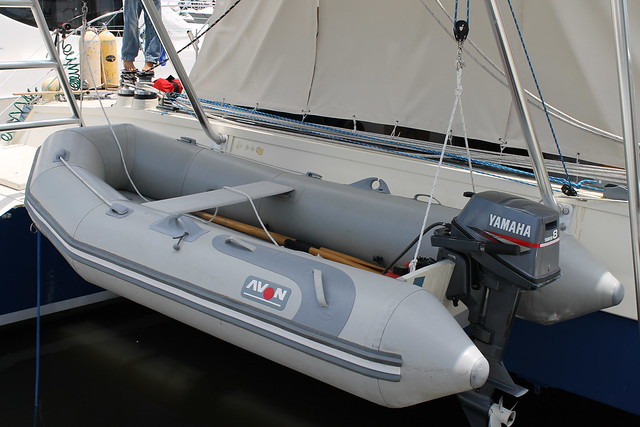
The new dinghy is a 10' Avon inflatable with a high pressure air floor.  It will roll up and fit into a space smaller than that taken by the PB's seats.

Another Dinghy

The driving factor here is that we're no longer a one dinghy family.  With Rachel's birth we've exceeded the rated capacity of our 12' RIB, which really only matters in places that care about that sort of thing (ie. the US).  More importantly, we have growing boys that are ready for a little more freedom.  We already let them go explore alone by kayak, and this new boat is intended to be the "kids" boat and extend their range.  As the boys grow in size and appetite, we're also expecting this boat will help them contribute to the dinner table in the form of fish and lobster.  

Another consideration is that we've felt constrained in some of our dinghy excursions in remote areas by the prospect of engine failure.  With this second dinghy, we'll have a built-in buddy boat.  Both of these uses require the backup boat to be readily available, which the PB is not.  We're expecting the air floor dinghy will be easier to deploy and spend more time in readiness.

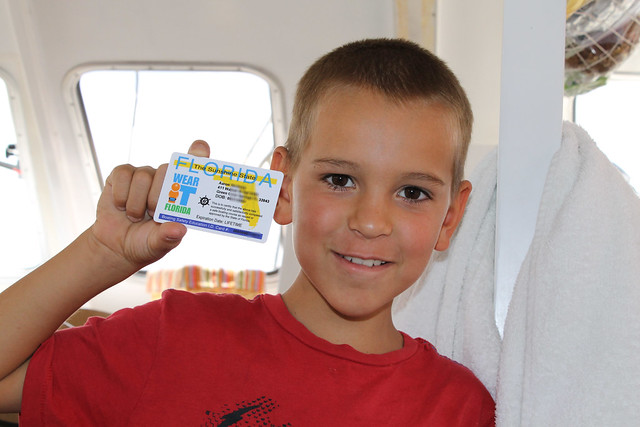
Of course, this second boat will need a driver.  Aaron has recently received his Florida Boating Safety Education I.D. Card and is now a legal operator in Florida.

Legal

Cameraman

For some reason, most of the pictures we took in the Bahamas turned out beautifully.  The colors… the light… the scenery… it was really hard to take a bad picture.  I must say that it went to my head a little.  Suddenly I had standards for when a picture was good enough.  Suddenly I wanted to spend a bunch of money on a camera that lived up to those standards.  And suddenly, now that we’ve left the Bahamas, all our pictures suck.  That explains the lack of them recently, by the way.  

I really know next to nothing about photography.  I’m a point-and-shoot kind of guy.  So when looking at DSLR cameras I was a little bit daunted by all the specs and features and lenses.  I talked to a friend of ours who is a real photographer and Peter was able to make a specific “you should get this camera” recommendation.  His suggestion was a Canon EOS Rebel T3.

It arrived yesterday, and though I’ve done little more than take it out of the box at this point, I hope that we’ll have better pictures showing up soon.

I’m not really looking for a hobby, but after getting this fancy camera, I should probably at least learn the basics.  What I need now is a subject to practice on… something that looks interesting… something that people want to see… something that doesn’t move too much… something like a baby…  a baby!  

Now all I need is a baby.  One should be delivered any day now, but those don't ship with tracking numbers.

Diapers & Beer

I uploaded this picture earlier, but Tanya thought it required some explanation:

Diapers & Beer

You see, in my line of work (analyzing data and finding hidden trends) it's an old joke that diapers and beer are often purchased together.  So I got a giggle today when I looked down into my shopping cart and found none other than "diapers & beer".  It seems the store has heard the joke because the diaper aisle is right next to the beer aisle.

No, this does not mean the baby has arrived.  Any day now.  Be patient.

Nav Station Complete

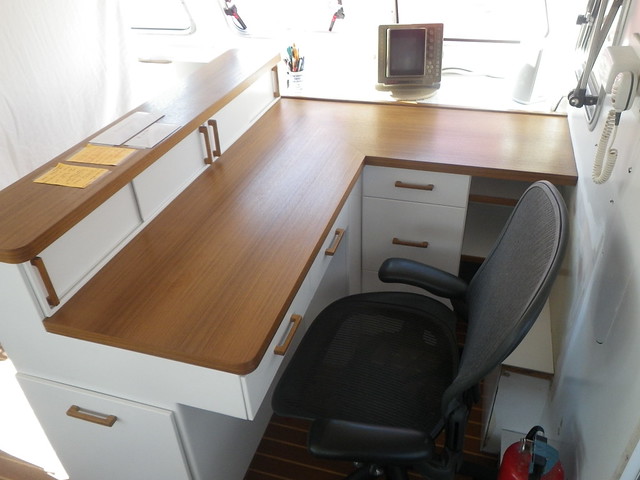
The new nav station is installed, and we couldn't be happier with it. 

Desk

It has lots of drawers and little storage places.  The office chair used to be down in our starboard hull, but we decided that wasn't working and impeded access to the new forward bathroom.    

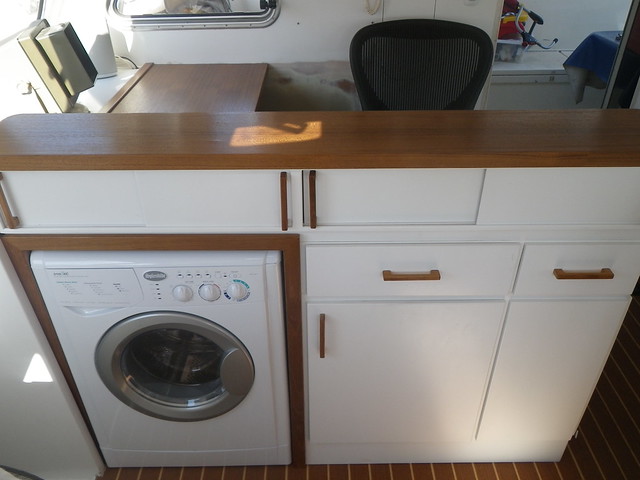
Tanya traded quite a bit of cabinet space for the new washer/dryer, but she seems to be coming out okay through more efficient use of space in the new galley drawers.  Unfortunately, I did something to my right knee which has put a damper on the boat project progress, so the washer/dryer is not yet hooked up.  It needs power, water, drain, and vent lines run through the adjacent bulkhead to the bathroom-turned-pantry there.

Washer Dryer

The crib is nearing completion and will be the next piece to get installed.  After seeing the look of the new furniture, we decided to go ahead with new galley countertop and a new salon table of the same wood.  The galley already has new drawer banks, and the table will have additional drawers and shelves in its base that should help with storage.  We're also nearing completion on the new catwalk design, so that will be built in the coming weeks.  The new bathroom is still undergoing trials and there will be post on it soon.

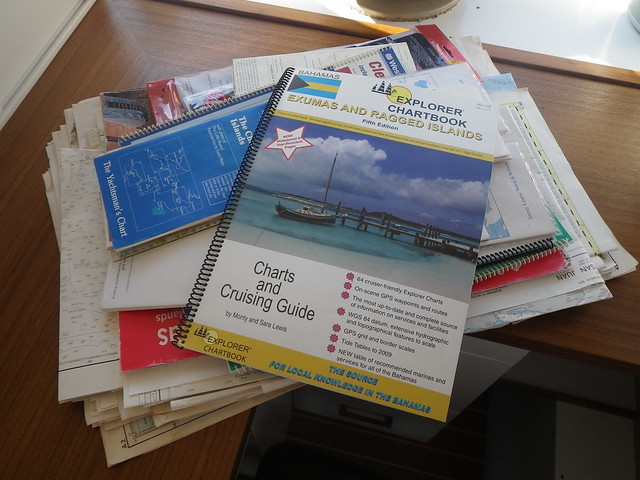
The one thing this new nav station doesn't have room for?

Homeless Charts

Paper charts.

Semi-Rugged

It's new laptop time here on Take Two. 

It’s an endurance test for Tanya's machines.  She squeezes about 5years out of them, by which point they're literally falling apart.  It'shard duty too.  Drops, spills, kids.  Mine get more use, but I'mgenerally nicer to them.  I depend on them heavily though, so I typicallyget a new one every 12-18 months whether I need it or not.  I still haveoccasional failures, and even though I pay for next-business-day on-sitesupport, it doesn't always work out that way.  So when I get a new one, theold one becomes a backup.

Lots of people we know use netbooks on their boats.  The theory beingthey're cheap and easily replaceable.  We have one, but the only use we'vefound for it is teaching the kids to type.  It's cute, but it isn't aserious computer, and neither of us can bring ourselves to use itseriously.  I've considered switching us to Macs.  I think the Macshave reached a level of maturity and market acceptance to make them viable forme.  Simultaneously, as my usage skill trends more toward the median I'verealized the overall suckage of Windows.  But Macs are too expensive forwhat we subject our computers to.  The ports on the laptop I've used forthe last year and a half are actually starting to corrode.

I've also had trouble with heat.  Modern machines are designed to runin air conditioned offices and they just can't cope with tropical climes. During the summer my laptop's fan would be running full tilt boogie 24/7, andin direct sunlight it would just roll over and die.

I considered ruggedized computers like the Panasonic Toughbook, but they areridiculously expensive and the specs aren't even that great.  We'relong-time Dell customers and Dell does have a rugged laptop called the XFR, butit has a starting price of $3800.  The specs are better, but it is stillridiculously expensive and looks like it belongs to Robocop. 

In between is their "semi-rugged" laptop called the ATG.  Tanyahas dubbed it the All-Terrain Gadget.  Shealso thinks the term “semi-rugged” is somehow fitting for me.  It is essentially just a business-classLatitude, which I have been using exclusively for the last 10+ years, but itcan tolerate higher temperatures, humidity, dust, vibration, and has asunlight-viewable display.  I decided that was the way to go and onearrived today.

While I'm moving into the new computer, I have the old E6400 and the newE6410ATG side-by-side on my desk.  For the most part the ATG looks andfeels just like the regular Latitude.  I don't know what might bedifferent under the covers, but the chassis is only slightly different. The back part of the base is wrapped in a rubber sleeve that includes portcovers.  These covers should prevent the corrosion the old one has.  Butthe sleeve also covers the E-Port on the bottom for Dell's port replicators anddocking stations.  I can see the E-Port is there, but I don't see how itcould be used.  The ATG's lid is more substantial and has a slightly morerugged look.  It weighs a little bit more and the screen is indeedbrighter.  Everything else appears to be the same.

We’ll see how it looks in a year.

Bondo

How have I never discovered Bondo before?  I thought it was used exclusively by auto body shops, but I watched our carpenter using it to fill and fair the floor and walls after demoing our old nav station.  The stuff is amazing.  I've been using West System 410 Microlight for these types of jobs, but the epoxy is much harder to work with and takes longer to cure.  The Bondo can be sanded within minutes, which greatly reduces the fill-sand-fair-sand-paint cycle. 

I might actually get more painting done now…. well, at least the fairing and sanding part.  I had to kick T and kids off the boat for 24 hours for the last painting project.  Partially because of the fumes, and partially because if there's wet paint around one of them is bound to put a hand (or worse, a foot) in it.