Author Archives: Jay

George Town to Black Point

February 12, 2011

Repeat after me: don’t play with cold fronts, don’t play with cold fronts …

We left George Town in the morning with the stated intention of getting out ahead of the cold front due in the afternoon.  The front would arrive with strong NNE winds, and the breeze would fill from the E in its wake.  This would make exiting George Town, travelling 40 miles NW up the coast in the Exuma Sound, and re-entering through a cut very uncomfortable.  Meanwhile post-frontal conditions would be ripe for a run to Florida.

I’ve stated that we can only predict the weather about 4-5 days with any certainty, and we could not see far enough ahead to sit in GT long enough for conditions to abate there, and still expect good conditions all the way to FL.  We’re eager to get home and hated the idea of losing this window.  When the morning forecast showed the front arriving later than previously expected and extending into the next day, we suddenly realized we were going to lose a day of our good forecast AND get hammered on the first leg.  In the space of about 10 minutes, we decided to go.  

Our bottom had not been cleaned in a few weeks, and I had planned to do that.  I also wanted to take our last load of trash ashore, get some ice for all the fish we were going to catch, and run some other minor errands and boat chores.  All were optional, and I opted to skip them.

It was a beautiful day; flat calm with about 5 knots from the NNE.  We can’t reasonably sail in less than 8 knots and the angle was a little tight, so we left an engine on.  I could feel the dirty bottom and props and estimated we were down about a knot of boat speed.  We did some fishing with three lures out, but only caught one barracuda.  We were happy with our decision to go.

The wind gradually built up to 10 knots, but went farther north, making it harder to use.  Around our half way point, the GPS was showing a 4:30pm arrival at Big Farmers Cut, but I wasn’t confident we could keep up our 6 knots that long.  The front would arrive earlier than the forecast as we travelled north to meet it.  I was not concerned about the front itself at this point, though I probably should have been.  What was on my mind was the cut, and that we would arrive in the middle of an ebb tide.

When we were going south on our way to George Town, we left through Galliot Cut (right next to Big Farmers) on an ebb tide and a light onshore breeze.  The effects of wind against tide on that day were mild, but still pronounced, and the current carried us through it.  This day we could have up to 25 knots opposing the flow and we’d have to fight our way into it.  It was not going to be fun, and possibly even dangerous.  Once we got to the cut, if we didn’t like it, we would have no options except to wait offshore until the current slacked near 8pm. Yuck.

Or, we could turn around and take the Square Rock Cut, which we had just passed.  It was a longer route since we would have to go around the large Galliot Bank on the inside, but that appeared to be the only downside.  The tide was currently slack, so the cut would not be a problem.  We expected the inside route to offer protection from wind and waves from the front.  We would have to motor upwind for about 10 miles, but did not expect that to be a problem.  So we turned around and headed for Square Rock.

It was about 2pm when we entered Square Rock Cut.  There were a couple boats anchored inside.  It occurred to me to join them, but I dismissed the thought.  It was still early and I had my mind set on getting up to Little Farmers Cay.  It would be dark when we arrived, but we were familiar with the area and didn’t see that as a problem.  We continued on, travelling south, then west, then northwest as we rounded the back side of Galliot Bank in about 10 feet of water.

The front arrived at about 4pm and the wind built quickly from 15 to 20 knots.  We had put a preventative reef in the main, so were not overpowered from a sail perspective.  The 20 knots turned into a sustained 25 and we rolled up a little jib.  We were moving at about 8-9 knots at this point.

The waves coming off that bank were quite surprising and we were bashing into them pretty hard.  Large amounts of heavy spray, and occasionally partial waves were washing along the decks.  At one point I was standing at the cockpit door and saw a wave come up from between the hulls and over the salon windows.  It came across the cabintop and heavy water dumped on me at the door.  In retrospect, we should have put another reef in the main, or otherwise slowed down.  We were being too hard on the boat, inside and out.  This went on for about an hour.

At some point I realized the trampolines were becoming detached from the boat.  I ventured forward to investigate and saw that the catwalk out to our crossbeam was also broken from the force on the trampolines.  We started the engines, but could not put them in gear because of all the lines in the water, and it was too dangerous to go on deck to get them.  In the ensuing chaos, we accidentally tacked the boat.  

Silence.  It was like everything stopped.  We were hove to and it was wonderful.  We were drifting at about 2 knots, I’m not sure which direction, but didn’t care since the wind was from off the bank.  I went forward and cut away the lines holding the trampolines, and hauled the tramps and the catwalk wreckage aboard.  While I was forward doing that, the port engine stopped.

With the foredeck cleared, we got back underway, now with the starboard engine, a second reef in the main, and no jib.  I went to look at the port engine and realized pretty quickly that the bowl of the fuel filter was full of water.  That meant the pickup was immersed in water at the bottom of the fuel tank.  I checked the gauge, and sure enough, we had about 5 gallons more “fuel” than we should.  It wasn’t going to be a quick or an easy fix.  

With only one engine, we weren’t going to be able to motor into this wind for the 10 miles to Little Farmers.  We needed to hunker down and regroup.  It was finally clear that we should have stopped in the vicinity of Square Rock.  So we picked a spot about an hour behind us where we could tuck up close enough to land where we could anchor comfortably, and once again turned around.

Sailing in 5-6 feet of very choppy water, in the dark, was a little bit nerve-racking.  We eventually dropped the main and just motored.  We found that we could not motor upwind at all.  The boat would slow to the point where the rudders stalled and we fell off, for some reason always to port.  With only our starboard engine, it was hopeless to bring the nose back up to the wind and we had to gybe around.  We did this three times, each time getting closer to some rocks marked “position approximate” on the chart, before we learned not to go upwind and instead just motor with the wind about 30 degrees to port.  With such limited maneuverability we couldn’t get to an ideal spot, and we were getting more and more nervous about the depth.  So eventually we decided we were close enough and just dropped the hook.   Putting the bridle on the anchor chain without the trampolines or catwalk took a little doing, but once done we settled down quite comfortably.

A quick dinner was made and the kids went to bed.  It was 9:45pm.

February 13, 2011

We rested today and waited for the cold front to pass.  We also cleaned up and got everything shipshape again (at least as much as it was before).

The catwalk is destroyed.  It was a box section and only the top layer and one side remains intact.  It can’t support any weight at all.  Neither of the trampolines was damaged and I have retied them to each other underneath the catwalk remnant.  Between the time when the catwalk broke and I discovered it, it was hanging in the water, and with each wave it was bashing the front and bottom of the bridgedeck.  I can’t see any serious damage, but I haven’t looked under the boat yet.

I pumped all the fuel from the port tank over to starboard and then opened port and cleaned the remaining water out.  That transfer pump sure comes in handy.  Then I pumped half of the fuel back, drained the water out of the Racor filter, primed the engine, and… it wouldn’t start.  The filter has a little ball that floats on water and shuts the fuel supply before the engine gets water, so that shouldn’t be the problem.  I’ve starved the engine of fuel a few times before due to plugged vents, but have never had any trouble getting it started again.  This time I had to bleed the fuel system, but eventually got it running again.

Our fuel and water fill ports are recessed below the deck for some reason.  The compartment drains, but not fast enough to cope with the water we were taking on deck.  We need a better hatch over the compartment to prevent water getting in that fast.  Since our water fill is in the same place, our port fresh water tank was also contaminated with salt water.  Unfortunately, that can’t be fixed as easily and we are the proud owners of 80 gallons of brackish water.  We probably won’t try to rinse and reuse the tank until we get to a dock with a hose.  Fresh water is too preciously made.

The interior was a mess.  We had lots of water come in through hatches that weren’t dogged tight, as well as things that were precariously stacked and fell down.  Our confidence in our stability allows us to get away with some bad storage practices… for awhile anyway.  But the boatbuilder bears some blame too.  The catches he put on the galley drawers were not enough to keep them from flying out.

February 14, 2011

Back on that horse cowboy.  

Conditions today are a clear sky with NE 14-18 and occasional gusts to 20.  We had to psych ourselves into picking up the anchor this morning.  We started with a just a reefed main, and gradually added the jib until confidence was fully restored.  Thankfully, the wave machine isn’t on today.  What a difference 10 knots makes.

Thinking back to our decision to leave Saturday, if we had not escaped George Town when we did, we would have been stuck there Sunday too, and just left (maybe) today.  It would have been a raucous day in the Exuma Sound and we probably would have ducked into the first cut and stopped, perhaps even at Square Rock, and perhaps with rage conditions at the cuts.  As it is, we’re now past the Galliot Bank and making an easy 6-8 knots toward Black Point.  We’ll stop there briefly to unload trash, update our weather forecast, and post this.  Then we’ll pick back up and keep moving north. 

Despite our missteps and wounds, I’m feeling pretty happy with our progress.
Lessons from Adversity, Part II

“It’s all very well to read about sorrows and imagine yourself living through them heroically, but it’s not so nice when you really come to have them, is it?” –from L.M. Montgomery’s Anne of Green Gables

I have read lots of books about disasters at sea—call it research, if you will. I always wonder, “How would I handle a similar circumstance?” I’ve come to the conclusion that you can’t really know until you’re in the thick of it. I’ve also read the Little House series of books to the kids (by Laura Ingalls Wilder) about the survival of a pioneer family, and often hoped I would handle adversity like Ma, who weathers everything with composure.

I’m sure Jay will give the blow-by-blow of our little encounter with Mother Nature recently, so I will spare you the details. We learned a lot, though, from our miserable few hours. One thing I learned was that I only freak out about small things. When it comes to the moment when panic might be expected, I was actually very calm. I owe this to two things: prayer (that is, faith that we’re being looked after), and the need to reassure my children. While waves washed over the top of our main cabin and everything around us tossed and turned (including the contents of all our drawers and cupboards), I sat and read Beatrix Potter’s timeless stories loud enough to cover the sound of wind and waves. It really helped the kids stay calm and happy. I confess that I wondered when and how it would all end, but while we were in it, I decided to make the best of it, and hope that we’d find a safe and quiet place to recuperate. We did.

Another thing I learned was that Jay and I can do this, even with four (or five) children. Even in unpleasant conditions. I am not good at snap decisions, like if Jay asks me to look at the chart and find us a safe place to anchor, or if he hands me the wheel without explicit instructions and then heads up on deck. But I am good for a second opinion, and I’m good at preparing ahead of time, and I can follow instructions and provide endless snacks and drinks and dry clothes to wet and tired crew. Jay can stand for hours in cold and salt and wet, enduring the ills of seasickness or adrenaline overload, making decisions that are difficult because the outcome is hard to predict. He’s never gotten us into a mess he can’t get us out of. And, I must say, he can be humble, like when he apologized to all of us for heading into bad weather instead of stopping earlier. He is a good captain, in short, and I am good at supporting him in the role of first mate.

The kids, in their turn, are good at entertaining themselves on travel days, are sympathetic when they see us stressed or struggling, and don’t complain when conditions are rough—they just lie around quietly and wait for us to fix things. If I someone gets cut or hurt in some way, they are quick to run for first aid supplies, and are not bad at caretaking. The older ones help the younger, and when called upon, they are good assistants to us as well. Suffering something difficult together really reveals not only your weaknesses, but also your strengths, and I am proud of how far this family has come in learning to operate as a team.

We are also learning to trust our boat more and more. Of course, if you’re never in unpleasant conditions, you don’t really test the boat at all, and despite our stated goals to do so, we never seek out these conditions. But we figured eventually they would find us, and we would find out what this boat can do. We are learning how strong she is structurally, how well her systems work, for the most part, and what a good and comfortable home she makes for us. We are also learning her weaknesses, and what things we can do to ameliorate them. One last thing we learned: she heaves to just fine (that’s a mono-hull trick where you can use a sail and the rudder to basically stop the boat), and it’s a great way to buy a few minutes’ respite and figure out what to do next. As long as you’re not going to drift into anything, you could even use this tactic to get a few hours’ sleep if you were really worn out from a long storm, or waiting for daylight to enter an unfamiliar harbor. 

We are making a nice recovery—fixing broken things, de-salinating and drying out, cleaning up and re-organizing. It feels good to be anchored and not moving, just resting up for the next leg of the trip. I am glad we learned the things we did while we were in the middle of the storm, but, all the same, I hope we don’t need to heave to again anytime soon.

Underway

We've decided to take advantage of the calm before the next front to leave Elizabeth Harbor and get up into the Exuma chain.  We'll weather the front there and then have the prevailing easterlies behind us as we head west.   We don't know yet how hard we'll push, so our arrival date isn't known.  The Where Are We? page will show our position.

Communication

The Bahamas cell phone has been a big success.  Not only for talking to the US as we’ve already detailed, but also for local communication too.  The cost of the phone, SIM card, minutes, and forwarding services have been well worth the convenience to us.  We’ve also loaned the phone to other cruisers on a couple occasions.  If we were moving around from country to country, like we expect to in the Caribbean, then acquiring new SIM cards in each would become a greater hassle and expense.  In that situation, we may investigate roaming service from Gymsim, a provider of SIM cards that work (relatively) inexpensively in multiple countries.

Cell coverage is pretty good in the Bahamas, at least around the inhabited islands.  We have a cellular amplifier with an antenna on top of the mast that is supposed to dramatically extend the range.  Unfortunately, it has never lived up to our expectations.  Part of the problem may be that it is a “direct connect” model, requiring the amplifier to plug into the phone’s antenna port.  This connection was always tenuous and highly inconvenient.  It is also becoming more difficult to find phones that even have these ports.  I think we’ll trade ours in for a connectionless “repeater” model.  This essentially puts a cell tower inside the boat, which doesn’t really make me happy, but if it works…

We’ve also already lamented our need for Internet access and problems finding it.  For our next cruise, we will have an Iridium satellite phone.  Besides being a phone which works pretty much anywhere, itself attractive for emergency situations, it can also be used for data.  The connection is slow, but workable for emails and weather data.  

To illustrate the need, at this moment we are watching for a weather window for a 4-day trip back to Florida.  Today is a nice day for the first leg, but the day after tomorrow is no good at all.  If we had the ability to get continuous weather updates, we could go part of the way today and then wait to proceed.  Instead, we feel compelled to wait here for a weather picture clear enough to do the whole trip.

Many boats have single sideband (SSB) radio transceivers for voice communication.  These can even do email with the addition of a Pactor modem.  However, reviews are mixed.  They are not as reliable or easy to use as a satellite phone.  One has to consider all kinds of atmospheric conditions just to figure out which frequencies are likely to work.  Take Two used to have an SSB radio, but her previous owner took it with him.  We still have the insulated backstay and grounding plane, which are the hardest part of an installation, so we may get another transceiver just to be salty.  We’ll skip the modem, though.

We do have a little Sony all-band radio receiver that can pick up SSB broadcasts.  With the proper cable and software it can even be connected to a computer to receive weatherfaxes.  My luck with it has been very poor to date, both for quality of the signal and quality of the information, which has really helped push me toward satellite.

Lastly, we learned during this cruise that our VHF radio does not work well.  In retrospect, we’re not sure it ever has.  Hopefully it is just the antenna at the top, or the unit inside, and not the cable in the mast.  We’ll hire a pro when we get back to diagnose it and make sure we’re putting out a clear strong signal.

Living vs. Sailing

One of the things we’ve learned while cruising is what a small percentage of time is spent underway.  I may have to turn in my man card for this, but I think men often lose sight of this when choosing and outfitting a boat.

Every boat is a compromise, and we have always liked the choices made when Take Two was drawn.  We are still happy in that regard, but if we were ever to buy another boat we might reconsider many of the designs that were summarily rejected before.  Beyond basic seaworthiness, bridgedeck clearances, displacements, and weight distribution just don’t seem as important now as they once did.  Admittedly, they would be more important if we were crossing oceans, underway for days on end, and unable to choose our weather as we now do.

Now don’t get me wrong: I love a sweet sailing boat.  And when we’re underway I’m usually trying to squeeze out every knot.  Realistically, though, much more time is spent at anchor where stability, a light airy interior, ventilation, and other creature comforts are more appreciated features overall.  Besides, I think we sail fast enough as it is.  I would not trade my big dinghy, generator, or watermaker for any amount of additional speed.

This perspective helps us prioritize the summer project list.  While the boat must remain functional, we’ve decided that sailing-related improvements are less important than those that pertain to our day-to-day comfort.  Should we buy new sails, new engines, and new navigation electronics?  That’s all on the list – but at the bottom.  No, our highest priorities are those that we’ll appreciate every day no matter where we are: a galley renovation, reupholstered cushions, shade-giving window covers and awnings, a second bathroom, a clothes washer.  Next priority is our bi-annual haulout to refresh the anti-fouling paint, which keeps us mobile and prevents a reef from growing under the boat.  Then, if we have any money left, I want to add dual wind turbines to reduce our dependence on the generator and extend our supply of diesel fuel.

Replacing the air conditioners will quickly go to the top of this list if they should happen to die while we’re in Florida this summer.  We’ve been waiting for it to happen.  We thought it had happened last summer until I realized the problem was just a $20 capacitor.  If we can’t escape from Florida at the end of the summer, then we’ll install a heating system to help us survive the winter.

Some readers may notice that the projects receiving priority are decidedly “pink” and suspect that Tanya has me at some disadvantage.  But I assure you that is not the case.  I came to these conclusions without (much) assistance, and maintain full control.  So keep your hands off my man card.  Thank you.

Life of Adventure

A lot of preparation for this trip wasn’t actually related to the boat.  We had a landlife that needed to be put in stasis.  We had everything possible automatically billed either to a credit card or the checking account, forwarded the mail, forwarded the phones, but we (I) did screw up in one regard, and that was Tanya’s van.  Basically we abandoned it.

The plan had been to sell it.  Lyle, our Man-in-Bradenton, was going to handle that for us.  But then Tanya got knocked up and that threw everything into confusion.  The van was our only vehicle that had enough seatbelts for the whole family-to-be, and we were no longer sure we should sell it.  So it is still sitting where we left it 9 months ago.

Two people tried to kill me right before we left Bradenton.  One when I was driving the truck (nice try), and then another when I was in the van.  Some people may consider that a wakeup call to their mortality, but I’m ahead of that game, so all I learned was that I didn’t like State Farm as my insurance company.  Right after they denied my claim on the van (Tanya has a predilection for backing into things, and the van had some previous damage), they sent me a bill to renew the policy.  I filed that under bullshit and promptly forgot about it.

I think I lamented in another post the cost of having things shipped into the Bahamas.  Ordinarily we have a mail package sent to us about once a month, but it never seemed worthwhile to have a mail package sent to us here.  Our mail service estimated it would cost a couple hundred bucks for them to send us all the (mostly) crap they’ve received for us.  So we didn’t receive any notice of the impending bureaucratic nightmare.

Fast forward a few months and I happened to be looking in the bullshit file.  Uh oh.  I called State Farm, and sure enough, the van's policy was ancient history.  Even better, in Florida the insurance companies report policy lapses to the DMV, who assuredly does something nasty to the owner’s driver’s license.  Thankfully, the van belongs to Tanya and not me.

Lyle reports that the van is right where we left it 9 months ago, which is pretty funny considering it is right across the street from the police department.  It has no insurance, the tags have expired, and I can’t renew them online without physically showing proof of insurance.  For all I know, there could be a bench warrant for poor Tanya.

Did State Farm call or email before the policy expired?  No, they did not.

There may be other problems waiting for us that we don’t even know about.  This is a life of adventure.

Fuel Usage

A good long trip is a great time to evaluate fuel consumption and capacities.

With 200 gallons of diesel aboard, there is a tendency to think it will last forever.  Of course it doesn’t, as we’ve already proven.  We also now know that actually putting 200 gallons into the tanks is not such a good idea, and have revised our capacity down slightly.  

With the rough graduations we put on the fuel gauges during our last fill we’re now at least able to monitor the decline with some confidence.  And with the empirically determined generator burn rate (0.4 gal/hr), and the new engine hour meters, we can extrapolate our propulsion burn rate (0.6 gal/hr).  This is useful for various planning exercises.  For example, we can now estimate with some confidence that with a full load of fuel we could either motor 1,600 nm on one engine OR run the generator daily for 320 days.

Propane is our second most important fuel since we use it for cooking.  We were very uncertain when considering a switch to propane because we didn’t know how much we’d use.  With all the cooking, bread baking, and tea & coffee drinking we do, the concern was that we couldn’t reasonably carry enough propane and would be constantly in search of more.  Those concerns were unnecessary as it turns out.  Our 10-month average shows that we get 30 days out of a 20# bottle.  We carry three bottles dedicated for the galley, so we have about 3 months of fuel there.  Our last bottle is projected to run out in 10 days (yes, I have a spreadsheet for that), but we have another 30 pounds for the grill.  The grill has seen very little use on this trip due to lack of fish and cows.

It is very nice not to have to worry about getting propane.  It isn’t available everywhere in the world, and in some cases the bottles have to be sent off to be filled.  George Town is supplied by a truck that comes once a week and queries about when/where are almost a daily occurrence on the morning radio net.  Apparently the truck broke down this week which is causing some anxiety in the harbor.  I’d like to add a fourth bottle for the galley and build a rack to store them more securely and efficiently.

We also carry a fair amount of gasoline.  Our dinghy motors, little Honda generator, and hookah dive compressor all have gas engines.  Gas is harder to store (and more dangerous), so we try to strike a balance between having enough without having too much.  We have four 5 gallon jugs and try to have at least two full at any time.  The dinghy has a 12-gallon tank and we feed it 5 gallons at a time to make it easy to mix in the oil.  

We don’t really have a good way to store gas, but I’m not sure that there is a good way.  I prefer to store the full jugs on the deck to prevent the possibility of fumes inside the boat, but then they are subject to temperature and pressure variations which can’t be good for them.  A hot fuel tank can build an enormous amount of pressure.  Maybe some type of cover would help.  I suppose I could also vent the tanks, but then I’d be concerned about the fuel absorbing moisture.

I count the dive tanks among the fuels.  We have two and they live on deck also, although probably shouldn’t for the same temperature/pressure concerns.  I didn’t put them in a locker thinking they might be a safety risk there too.  We carry the tanks in addition to the hookah simply because we have them.  I can throw a hose on a tank and be in the water in minutes, while the hookah requires more setup and cleanup.  Tanks are also much quieter than the hookah.  But tanks have a very finite capacity, which makes the hookah way more practical overall.  I suspect we’ll continue carrying the tanks (because we have them and do find them useful), but need to evaluate how they’re stored.

I Don’t Fish

My friend Ken will be so disappointed in me.  

Ken and his family are out on the water almost every day.  In the summer they're catching lobster and spearfishing, in the winter they go crabbing, and they're fishing all the time in between.  When we were planning to cross the Gulf Stream, Ken gave me a lure and told me how to use it.  My track record for fishing at that point wasn’t so good.  Lots of money spent on gear, but not much time getting it wet, and mostly catfish and barracuda to show for it.  But with visions of tuna and mahi mahi I gratefully took the lure.  We were in the Gulf Stream for about 12 daylight hours.  Did I put the lure in the water?  No, I did not.

Before a trip, catching a big fish seems like a no-brainer.  After the trip I pine for those big tuna steaks with regret.  But during the trip it just seems like a hassle.  I’m not hungry.  I don’t want to fight with a fish.  I don’t want to slow the boat down to haul it in.  I don’t want to clean a fish.  I don’t want to dehook another damn barracuda.  I'm focused on running the boat and everything not necessary to that end is put aside.

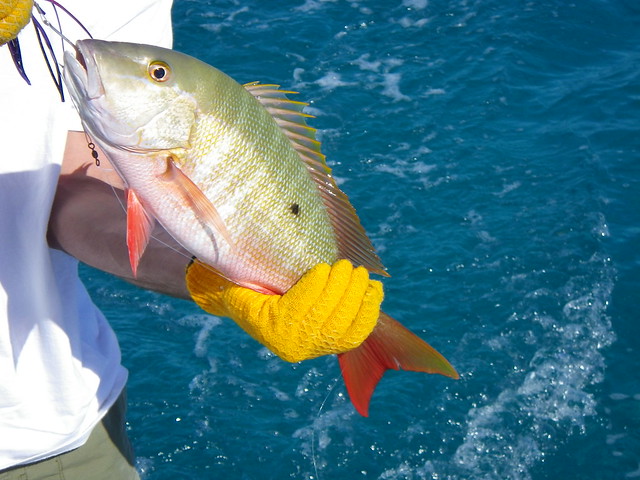
It was the same story between the Abacos and Eleuthera. I did put Ken’s lure in the water on the banks between Eleuthera and the Exumas.  It yielded a very nice snapper, followed by two very angry barracuda, the last of which bit through the wire leader and stole the hook.

Mutton Snapper

We went offshore a third time between Big Farmer’s Cay and Elizabeth Harbor.  I put a new hook on the lure, but once again, didn’t feel like putting it in the water.  A boat making the same trip alongside us caught four mahi-mahi on hand lines.  If they were in the fish, so were we.

It isn’t just fishing.  I have a new pole spear that has never tasted blood, and I haven’t bagged any lobster since the last time we went out with Ken.  Technically cruisers aren’t allowed to take conch in the Bahamas, but they were never in much danger from me anyway.

I’m not proud of any of this, and I hope to improve.  We expect that fish will eventually make up a large portion of the meat in our diet.  What we’ve seen available in the stores tends to confirm those suspicions.  Have you ever seen a Bahamian cow?  I haven’t had a good steak since my dad brought some in before Christmas.

Once the fish is cleaned, we can do it justice.  Another boat donated a big hunk of tuna to us.  We marinated it in lemon, soy, sesame, ginger, and garlic, then pan seared it and ate it rare.  Oh, it was good.

It would probably help if we started the trip with a cooler full of ice and could just throw the fish in without having to worry about cleaning it right away.  Hand lines are also probably better for hauling in a fish than reeling in 100 yards of fishing line.  But until I take a more relaxed view of our passages rather than being focused on VMGs and ETAs, I'll probaby never want to fish.

We have three more bodies of deep water to cross before we return to Florida, so I still have an opportunity to redeem myself with a big fish.  I’m not holding my breath.

Anchoring in the Bahamas

We had expected anchoring to be more difficult in the Bahamas.  We’d heard about poor holding in hard bottom scoured by current, and the need to use two anchors in a “Bahamian Moor” to prevent breaking one out of its set with every reversal of the current.  After dropping the anchor 36 times over the last 2 months, we don’t see what the big deal is.

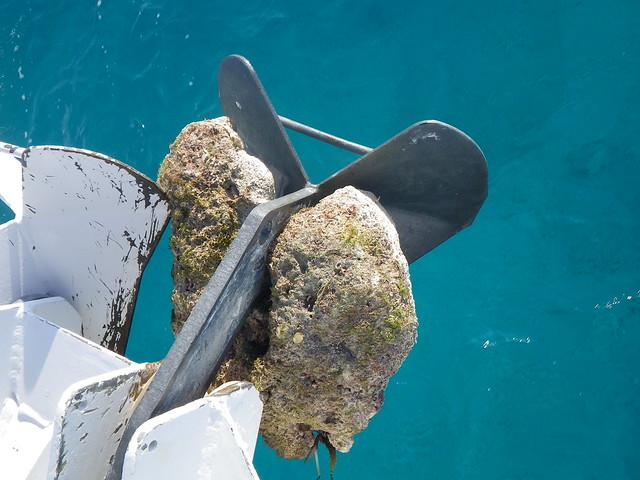
Rock Anchor

We’ve never needed to use two anchors.  Maybe we’re not going to the right places, but if the chart says “strong current”, “surge”, or “poor holding” we don’t go there.  We have seen one place where boats were using two anchors: the Norman’s Cay cut.  We looked at the cut, looked at the boats anchored there, looked at the forecast, and went somewhere else.

Our primary anchor is a 44# Delta.  For the most part we drop it and forget it.  We try to hit sand, and usually can see a cloudy spot where it lands.  We don’t back down on it, we don’t dive on it.  Sometimes I’ll go look at it with a glass-bottomed bucket, but that is rare.  Knocking on wood, we’ve never had a problem.  Sometimes it comes up clogged with weeds or rock, and sometimes a wind shift breaks it out and it has to reset.  But we’ve never had to re-anchor.

I don’t mean to sound flippant.  I’ve spent plenty of time worrying about my anchor, and many nights curled up with a portable GPS, getting up every hour to check the wind.  We’ve just never had a problem with our anchor holding.

We’ve come across two cases that make anchoring a little bit challenging: close quarters and high winds.  It takes a little practice to figure out where to drop the anchor to make the boat lay where you want it.  This is especially challenging when you’re trying to find shelter, the wind is forecasted to shift, and you want to make sure you remain sheltered without swinging into anything.  Sometimes I’ve ended up a little closer to the rocks after the shift than I planned to be.

When anchoring we let the boat come to a complete stop pointed into the wind before we drop, then we let her fall back as we pay out the chain.  We try to tie on our bridle quickly before the chain comes up short to prevent shock loads on the chain, windlass, and crossbeam.  This gets tricky when it is blowing since the boat is difficult to control when it isn’t moving forward.  We often use the engines to keep from falling back too fast or the bow getting blown off to one side, but it doesn’t always work.  If it were a big problem we could drop the anchor while still moving forward and use a hook for the bridle instead of tying it on.  The hooks aren’t as strong as the chain or are prone to falling off, so we prefer to tie them.

The adverse waves we've complained about before continue to be a mystery.  We've been anchored in this particular part of Elizabeth Harbour for about a week now, and a few days ago we had mystery waves.  The wind had not recently changed directions or strength, we were miles from any cut that would admit surge, and yet soon after the sun went down we started getting waves on our beam.  They are irritating and frustrating because we don't know what causes them, and therefore how to avoid them.  By the time they show up, it is always too late to do anything about it.

All in all, in our experience, anchoring difficulties in the Bahamas are over-rated.  We carry four (not counting dinghy anchors), but one always does the job.  If I had to buy a new anchor today, I might consider a Rocna, but they’re so expensive.  I’m more likely just to stay with Delta, though I’d probably move up to a 55 pounder.

Internet in the Bahamas

While our Internet use doesn't approach anything we'd consider unhealthy, we do use it quite a bit.  I am dependent on it for work, and while I don't necessarily need it all the time, I'm not retired either, and therefore need regular access to high-bandwidth connections for this lifestyle to be possible.  We undertook this trip without knowing exactly what we'd find in terms of Internet availability and quality.  We were pleasantly surprised in the Abacos, but not so much in the Exumas.

There are two Wi-Fi Internet providers in the Abacos, Out Island Internet and Bahamas WiMax, and one or both can be accessed from most anchorages.  If anything, the problem was too much Wi-Fi as the signals were often very noisy due to the number of networks within range.  We found ourselves selecting an access point not only by signal strength, but also by how many others were on the same channel.  We also found it helpful not just to select a network (the Bahamas WiMax APs all use the same SSID), but also to lock to a particular AP’s MAC to prevent us from skipping around.  Rates are $35/week.  We generally favored Bahamas WiMax since we felt they had a better network, but they had fewer APs and sometimes we had to use OII.  On several occasions while in the Abacos we were able to watch movies streamed from Netflix.  

The only settlement we visited in Eleuthera is Spanish Wells.  It did not have any public Wi-Fi signals and the harbor was also not big enough for us to enter with the big boat.  We parked outside, but could not hear any signals from there because of the topograhy.  I eventually found an open network by putting around in the dinghy, which allowed me to at least send and receive email.

The northern Exumas are uninhabited until you get to Highborne Cay.  The Highborne Cay Marina has Internet for its guests, but we never got close enough to see the signal.  Norman’s Cay is next.  I heard that there was an open network that could be used inside Norman’s Pond, but we never went inside and did not find any open networks on the West side.  The first network we actually saw was at Warderick Wells.  It is $10/day and is limited to 100MB, but is only for boats on moorings.  We were not on a mooring, so did not use it.  Next was at Staniel Cay.  We were anchored at Big Majors and could not get a signal there, but took a laptop ashore on Staniel.  The Exumas WiFi network at Staniel was so bad that we couldn’t even log in.  The Staniel Cay Yacht Club also offers Wi-Fi for guests, but we were not.  Next was Black Point settlement on Great Guana Cay, where a couple restaurants and bars offer Wi-Fi.  We did use the Internet here, after going 12 days without, but it was difficult at best.

The Warderick Wells, Staniel, and Black Point networks we found were all satellite-based.  That means signals had to travel about 100,000 miles round-trip through space.  The laws of physics prevent this type of connection from ever being considered fast by general standards.  By comparison, for terrestrial networks the max roundtrip is about 25,000 miles, even if the computers are on opposite sides of the planet.

We were hoping the availability in George Town would be better, since more people live there.  It was better, but we were still disappointed.  There are only two public Wi-Fi access points, each on different networks, and on opposite sides of the harbor.  

Harbour Wi-Fi broadcasts from the town side, and offers unlimited access for $15/week or $50/month.  One must go to Exuma Pets and pay cash for a username/password.  The pet store is left from the Exuma Markets dock, past the intersection and on the left.  The other network is Gaviota Bay and they broadcast from somewhere near Hole #1 behind Volleyball Beach.  They are very careful about their bandwidth.  One must buy “tickets” at the St Francis Resort for $2.  Each ticket is good for 25MB or 80min (your choice), but you can only buy two tickets a day.

Quality of each network varies.  Usually one of them is barely decent at any given time.  With a booster and some luck, both networks can be used at either the Volleyball Beach or Kidd Cove anchorages.  The Gaviota network is better both for speed and signal strength, but the bandwidth limitations prevent this from being a single solution for us.  However, Gaviota internet is free (and unlimited) for boats on St. Francis moorings.  Mooring rates are $20/day or $300/month.

There are several businesses ashore that offer either free or paid Wi-Fi, but we did not try those since they did not meet our needs.  I want the Internet all day for work.  Tanya wants it at night after the kids are in bed.  For both of these cases, we want Internet access on the boat, not in a café.

We have a Ubiquiti Bullet with an omni-directional antenna to pull wi-fi signals into the boat.  The Bullet is connected to a Cradlepoint wi-fi router, which constitutes our onboard network.  The Cradlepoint router supports a USB cellular modem, so when 3G/4G cell networks are available we can use those seamlessly.  For our next cruise, we’ll carry a directional Yagi antenna to help pull in weaker wi-fi signals.