Author Archives: Jay

FAQ: How do you receive phone calls?

I mentioned earlier that our US cell phones are forwarded to us here in the Bahamas.  We wanted to make it as simple as possible for people to get in touch with us.  Our cell numbers were already well known and we wanted to avoid changing our contact information.  We also wanted to avoid high international rates charged by most carriers, both for ourselves and ourcallers.  To meet these goals, we forwarded our US (Verizon) cell numbers to a US Skype number which is then forwarded to a Bahamian cell phone.  So far it is working very well.  Details can be read below for those interested.

[more]

Our cellular plans have plenty of minutes and forwarded calls count against them, but they also allow us to provide a set of numbers that are airtime-free and the Skype number is one of these.  The downside is that we are continuing to pay for a US cellular plan that we aren’t using.  If we had better planned ahead we could have “ported” our cellular numbers to Google Voice, which could forward those calls to Skype for free, and we could have then suspended the cellular plans.  Oh well.  I'm also the guy paying $10/month for Tanya's old email address from an ISP we haven't used in (best guess) 11 years.

The Skype number costs $18 for 3 months.  Calls to it can be answered anywhere in the world with a Skype “phone”, which is generally an Internet-connected computer, though other devices do exist.  We usually have Internet access to some degree.  I use it for work, we use it for email, news, weather, etc.  But since we are often hitting Wi-Fi hotspots that are miles away it is seldom good enough for Skype, and we have never been fans of VoIP to begin with.  Local cellular networks offer better call quality and greater coverage area, so we bought a Bahamian SIM card for $15 and forwarded the Skype number to that.  

The Bahamas is one of those places where the caller pays for calls to mobile phones, so the phone only incurs costs when we make local calls from it.  But since we’re forwarding from Skype, we are the caller, and have to pay an international rate to boot.  Fortunately, this is what Skype does best and the rate is only 24¢/min.  Further, Skype has subscriptions that let you buy a block of minutes at a lower rate.  A block of 400 minutes to the Bahamas is only $14/month which drops the rate to 3.5¢/min.

Outgoing calls to the US are a little trickier.  Skype doesn’t currently have any facilities that would let us call the US cheap without using VoIP, and we certainly didn’t want to dial internationally from our Bahamas cell phone.  Initially we would call using Skype and struggle through the first few minutes of the call before asking the person to call us back.  Google, however, has a nifty callback feature that helps out here.  We can initiate a call via Google Voice on either the website or through an app on my US cell phone.  Google first calls us, then calls our party and connects us.  An Internet connection is required in either case, so we can’t initiate calls from remote areas.

We expect that this strategy will work equally well in other countries.

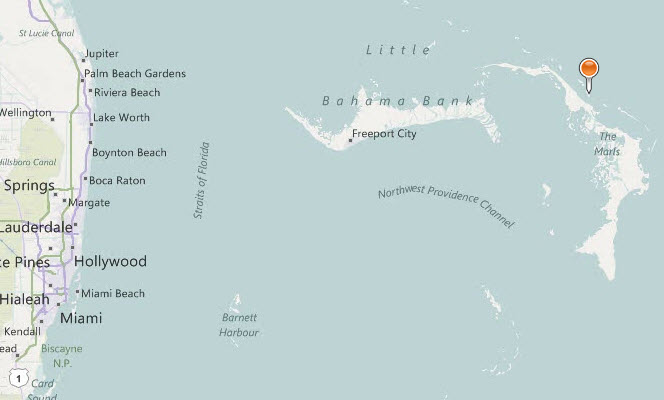
Green Turtle Cay, Abaco, Bahamas

We're in the Bahamas!  The trip from Florida was fantastic.  We successfully timed our trip so the mighty Gulf Stream was smooth as glass, but then we had lively sailing conditions in protected Bahamian waters.  We did a little exploring ashore today, but are generally catching up on rest and trying to figure out what to do next.

We have Internet access when we're near civilization (which hopefully isn't all the time).  Our US cell phones are forwarded to Skype, so that is available but we're not sure yet how well it will work.  Give it a try?

Marathon, FL to Abacos, Bahamas

We're in final preparations to leave Florida and head to the Bahamas.  We've been waiting for the weather to cooperate and finally see a window we like starting tomorrow. 

If I get to it, I'll update this post with more details about our expected route, anticipated weather, etc.  Our SPOT messenger will be on and our real-time track viewable on the Where Are We? page while we're underway and for a few days afterward.  My father is our emergency contact ashore.

Sunday

It was a productive day here on Take Two.

I started off with a simple (hah) project to temporarilyre-route the engine fuel lines to jugs. 
We need to run the engines out of jugs so we can limp overto the fuel dock to fill up. 

You may recall that we ran our tanks dry with our profligategenerator use.  We now know that thegenerator uses 0.45 gallons/hour and we burn about $2.50/day.  This of course doesn’t consider the wear andtear on the generator, nor the costs of our solar installation, or batteries.  But without those factors, this is prettygood.  When is the last time your monthlypower bill was $75?  Of course this comesonly by foregoing air conditioning.  Bumpthe generator usage up to 8 hours a day and our power bill jumps to $360.

Our engineslive in the middle of our hulls.  We havelittle stairwells from the main cabin down into each hull.  It is two steps down on either side, then twosteps either forward or aft.  The enginesare under the landings.  When I’m workingon the engines and the covers are off we just step right on the engine head.

But this morning when I stepped on the starboard engine Iwas treated to a spectacular fireworks show right under my feet.  The kind that can only result when 3,500cranking amps finds a dead short.  Whileit stopped arcing as soon as I took my weight off the engine, the next coupleminutes showed me that I probably need better access to my battery switches.  My plan for the day was officially cancelled.

The post-mortem revealed that the starboard engine had aloose motor mount under the alternator. 
Stepping on the engine caused it to compress on that side until thepositive post on the alternator contacted with the motor mount, which of coursewas grounded through the block.  This wasan awesome thing to find out before we try to cross the Gulf Stream.  Jay: 1, Murphy: 0. 

The last jerk to touch that motor mount cross-threaded theupper nut and decided to just leave it that way, rather than fix it.  The resulting vibration (which I’d noticed,but hadn’t yet found) loosened the lower nut which led to the problem above. 

I found four battery cable lugs to replace: the alternator positive,the solar positive and negative, and the starter positive.  Unfortunately, I think the alternator is fried.  This will be the third time I’ve had themrebuilt, and we hardly even use them.  Ialso installed new hour meters on the engines.

It isn’t unusual to be faced with these unexpectedprojects.  The boat is heavily stockedwith tools, parts, and other supplies to prepare for them.  It was somewhat satisfying to survive today’sunexpected projects without any need to go ashore.  The only thing I didn’t have today was a newnut for the old motor mounts.  I havefour completely new motor mounts waiting for that starboard engine, but thatwas a bigger project than I wanted right now. 
To be clear, I have big nuts, but none that fit.

In other news today, Sam showed he knows 15 letters.  Sarah sewed herself a purse.  We set the big boys loose on the kayak fortheir first solo explore.  And Tanya madeuse of our local cruiser’s net to find herself a haircut.  Oh, and it’s cold.  Getting time to leave.

A Dream Deferred

All men dream, but notequally.
Those who dream by night, in the dusty recesses of their minds,
wake in the day to find that it was vanity.
But the dreamers of the day are dangerous men,
for they may act their dreams with open eyes, to make it possible.
– T.E. Lawrence

My dad and stepmom bought a new catamaran, a Sunsail 384.  Their current boat, a Prout 31, is about as old as I amand lacks systems and amenities for comfortable cruising.  It probably also requires a bit moremaintenance than my dad cares for anymore. 
And lastly, the boat is located about 1,200 miles from where theyultimately want it.

The news is exciting to us on a number of levels.  They have been looking at new catamarans forabout 19 years by my count.  Since I wasa teenager.  They were regulars at theboat shows and there were always magazines and brochures around the house. 

It is tough for a kid to accurately gauge the seriousness ofan adult’s dreams, a child’s view of the world being much simpler than an adult’s.  So I spent a portion of my formative years withthe notion that buying a large catamaran was actually possible.  And it stuck with me.

The first boat I recall them dreaming about with apparentseriousness was a Privilege 48.  Thisimaginary boat even had a name.  Thatwould have been about 1991.  As I writethis aboard my own 48-foot catamaran, built in 1991, it is impossible not to thinkof that boat, and those dreams, as our beginning.

But as we were developing the Five Year Plan that led to thepurchase of our boat, we came to the realization that they would probably neverbuy theirs.  They didn’t have a plan, orwhat plan they did have started and ended with winning the lottery.  They went on to develop property interests inPanama, which I assumed was a replacement for the boat dream.  So I was surprised a couple months ago when Iheard they were making a trip to Ft Lauderdale to look at a boat, even moresowhen I learned they had a plan.

They are buying the boat through the Sunsail Yacht PartnershipProgram.  Many charter companies haveprograms like this whereby the company will take care of the boat, paying allexpenses and performing all maintenance, while it is used by charter guests.  The program guarantees a certain amount of monthlyincome for the owner which is expected to cover any loan payments.  At the end of the program period, owners takepossession of the boat or the charter company will help them sell it throughtheir brokerage.

During the term of the program, owners have rights to usetheir boat for a certain number of weeks a year.  They can also trade the usage of their own boatfor boats in other locations.  This is oneof the benefits of using a larger company. 
Sunsail has bases in the Caribbean, the South Pacific, theMediterranean, and the Indian Ocean. 
Pretty much anywhere you’d want to go sailing.  My parents’ boat will be based in Belize,which is very close to where they will ultimately keep it in Panama when itcomes out of charter.

I think we’re all hoping that they’ll use some of those built-inchartering vacations to visit us at various points along our way.  Conveniently, there is a Sunsail base right wherewe’re headed in the Bahamas.

I often wonder: if our lives were influenced by seeing myfather dream, even when the dream seemed out of reach, what will be the effecton my children when our dreams are lived daily?

Mercury 25, Part 3

It looks like the Merc got a reprieve. 

The new carburetor arrived today and I slapped it in.  I'm a pro at swapping it now.  The idle was definitely smoother, but for the real test I closed the low speed air mixture screw 1/4 turn.  Lo and behold, the motor started to sputter and die, just like the shop manual said it should.  I put in a new set of plugs and then Aaron and I went out for a trial run.  It ran great at everything from idle to wide open.

So the Mercury lives to die another day and that little project gets checked off our Bahamas TODO list.

Outta Gas

We ran out of diesel during this morning’s generatorrun.  For some reason I thought we weredrawing off of only one tank, and therefore had been very lax in monitoringfuel levels.  I guess I had been waitingfor this to happen.  It was a little disconcertingto learn that we were dry on both sides.  Oh well.

We already had a trip to the fuel dock planned in the comingweeks before we leave for the Bahamas.  I’mglad we ran out when we did because I probably would have gone on the fuel runwithout checking how much we had. 
Running out underway would have been seriously inconvenient.  Even though we can see the fuel dock from ourmooring, there’s an overhead wire we’re too tall to go under, and we have to gothe long way around Boot Key. 

On the bright side, this is a good opportunity to graduatethe fuel gauges and dipsticks, and find out how big the tanks really are.  We’ve been operating on the assumption thatthe tanks are 100 gallons each, but don’t really know for sure.  And when the gauge says 50%, we don’t knowhow much that really is because the tanks are not a uniform shape.  Nor do we know how much fuel the generatorand engines really use.  So we don’treally know much at all.

Truth be told, we do have a fuel transfer pump, so we couldhave found some of these things out before now. 
But it will be easier with the calibrated high speed pumps at the fueldock, if we can get them to let us sit there long enough.

We do know that the fuel tanks are clean.  First, we had the fuel polished before deliveringthe boat from Fort Lauderdale.  This iswhere they cycle the fuel by running it through a filter and blowing it back inunder pressure to loosen up more gunk.  Iwas not there to witness the process, but I have since been told the only wayto really get it clean is the open them up and scrub them out.  So we did that and found there was quite abit the polishing didn’t get. 
Interestingly, there was a pile of something granular under thestarboard fill pipe.  I figured it waseither sand or sugar.  Either way, itseems someone was attempting to sabotage the boat.  Not telling when it happened, but fortunatelythere were no ill effects.  With thetanks now empty, we can see that the bottoms are still squeaky clean.

So if we had 200 gallons when we filled up 140 days ago,that would be a burn rate of 2.8 gallons per day, which doesn’t seem verygood.  Most of it is generator usage, butthere is also probably about 300 miles of motoring in there too.  Unfortunately, we don’t have functional hourmeters on the engines.  The generator hasone, but I don’t think it is correct because it is way high.

I’ll dinghy over the fuel dock today (it is time for thatanyway) and get 5 gallons of diesel.  I’llput that in one of the tanks and see how much generator run-time that gets us.  Then we’ll start keeping track of the generatorhours, and I’ll install new engine hour meters so we can keep track of thosetoo.

The gallons per hour calculations should produce pretty gooddata.  Even though an engine burns fuelat different rates depending on load, our loads are fairly constant.  Our battery chargers max out at 33% generatorcapacity and only charge at that rate for a short time.  So the generator is just loafing most of thetime.  When underway we usually run theengines at about the same RPM, which is easy because its right below the point where they smoke and shake the boat.  We generally only use two for manueverability or to power into wind and waves.  Otherwise, we go about the same speed with just one.

Getting the boat to the fuel dock might be a challenge.  It is going to take a good amount of fuel, orvery flat water, to keep the pickups submerged. 
The weather pattern we’re in makes it pretty bouncy outside.  Too bad there isn’t a fuel delivery boat herelike they have in Fort Lauderdale.  MaybeI’ll run them out of jerry jugs instead of the tanks.  Yeah, that sounds pretty good.

Once we get to the fuel dock, the plan is to fill the tanksin 10 gallon increments, at which points we’ll mark both the dipstick and thefuel gauge for each tank.  The dipsticks aremade of smooth stainless steel rod and it is very difficult to see the fuel onit.  We plan to score the rod with a Dremeltool and a cutoff wheel.  Hopefully themarks will retain a little bit of fuel that will be easier to see when pulledout, and still be visible through the inspection port. 

With meaningful graduations, maybe I'll actually look at the fuel gauges more often.  And armed with burn rates I can put together a nice spreadsheet to predict when we'll run out again.

Mercury 25, Part 2

When we bought the Mercury, we wanted a used motor.  It was a prospective purchase; we’d never hada RIB before, didn’t know whether it was going to work for us, and had no ideahow much horsepower we wanted.  We alsowanted electric start and power tilt for Tanya, since she would be a primaryuser.  It would have been a veryexpensive motor new, and we were trying to be frugal and limit our exposure to a bad decision.

Now, we think a brand new motor is warranted.  We’re committed to the RIB and we are willingto make the investment for reliability.  We're ready to leave Florida and don't need the additional risk of a grumpy outboard.  Our mantra has changed to "the motor we don't know doesn't work is better than the one we do".  We’vealready determined that used motors aren’t economical for us anyway.  The only downside is that a new motor has to gothrough a break-in period, and we can’t start abusing it right away.

[more]

We have never seriously considered a 4-stroke motor.  They use less fuel and have cleaneremissions, and it would be great not to have to fool around with mixing oilinto the fuel, but for us the costs outweigh the benefits.

For starters, 4-strokes are more complicated.  They are now standard in the US because of ouremissions laws, but this is not the case in much of the world.  We envision ourselves going to developingcountries where we have to rely on ourselves and locals to keep our enginesrunning.  A sophisticated motor thatnobody understands and requires special tools and parts would be a liability,and possibly completely useless.  We’remuch more comfortable with a 2-stroke design that has been manufactured for 20years and is used worldwide.

Four-strokes are also heavier.  To my simple mind, the piston has to cycletwice as many times for each power stroke of the engine.  It can’t run twice as fast, so instead it hasto have a larger displacement in order to deliver equivalent power.  That means a larger, heavier block and flywheel.  Because we eventually have to lift it, either when moving the motor on and off the boat, or hoisting the boat in the davits, the weight is a problem.

The 4-strokes are the beneficiaries of more modern engineering,which helps with the power-to-weight ratio.  It’sone of those cases where improvements only occur when the manufacturers areforced to make them.  Progress is painfuland it took years for manufacturers to figure out how to make a good4-stroke.  It does appear that they’rethere now and today’s motors are fairly reliable.  But mandated progress is often misguided,like what they’ve done with ethanol in gasoline.

We compare the 4-stroke revolution to the way cars changedto electronic fuel injection.  Suddenlyyou can’t work on your car anymore, but the cars are more efficient and reliable. 
Like an old VW bug versus a HondaAccord.  But everything breaks eventuallyand back to my original point: try getting your Honda fixed in a coastal villagein Nicaragua.

So 4-strokes are pretty much off the table when looking atnew motors.  But we did make the roundsto the local dealers to kick the tires and let them help solidify ourposition.  And we learned a few things,too.  For example, a 4-stroke is harderto pull-start, which makes sense with the lower cycle ratio and largercylinders.  Electric start was already arequirement, but we want a pull-start backup. 
A 2-stroke will have both the electric button as well as a pull-starthandle, but to pull-start an electric 4-stroke you have to take the cowling and flywheelcover off and install a handle (at least on the models we've seen).

The Yamaha dealer was not very helpful, nor was the factoryrep, who happened to be there.  Neitherof them knew the product very well, and between them they gave us a couple of mis-truths. 
For example, they said the warranty could beused internationally, when Yamaha’s website clearly says it can’t.  But we did get to see the models (and how bigthey really are).  And we were surprisedto learn that Yamaha’s 4-stroke 20hp is only 10 lbs heavier than the 2-stroke25, which is almost acceptable. 

Of course, all the models he had were 4-strokes.  New 2-strokes are very hard to come by in theUS these days, and can only be had from dealers with the foresight to stock upon them before 2010.  We know of a dealer in St Petersburg that has them, but haven't given up on Miami yet.

The Mercury-Suzuki-Evinrude dealer was great.  When we explained what we want to do, he saidhis money would be on a Yamaha 2-stroke if we could find one.  He lamented not stocking up on the 2-strokeMercury motors, but Yamaha was still #1 internationally and he thought Mercurywas a distant second.  Apparently Suzukionly lets dealers carry above or below 40hp, so he couldn’t tell us much about thesmaller motors, except that he’d heard the Suzuki 25 was a turd. 

Evinrude is an oddball because their E-Tec motors are2-strokes that are actually cleaner than 4-strokes.  However, they do this with oil injection andelectronics and are therefore even more complicated.  This technology doesn’t scale down well andtheir smallest motor is a 25hp.  Itweighs 146 lbs, which is 35 lbs more than the Yamaha 2-stroke, so not acontender.  Otherwise they’re greatmotors and we see lots of them.  Thedealer has one himself, but said that 3 years between scheduled maintenanceoften leads to nasty surprises.

A new Mercury holds no attraction for us.  The only real differentiator is how theyshift.  On a Mercury you twist thethrottle one way for forward, and the other way for reverse.  Everyone else uses a handle on thepowerhead.  We tried to see this as anadvantage when buying our current motor; that a person could shift gears one-handedwithout fumbling for a shift lever, but previous experience told us this wasnot as simple as it sounds.  This hasheld true, and after using our Mercury almost every day for the last 5 months westill screw up the gears, or have to look down to be sure.

It is a major disappointment is that nobody has a power tiltoption in combination with a short shaft and a tiller on a new motor.  But our old Mercury 25 2-stroke does.  Actually, the Nissan 25 4-stroke does too,and it’s even fuel injected, but it weighs 182 lbs.  The only hope we have at this point on a newmotor is an aftermarket solution from CMC. 
This is a separate tilt bracket that bolts to the back of the boat andthe motor clamps onto.  It weighs 24 lbs.  It’s either that, or we continue to invest inour Mercury, or we give up on Tanya and the kids ever taking the dinghy ashorethemselves.

So assuming our old Mercury is a lost cause, our next choiceis a new Yamaha 25hp 2-stroke with a CMC tilt bracket. 

The final consideration for a new Yamaha is domestic orinternational.  We can buy a new Yamaha2-stroke 25 either in Florida or in the nearby Bahamas.  I don’t know if the motors are actually different,but the US dealers don’t recognize the international model numbers.  We discovered this with our old Yamaha 4hpthat Take Two’s previous owner bought in the USVI’s.  This really forces us to decide where themotor is going to spend its time.  A USmotor will come with a warranty that can only be used in the US, but we knowhow to get US parts shipped internationally, so that may be our best bet.  We have not checked the motor prices in the Bahamas,but we should since 2-strokes are not the rarity there that they have become here. 

Mercury 25, Part 1

The saga of our Mercury 25 2-stroke is nearing an end.  Unfortunately it doesn’t look like it is going to be asuccessful one, at least from the perspective of that motor’s continued serviceto us.  This will be a multi-part post;first to discuss the problems we continue to have with the Mercury, and then towalk through our options and thought processes as we begin to consider a new motor.  By the end of next week we should have a final decision up or down on the Merc.

[more]

There were warning signs from the beginning; we just didn’tknow enough to see them.  When we boughtthe motor, the skeg was damaged and it had a new prop.  The owner told us he had hit a rock and thedriveshaft had also broken and been replaced. 
There was also salt buildup around the cylinder heads from a coolingwater leak.

We used the motor daily for 6 months without so much as ahiccup.  It started immediately on thefirst pull or first touch of the button. 
It ran smooth and never gave us any trouble.  It idled evenly, though perhaps a touch fast,and it smoked a little, but not abnormal for a 2-stroke.  It was plenty fast; pushing our 12 foot RIBat 29mph.  The power tilt was a boon forTanya and she was the envy of other women struggling with big motors.

But after awhile we could no longer ignore little drops ofoil we saw leaking from the lower unit when the boat was lifted out of thewater.  And we noticed lots of oil aroundthe inside of the lower cowling. 

We thought the oil from the lower unit was a bad rear oilseal on the gearcase, and pulled the motor to work on that.  In retrospect, the length of time that weobserved oil without the gears seizing and the presence of oil up top shouldhave led us in a different direction. 
Sure enough, the gearcase was full and had no water in it, so the sealwas fine.  But during the course ofchecking it, we discovered that the prop shaft was twisted and the thrust hubdid not want to come off.  We alsolearned that the exhaust body had lots of oil and tar-like buildup inside it.

It was also during this initial project that we removed andcleaned our perfectly running carburetor (or so we thought).  That was dumb and it took a good bit oftweaking and tuning to get it running again, and it never ran as well as before,with misfires and fouled plugs in the #1 cylinder.  At this point the salt around the headreturned to our consciousness and became a likely factor.

This is the stage we were at when we began to think that anew motor was justified; faced with the twisted shaft, the mysterious oil, andthe wet cylinder heads.  But weconsidered it a learning opportunity and told ourselves that “the motor we knowis better than one we don’t”.  So wehauled it again, took it completely apart, and inventoried the parts thatneeded replacing.  The parts list topped$700 (at Internet prices), plus the powerhead needed a $300 trip to the machineshop to rethread some broken head bolts.

In the lower unit we replaced the prop shaft, thrust hub,bearing, bearing carrier, and rear oil seal. 
The oil seal itself was fine, but the bearing carrier was broken,probably from the same impact that did the other damage.  We were operating under the philosophy ofreplacing everything that wasn’t right, whether it was actually detrimental ornot.  The water pump received a newimpeller and new gaskets.

We discovered a broken exhaust tube between the powerheadand the lower unit, which explained the strange rattling noise from that partof the motor.  It also had an amazingamount of exhaust buildup.  We weren’tsure exactly how the exhaust tube was supposed to be attached, so rather thantry to fix it we just replaced it, which entailed a new adapter plate under thepower head.

Removing the head bolts was a serious exercise infrustration.  Aluminum block + stainlessbolts + salt water = corrosion.  Thebolts really, really should have been treated to prevent them from freezinginto the block and then breaking when we tried to remove them.  It turned out that this motor doesn’t reallyhave a head, just a cover for the water jacket. 
The cylinders are sealed except for the spark plug holes.  So the salt buildup (and leak it indicated)was relatively innocuous except to the bolts holding the cover on.  Like the carburetor, we would have been much betteroff to just leave it alone.

The powerhead was removed because we wanted to inspect thelower seal.  The impact and brokendriveshaft were factoring heavily at this point.  This necessitated removing just abouteverything from the powerhead.  All the electronics,the throttle controls, and flywheel came off. 
It was a good thing we took pictures during the disassembly because itwas a lot of little parts and wires.

Through the course of removing the electronics, wediscovered a bad coil on the #1 cylinder.  This was an excellent explanation for thesource of the misfire, and possibly for the oil, too.  We subsequently discovered that the lowerseal was fine, but the exhaust manifold was full of oil.  This hurt, because we could have figured thatout without taking the whole thing apart if we’d only thought to look.

Now the problem simply looked like incompletecombustion.  The leftover oil was oozingout of the block through the exhaust, down the body, and out of the lowerunit.  The oil in the lower cowling underthe powerhead was leaking past a failed gasket on the exhaust manifold.

With the problem presumably solved and all the parts wecould find to replace replaced, we began reassembly.  Miraculously, there were no “extra” partsleft over and after a few initial problems, it even ran.  But it ran like shit.  And that’s about the way it has been eversince.

We have rebuilt the carburetor multiple times.  We have fiddled with the bowl float level.  We have checked the timing.  We have tested the spark with the mostreliable (and painful) method we knew. 
We’ve gone through multiple sets of plugs and played with the gaps. 
We’ve endlessly adjusted the idle speed and thelow speed air mix.  At times we thoughtwe had it, but then after a high speed run it would fail to idle at all.

We are completely baffled. 
Configured to the specifications in the shop repair manual, the motorruns so rich it pours smoke and little droplets of oil are suspended in thewater.  When completely closing the lowspeed air mix screw, the motor continues to run, and idle speed actuallyincreases when the motor is supposed to die. 
This seems to indicate some type of leak or malfunction inside thecarburetor.

Carburetors are magical devices.  Their job is to mix atomized fuel into amotors air intake, and maintain the proper mix at all engine speeds.  It took us awhile to comprehend how this actuallyhappens, and then we were amazed that somebody thought of it, and then justshocked that they could make it work. 
There aren’t very many adjustments available, and those are rather crudeconsidering the precision of the carburetor’s function.  So when faced with a carburetor that isn’tacting normally, there is really only one option we can think of: replace it.

So that’s it.  Thecarburetor was probably off the entire time and the previous owner (or hismechanic) managed to make it run smoothly, but it was probably running way toorich even then.  The only choice we feelwe have with this motor at this point is to throw more money at it in alast-ditch effort to make it right.  Ifit doesn’t work, and we don’t have a lot of confidence that it will, we’ll ditchit and get a brand new motor. 

During the course of the repair we’ll have spent about asmuch again as we paid for it to begin with. 
And if our time is factored in, it would have been more economical tosimply buy a new motor each time.  Youread that right; we could have two brand new motors for what we’ve spent onthis used one.  That’s the hidden cost ofbuying used gear.

In the meantime, there is a toolbox in the dinghy at alltimes and Tanya won’t drive it by herself.

Shaft Retention Collar

Not many things will ruin your day on the water like losinga propeller shaft.  We once backed down underpower to spin some grass off the props and had one of the shafts slip out ofits coupling.  Thankfully, there was azinc nut on the shaft that kept it under the boat, but it wasn’t in the boat,and there was a large hole in the hull where it was supposed to be.  These types of things are typical fordelivery trips, but not really something you ever want to happen if you canhelp it.

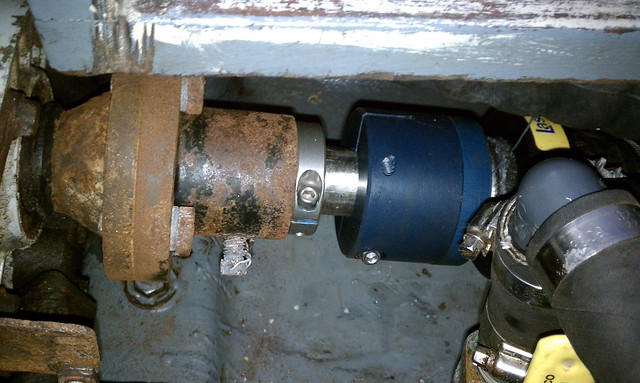
So the Shaft Retention Collar from PYI seemed like cheapinsurance.  And they were easy to put on,even with my ridiculously tight bilges. 
Getting a picture was tough, though. 
There isn’t much room to swing a camera, much less a wrench. 

Shaft Collar

I placed them right up against the couplings so any movementwould be apparent.  If the shaft comesfree, it will slide back until the collar hits the shaft seal.  Ideally I want enough space between thecollar and the shaft seal so the shaft can completely exit the coupling.  This would let the prop freewheel,drastically reducing the pulling force against the collar and letting the helmsmanknow something was wrong. 

Unfortunately, I don’t have that much room.  I will only know if the coupling has failedby making visual checks, or until the collar lets go too, probably making thecollar pointless in my case.  I shouldhave had the shafts through-bolted to the couplings the last time they werepulled, but didn’t think of it.

The shaft seals are new and quite a bit bigger than the oneswe had during the delivery fiasco.  Lookingat the picture above, I suddenly realized that if I do lose another shaft I’m goingto have a hell of a time getting a plug in there.