Author Archives: Jay

Tropical Storm Bonnie

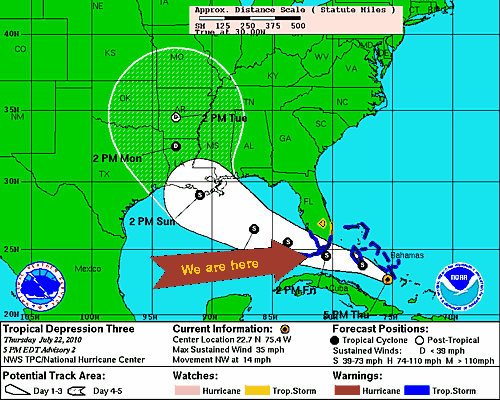
It looks like we’re about to get our first tropical storm.

I don’t have any concerns about our safety.  We’re in a well protected harbor and I’m pretty confident that the moorings are strong enough and well-maintained.  In fact, I’m a little bit excited.  Hurricane experience is hard-won and this will be a nice little introduction.  This will help us know what to expect and evaluate our exposure to future storms.

I do have a misgiving about the way we’re secured to the mooring.  The harbormaster and I have a little disagreement about the best way to moor my boat.  We’ve been doing it his way to keep things friendly and while the weather was mild, but his silly rules won’t be on my list of concerns when it starts to deteriorate tomorrow.

At this point it is just a tropical depression.  It was expected to become a tropical storm for the 5pm forecast, but the hurricane hunter didn’t find that it had strengthened enough.  It is still expected, though.  Slow development is fine with me since it reduces the chance that it could turn into a hurricane overnight.  The dockside prognosticators are predicting 50-60 knots, but I’m skeptical it will be that high.  We’ll have the instruments on to watch the wind speed.

What we have most to fear is other boats.  The boats on moorings have people aboard and are generally well looked after, but other boats are anchored, and many of these are neglected.  Either could break free, but think I we have more to fear from the anchored boats.  There aren’t very many boats around us, but most of the ones that are fall into this latter category.  I don’t think the wind speeds will be anywhere near strong enough that we’d have to worry about flying debris from the surrounding houses.

If we did have a problem in the harbor, there is a nice mangrove creek nearby that we should be able to get into without much trouble.  Tying into mangroves is a proven tactic for securing a boat for a storm.  They grow along twisting channels that don’t allow waves to build, and their root systems are very strong.

My secondary concern after the wind is about the water quality.  With all the rain that is sure to come, there will be a massive amount of runoff.  This tends to carry all kinds of trash that can clog our raw water strainers, and possibly chemicals that could damage our water maker, or otherwise compromise our ability to make water.  Most bacteria are larger than aqueous salt, so the water maker will remove them, but pesticides and other chemicals will pass through.

Automatic Generator Start


This morning I was very pleased with myself because thegenerator started all by itself.  Lastnight I installed a little gadget for that purpose and it worked beautifully.

Starting the generator automatically has always been on theproject list, but seemed like a solution looking for a problem, so it nevermade it near the top.  It wasn’t until wemoved aboard and spent some time away from the dock and shore power that werealized that running the generator was an essential part of our power diet.  If nobody were here to start the thing, ourbatteries would die and the refrigeration would shut down.  It meant we couldn’t leave, and suddenly anautomatic generator start became more important.

Yes, we have a large solar array, no, it isn’t enough, andyes, our refrigeration is grossly inefficient. 
If we were going to be gone for a long period, we would probably throwaway all the food and turn the refrigerators off.  But if we only want to be gone for a fewdays, it’s better to keep everything running while we’re gone.

Another part of the problem was finding the right unit.  It is most common to find the generator startcapability as an optional add-on to higher-end inverters.  Our inverters have the capability, but notthe option, and they’re too old to find the necessary module.  Plus, different generators have differentstarting requirements, and we needed a unit that had the flexibility to start our Northern Lights.

It wasn’t until the project received priority that a searchin earnest began.  It yielded a few hits,but none as clearly perfect as the GSCM from Atkinson Electronics.  A call to the company had one on the way $249later.  Installing it was really no moredifficult than looking at the back of the Northern Lights’ control panel andwiring the GSCM to the appropriate switch contacts.

Most of these units are designed to work off battery voltageto determine when the generator is needed for charging.  I could do better since I have a VictronBMV-600 battery monitor that watches the Amps flowing in and out and calculatesa precise depth of discharge.  Thebattery monitor allows me to set thresholds at which it will energize a relay,perfect for signaling an automatic generator start if the unit supports it,which the GSCM does.  I will add a Flexchargeprogrammable timer to institute quiet times when the generator can’t run. 
Typically I only want it to run between 9 and11am, and when the battery is below 85%.

If air-conditioning were important, I could also use thetimer to make the generator start on an interval, or use a demand device like athermostat to start it.  But that getsback into solving a problem that I don’t really have.

Folding Bike


For the first post with the new way of embedding pictures, Iwill introduce our latest purchase: the Dahon folding bicycle.

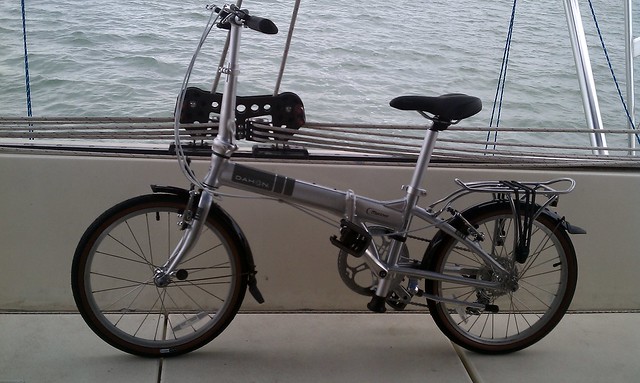
Bike

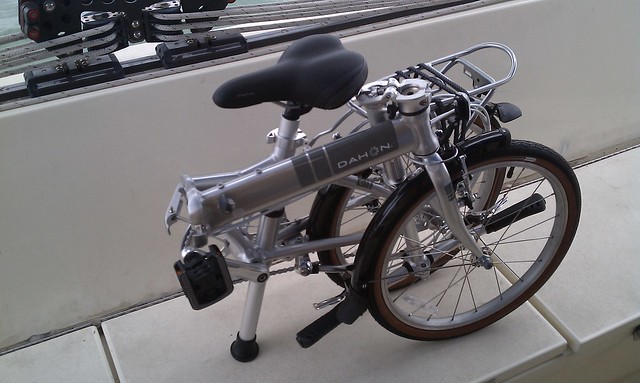
As the name would imply, the bike folds for easier storageand transportation to shore.

Bike, folded

We’re very excited about this bike.  Aside from folding, this also happens to be areally nice bike.  From reading theirmarketing, it appears that most of Dahon’s market is city folk who ride to workand carry their bikes onto subways and elevators.  Secondly are really, really committed bikeriders who need one they can take with them wherever they go.  People on boats appear to be an afterthoughtand though they make many different models, ours it the only one specificallymarketed for mariners.  Hence it iscalled the Dahon Mariner D7 (it has 7 speeds).

Our excitement is also because this bike significantlyenhances our range ashore.  This wassomething we never appreciated when we had two vehicles waiting at the end ofthe dock.  My trips to West Marine, HomeDepot, and ACE Hardware were almost daily when my transportation was atruck.  When it is my feet I seem to goless often and buy less.

The cargo carrying capacity currently consists of a milkcrate strapped to the back.  A foldingtrailer is a possibility if our needs prove greater.

The bike is ostensibly Tanya’s, since she is ourGalley Officer, and the one that has to make the 1-mile provisioning trek tothe store when we run low on beer.  Shemade a trial run to the local K-mart yesterday and I barely got the dinghy backto the boat before she was calling to be picked up at the dock.  The kids all have folding Razor scooters, so ona family trip I’ll be the only one without wheels.  We’ll have to wait and see if another bikemakes sense.  We haven’t even figured outwhere we’ll put this one yet.

Pictures

Getting pictures on the blog has always been a bit of a challenge, and therefore hasn’t happened with any regularity.  The editor tired of the situation and cracked down on the technical staff to make it better.  Hopefully the situation is now improved and following us here will be more visually interesting.

The main change is a move to Flickr for the image hosting.  I didn’t exactly make an extensive evaluation of the options, so there may be significant downsides to this, but for now it seems to be working.

You’ve probably noticed the photos in the sidebar.  This will always show our most recently uploaded photos.  Additionally, the same photos can now be easily embedded in the blog posts themselves to supplement the content.

Probably the biggest advantage to using Flickr is that we have phones and cameras that can upload pictures there directly.  So, in theory anyway, a picture could be in the sidebar gallery within seconds of being taken, with nobody having to sit down at a computer to do it.  All of the recent pictures over there now were taken from my phone and transferred wirelessly.  

The only currently known downside to Flickr is the image quality.  Regardless of the image we capture and transfer, Flickr reduces it to their standard size.  This is actually a partial benefit since part of the previous picture posting routine was to do this reduction manually.  However, we are now scaling them up slightly for display in the blog posts, so there is a bit of loss going on.  Ironically, if you click on the photo, it will actually display smaller when it reloads from the Flickr website in its native size.  We’ll have to see how this works out in practice.

There will probably be a burst of new pictures added soon as Tanya goes through her camera and uploads older photos.  Some of the previous posts that were intended to have pictures at the time, but required technical assistance, may now get them.

FAQ: What kind of safety equipment do you have?

This is an awkward question because it delves into a number of emergency situations that I contemplate and prepare for, but never expect to happen.  I give fair warning that the discussion of the safety items we carry may conjure images of potential disasters that necessitate their use.  I assure you, dear reader, that I have considered these in detail and with a great sense of responsibility.  Your nightmares are no match for mine.  That said, we feel strongly that our life afloat is no more dangerous, in fact less, than life ashore.  Perhaps a future post will address this point directly.

Boats are required to carry certain items for the safe operation of the vessel.  The list varies by the length of the vessel and how many passengers it carries.  The most prominent items are flares, fire extinguishers, and life jackets.  My boats have been boarded by the Coast Guard twice for inspection.  Both times were pleasant, cordial experiences and no deficiencies were cited.

Take Two came to us with a very extensive set of flares, some very exotic and expensive-looking.  Unfortunately they were all expired.  Some even said they were made in “West Germany”.  We went through them and kept the ones that still looked good, just in case, and the rest we donated at the local hazardous waste dropoff.  We have newer ones to show the Coast Guard when they check, but the old stuff probably still works just as well.

Everybody has their own life jacket (Personal Flotation Device in Coast Guard lingo).  The kids spend so much time wearing theirs that they look natural in them.  Tanya and I have the auto-inflating kind, but wear them less often.  Mine has an integrated harness so Tanya has a way to haul me back aboard if I’m injured or unconscious.  Tanya has a separate harness because her PFD is designed for women, and they don’t make those with the integrated harness for some reason.  During rough weather or at night, the harness is attached to the boat with a tether to keep us from going overboard in the first place.

We have an Autotether system to alert us if someone does go over.  The system consists of little transmitters that are placed on the life jackets.  The transmitters communicate with a base station aboard the boat several times a second.  If the base station loses contact with the transmitter, it immediately sounds a very loud alarm.

The boat also came with an exposure suit, which is kind of a cross between a wetsuit and a ski jacket.  I tried it on and almost passed out from heat.  We don’t have any plans to be in water cold enough that we would need something like that, so I got rid of it.

We have these silly little tapered plugs that you’re supposed to have so you can jam them in holes or broken hoses to stop water flow.  I was sure I’d never need them, but damn if I haven’t had to use them TWICE to keep the ocean on the outside.

Of course we have a VHF radio, but it only has a range up to about 40 miles.  At some point we will probably get a single sideband (i.e. shortwave) radio that can bounce signals off the ionosphere to the other side of the planet.  In addition to voice, the SSB can be used for receiving weather faxes and even email.  When we start venturing beyond US coastal waters we’ll probably get an Iridium satellite phone, which can also be used for email and very light Internet access.  All of these can be useful for giving and receiving help during emergencies, but the satellite phone would be especially valuable if we needed to obtain medical advice.

We carry a rather extensive first aid and medical kit, including some good prescription medicines and surgical supplies (thanks Jeff!).  We have received two days’ worth of training on how to use the stuff, but we’ll still need outside advice for any major issues.  Additionally, Tanya has had CPR training and attended a Safety at Sea seminar.

If, God forbid, someone should need immediate medical attention when we’re far from civilization, we have an Emergency Position Indicating Radio Beacon (EPIRB).  When triggered, it communicates who and where we are to a satellite, which relays the information to global search and rescue authorities (such as the US Coast Guard, among others).  It does not, however, indicate what our problem is, and the assumption is that we require evacuation.

Depending on where we are, help will usually come in the form of a rescue boat or helicopter, but I have heard of things as diverse as military jets and commercial fishermen making initial contact.  It just depends on who can get there the fastest.  How long it takes will depend on weather and location.  Helicopters don’t fly in hurricanes.  

I have heard of two recent EPIRB rescues that probably represent the best and worst cases.  Abby Sunderland was recently rescued from the southern Indian Ocean.  She set it off on Thursday morning and was picked up by a fishing vessel on Saturday.   Then earlier this week a boat capsized 20 miles off the coast of California.  The Coast Guard was there within an hour to rescue three hypothermic crew members.

EPIRBs, personal locator beacons (PLBs), and the SPOT devices have been criticized for emboldening people who aren’t adequately prepared for their adventurous undertakings.  When they get in a little over their heads they just turn on the EPIRB for a ticket home.  We take our EPIRB very seriously.  We know that if we ever set that EPIRB off we will be leaving the boat with nothing but the clothes on our backs and will probably never see it again.  Needless to say, that isn’t something we’ll do unless absolutely necessary.

The life raft is our last resort.  The boat came with a raft, but upon evaluating its condition and the costs of recertification, we opted to buy a new one.  We’ve been without one for awhile, but we finally placed the order for an 8-man Winslow this week.  This particular brand is made here in Florida, so we’ll go see it when it’s ready and before it is packed up and sealed.  This familiarity will be important, especially for the kids, if we ever have to use it for real.

I really don’t think there is a likely scenario that would see us use the raft.  The adage says you should always step up to the life raft, meaning your boat should be sinking.   History is rife with examples of crews taking to the raft and being lost, while the boat is later found afloat.  Being a catamaran and thus not having ballast, I don’t think Take Two is likely to sink.  We have powerful pumps to remove unwanted water and materials for plugging any holes.  But any number of unexpected things could happen that we might need to abandon the boat.  Since mothers may be reading, we’ll let those horrors remain nameless.  If nothing else, the life raft is a really expensive insurance policy.
Leatherman

I’m hard on tools, so when somebody offers an aggressive warranty I’m there.  Actually taking advantage of the warranty is another matter, though.  Usually I’m too busy, or forget, or the tool gets lost after falling out of service, or maybe I feel guilty about the blatant abuse I gave the tool to break it. 

So I was very impressed with myself when I sent in three Leatherman tools for replacement last week (Yes, when one broke I bought two more).  I was even more impressed with Leatherman when three replacements arrived yesterday.  Say what you will about the quality of their tools (and I have), but they stand behind them.

FAQ: How do you handle sewage?

Very carefully.

A boat cruising in US waters pretty much has to have a holding tank rather than flush the toilets directly overboard.  That’s because the US has laws preventing overboard discharge within 3 miles of the coast.  Never mind that many coastal cities pump their sewage into the ocean as a matter of course (Miami), or regularly have accidents whenever it happens to rain too much (Tampa).  Or that the real pollution problem in our oceans is caused by fertilizer runoff from residences, golf courses, and farmland.  It stinks but that’s the way things are.  

When being inspected by the Coast Guard usually the first thing they want to see is your Marine Sanitation Device, which is their official term for the commode, to make sure it is properly secured.  In typical government fashion, the laws only apply to the toilets themselves.  It is perfectly legal to go in a bucket and toss it overboard.

We can hold it comfortably for about ten days, which is pretty good for having 6 people aboard, but usually empty the tank on a weekly schedule.  The tank can be pumped out at a shore-side facility such as a marina or fuel dock, or by a special boat that comes to us.  Additionally, most boats also have their own pumps so they can dump overboard when beyond the 3-mile limit.  We do all of the above.  

When offshore, we empty the tank with a macerator pump, which has little blades like a kitchen sink disposal.  The kids particularly enjoy watching our muddy wake while the pump does its business, but it isn’t all fun and games.  The thing is notorious for breaking down and I have had to rebuild it multiple times.  Every aspect of the process related to the tank is fraught with danger.  Poo under pressure is never a good thing and I have witnessed a couple nasty accidents during dockside pumpouts, but have fortunately never experienced one myself.

Outside the US, the holding tanks are usually dispensed with and the goods go straight overboard.  The Caribbean is full of boats doing this and it doesn’t seem to be a problem.  From what I’ve heard, though, you aren’t allowed to flush paper in the Caribbean.  Go figure.

The marine toilet is a bit different from those typically found in a house.  Household toilets operate by gravity, which is not quite as reliable on something that moves the way a boat sometimes does.  You want to deposit that stuff in a safe place where it can’t get back out except on your terms.  Marine toilets operate on principles similar to those on an airplane, but rather than a simple device that empties the bowl in one big vacuum flush at the push of a button, like on a plane, our toilet has handles and levers and must be pumped manually.  It’s definitely a more complicated procedure and most guests require a briefing.  If you’ve been aboard, you’ve probably experienced it for yourself.

There are several different toilets types available for boats.  Our current one was selected because it was the cheapest and most commonly available, but certainly not the best.  It was installed as an expediency after I canned the four toilets that were on the boat when I bought her.

That was over two years ago and six of us have been enjoying it daily for almost a year.  It has proven surprisingly reliable, but when it does have a problem, it immediately goes to the top of the project list.  Usually the problem isn’t discovered until someone has to use it.  In a pinch, we get the bucket out.  Installing a second toilet is somewhere further down the project list and staying there for now.

The biggest challenge to our toilet’s regularity is the kids’ toilet paper use.  Every once in a while, one of the kids will use about half a roll of TP and clog it up.  They have all been amply warned, so when it happens the culprit becomes my special helper for the unclogging.  You can’t just use a plunger the way you would in a house (remember, poo + pressure = bad).  You have to open the hoses until you can find the clog and clear the line.  It’s a messy, messy job.  So far there haven’t been any repeat offenders.

Depth Perception

Apparently, I have a habit of dropping my glasses in the drink.  The main problem is that I like to hook them on the collar of my shirt.  But they aren’t secure there, and if I bend over they slip off and the next thing I hear is the splash.

Now this doesn't happen in crystal clear tropical beach kind of water, only in dirty murky water with who-knows-what on the bottom.  I’m no fan of murky water, and the last thing I want to do is get in it and search around down there.

So the first time I dropped my glasses, about two years ago, I said “Oh well” and bought a new pair.  A new pair was about $400.  Then when it happened again last year, I called a diver to have the bottom of the boat cleaned and mentioned, “Oh, by the way, could you look for a pair of glasses right about here”?  He found them with no problem and I got the bottom cleaned for about $80.  Good deal.

We place a big emphasis in this life of ours on taking care of ourselves.  I won’t always be able to whip out my credit card, or call on someone else to help. I have spare glasses, but I also try harder not to drop them in the first place, and take more responsibility when I do. 

So when I dropped them again a couple weeks ago I sighed and said, “Aaron, get my mask and fins”.

FAQ: What about hurricanes?

I have spent a lot of time thinking about this.  At this stage in our life aboard, we don’t move around too much, and our home base is at risk of the occasional hurricane.  In the future we’ll likely change our location seasonally based on weather patterns, but for now we have to take what comes.  Florida has had a couple bad years recently, but fortunately it has been pretty quiet since we’ve owned the boat.  But one thing I learned from owning a house during those bad seasons is that if you wait until a storm is forecasted before making your preparations, you’re pretty much screwed.  So we have a plan for Take Two.

Hurricanes are big enough and unpredictable enough that moving the boat out of a forecasted landfall area isn’t really practical.  You would be pretty much guaranteed to experience bad weather of some type during the transit and may very well increase your risk.  I think the time is better spent preparing the boat and taking your chances where you are.

In theory, the boat is safest at sea in open water.  My understanding is that the Navy and Coast Guard take their ships to sea.  As I’ve posted elsewhere, Take Two’s original owner did this with success, but there are several key differences between then and now.  For one, Take Two is older than she was then.  I like to think that she’s still strong and capable, but I don’t know for sure and haven’t tested her much.  The other factor is the crew.  Tanya and I just don’t have anywhere near the skill and confidence to face that kind of weather intentionally.  Could we do it?  I bet we could.  But it isn’t a reasonable risk.

To prepare for a storm in the marina we move the boat into a more protected slip and double the number of fenders and docklines.  We take the sails and other gear off to reduce the windage.  But the boat is only safe in the marina up to a certain point.  Docklines frequently break or chafe through under those conditions, and even if you prepare adequately, what if your neighbor doesn’t?  Storm surge is also a serious problem.  It is virtually impossible to set your docklines such that they restrain the boat properly when the tide may rise 20 feet or more.  In our case, it would only take about a 10 foot surge for the docks to float right off the pilings.  The boat is now secured to a raft that isn’t secured to anything at all.

So for an intense storm or a high strike probability, we’ll take the boat to what we hope will be a sheltered area nearby, moor her as best we can, and leave her to her fate.

This is the scenario we’ve spent the time planning for.  It involves many anchors (I currently own five), lots of high tensile chain and heavy duty shackles, and heavy 1″ line.  The goal is to array the anchors so that as the wind shifts they don’t have to break out and reset.  Shock absorption is necessary to avoid breaking the chain, so we’ll use relatively stretchy lines for the rode and bridle between the boat and the anchors.  And we will also try to eliminate all points of chafe by using thimbles and shackles on each end of the lines.  For the boat side, we’re currently planning to use chain inside hose looped around the cleats, but I’m still thinking about putting stronger attachment points on the bows that the line can be directly shackled to.

We’ve purchased all the gear called for in the plan and have it in our storage unit, so there should be a minimum of panic shopping.  Setting it all up will require a significant amount of time (much of it underwater).  We should probably practice it at some point.  Hopefully we’ll never need it.

Sailing Around a Hurricane

Something interesting turned up during my research of Take Two.  Her original owner's name was David Brockman and I believe he commissioned her construction and had some degree of input on the design.  (David, if you're out there, please get in touch!)  I found an account that he wrote
here of sailing Take Two around Category 2 hurricane Marilyn in 1995.  They say a boat is safest at sea during a storm…

David writes:

Anchored in Charlotte Amalie on St. Thomas with hurricane "Marilyn" fast approaching (she traveled from Barbados to southeast of St. Croix in just 24 hours) the question of what to do in the little time available arose!

To cripple a perfectly safe seagoing vessel by tying her into the mangroves of a hurricane hole with a dozen lines and anchors, as we did for hurricane "Luis" just over a week before … and hoping the storm wouldn't come too close — just didn't appeal to us any longer. We have seen the damage that can result from just one vessel coming loose in a hurricane hole, not to mention the damage resulting from "Luis" in Antigua and St. Maarten.

Our catamaran "Take Two" can cruise at about 10 Knots (12 mph) and with a top speed of about 18 Knots (21 mph). She is faster than the average hurricane, so this time we decided to sail around the storm!

Armed with a short wave radio to receive the position of the storm at all times, we sailed south in front of her. "Marilyn" was heading northwest. On the northwest hemisphere the winds blow counter clockwise around the eye of a hurricane, so theoretically one can go for a "nice" downwind sail all the way around without getting too close to the dangerous center.

And it worked! On Sept. 15, at 11 am we were at the same latitude as Marilyn, just 78 miles west of her center. The seas were high (we didn't even try to estimate their height), but the wind speed didn't go over 30 Knots… a good sailing wind for "Take Two". Everything is down hill now… we've made it… we thought.

As the wind came around we changed course as well. The seas were confused by the change in the wind direction and the winds became stronger and stronger. With 55 Knots of wind and sailing 15 Knots under a heavily reefed Genoa we waited for the next update from the Hurricane Center in Miami.

This gave us the clue: "Marilyn" had slowed down significantly while she whipped St. Croix and St. Thomas, and we were actually catching up with her! This was the first time we had ever wanted Take Two to slow down. More reefing didn't help at all and in torrential rain.

Fatigued from being in the storm for 30 hours, we remembered the old tales of sailors — who used to "heave to" in a hurricane. We decided to try this maneuver and experienced sudden quietness, as if somebody had turned off the storm. We were drifting sideways at about 2 Knots riding softly over the long high waves and old swells. After having slept for about 5 hours, the wind speed had fallen to a comfortable 25 Knots, the sun rose, the seas were still high, but the breaking crests were no more.

Having circumnavigated "Marilyn" we sailed home, expecting the worst, but were glad to discover that the crew charted fleet had survived Marilyn without any major damage and all of our friends were safe and sound aboard their yachts.