Category Archives: General

Pete’s Pub

One of our favorite places in the Abacos is Little Harbor, a sweet spot at the southern end of the Sea of Abaco. We’ve stopped there both coming and going—it’s either our first stop after crossing Northeast Providence Channel from Eleuthera and the Exumas or our last taste of Abaco before heading south. The area has a lot going for it—caves with stalactites, stalagmites, and bats, a beautiful protected cove filled with sea turtles, a nice hilly hike, an ocean beach with dramatic views and good waves, a bight with good snorkeling and excellent kayaking, blue holes, and, of course, Pete’s Pub and Foundry.

Pete Johnston came to the Bahamas on a boat with his parents in the 1950s. His father was a sculptor skilled in the art of lost-wax casting, and he built the foundry that is there to this day, open for tours daily. The last time we visited, Eli got an early Christmas present in the gallery: a bronze shark belt buckle on a leather belt made by none-other-than Pete himself. He even measured Eli and punched the holes. He does beautiful work, and also happens to run our favorite restaurant.

Pete’s Pub is the ultimate low-key beach bar. The food is always fabulous, with the fish and conch on the menu usually caught and cleaned that day. The burgers are a bit pricey, but better than you’ll find anywhere else in the Abacos, where good meat appears to be scarce. The sides are always a spicy version of the Bahamian standard, peas-n-rice, and a to-die-for pineapple cole slaw. We’ve never been disappointed. The atmosphere is special, too, with the picnic tables in the sand, little shady places to sit, a “porch” near the bar with Adirondack chairs to sink into with your cold Kalik or their famed fruity rum drink, “the Blaster” (why walk when you can crawl?). The whole place is lit with small lanterns and Christmas lights and festooned with tee-shirts donated and signed by past visitors. Add some good music and a hook-and-ring bar game and you have the perfect place to relax at the end of a long sail.

We like to head over in the dinghy around 6-ish, when the red-yellow-green traffic light on the beach comes on. You can go up on the rooftop balcony to see a great view of the sunset or the breakers on the ocean side. The kids bring things to play with (army guys, buckets and shovels, dominoes, coloring books, etc.) and we spend the whole evening enjoying a meal or drinks, meeting other boaters and talking to locals. It’s the sort of place that seems outside of time, unchanging, like the Restaurant at the End of the Universe.

We often have a hankering for Pete’s Pub, but part of its charm may be that it’s so hard to get to. When we arrive, it is usually with weariness and joy in equal measures. Little Harbor is an easy place to pass up, with the washing-machine surge against Tom Curry Point and its shallow entrance, but once inside, it is a little slice of paradise, remote but not isolated, secluded yet welcoming. It’ll be awhile before we get back there, but, eventually, when the craving hits, we’ll untie the dock-lines and brave the ocean waves again, knowing that there’s a bright spot at the end of every journey.

Life is School

I have written elsewhere about our homeschool, or rather, boatschool practices (see FAQ: Do You Homeschool the Children?), but from time to time I like to post an update about what we’re learning on Take Two. Now that we are traveling, formal schooling has taken a back seat to fun and exploration. Instead of doing the “Daily Dozen” (see footnote), we’re down to three: Reading, ‘Riting, and ‘Rithmatic. The children are still responsible for a page in their math workbooks, an entry in their journals, and a chapter in the book we are currently reading (we just finished the WWI autobiography Seargent York and the Great War and have moved on to Karen Hess’s Out of the Dust), but these tasks are usually done before noon. When the school-work and chores are done, the kids are free to pursue their own interests, and I am pleased to report that the choices they make for free time are both diverse and fascinating. Our key mission is to inspire our children to be life-long learners—after all, life is school—and we are beginning to see them independently take on challenging books and projects (yay!). Aside from the history and science they pick up as we travel, they are each exploring new areas on their own.

Eli, 11, is learning Small Basic. Jay set him up on an old computer and gave him a tutorial and a book, which he is working through as if it were a game instead of a new language. (I wish he felt that way about Spanish!) Earlier this year, Jay gave a mini-lesson on a base-two number system, and Eli took an interest and wrote a coded letter to a friend in binary. While we lived in Marathon, he picked up a new sport: tennis. He and I spent many a happy afternoon hitting and chasing little green balls. He reads like a fiend when given the chance, and is currently reading Mary Shelley’s Frankenstein.

Aaron, 10, is our most mechanically-inclined child so far, and is teaching himself electronics. It started with a set of Snap Circuits he got for Christmas one year, but has quickly morphed into projects from Charles Platt’s Make: Electronics using chips, wires, a soldering gun, capacitors, resistors, LEDs, and some tiny little color-coded wires. Don’t even ask me what he’s doing, because I don’t understand it. He also got a neat Lego motorized loader/bulldozer set for his birthday last year and has been using gears from that set to build gear boxes that have six speeds and actually shift. While his brother was enjoying tennis, he was practicing the half-pipe on his skateboard and discovering a love for basketball. His favorite book is David Macaulay’s The New Way Things Work.

Sarah, 9, is a little like Ginger Rogers, who could do everything Fred Astaire could do, only backwards and in high heels. She’s working on her online test to get a Florida Boating Safety Education I.D. card so she can captain the dinghy and also doing some computer programming and electronic experiments in her spare time. She prefers learning French to Spanish, paints with acrylics, and writes stories for fun. She is always working on a new knitting project, and is also currently sewing her sister a nine-patch quilt. She’s taken to gardening, and even though we are short on space, she has a pot of carrots growing on deck and an assortment of herbs on my galley window sill. Given some alone time in her room, you can hear her playing her keyboard and it actually sounds like music. She’s always reading at least three books simultaneously, but loves Walter Farley’s Black Stallion series of books on her Kindle.

Sam, 6, is still learning to read, but seems to have a gift for numbers. He has excellent mental math for someone so young and seems to absorb math facts just by being in the same room as the older kids. He is learning to draw airplanes and WWII battle scenes, can play a mean game of chess, put together a 1000-piece puzzle, do complex dot-to-dots with hundreds of dots and really likes stories by Dr. Seuss. He has joined the bigger boys on their flight simulator and enjoys dogfights in his Spitfire.

Rachel, 2, is the smartest toddler we’ve ever produced, a fact I credit with the time Sarah spends reading to her and teaching her every day. She talks in complete sentences, is potty-trained, sings nursery rhymes, counts to ten, and surprises us with her accuracy when naming shapes, colors, and even some numbers and letters. She can dress and undress herself, brush her own teeth, and blow her own nose. She has impeccable manners and loves to have stories read to her. She’s learning to swim, but I’d like to see that skill really solidify this summer, as it will increase her joy and our peace of mind.

Jay and I don’t seem to find a lot of “spare” or “free” time, but when we do find those moments, we love to read. Jay is experimenting with Arduino microcontrollers, and is rereading the Hornblower series by C.S. Forrester for pleasure. He just finished a WWII memoir, With the Old Breed: at Peleliu and Okinawa by E.B. Sledge. As an English major, I read lots of dead white guys in college, but missed a lot of the American authors, so I’m trying to cover some lost ground. I started with Herman Melville’s Moby Dick, and enjoyed it more than I expected to. I took a break and read James Mitchener’s Chesapeake, which led logically into a reading of Harriet Beecher Stowe’s Uncle Tom’s Cabin.

While Jay fiddles with electronics projects with Aaron, Sarah and I experiment with new recipes. We made a skillet coffee cake from Robbie Johnson’s Gourmet Underway. I love it when learning becomes a whole-family venture, and one of my favorite things about homeschooling is that everything at home becomes an opportunity to learn, whether it’s peaceful conflict resolution or how to mix a Goombay Smash for sunset visitors.

Note: The Daily Dozen replaces a project-based curriculum while we have a toddler on the loose. It’s an experiment to see if we can do school in five-minute increments between potty-training and temper-tantrums. The dozen mini-lessons cover these areas: Bible/Family Devotions, Music, Math, Science/Nature, Spanish/French, Vocabulary/Grammar, Geography, Logic/Brain Teasers, Art History, Navigation/Seamanship, Poetry, and History/Literature.

Exploring the Exumas

We love this remote and rugged island chain for its clear blue water, its dramatic rocky terrain, and its idyllic deserted beaches. It is rare that you share a beach (and sometimes a whole island) with another person, and if you do see someone else, you merely hop in your dinghy and zip over to the next, less-crowded beach. What follows is a summary of our stops on this trip.

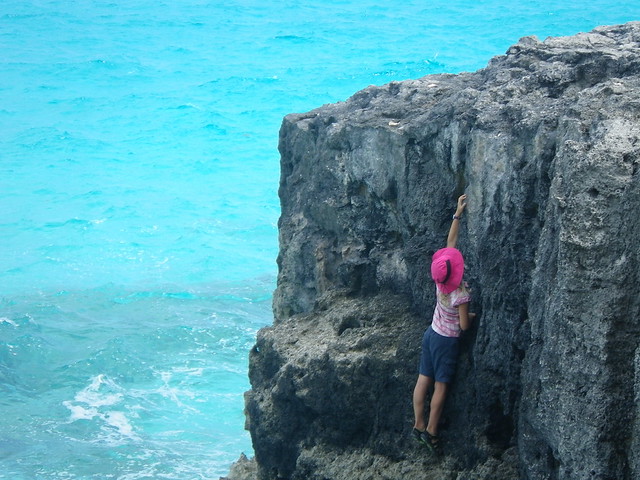
March 22, Highborne Cay—We picked up where we left off two years ago, at a familiar anchorage with a pretty beach, good snorkeling, and plenty of calm, clear, shallow water for swimming. Our kids have a great love for two things: swimming and climbing. The Bahamas has plenty of both, so sometimes it feels like a giant playground made just for us.
Reach

March 25, Warderick Wells—The Exumas Land and Sea Park is probably one of my favorite places on planet Earth. We anchored at Emerald Rock and returned to the park headquarters on Warderick Wells. We did some hiking on familiar trails, actually saw a hutia on Hutia Hill (it looks like a giant hamster), looked for friends’ boat names on driftwood up on Boo Boo Hill, climbed around near the Blowholes, and spent some time on one of those idyllic beaches. There we found the biggest hermit crab we have ever seen.
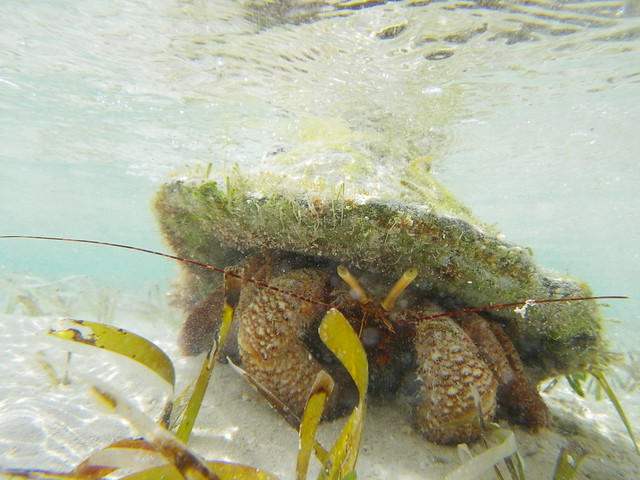
IMGP0028

March 26, Hog Cay—Hoping to branch out from the familiar, we decided to spend a day exploring the southern end of Warderick Wells. We hiked to the Davis ruins, a Loyalist settlement dating from the late 1700’s—two stone walls and the foundations of a few buildings—up on a hilltop. Great view, but I found myself wondering how anyone could survive on an island where nothing grows and the only fresh water is rain that gathers in the natural indentations or “wells” in the limestone bedrock. I’m guessing they ate a lot of seafood. Rumor has it that they were attacked by the pirates that occupied the southern tip of the island. There is a simply breathtaking harbor (aptly called “Pirate’s Lair”) where a ship could lie in wait in the deep harbor hidden between Warderick Wells and Hog Cay and attack passing ships. “Capture Beach” was a favorite hangout of these ne’er-do-wells, and “Escape Beach” on Hog Cay was where we parked our dinghy to stop for picnic lunch and play. The kids disappeared immediately, having found cliffs and boulders to climb. Hog Cay has some beautiful features—large rocky ledges, a tunnel where the water flows from Exuma sound into the harbor, tide pools, hilltop vistas and sandy beaches. Even though we didn’t find any pirate treasure, it was a gorgeous spring day and perfect for this kind of exploring.
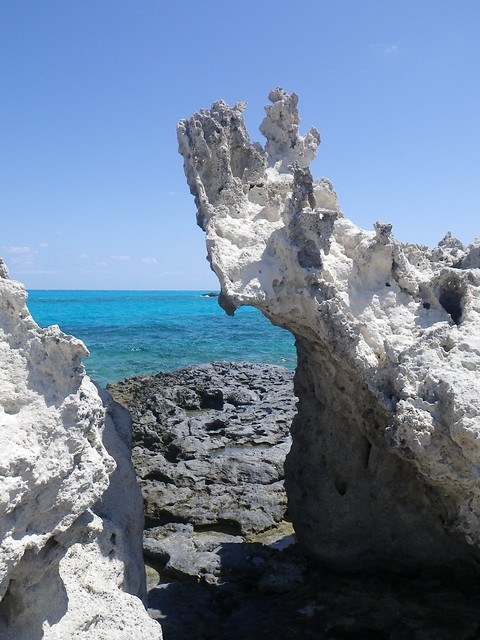
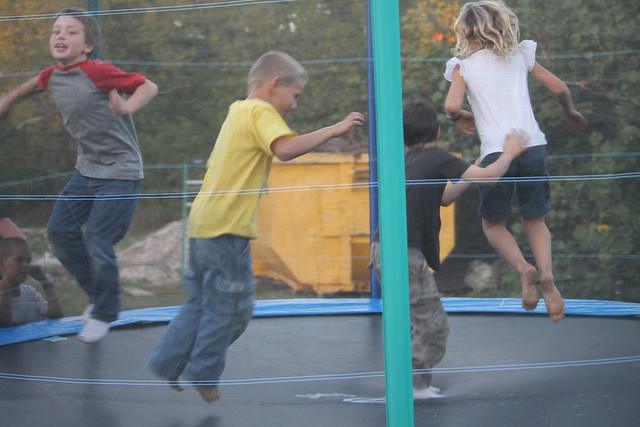
March 27, Cambridge Cay—We moved on to Cambridge Cay, where there were more climbing opportunities and an even more beautiful, deserted white sand beach. We took a park mooring ball for a night and watched a spectacular moonrise from a calm bay. We kept the family tradition of storytelling and stargazing on the trampolines. The next morning we went to the south end of Cambridge to snorkel right off the beach. There were some rare and beautiful Elkhorn coral formations, but we were also sad to see a lot of damage and bleaching. The beach itself was perfection, and the water like an endless swimming pool. We chose this setting to baptize the four oldest children (which was something they had been talking about for a long time) and then went back to the boat for cake to celebrate.
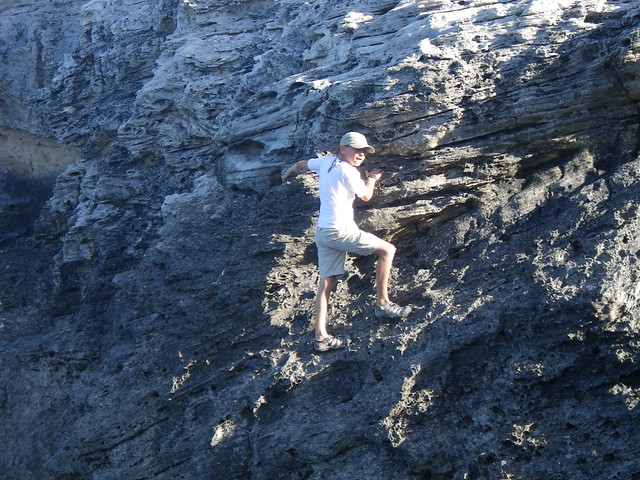
Mountain Goat 

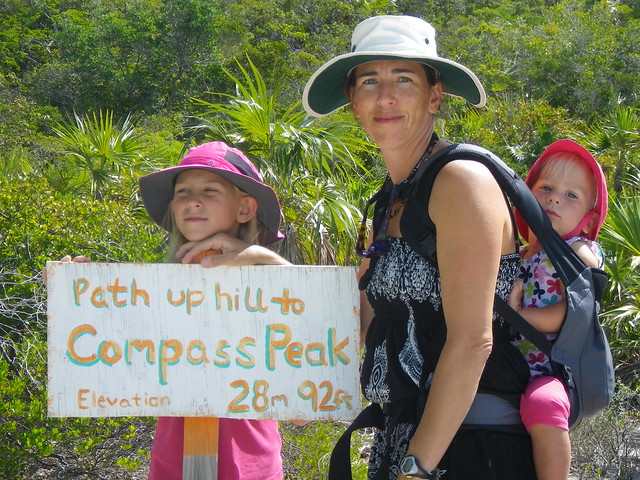
March 28, Compass Cay—Our next stop was Compass Cay, home of the Compass Cay Marina where you can jump off the dock and “Swim with the Sharks” (for a small landing fee of $10/person). The kids were nonplussed, as they were tame nurse sharks—they swim with nurse sharks that hang out under our boat all the time (for free). We anchored near Pipe Cay and witnessed a huge wildfire just after sundown, the cause of which was a stray spark from fireworks set off by one of the marina guests. And we thought the fireworks were exciting! The next day we spent cleaning the boat and preparing for Passover, which we celebrate as part of our family’s Easter tradition. The morning of the 30th we explored Compass Cay by dinghy and found it to be as beautiful as the guide book said, with a crystal-clear mangrove creek, a hike up to Compass Point (elevation 92 ft.), pristine beaches and a really unique feature called “Rachel’s Bubble Bath.” This is a tidal area with sandy flats that flood during high tide. The ocean’s surge passes into a limestone bowl through a crack in the rocks and all the sea foam gathers in the bowl and looks like (you’ll never guess) a bubble bath. On a warmer and less-windy day, it would be a perfect swimming hole.
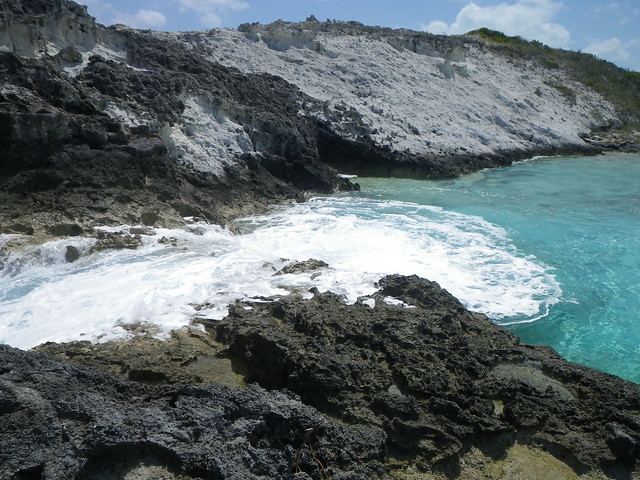
Rachel's Bubble Bath

Compass Peak

March 30, Sampson Cay—Looking for protection from the wind, we moved to Sampson Cay. There is a popular marina and club there, but it seemed very quiet for Easter weekend and we saw almost no other people. We scoped out a few of the small islands nearby and found one with a hidden beach. As it had no name on our chart, we decided to claim it for our family and dubbed it “Robinson Island” after the Swiss Family and Robinson Crusoe, of course. We enjoyed a day of sandy, salty play on our very own private island.
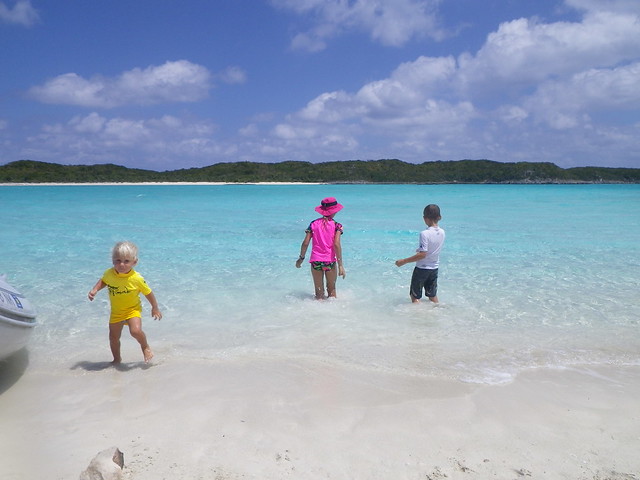
Robinson Island

April 1, Staniel Cay—Hoping to make it to the Batelco station to pick up a local phone/SIM card and try out their new network, we went ashore at Staniel Cay. No luck with the phone—it was a holiday. No, not April Fool’s, but Easter Monday. We expect this sort of thing to happen in the islands. We did have good luck at Pink and Blue, however, the two grocery stores on the hill. They are more like tiny cottages than supermarkets, but if you get there just after the mail boat comes, they have eggs, butter, cheese and fresh produce in addition to the canned goods they usually carry. I found everything I needed to refresh my supplies on the boat at Blue, so we waved to the ladies at Pink and headed back to the boat.
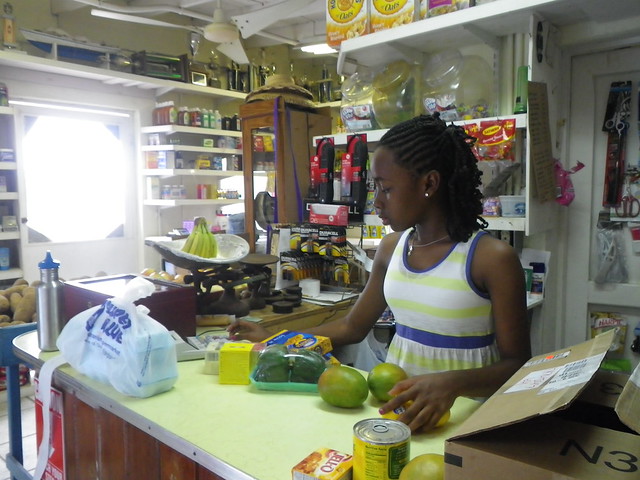
The Blue Store

April 2, Black Point Settlement, Great Guana Cay—We left Staniel, which we really don’t like and headed for Black Point, which feels more like a family place. We had been here before, and when I took laundry ashore at Rockside, the owner, Ida, remembered our family. This is my favorite Laundromat anywhere. Ida always has a freshly-baked cake in her welcoming store, and keeps the Laundromat impeccably clean. And you can’t beat the view. It becomes the popular gathering place for cruisers with clothes to wash and stories to unload. Jay tried the Batelco station around 11 AM, but it was locked, with hours posted as 9-12 on Tuesdays. Island time, I guess. While the laundry was drying, we headed to Lorraine’s Café for burgers and fish sandwiches. I also bought two loaves of still-warm coconut bread from Lorraine’s mom—the best I’ve had anywhere in the Bahamas. We collected some sea glass from the ocean beach on the East side of the island, spending another beautiful afternoon on a deserted strand.

April 2, Robinson Island—We returned to our own private paradise to anchor for the night, with hopes that it would be calm enough to have a bit of fireside fun. It was a perfect evening. I made a pot of chili, packed up tortilla chips, cheese, a bottle of wine, and S’mores supplies and we headed to our little beach just before sunset. There was just enough daylight left for gathering firewood and setting up dinner around the fire. This has to be our favorite part about finding deserted beaches—no signs, no rules, no one to tell you “No.” After witnessing the fire on Compass, we were especially careful. We stayed until we had burned every stick we’d gathered, and the fire was nothing but gently glowing embers. We covered the fire with damp sand, and tried to erase all evidence that we had been there. We hope to keep our island in pristine condition.

April 3, Shroud Cay—A perfect breeze made for a gorgeous sail north to Shroud Cay, what is, to me at least, the crowning glory of the Exumas Land and Sea Park. With miles of mangrove trails, long, white ocean beaches, and beautiful swimming holes, it has something to offer everyone. Immediately upon setting the hook, Jay launched the kayaks (twin yellow Ocean Kayak Malibu Two’s) and the kids and I geared up for an explore. While I love the deep, dark, swampy tangles that make up Florida mangroves, nothing compares to the beautiful contrast of Shroud Cay’s crystal blue channels and lush green leaves topping red arched roots. We took the southern trail which connects the Western side of the island to Exuma sound. The beach sand there is so fine it squeaks when you walk on it, and the deep tidal channel is perfect for cooling off after the hard work of paddling upwind. The downwind paddle was relaxing, though we missed a turnoff and ended up paddling home through an alternate outlet and across choppy open water to the boat.
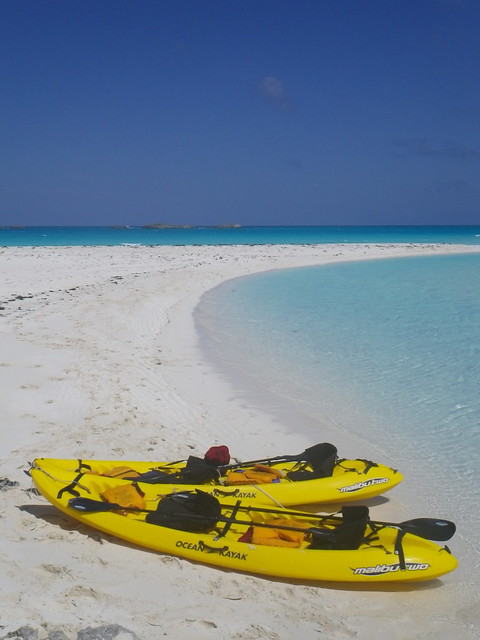
Private Beach

April 4, Shroud Cay—Another beautiful day, another kayak trail to explore. The other kids being tuckered out from our previous paddle, Eli and I hopped in one kayak to explore the trail across the middle of Shroud Cay while the others took the dinghy on the trail to the north. They found what they said was the perfect swimming hole, with a steeply inclining beach for big-kid swimming and a shallow sand bar where Rachel could safely play. Eli and I found a long, clear trail that got gradually shallower and shallower until we were walking alongside the kayak through sandy shallows. We pulled the kayak out onto the sandy bank at low water and tied it to a mangrove root. A hike over tidal flats and through Casuarina forest revealed (yet another) deserted white sand beach. After a long walk, a cooling swim, and a drink and a snack, we hiked back to where we had left the kayak and found it floating on an incoming tide. Though the tide was rushing in, the wind was at our backs, so the paddle back was easy and pleasant. We found a swimming hole on the way out where we could jump off the rocks into deeper water, so we cooled off there before heading out of the mangroves and back to the boat for lunch and a nap.

April 4 Highborne Cay—We returned to what has unexpectedly become our favorite anchorage in the Bahamas, the north cove of Highborne Cay. With a cold front coming, we needed a protected place to spend a couple of nights. The front brought only some gusty wind, but dumped buckets of rain, so we got a free de-salting wash-down. We awoke April 6th find a big beautiful blue day before us.

April 6, Leaf Cay—We took Take Two over to Leaf Cay for some beach fun and iguana chasing. After lunch and birthday cake (for Jay’s 38th), we went ashore with beach toys and chairs and some Romaine lettuce. Jay hadn’t even secured the dinghy before Eli had caught a Rock Iguana. Evidently they aren’t very smart, though they are pretty quick. Sarah managed to trick one as well, though she got scratched up a bit in the attempt. By the time Aaron got into the game, the wary iguanas were coming close enough to nibble the edge of the lettuce but not close enough to get caught, much to his chagrin. Sam and Rachel seemed content to throw lettuce and then back away as several iguanas would scuffle for the offering. Jay and I sat in beach chairs and talked about what we’d like to do next. No sooner discussed than enacted—the next posts will be from the Abacos!
Clearing Obstructions

Lately, every time we formulate a plan for a fun family getaway, something happens at the last minute to throw a wrench in the works. Whether it’s weather or inopportune illness, we just can’t seem to break free. Sometimes it feels like we’re simply stuck. So it was comical this past weekend, as we were preparing to leave for the Bahamas (weather permitting), one of our children accidently swallowed the pull tab from a Sprite at the local tiki hut/burger joint. At first I thought he was joking (this kid is real practical joker). The good news was that he didn’t choke. The bad news was that we couldn’t go offshore with a piece of metal lodged somewhere in our son’s digestive tract. What to do?

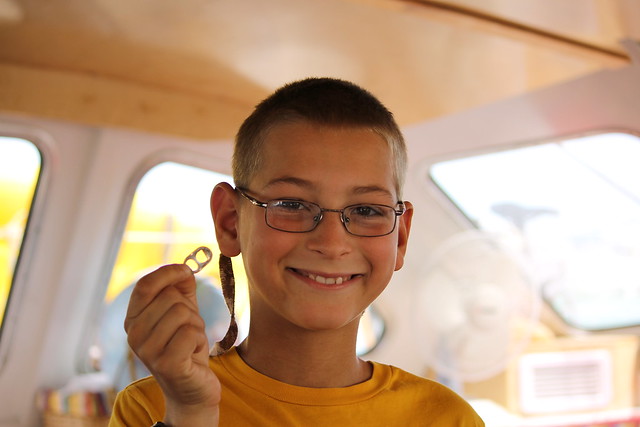
It seemed premature to get an x-ray or plan abdominal surgery, so we decided to wait. We looked it up online and figured at least a 36-48 hour wait, assuming the thing wasn’t wedged in there somewhere. Then there was the blue-glove task at hand (lucky kid!)—we jokingly called him the gong-farmer (look that one up). We had him swallow some pieces of crayon as a marker that would help us gauge how long things were taking to pass. He has a champion system, that kid. He dug for buried treasure today and came up lucky. A friend suggested he wear the tab on a necklace. Whether he keeps it or not, the memory and the jests at his expense are his forever. Barring any other mishaps, we should be moving smoothly again soon.

Mmm, Tasty

Mom’s Night In

One great thing about the Keys for our family is the social scene. We are used to being the only people in the marina with kids, and our kids are used to entertaining themselves and each other. And traveling isn’t much better, as very few people out there cruising are in our stage of life. So we meet up with other boat families whenever possible, and cherish those times as rarities. While Jay is sort of a lone wolf, I am more of a social butterfly. I struggle with feelings of isolation when my only girlfriend also happens to be my husband (this doesn’t work so well), and if he is traveling for work, it can be pretty lonely. Sometimes I feel like our boat is a little desert island, but if that’s true, then coming to the Keys is a social oasis.

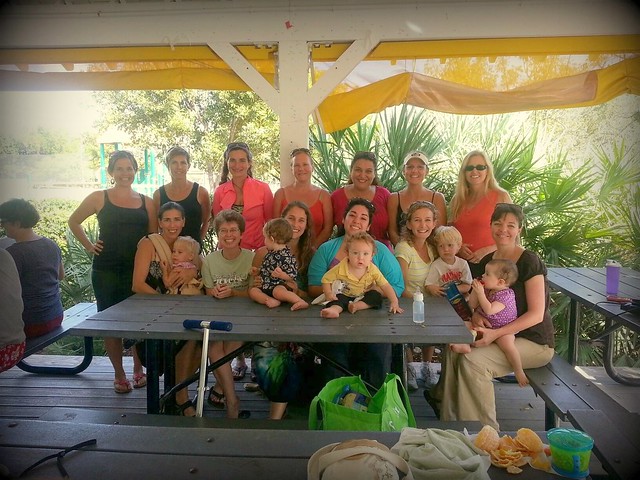
When we arrived in Marathon, we came “home” to an established group of friends among the homeschool and boatschool families here. That means playmates for the kids and “colleagues” for me. Even Jay enjoys having someone to have a beer with from time to time. Take Two has become the party boat. We’ve hosted friends for the Christmas boat parade, dinner parties that required using both indoor and outdoor tables, Lego playdates, kayaking expeditions, and a Thursday night tradition which has come to be known as “Mom’s Night In.” While Jay was working in Fort Lauderdale, I would invite the other homeschool moms over after all the kids were in bed for a night of drinking, snacking, and lots of talking and laughing. For me it was a life-saver, and I like to think it was refreshing for the others who came to sit in the warm glow of our cockpit lights. When we move on this spring, it will be sorely missed. Although I’m sure I could replicate it somewhere else with other women, it just won’t be the same.

I have great admiration for this brave group of fellow moms who have chosen to educate their children at home here in the Keys. People often feel isolated on the islands away from the mainland, and staying at home with one’s children would seem to exacerbate that feeling, but the community here is so supportive that it definitely eases the burden. The teaching philosophies vary widely, as do the number of children and parenting styles, but the conversations are not contentious. I have learned that there really is more than one way to skin a cat, as the saying goes. I relish not only the common goals we share, but also the different ways we’ve contrived of reaching them.

At Mom’s Night In, we get to talk about these and other things without the constant interruption of little ones. We actually get to finish conversations that we start, learn things about each other that otherwise we would never know, and get a chance to be something other than so-and-so’s wife or so-and-so’s mother—to let our hair down a little and just be ourselves. For a few magical hours, we come together to share our journeys, let off a little steam, and re-charge our mom-batteries. My thanks goes out to all the wonderful women who have hopped in my dinghy to join me on my little island this year: you have all taught me something, not the least of which is that friendship comes in lots of exciting flavors. You are funny, kind, thoughtful, creative, intelligent, and loyal—I can’t wait until next time!

Marathon Homeschool Mamas

Sleeping Under the Stars

Ever since we moved aboard Take Two and de-cluttered our lives, birthdays are less about stuff and more about making a memory. Instead of asking the kids, “What do you want?” we ask, “What do you want to do?” Sam just turned six, and what he really wanted was a repeat of his fourth birthday, which we spent in the Bahamas, jumping and diving off of Take Two into beautiful warm water with friends we had made there. We told him it would be “weather dependent,” but we knew it was too cold and windy right now in the Keys for a wet birthday. Instead, we surprised him with a camping birthday weekend with his cousins.

Birthday Camping

The last time I went camping with my brother, he was Sam’s age, and we were sleeping in my dad’s old army tents in Rocky Mountain National Park. Now my brother and his wife have seven kids and two tents, a collection of cast iron pans, two large coolers, and a propane camp stove to boot. They are real campers. We, on the other hand, never go camping and had to borrow our friends’ tent, inflate some air mattresses, and set up camp in their backyard (they live in a state park). We pitched tents on a Friday afternoon and tried to figure out what the sleeping arrangements should be. I had assumed there would be very little sleeping going on, so we planned for maximum fun: all the kids (minus the babies and toddlers) in one tent. That’s the eight biggest kids, plus two of our friends’ kids, for a total of ten.

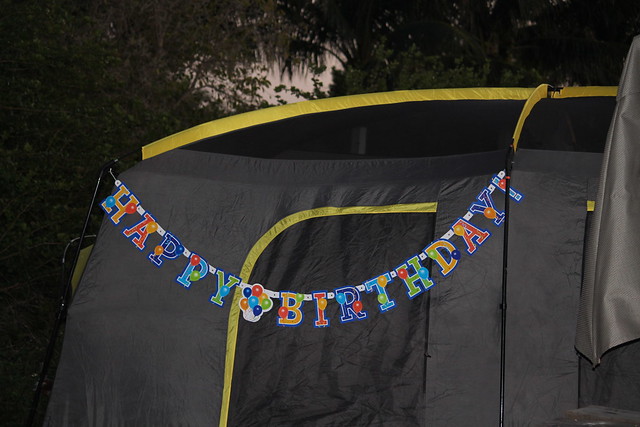
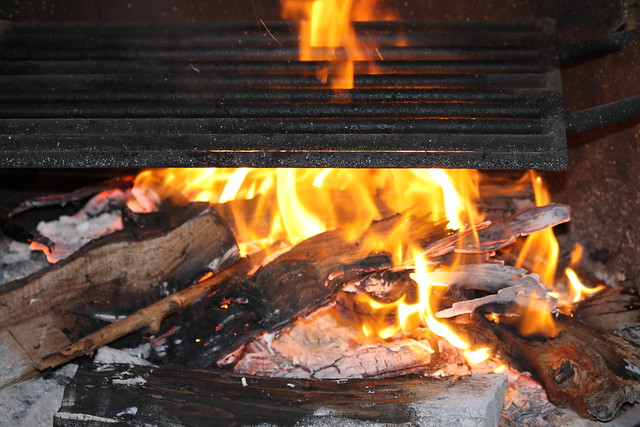
The birthday dawned sunny and bright, with the first of the kids making noise around 6 am. It was going to be a long day. We took the kids on a field trip to Pigeon Key—we thought we could wear them out by making them walk the last two miles of the old Seven-Mile Bridge, but, as it turns out, kids don’t wear out, but moms and dads do. At sunset, we gave away glowing bracelets and let the hooligans run wild in the dark. I think they were playing Cops and Robbers, but it sounded more like Cowboys and Indians. When everyone got hungry, we passed out roasting sticks and hot dogs. Nothing better than a meal cooked over an open fire. We then gathered around and set six marshmallows ablaze to sing Happy Birthday to Sam. And then the S’more factory went into high gear, with children roasting marshmallows faster than I could assemble graham crackers and chocolate. Yum…

Birthday Fire

After they were done around the fire, we sent "tired" kiddos into their tent. Backlit by the battery-powered lantern, you could see the silhouettes bouncing around like molecules of hot gas caught inside a balloon. It looked like the tent might explode at any moment. At some point, Sam escaped from a leak in the tent and came to sit with us, periodically placing logs on the fire and generally messing about with burning sticks. He has the makings of a pyromaniac, that one. He’s a wild child, full of life and exuberance and boundless energy. He’s a lot like Tigger, and I’m sometimes like Rabbit—while I’d like to remove some bounce, I would be lost without him.

Birthday Bouncing

As the fire burned low and the kids began to grow quiet, the grownups drank the last of their drinks, ate the last of the S’mores, rocked all the babies to sleep, and solved all the world’s problems by firelight. It was a birthday we’ll never forget.

Lying awake under the stars (slapping at No-see-ums which had snuck into our tent), I realized that the reason why we never go camping, aside from the fact that it’s uncomfortable and our tents are in storage, is that our regular life aboard contains enough of the Outdoor Adventure to sustain us through all the mundane parts of life like work, school, and chores. We have access to wide open spaces, the occasional deserted island where we can light a bonfire out of driftwood, kayaking, hiking, swimming, and a change in surroundings whenever we get the itch for something new. We don’t need to go camping to sleep out under the stars because there’s a hatch over each bed, giving us a nightly panorama of the cosmos. You might think we would become bored by this, but the constant change Nature provides keeps amazing us and infusing our normal lives with a sense of wonder.

The Keys to Happiness

This is our second stay in Boot Key Harbor (Marathon, FL), and after six weeks here, we have concluded that we like this place more than we did the first time. Because we were new to cruising the last time, I don’t think we knew what we were looking for. As the harbor fills up with winter visitors, we understand a little better what draws boaters here. We have discovered that it takes certain characteristics in our surroundings to make us love a place. While there’s no magic formula, we can rate a place based on the presence or absence of these factors. The presence of so many makes Marathon a favorite.

Good Weather—We live on a boat that is not “winter-friendly.” An old Norwegian adage says that there is no such thing as bad weather, only bad clothes. If this is the case, then all of our closets and cubbies are filled with bad clothes. In either case, we like to head south when temperatures begin to drop below 60. Even living in middle-Florida, it can get cold at night. The Keys are a place we can winter without having to tie up to a dock and run space heaters or break out the down comforters. It is sunny and pleasant here most of the time, and there’s almost always a breeze, so that even on hot days it is comfortable in the cockpit.

Clean Water— After the Bahamas, the words “clean and clear” have new meaning. We’re a bit spoiled, I know, but even the less choosy would not use those words for Boot Key Harbor itself. It’s more like a marina than an anchorage, so we don’t really expect to jump in. The water is a murky green and people are constantly buzzing by in dinghies. We don’t even go in to clean the bottom. However, just a short ride out Sister’s Creek, one can find suitable water for swimming, snorkeling, fishing, or scrubbing the bottom. With Sombrero Reef nearby, we have a place to go play and enjoy our watery environment.
 
Islands with Beaches and Trees—The Keys are nothing but islands, and if there is a tree anywhere nearby, all you have to do is look up to find out where our kids have gone. Palm trees, mangroves, banyans—they’re not picky, and there seem to be plenty. And while beaches as we like them are scarce in the Keys, there are a few nice ones close to Marathon, the best of which, Sombrero, is accessible by dinghy and happens to have a great playground as well.

Friends/Community—It took us awhile to make friends here, but now that we have them, coming back to Marathon is like coming home. Most are also home-schooling families, so we’re on the same wave-length (or at least the same schedule). And every time we come, we expand that group of friends! Marathon itself has a very small-town feel to it; everyone knows everyone else. We like the familiar faces in the harbor—people who have lived on their boats here sometimes for decades—who are quirky and kind and add a lot of local flavor to the place. There’s something special about the boating community that reminds me of the neighborhoods of yesteryear when people actually sat on their front porches and everyone helped their neighbors.

Safe Places for the Children to Play—Aside from beaches and trees, this includes public parks and nature preserves. Marathon has a great Parks system, even hosting a Homeschool PE once a week, and there are plenty of places to get some fresh air and exercise. The park nearest the marina has tennis courts, a playground, soccer and baseball fields, a hockey/basketball court, and a skate park. And there are state parks on almost every key where you can go hiking or kayaking and get out in nature.

Low-Key, Family-Friendly Restaurants—Among our favorites here are the Hurricane, Burdines, and the Sunset Grill and Tiki Bar.  It’s hard to go wrong under a tiki bar, especially if there’s a pool where the kids can enjoy the water while the grown-ups have a drink. We keep discovering new places, and so far we haven’t found one that isn’t kid-friendly and low-key. In fact, I think that word was coined for the laid-back people of the Lower Keys!

Beautiful Natural Surroundings—This is not the prettiest anchorage in which we’ve ever stayed, but there is natural beauty around if you look for it. It’s easy to drop the kayak in the water and find mangrove tunnels to explore, or to go ashore and take nature walks, or to take the boat out and just enjoy the sparkling aquamarine water. You can’t beat the parks and preserves of the Keys for unspoiled beauty and wildlife.

Interesting History—No doubt about it, this place is interesting. A friend recently lent me a copy of Les Standiford’s The Last Train to Paradise, about Henry Flagler’s Overseas Railway, which opened the Keys to landlubbers and eventually led to the building of the Overseas Highway (a.k.a. US 1, which runs all the way to Key West). After reading that excellent book, I look at the drive from Miami to Marathon in a completely new way. There are all sorts of places to take the kids for field trips relating to the history of the Keys, not the least of which is Pigeon Key, a worker’s camp for those who built the miraculous Seven Mile Bridge.

Quiet Anchorages—Boot Key Harbor is not exactly quiet, nor is it precisely an anchorage. With our 68’ mast, ducking under a bridge to anchor in Florida Bay isn’t an option, and there is a serious shortage of safe, quiet places we can anchor our boat on the Atlantic side of the Keys. But the water here in the harbor is very still, and we have 360º of protection from weather. We feel safe enough to let the kids take the kayak out or borrow a little sailboat to putter around in. If we want to find a remote and quiet place, we can head west to Fort Jefferson at Dry Tortugas National Park, or hop in the Gulf Stream and head toward the Bahamas. At least we’re poised to do that in Boot Key Harbor. This is a great place to wait for a weather window, though there’s a running joke that people stop here for two weeks and end up staying two years.

Small Town/Walking Distance Amenities—It’s hard to have a cute little downtown district in the Keys because everything is built along the main drag. The islands are so narrow, there’s just no other way to do it. But what the town lacks in charm, it makes up for in convenience. This really is a boater-friendly community, and everything is relatively close to the City Marina. Within walking distance we have a library, a park, West Marine, Home Depot, a Chevron station, Walgreens, Publix, the Marathon Deli and Liquor Store, Salvation Army, Dive Shops and lots of little restaurants.

A Good Library—In order for me to call a library “good” it has to have friendly staff and a separate kid-welcoming room which houses the youth collections. Marathon’s public library, while small, meets those conditions. Any book they don’t have, the super-nice librarians are willing to help you find and order from another branch. I have always found what I needed there to keep our home-school running and the kids happily reading.

Access to Marine Services/Ability to Get Parts—Just having a place to pick up packages helps a lot, as Jay usually gets parts for projects from Amazon or Defender. In addition to the City Marina’s handy mailroom, there are so many boats in the Keys that there are also services galore—engine dealers and mechanics, water maker specialists and canvas shops. You name it, you can find it nearby. Except, of course, a place big enough to haul us out.

Freedom and Space—Although the city marina can pack 225 other boats into the mooring field, I really don’t feel crowded where we’re positioned. Living on a mooring ball is a lot freer and more spacious than being tied to a dock, although it is not quite the same as being anchored. There are still rules to follow, people to get along with, and competition for amenities like the laundry room and dinghy dock. But there’s also the ability, if one gets claustrophobic or tired of the neighbors, to simply let go of the ball, sail out of the harbor and get away for awhile. It’s that flexibility that gives the boating life part of its charm.

Although we have long-term goals of traveling throughout the Caribbean and coastal Central America (and who-knows-what beyond), we realize that while we still have very young children, we have to take baby steps. With family on the west coast and a great boatyard on the east coast, we will probably always use Florida as a home-base. The Keys are a logical stopping place to or from anywhere we are likely to go in the near future, and Marathon is one of the many places we like to call home.

Paddling Upstream

Some people are content to float downstream, happy to “go with the flow,” accepting wherever it takes them. I sometimes I wish I could be like that. For better or worse, I tend to paddle upstream, fighting my way toward some nearly-impossible goal, sometimes hurting myself or others in the process. I don’t doubt that my sense of purpose and perseverance takes me far, but it also lands me in a heap of trouble.

When I left for Paris during college, my dad warned me to pack light and take a taxi from the airport. I packed heavy and got off the airplane ready to try my hand at public transportation in a foreign country, surrounded by strangers speaking a language I had not mastered. Right…you can guess how that ended. I reached my destination safely, but with no small loss of blood, sweat and tears. Once I got some “free mulch” from a neighbor, and all I had to do was go get it. It seemed so easy at the outset—but the shovel and wheelbarrow weren’t getting the job done fast enough. So I used my minivan as a truck and loaded up the back. Six hours later and with a terrible mess in the back of my mom-car, I finished what I had started. But that mulch was decidedly not free. And Jay ended up cleaning up my mess.

Today I set out in the kayak to explore in Sister’s Creek. It was a bit blustery, and I lost my kayak partner to a mysterious rash. So I went alone, and after twenty minutes of fighting, I finally got into still water and had a moment to breathe and think about what I was doing. I realized that the way I approach kayaking is a great illustration for life. Sometimes paddling upstream has paid off beautifully—in the Bahamas, my fearless crew and I fought hard to get past the pull of the tide to find the blue hole in the Bight of Old Robinson, and after our explore, we simply drifted back the way we had come earlier, over upside-down jellyfish beds and shallow coral reefs—the breathtaking beauty and relaxation well worth the hard work. Other times, I have fought a hard battle against the pull of water and wind for very little reward. I should have turned the kayak around early on and admitted that we weren’t having fun. I mean, isn’t that what it was for to begin with?

Once I get that tunnel-vision about a project or a relationship, I seem to lose sight of what the thing was for. In my rush upstream, I leave all caution behind and my wake is littered with misery and madness. As I contemplate the year’s end and make goals for the next one, I realize I learned a lesson in my kayak this morning. Once I reached the still water, I decided I didn’t want to fight anymore, and turned around to head for home, wind and waves at my back. I think I’m coming to a place in my life where I don’t need to try so hard, but to rest and trust more. I see this in my relationships with my children especially. As they get older, a heavy hand can crush the relationship it was trying to create. It might be time to turn that kayak around and enjoy a downwind run.

It Takes Two to Make a Thing Go Right

A man who is not afraid of the sea will soon be drowned…for he will be going out on a day he shouldn’t. But we do be afraid of the sea, and we do only be drownded now and again. –John Synge

When we bought Take Two, she already had her name, and even though we’re not particularly superstitious, we decided not to rename her. She was the second boat we thought seriously about buying—the first having slipped through our fingers as we dawdled and debated—so in many ways, she represented a second chance at success. Since that time, some folks suggested that we should have renamed her “Take Six,” but then we added another crew member. It’s too much work to keep scraping off the old number and applying a new one, so that’s out. Besides, it only took two to make the rest of the crew.

Last week as we attempted to leave Fort Pierce, a new meaning for the name of our vessel became apparent. We headed out the pass against the current (we had been trying to make it out at slack tide, but missed), and then slammed straight into 6-9 foot confused waves that wreaked havoc on our interior. Oops, forgot to duct-tape the refrigerator door…and take everything off of the galley counters. We’re a catamaran, so we sometimes forget that sort of thing. Actually, we make it a point to never set sail in weather that rings our ship’s bell or causes the drawers to fly open. The fact is, we didn’t know what we were going to find, so we decided to take an exploratory look. Needless to say, we did not like what we saw, so we headed back to anchor and wait for better conditions. This is a familiar scenario. When we left Bradenton, the same thing happened. It seems to always take two tries for us to leave.

The first try requires a colossal amount of energy and courage, for whatever reason. Once we get entrenched in a place, we really struggle to untie the boat. Once that first hurdle is overcome, we spend at least one night at anchor to acclimate and help us get an earlier start. Then, with trepidation, we head out after sunrise to find out what kind of travel day we’re going to have. If it looks like a long, miserable day, we turn around. That’s why we never sail on a schedule. After the harrowing experience of take one, take two usually finds us more prepared, less nervous, and relieved when our patience pays off and we get the conditions we were waiting for.

So after a week of waiting on the hook in Fort Pierce, we tried our luck again on Sunday and were happy to find calmer seas. By the time we reached the Keys, the wind was cooperating and we had a great sail to Marathon, where Take Two will be moored for the winter months.

Riders on the Storm

Weathering storms is not only something our family has gotten used to, it is something that actually excites us. I admit that sometimes this excitement is not a pleasant sensation, but whether at anchor or tied to a dock, a storm never fails to add a bit of the unexpected to our daily lives. Jay called me a “storm junkie” last night when I suggested we walk in the wind instead of do dinner dishes, but I would argue that he is the not-so-secret admirer of wild weather. I remember a year just after we moved back to Florida, during one of the many hurricanes that season, Jay took our two boys (2 and 3 at the time) outside to “play” in the wind and rain. I am sure I objected (“a tree could fall on all of you”), but he initiated them anyway, and every storm that has approached since then, I’ve noticed that gleam in their eyes—a mixture of nervous excitement and pleasure.

Hurricane Sandy

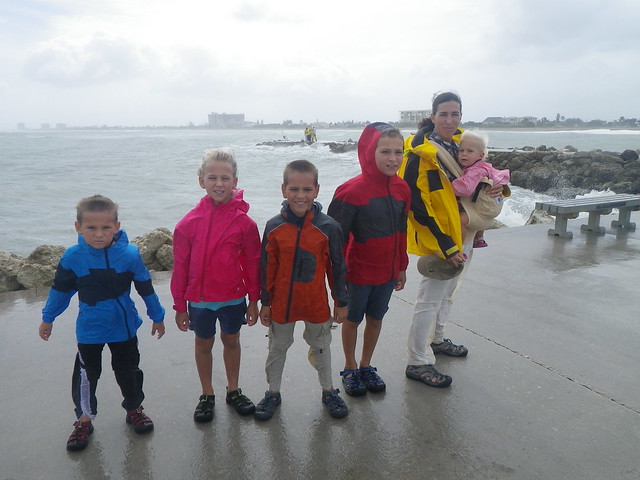
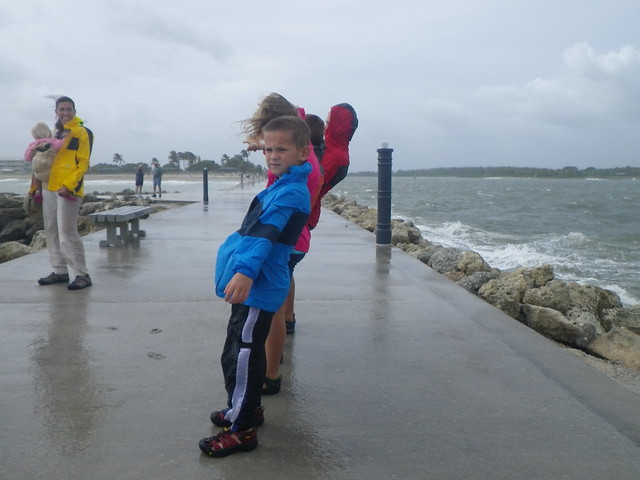
We took all five of our little adventurers out to the jetty today to observe the effects of 48 hours of steady breeze from Hurricane Sandy, sometimes gusting in the 50-knot range. The waves were crashing up over the sidewalk that skirts the rocks and the wind was so full of salt spray that we could actually taste it. There were the ubiquitous storm surfers out there fearlessly enjoying kite boards and windsurfers, but everybody else looked a little anxious. I had Rachel in the carrier, and though she kept asking to get down and walk, I said no—I was actually afraid she would blow away! Even the big kids couldn’t walk straight.

Lean Into It

There were a group of manatees hiding out in a protected corner created by a right angle in the south jetty, and it looked like they would be stuck there for awhile. It made me wonder—did they go there looking for shelter, or did they get trapped there by the surge? Do manatees have enough warning to escape heavy weather? I would have expected to see them in intracoastal waters, maybe up Taylor Creek where we see them all the time, or in the mangroves, but sometimes storms catch one unprepared.

We’ve seen several incidents over the years of humans on boats being caught in that state, whether from lack of know-how or good sense I can’t say. Someone had their jib shredded last night in the early stages of the storm and it was only because of the kindness of strangers that they didn’t lose their whole rig. Another acquaintance who was out of town for the storm will have to deal with the sad fate of his vessel when he returns—she dragged anchor and is currently lying on her side in the muck on the other side of the channel.

We do the best we can to prepare Take Two for storms, and to brief the crew so that they will be mentally prepared, but we are not arrogant enough to believe we are immune to the damage caused by the tantrums Mother Nature throws each year in Florida. We have scoped out a couple of hidey-holes nearby where we could tie the boat up in the mangroves if we felt that the storm would be too strong to weather in a marina. But even with all the planning, sometimes by the time you decide the weather is bad enough to take drastic measures, it’s too late. You do the best you can to get ready, and then all that’s left to do is go outside and bow before the sheer power of wind and water. One lesson storms have taught us over the years, and which our children will no doubt remember for the rest of their lives: don’t mess with Mama Nature.