Category Archives: Recipes

High Frequency

We feel the need for some method of long-distance communication.  Currently, we lose access to weather forecasts as soon as we leave Wi-Fi and VHF range, both of which are very short, about 2 and 20 miles respectively.  We’re fair weather sailors and depend heavily on weather forecasts when traveling.  We also like to get off the beaten path, but feel the need to stay at least somewhat connected by email.

There is much debate about whether a marine HF radio (called Single Side-Band, or SSB) or a satellite phone is best to fill this need.  Of course, each has its own strengths and weaknesses:

  • SSB radio supplies broadcast or “party line” communication where one station can talk to many.  The satellite phone is point-to-point just like a regular phone.
  • SSB can transmit and receive over thousands of miles and potentially halfway around the world (depending on atmospheric conditions).  The satellite phone can call any telephone from almost anywhere on the globe (depending on provider).
  • SSB can only communicate with other stations, while the phone can only communicate with other phones.  So you need the satellite phone to call mom on her birthday, and the radio to talk to another boat.
  • SSB is far more technically complex to install and operate.  The satellite phone is as simple to use as a terrestrial cell phone.
  • SSB transceivers (transmit & receive) are very expensive, probably $3000 for a new unit with installation.  Handheld satellite phones are available for under $1000.
  • SSB is free to operate, while the satellite airtime costs upwards of $1/min.
  • An SSB radio can receive synoptic weather charts that are faxed from various met offices around the world.  A computer or dedicated weatherfax machine are required.  The satellite phone could receive the same information electronically via email.
  • Satellite phones can send and receive text messages.  Texts can typically be sent to the phone for free from the provider’s website.
  • Both can transmit and receive data.  The SSB requires an expensive Pactor modem to communicate with shoreside radio stations for sending and receiving email.  A satellite phone works like an old-school dialup computer modem, effectively putting you directly on the Internet.  Both are very slow and greatly benefit from services that filter and compress email messages.
  • It is technically possible to get higher data speeds and always-on access from a satellite system, but the equipment is very expensive and then the bandwidth pricing is about $10/MB.  Maybe someday.
  • Both are susceptible to atmospheric weather, but SSB moreso.  Both would likely be useless in the event of a major disruption like a volcanic eruption or solar storm.  

So which to choose?  The scenarios we envision using long-distance communication (in order of priority) are:

  • Emergency calls.  Getting shore-side medical advice or communicating with Search and Rescue agencies.  Advantage: satellite.
  • Email.  Staying in touch with work, friends, and family from remote areas.  Advantage: satellite.
  • Weather data.  Getting forecasts and data from electronic sources.  Advantage: satellite.
  • Weather forecasts.  Receiving voice broadcasts, specifically from Chris Parker for the Bahamas and Caribbean regions.  Advantage: SSB.
  • Routine calls.  Making regular phone calls for any purpose.  Advantage: satellite.
  • Keeping in touch with other boats.  Advantage: SSB.

Clearly we can see a use for both SSB and satellite.  Satellite receives the priority, and as the simplest to use, is almost a no-brainer.  Most of the proponents of the SSB appear to be older, more traditional cruisers, who put the investment into radio back when that was the only choice.  

A previous owner of Take Two made the SSB investment.  The radio itself was gone by the time we took possession of her, but the hardest parts of the installation are done.  She has an insulated backstay for an antenna, and a submerged ground plate for a counterpoise.  Getting good RF on boats is a lot like voodoo, but it looks like we should be able to get a pretty clean signal.

Taking all of the above into consideration, a used ICOM 710 and AT-130 tuner to complete our SSB installation seemed like a good idea.  We’re having some new cables made up, so we haven’t installed it yet, but we’re pretty excited just to have it.  Replacing the SSB has been on the “someday” list for a long time and crossing it off will give us a feeling of progress.

A satellite phone is still high on the list.  The major decision points there are choosing a provider and a plan.  That will be the subject of another post.
Adam

We met Adam in the Bahamas this past winter.  He’s younger, probably mid-twenties, and looks very much at home there.  We’re often asked by older cruisers how we’re able to live this way.  We asked Adam.

He runs crewed charters on his St Francis 44, Rubicon, taking paying guests aboard for weeks at a time.  We see crewed charter boats a lot, but never before with such a young captain.  He caters to a more active clientele, and is probably the source of the kitesurfers that are often buzzing around Elizabeth Harbor on windy days.

We learned that Adam was a cruising kid and sailed around the world with his family.  He looks at home in the Bahamas because he is.  He practically grew up there.  

When someone on an internet forum was looking for a charter captain in the Bahamas, I suggested they contact Adam.  I didn’t expect to hear anything else about it, but then recently received this:
"Your suggestion was excellent. We just returned from a 10 day sail with Adam and had a great experience. He is mechanically astute, a great sailor and a perfect addition to our group. He's now a good friend whom we will see again.  Thanks."  I was strangely pleased, and not just at having provided good advice.

We don’t know what our kids will do with their lives, what skills they will develop, or what loves they will pursue.  We expect them to be different, though.  We’d be proud if any of them turned out like Adam.

Fire

The boat directly across from us on the next dock caught fire a couple weeks ago.  We didn’t notice until the fire trucks arrived.  

The fire department keeps a little rescue boat on that dock, and we’d previously seen them rush down and launch it.  We thought that’s what they were going to do when they rolled up this time, but they started unloading hoses instead.  

The kids saw the smoke immediately.  Within a minute we could see flames.  I was too busy watching to get a more dramatic picture.

[flickr: 5970624647]

Fire is the last thing you want on a boat.  They burn fast.  They’re loaded with flammable stuff.  The fumes are toxic.  Even a small fire can damage a boat beyond repair.  Left alone, they burn to the waterline and sink.  That’s the end for the boat, but maybe not the fire.  In a marina the fire can spread.  Maybe there’s a burning fuel slick.  Maybe the docks are made of wood.  Maybe the mast falls on another boat.  Maybe the boat burns through its lines and comes adrift.  Maybe it explodes.

The firefighters unleashed torrents of water on the burning boat.  The fire was coming from down below so they had to get aboard to spray water inside.  The boat’s bilge pump was running non-stop and she was listing visibly.  It took a lot of water to put the fire out.

A man lived on that boat.  His grandson was visiting for the summer.  The man was at work and the kid was aboard watching TV when he smelled smoke.  He got off the boat and called the fire department.  We don’t know how long it was before the trucks arrived, but we assume that the early call saved the boat; “saved” being a relative term, because the insurance company totaled it.  But it didn’t sink, and the fire didn’t spread.

What if the kid hadn’t called?  Add five minutes to that fire and it would have been a totally different situation.  He may have saved more than one boat.  He may have saved ours.

Watching the firefighters crawl around on the burning, listing boat gave me a very bad feeling.  I wasn’t sure if they knew the potential danger.  I recall thinking that I wouldn’t be doing that. 

Boats have things houses don’t: fuel tanks, batteries, flares, propane.  Did they know?  I assume that departments in coastal areas must train for boat fires, but various boats can greatly differ.  Could I walk onto any random boat and locate those items?  Could anyone do that on ours?

Up to this point, we haven’t worried too much about fire safety.  The concern I do have is more for the boat and our home than for ourselves.  I’m confident that anyone over the age of two could escape any conceivable fire scenario.  In that regard the boat is better than most houses.  

If there were a fire, we’d have a small window of opportunity to put it out quickly.  Some sources claim there are only about 30 seconds before heat and smoke force you out.  To that end, we have handheld fire extinguishers placed around the boat.  We have a fire blanket in the galley.  We have automatic halon systems near the engines, inverters, and the generator.  We have a high capacity washdown pump with a 50’ hose.  If that didn’t do it, there wouldn’t be much choice but to stand back and watch her burn.  

The cause of this fire was electrical.  We’ve had our own electrical problems.  We were lucky because a breaker tripped.  Corrosion.  It increases resistance and therefore heat.  Breakers and fuses are sized for the capacity of a wire to carry current without melting, but they have no idea if that wire is corroded or badly connected.  Once the insulation melted, the hot wire found a dead short which blew the breaker and our fire was over before it started.  Must not have happened in this case.

Shutting off the power is obviously the first thing that needs to happen for an electrical fire.  The firefighters unplugged the boat’s shore power cord immediately, but that’s not enough.  Batteries are perfectly capable of starting a fire.  Typically, battery-connected circuits don’t demand enough current to start a fire unless there is a short, and a fuse would put an end to that.  Every wire should have a fuse or breaker on the end nearest the source.  Of course, “should” is often not reality.

Batteries should have disconnect switches.  Our switches are not very accessible, but that was intentional.  They used to be too accessible and the batteries could get turned off accidentally.  Our battery bank is split on either side of the boat, so there is no getting to the switches quickly anyway.  I was already planning to install a single button to control remotely operated battery switches.  It will be located right next to the AC transfer switch.  That will allow a person to quickly disconnect all power from a central location.  

It took the firefighters a long to time to find the boat’s batteries.  We could tell by the steady output from the electric bilge pump.  It had gotten much of the water out, and the boat was listing less.  She was still steaming, but the firefighters were satisfied that the fire was out.  They collected their gear and left.  

They had tried to contact the owner at work, but were unsuccessful.  Hopefully he received their messages and was somewhat warned before he returned home to his smoking wreck.  The reek of burned plastic could still be smelled a hundred yards away for days afterward.

Upon reflection, I really don’t think there is much additional fire preparation that is worth doing.  Take Two is about as well-protected as I think she practically can be.  Perhaps an extra smoke detector near the inverters would be a good idea.  There’s still some dodgy wiring that needs to be redone (and will be).  But everything has to be put in proper perspective.  The wiring could be perfect and a lightning strike could still start a fire.  All our preparations would be for naught if we’re not aboard to employ them.  And even the fire department can only do so much.

Update

I've learned that an automatic fire suppression system shouldn't be used in a diesel engine room without pairing it to an automatic shutdown.  1) The engine keeps running, 2) the chemicals can damage the engine, and 3) the running engine sucks out any gas (halon) before it can put out the fire.

New Catwalk

No posts in awhile, but we’re making steady progress here on Take Two.  The latest finished project is the installation of our new catwalk.  The last one, you may recall, exploded under the strain of waves we took over the bow in boisterous conditions.  I didn’t share these pictures before because the wounds were too fresh.

[flickr: 5908795808]

Can you spot what's missing in that picture?  Apparently the weave of our trampoline nets is too close and doesn’t allow water to drain through fast enough for the amount that was landing on them.  The weather was on our starboard side, and the weight of the water coming over the starboard bow and onto the net caused the bottom and starboard side of the catwalk to separate.

The old catwalk was essentially a box, hardwood sides and ends, plywood top and bottom, painted on the outside and epoxied on the inside, with a teak surface laid on top.  Despite being hollow inside, the thing was heavy, which I didn’t fully realize until trying to haul it out of the water.  And despite the paint and epoxy, there was some rot in the top along the starboard side.  This rot undoubtedly contributed to the old catwalk’s failure.

[flickr: 5908238475]

Although the catwalk broke, the laces attaching it to the trampoline net did not.  The broken sections fell in the water and were dragged under the boat, becoming a bludgeon that pounded our underside.  I have no idea how much time passed between when the catwalk broke and we discovered it.  It is a good indication of just how much noise there is in a storm that we couldn’t hear the punishment we were receiving below.

[flickr: 5908238919]

It's hard to get a good picture down there that really shows the damage.  I've taken many, but chose to go with one that had pretty water.  If you can see it, none of that damage is serious and most of it just needs to be faired and painted.  The paint color under the bridgedeck is interesting.  Originally it was a cream color, like the decks.  They painted over the cream with a dayglo orange.  Apparently someone was concerned about the boat laying upside down in the middle of an ocean.  Over the orange, they painted red.  Unfortunately the orange didn't stick very well, which might have been the reason for the red, but it didn't really work.  The whole thing needs to be repainted, which will not be a fun job.  Cosmetic items are pretty low on our priority list and nobody even sees that area.

But the catwalk was a high priority.  The catwalk’s primary purpose is to resist compression between the forward crossbeam and the bridgedeck.  The mast pulls up and aft on the crossbeam.  The pelican striker opposes the upward pull, and the catwalk opposes the aft pull.  So it is structural from the designer's standpoint.  The secondary function is a solid platform to walk on when dealing with the anchor.  Operating the boat is tricky without it, so replacing the catwalk was a "must" before we start using the boat again.

[flickr: 5908792536]

Whenever something fails on Take Two, we see it as an opportunity to make the thing better, and the new catwalk was designed to correct the flaws of the previous one.  It has solid sides and ends like the old catwalk, but there are several cross members mortise and tenoned into the sides, strengthening it in the dimension that the old one broke.  Thin slats rest on these cross members to make the top.  There is no bottom.  It weighs maybe 25 pounds, while the old one was probably around 75.  Extra weight on the bow can be put to better use in a larger anchor.

The open bottom means there are no hidden places where rot and weakness can fester.  It also allows the slatted top, which is good for washing off the muck and weed that often comes up on the chain.  Both reduce weight.  But the slats are thin and not strong enough without additional support.  The cross members provide this support, and also help resist side loads from the nets.  We don’t have a chain stopper and couldn't figure out how to do it before.  If we wanted to add one now it could be bolted through one of those cross members.

[flickr: 5908795364]

Teak was chosen for its rot resistance and light weight.  We generally do not like teak on our boat, as we have no desire to maintain it.  However, we did not mind the raw teak surface on the old catwalk and felt it stood up well to the anchor chain running over it.  We briefly considered fiberglass but decided that was a loser on cost, weight, and resisting abrasion from the chain.  

Like most projects, the new catwalk opened the door for making other changes, and we were never quite satisfied with the way the trampoline nets were attached.  They used to be double laced through stamped eyestraps screwed into the catwalk and rest of the boat.  We had repeated problems with chafe on the lacing lines which required us to replace them about twice a year.  And the eyestraps sawing through the lacing was very loud inside the boat; like a big violin.  

[flickr: 5908791004]

We contacted Sunrise Yacht Products, the company that made our nets, and they recommended a perpendicular lacing pattern which allows less movement, and a track and slide attachment to the boat instead of the eyestraps.  They sell track, slides, and lacing for this purpose.

The track appears to be specially made and I could find no other source for it.  It is like awning track, but has a much heavier wall thickness.  It comes in two different extrusions for attachment to surfaces perpendicular or parallel to the load.  The slides are made by Bainbridge and can be found cheaper online, but Sunrise customizes them by bending the bail to keep the laces centered.  The line they sell for laces is a ¼” polyester double-braid.  

[flickr: 5908236617]

We found we could get much better tension on the nets with the new lacing pattern, and we’re very pleased with how the new arrangement looks and feels.  Unfortunately the teak won’t remain bright and pretty for long.  It will weather to a dull gray color unless we maintain it, which we won’t.

The nets themselves were undamaged in our little incident, and are possibly indestructible.  Despite the drainage problem, we really like them and we’re not planning to replace them anytime soon.  We will however try to avoid dumping that much water on them again.  If necessary, I’ll cut the laces next time rather than risk damage.

Two Dinghy Family

We just acquired our 3rd dinghy.  We've always carried a spare dinghy in the form of our 14'
Porta-Bote.  This new boat is intended to replace the PB, but be more functional.  In the time we've owned it, about 2 years, I can recall unfolding the Porta-Bote exactly three times.  It's a little bit of a major pain in the ass.  Yes, it folds to 4" flat and straps to the lifelines very conveniently, but the seats, oars, and transom still have to be stowed somewhere, and they are not small.

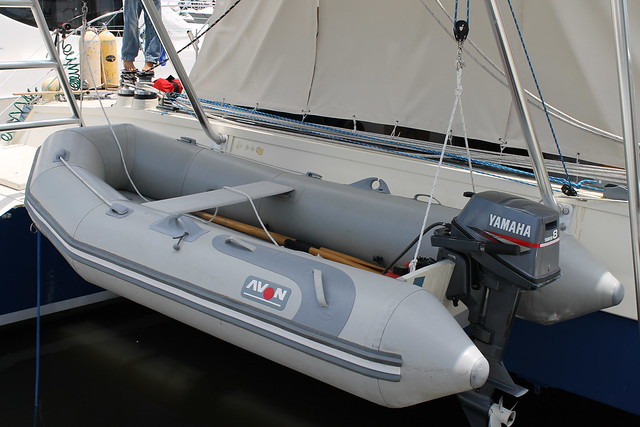
The new dinghy is a 10' Avon inflatable with a high pressure air floor.  It will roll up and fit into a space smaller than that taken by the PB's seats.

Another Dinghy

The driving factor here is that we're no longer a one dinghy family.  With Rachel's birth we've exceeded the rated capacity of our 12' RIB, which really only matters in places that care about that sort of thing (ie. the US).  More importantly, we have growing boys that are ready for a little more freedom.  We already let them go explore alone by kayak, and this new boat is intended to be the "kids" boat and extend their range.  As the boys grow in size and appetite, we're also expecting this boat will help them contribute to the dinner table in the form of fish and lobster.  

Another consideration is that we've felt constrained in some of our dinghy excursions in remote areas by the prospect of engine failure.  With this second dinghy, we'll have a built-in buddy boat.  Both of these uses require the backup boat to be readily available, which the PB is not.  We're expecting the air floor dinghy will be easier to deploy and spend more time in readiness.

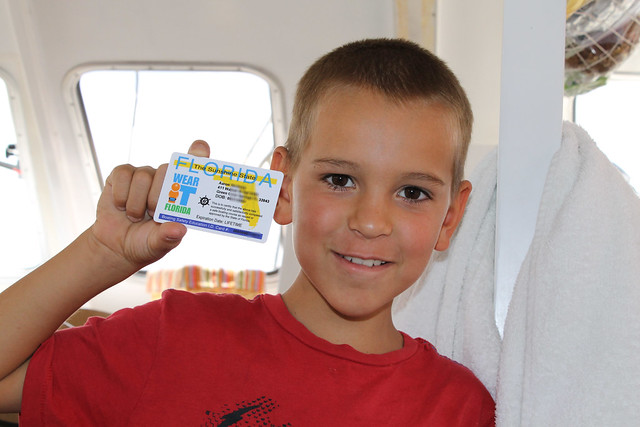
Of course, this second boat will need a driver.  Aaron has recently received his Florida Boating Safety Education I.D. Card and is now a legal operator in Florida.

Legal

3 AM Feeding

Sorry for the delay in getting information up about the newest crew member. Our captain is not a man of many words. After yet another marathon labor and delivery, we have been too wiped out/busy to post photos, though we should remedy that soon. I hijacked the camera and went to my mother in law's to rest and Jay is keeping the other four crew members busy at the boat.

So, here I am at three in the morning (a bit delerious perhaps) happy to announce that Rachel Pearl was born at 9:40 P.M. on May 2, missing sharing her big sister's birthday by about two hours. God must have a good sense of humor–He gave Sarah the very thing she had been asking for, just in time! We celebrated with chocolate cake at midnight. Rachel weighed in at a respectable 8 lbs, 11 oz. and was just over 20 inches. She couldn't be healthier (or cuter) and I feel like a million bucks.

I have business to attend to, but thanks to all for their prayers and love.

To be continued…

The Overdue Blues

I got me a bun in the oven
And it’s gettin’ overbaked
It’s been nine months and nine days—
How long’s this baby gonna’ take?

I got the overdue baby blues
I want to have this baby soon…

Everybody says that I’m so cute
But I feel like Porky Pig
I know I’m sposed’ to grow now
But that baby bump is gettin’ big!

I got the overdue baby blues
This baby better come out soon!

Well this isn’t exactly the first time
Since this is baby number five
You’d think by now I’d know how
To get a baby to arrive—

But the secret sauce ain’t workin’
And the herbal remedies
The eggplant parmiggiana
Or prayin’ and beggin’ PLEASE…

Let this pregnancy be through!
I got the overdue baby blues
Come on my baby, soon—

I got the overdue baby blues
It is time to end this ruse—
We just can’t wait to meet you!
Baby, I sure hope you show up soon…

Cameraman

For some reason, most of the pictures we took in the Bahamas turned out beautifully.  The colors… the light… the scenery… it was really hard to take a bad picture.  I must say that it went to my head a little.  Suddenly I had standards for when a picture was good enough.  Suddenly I wanted to spend a bunch of money on a camera that lived up to those standards.  And suddenly, now that we’ve left the Bahamas, all our pictures suck.  That explains the lack of them recently, by the way.  

I really know next to nothing about photography.  I’m a point-and-shoot kind of guy.  So when looking at DSLR cameras I was a little bit daunted by all the specs and features and lenses.  I talked to a friend of ours who is a real photographer and Peter was able to make a specific “you should get this camera” recommendation.  His suggestion was a Canon EOS Rebel T3.

It arrived yesterday, and though I’ve done little more than take it out of the box at this point, I hope that we’ll have better pictures showing up soon.

I’m not really looking for a hobby, but after getting this fancy camera, I should probably at least learn the basics.  What I need now is a subject to practice on… something that looks interesting… something that people want to see… something that doesn’t move too much… something like a baby…  a baby!  

Now all I need is a baby.  One should be delivered any day now, but those don't ship with tracking numbers.

Diapers & Beer

I uploaded this picture earlier, but Tanya thought it required some explanation:

Diapers & Beer

You see, in my line of work (analyzing data and finding hidden trends) it's an old joke that diapers and beer are often purchased together.  So I got a giggle today when I looked down into my shopping cart and found none other than "diapers & beer".  It seems the store has heard the joke because the diaper aisle is right next to the beer aisle.

No, this does not mean the baby has arrived.  Any day now.  Be patient.