The Squall

It breaks like a giant gray wave in the sky;
The wind and rain are the weapons it wields.
I stay inside and watch as it passes by–
It moves across the bay as over an open field.
The rain comes falling like a hail–
Sometimes it hammers, sometimes it pounds,
Falling sideways, driven by the gale.
Somewhere nearby a thunderclap resounds.
The wind: those invisible fingers of persistent strength
Whose touch is chilling and will is on mischief bent,
Whispering and howling until at length
The storm recedes with power drained and anger spent.
Such magnitude without body and without shape!
The creation of such a thing comprehension does escape.

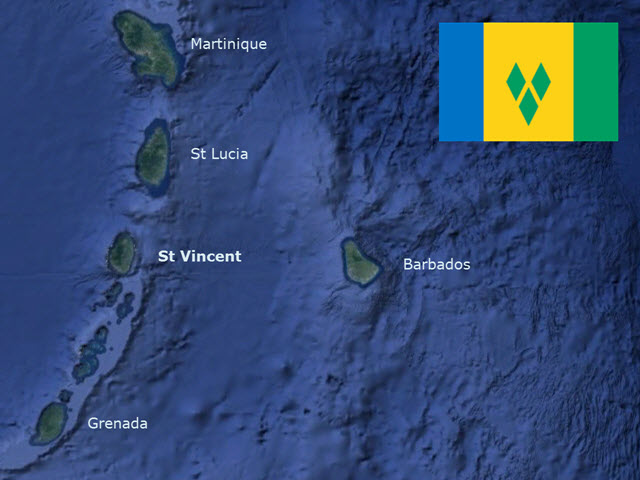
Geography Report: St. Vincent and the Grenadines

StVincentMapFlag

Basic Facts

Capital: Kingstown, St. Vincent
People/Customs: St. Vincent and the Grenadines has a population of 112,000, mostly descended from African slaves, with some Scottish, English, Irish, French, Asian, and Caribs.
Language: English, with locals speaking a French Patois.
Climate: In January the daily high temperature is 81°, and the low is around 72°. In July the average daily high is 86°, while the low averages 76°. Hurricane (rainy) season is June to November.
Food/Farming: Bananas, Arrowroot, Coconut, Cocoa, and Spices.
Government: St. Vincent and the Grenadines is an independent nation within the British Commonwealth.
Currency: East Caribbean Dollar
Art/Music/Culture: Reggae, Calypso, and Steel Band music is popular in St. Vincent, and common sports are cricket and football (soccer).

History

Spanish explorers discovered St. Vincent in the 1500s, and in the early 1700s French settlers established plantations on the island. The British and French fought over St. Vincent and the Grenadines and in 1783 the Treaty of Paris gave the islands to Britain. In 1812 the Soufrière volcano erupted and wiped out cocoa, coffee, and sugar plantations. Most plantations were abandoned after slavery was abolished in 1834, but those that had remained in use were further diminished by a hurricane in 1898 and another volcano eruption in 1902. Small farmers then continued to use the plantations as farmland. In 1969 St. Vincent and the Grenadines became a self-governing state of Britain, and gained full independence as a nation inside British Commonwealth in 1979.

Land forms/Flora and Fauna

St. Vincent has an elevation of 4048 feet. St. Vincent is around 133 square miles, and the Grenadines, consisting of several islands, (the main ones being Bequia, Canouan, Mustique, Mayreau and the Tobago Cays, and Union),  are around 17 square miles in all. The St. Vincent Parrot is the national bird and it is endangered. There are also protected coral reefs with many species of fish and sea turtles.

Things to Do

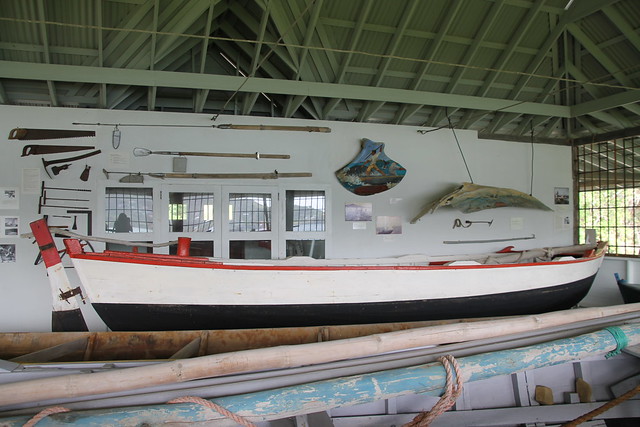
There are botanical gardens on St. Vincent, a whaling museum on Bequia, and the Tobago Cays have a Sea Turtle Sanctuary. Union Island is known for kiteboarding.

Bibliography

Bendure, Glenda and Ned Friary. “St. Vincent and the Grenadines.” Lonely Planet Guide to the Eastern Caribbean, 2nd Edition. 1998: Lonely Planet, Hawthorn, Australia.

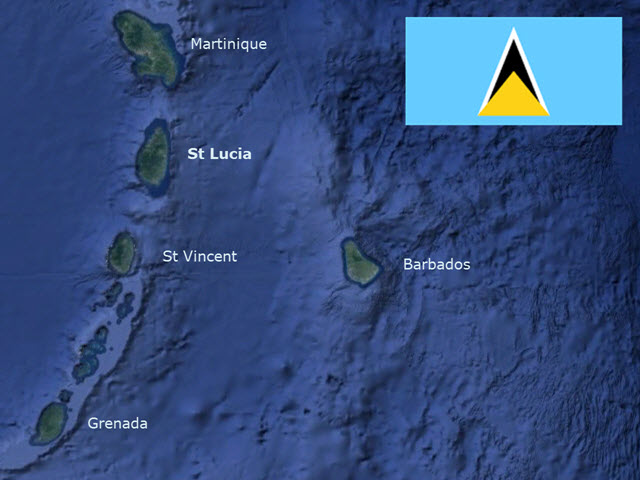
Geography Report: St. Lucia

StLuciaMapFlag

Basic Facts

Capital: Castries
People/Customs: approximately 150,000 people live on St. Lucia, mostly descendants of slaves or people who immigrated from other Caribbean nations to work in the hospitality industry.
Language: English
Climate: In the winter the high is around 81°, the low, 72°. In the summer, the high is 86°, the low, 77°. Hurricane season (rainy season) is from June to November.
Food/Farming: Bananas, Coconuts, and Cocoa are the most productive crops on St. Lucia. They also export rum made from sugar cane.
Government: St. Lucia is an independent state within the British Commonwealth, represented by a Prime Minister.
Currency: The East Caribbean Dollar (EC) is used here.
Art/Music/Culture: English, French, African, and Caribbean cultures influence St. Lucia. Carnival is celebrated in July.

History

The Spanish discovered St. Lucia in the 1500s and the British later attempted to settle the island, but after 2 years of attacks from the Carib tribes living on the island, the effort was abandoned. The French took interest in St. Lucia and struck an agreement with the Caribs. The first town, Soufrière, was settled in 1746 by the French and plantations were established on the island. Then for the next 150 years the British and French traded control of the island until 1814 when the Treaty of Paris ceded St. Lucia to the British. African slaves worked sugar plantations until they were emancipated in 1834. French influences can still be seen in the music, food, and city names. English became the official language in 1842, and locals speak a French-based Patois. Tourism is now the main industry in St. Lucia, though agriculture still accounts for about a third of the economy.

Land forms/Flora and Fauna

St. Lucia is 27 miles long, 14 miles wide, and has roughly 238 square miles. The highest peak is Mt. Gimie, the second highest is Gros Piton, and the third is Petit Piton. Much of St. Lucia is covered in rainforest, complete with tropical fruit trees and animals like birds, insects, and frogs. The Jacquot Parrot is the island’s national bird and almost went extinct.

Things to do

Visit fort ruins on Pigeon Island, Castries Cathedral of the Immaculate Conception, the beach at Rodney Bay; scuba dive or snorkel near Soufriere and the Pitons; spend the day at Marigot Bay (Capella Resort or Doolittle’s on the beach); rent sailboats (Rodney Bay, Marigot Bay or Sugar Beach); hike Gros Piton or climb Petit Piton, hike to the waterfalls or sulfur springs; or go to the “drive thru volcano” and mud baths.

Bibliography

Bendure, Glenda and Ned Friary. “St. Lucia.” Lonely Planet Guide to the Eastern Caribbean, 2nd Edition. 1998: Lonely Planet, Hawthorn, Australia.

Twilight Drive in Grenada

You are standing in front of a large yellow van parked on a high mountain road. You are tired and muddy from a four-mile hike through the jungle. It is past seven o’clock, and the sun is beginning to sink below the horizon. You and the other hikers pile into the van, and you take a window seat on the left side. The driver, aptly named Yellow Man, gets into the driver’s seat on the right side. He is wearing a yellow shirt, yellow pants, yellow socks and shoes, and a yellow rubber band in his long beard. He starts the engine and the van begins to roll down the slope. For no particular reason, you slide back the window and stick your head out in to the evening air.

The wind is warm on your face, carrying with it the smell of damp vegetation and, occasionally, goats. You also catch a faint whiff of rotting mangoes. Over the rushing air, you hear the almost-electronic peeping of thousands of tiny frogs in the jungle. The road winds through the mountains, looping back and forth through the valleys and slopes. Sometimes your view is blocked by a wall of volcanic stone, and sometimes the rainforest drops away, revealing the whole island spread out before you like a wrinkled green quilt.

You pass through a small town. The houses are painted all manner of colors: powder blue, bright pink, mango orange, and banana yellow. Reggae music blasts from a small pub where local men talk and play pool. Occasionally, a car rushes past in the opposite direction. Because you are seated on the left side of the van, you do not have to worry about your head being forcibly removed by on-coming traffic, but you do have watch out for branches sticking out into the road.

At one point, you pass a landfill. You smell it long before you see it in the fading light: the stench of burning rubber. The huge piles of garbage have been burning for years, rendering this beautiful valley entirely uninhabitable. You are very relieved as the van drives away, and start to breathe from your nose again.

The van gradually makes its way out of the mountains and into the capital, St. George’s. It is well past eight o’clock and the sun is long gone. The only light comes from the orange street lamps, and the van’s own headlights. By this time, your neck is very sore from holding it outside the window for over an hour. You briefly pull your head back into the vehicle, but you just can’t stand the inanity of the conversation from the back seat.

You are beginning to feel sleepy by the time the van drives through the marina gate. You hear the sound of tires crunching over gravel as the vehicle comes to a halt, and draw your head back through the window for the last time. Yellow Man kills the engine, hops out, and opens all the doors. The seventeen occupants of the fifteen-passenger van all tumble out. You gather up the bag of muddy shoes, and say good night to the other weary hikers. As you walk down the dock toward home, calypso music drifts across the water from faraway hills.

Asking Directions in French

I remember quite clearly the first time I asked for directions in French. I was a sophomore in high school, visiting Quebec with some friends of my parents, Peter and Linda. Linda is French Canadian, and we had struck up a bilingual friendship the previous year when they had come to visit us in Florida. I had taken one year of high school French in a part of the country where a large segment of the population speaks Spanish. As is often the case, one small decision—like which language class to take—leads one down a long and surprising path.

We were in a restaurant in the old city, and I asked for directions to the ladies’ room. Evidently, my ability to ask basic questions surpassed my ability to comprehend the answers, as the hostess responded with a long and very fast explanation involving only a few words of which I caught—something about “stairs” and “to the right.” Too proud to admit my ignorance, I smiled and thanked her and went looking for some “escaliers.” (I eventually found les toilettes.)

Peter and Linda lived in a rural village 20 minutes south of Middlebury, Vermont and that summer visit whetted my appetite for both language immersion and, coincidentally, Middlebury College. Two years later, I found myself conversing awkwardly at the French table in the Middlebury Chateau Language Café, out of my league with students who had had four years of French in prep school and a score of 5 on the French AP exam. Beyond French I and II with my Egyptian teacher, Madame Assaad, at my public high school, the only speaking practice I had had was with the Quebecois on my summer trip and Haitian refugees in my hometown. But after 2 years and a semester abroad at Middlebury’s Paris campus as well as many fun weekends in Montreal, I had even begun to dream in French—the holy grail of language-learners.

After Middlebury, my opportunities for language practice were only occasional, but often essential. I worked for several years as a teacher in an Atlanta-area public school where my training at Middlebury and my ESOL (English to Speakers of Other Languages) certification were quite helpful. The school was about 80% non-native-English-speakers. Translators for parent-teacher interactions were hard to come by, especially for the Vietnamese students, but lucky for me, and thanks to French colonialism, many of the Vietnamese parents had grown up speaking French in school, so I was able to help find common ground with a group of people who often felt alienated in their new country.

Twenty years have passed since I first asked for directions in French, and though I don’t get many chances to practice, the French language is deeply embedded in my memory. After sailing from Dominica, we anchored near the village of Saint Pierre in Martinique. Jay and I had to locate the café in which to fill out the customs paperwork, the Digicel store to buy a SIM card so we could have internet access, and a bank to withdraw some cash in Euros. A few days later, we took Le Petit Train Tour, which runs all over Saint Pierre, describing its former opulence and showing its devastation by Mt. Pelée; because the tour was in French, I had to act as real-time tour translator for the kids. Somehow, despite twenty years of vocabulary loss and imperfect grammar, I navigated all of these tasks in French, and also found the three things I’d been looking forward to in Martinique: le vin, le pain and le fromage! We even made friends with a French family anchored in Fort-de-France. These experiences make me feel so grateful for Middlebury’s immersion program and the gift of a second tongue. I hope the exposure to French and Spanish in the Caribbean will do for our kids what a visit to Quebec once did for me.

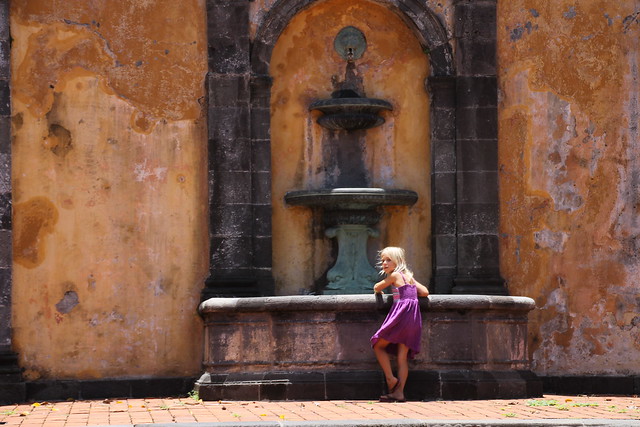
St Pierre, Martinique

Grenada Taxi Tour 

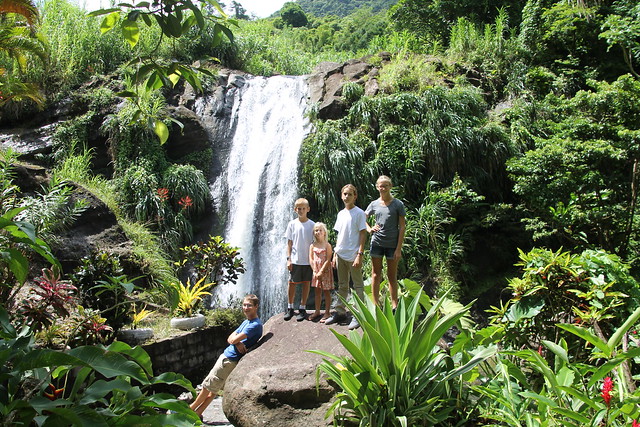
Last week we went on a taxi tour of Grenada. The first stop was Concord Falls. It was a waterfall about 55 feet high. There were stepping stones across the pool below, and then there was another waterfall below that. I am looking forward to swimming there another time.

Concord Falls

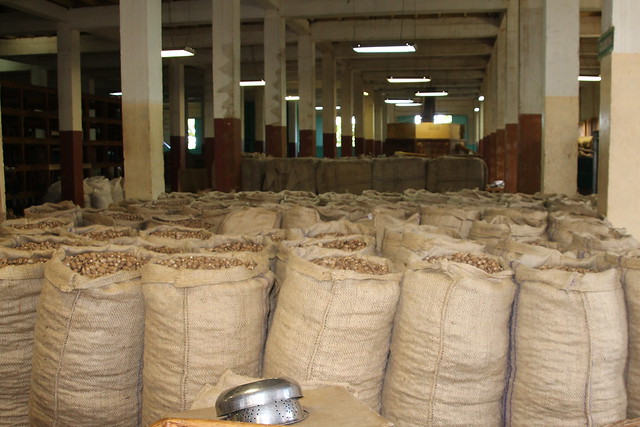
Then we went to the nutmeg factory. They process and prepare nutmeg for shipping all over the world.

Nutmeg Processing Plant

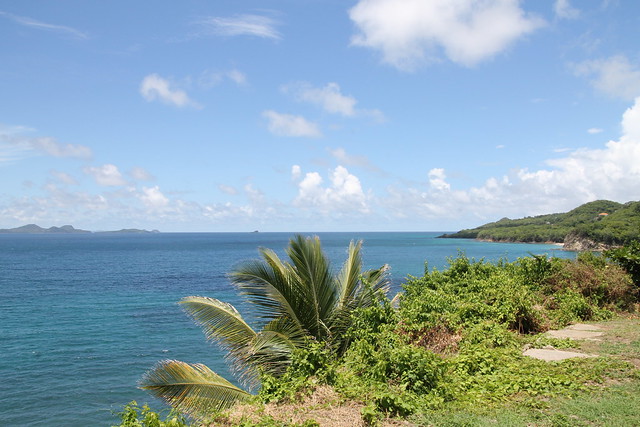
Next, we went to the Jouvay Chocolate company. We saw how they sort, roast, grind, melt, and mix chocolate. We got free samples; my favorite was the 60% dark chocolate. We also stopped at Carib’s Leap where the natives jumped off a cliff rather than becoming captives of the French.

Carib's Leap

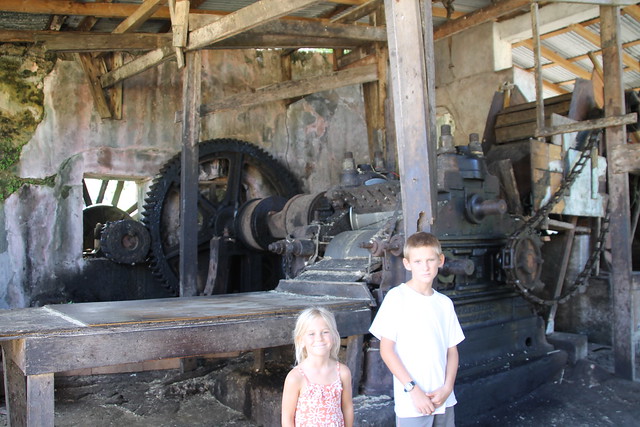
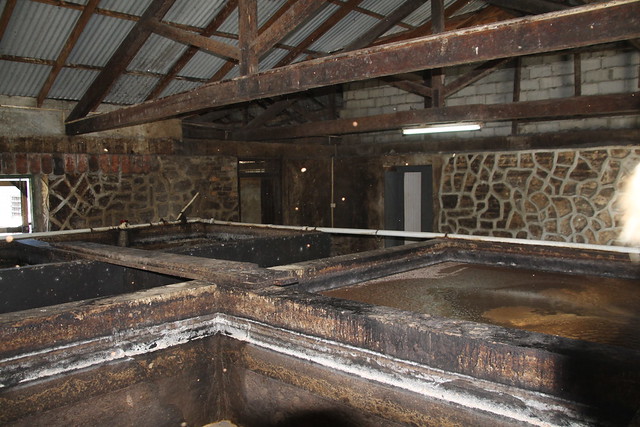
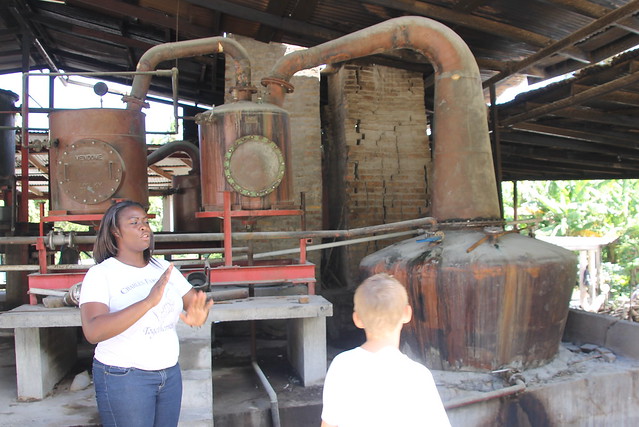
Last, we saw how they make rum the traditional way at Rivers Rum Distillery. The vats of fermenting cane juice were disgusting!

Antique Equipment

Vats of Fermenting Cane Juice

Rivers Rum Distillery

Finally, we drove back to St. George’s through the Grand Etang Rain Forest, but we did not see any of the Mona Monkeys that live there. It was a long day!

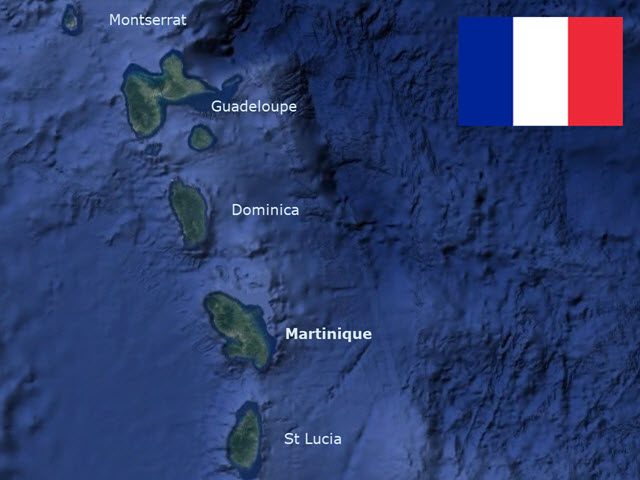
Geography Report: Martinique

MartiniqueMapFlag

Basic Facts

Capital: Fort-de-France
People/Customs: An estimated 400,000 people live on Martinique.
Language: French
Climate: In the winter the high is around 81°, the low, 72°. In the summer, the high is 86°, the low, 77°. Hurricane season (rainy season) is from June to November.
Food/Farming: Sugar cane, bananas and pineapples are the leading crops. “Rhum Agricole” is distilled from sugar cane juice for local use and export.
Government: Martinique is an Overseas Territory of France and is represented in parliament by 4 deputies and 2 senators.
Currency: Euros are used in Martinique.
Art/Music/Culture: French and Creole/African influences affect food, language, art, music and culture. The food is French-style cooking, altered to use tropical fruits and vegetables.

History

Columbus sighted Martinique in 1493, and sometime later French settlers established a fort there. The Caribs fought against the French but were exterminated by 1660. In 1636 King Louis the XIII authorized the transportation of slaves to work on the sugar plantations. From 1794 to 1815, England had control of the island during the French Revolution. French took back Martinique after the Revolution in a time of stability. The capital of the island, often called “the Paris of the Caribbean,” was St. Pierre until 1902, when Mount Pelée erupted and destroyed St. Pierre and killed 30,000 people. Fort-de-France was made the permanent capital. St. Pierre was rebuilt but never returned to its former state. In 1946 Martinique became an Overseas Department of France, and in 1974 it was promoted to a Region of France. Today it is a major tourist destination for French-speaking people.

Land forms/Flora and Fauna

Martinique is a volcanic island with an area of 1,080 square kilometers and its highest point is 1,397 meters above sea level. Most of the island is covered in rainforest. Anoles, snakes, and opossums are common; among the endangered species are the Martinique Trembler, the White-breasted Trembler and the White-breasted Thresher.

Things to do

In St. Pierre, take a walking tour or Petit Train Tour (if you speak French) of the old city and ruins, visit the volcano museum to see artifacts from the eruption of Mt. Pelée, or hike the aqueduct built by slaves. Go to the beach, zoo, or Botanical Gardens in Le Cabret. In Fort de France, there are shops, parks, a library, and an old fort. There are traditional sailboat races, “La Rond Des Yoles,” as part of Bastille day celebrations in July. In St. Anne, there are beautiful beaches, water sports and a floating water fun park. Eating is a major attraction in Martinique—go to ice cream shops, crêpe stands, patisseries and boulangeries (for pastries and bread), and shops with cheese, wine, and chocolate.

Bibliography

Bendure, Glenda and Ned Friary. “Martinique.” Lonely Planet Guide to the Eastern Caribbean, 2nd Edition. 1998: Lonely Planet, Hawthorn, Australia.

Taking the Heat

It is hot in Grenada. Hot, hot, HOT!  At mid-morning, with the door and windows closed, the temperature in the cabin would be around 99 degrees Fahrenheit. A good breeze brings the temperature within tolerable limits. At anchor, the trade winds provide a consistent source of…well, wind. However, tied to a dock in Port Louis Marina, the breeze is both blocked by a mountain and hitting us at the wrong angle. Cooking only compounds the problem. Unless you were born in the tropics, or the Sahara Desert, you will be unable to function efficiently.

We are pretty tough. Six years ago, we survived a summer in Boot Key Harbor, baked by the relentless sun and besieged by the relentless mosquitoes. We lived through that by spending the heat of the day lounging on the trampolines under a shade tent, doing nothing. Needful to say, now we’re older and have school and chores to do, so lounging all day is no longer a viable solution to our little problem. The frustrating thing is that we do have air conditioners capable of bringing the temperature below 85 degrees, and shore power is available. It’s just very, very expensive; 62 cents per kilowatt hour may not sound like much, but it adds up. We could run the generator all day, but that doesn’t bring the cost down much, and it’s annoying.

Despite the various roadblocks, we are winning the battle against the summer heat. Here are some of our strategies:

  1. Shade awnings. We have four large mesh awnings stretched over the cabin top and foredeck by fiberglass broomsticks, and held taut by a complex web of small-diameter lines. It may seem low-tech, but it really helps lower the temperature.
  2. Ice cream. Every week, when mom goes to the store down the road, she brings back a 1-gallon bucket of ice cream (along with the other groceries, of course). This doesn’t directly help keep the cabin cool, but it raises morale while temporarily lowering the body temperature.
  3. Breeze Boosters. This is a special type of wind scoop that does not require the constant use of a halyard for suspension. We have four, and position them over the bedroom hatches in an attempt to funnel whatever wind there might be in to the boat.
  4. Going to the pool. As a general thing, I do not like pools, and this marina’s pool is no exception. However, sometimes it’s just too hot to object, even if the water is lukewarm, cloudy, and feels like you are swimming in lubricating oil.
  5. A/C. We typically run the generator from 7 to 11 PM, to make water and power, so we also run the air conditioners. This counteracts the added heat from mom cooking dinner, and allows us to go to bed nice and cool (I like my room at a balmy 70 degrees Fahrenheit). We close up the boat, and keep it closed even when the A/C goes off, trying to keep the cold in.
  6. The poor man’s A/C. Take cold shower. Turn on fan. That simple.

If all these methods fail, a visit to the air conditioned marina bathroom, grocery store, or taxi tour will provide some relief until the sun goes down. In the tropics, you have to learn to take the heat.

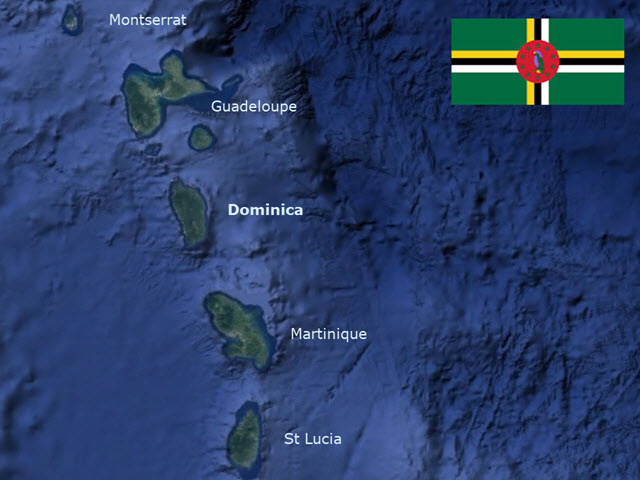
Geography Report: Dominica

DominicaMapFlag

Basic Facts

Capital: Roseau
People/Customs: Population is around 71,000, with one third residing in the capital. There are about 3000 native Caribs living in the Calingo reservation area.
Language: English (Locals also use a French Patois when speaking to each other.)
Climate: In the winter the high is around 81°, the low, 72°. In the summer, the high is 86°, the low, 77°. Hurricane Season is from June to November.
Food/Farming: bananas, coconuts, spices, coffee, cacao, citrus, cucumbers, melons, and a variety of tropical fruits are grown for export as well as local use. There is a coconut processing plant on the island which produces oil for cooking and cosmetics.
Government: Dominica is an independent republic within the British Commonwealth.
Currency: East Caribbean Dollar
Art/Music/Culture: Holidays are New Year’s Day, Carnival, Good Friday, Easter Monday, May Day, Whit Monday, August Monday (Emancipation Day), Independence Day, Community Service Day, Christmas Day, and Boxing Day. The culture is influenced by the French islands to the north and south.

History

Columbus named the island Dominica in 1493 because he first sighted the island on a Sunday, and in Italian Doménica means Sunday. The Spaniards took little notice of Dominica because there was no gold and the natives defended their island fiercely. In 1635 France attempted to colonize Dominica, but were thwarted by the Caribs. The French and British agreed to leave the island to the natives in 1660, but the French settlers from Guadeloupe and Martinique secretly established coffee plantations on the north end of Dominica. In the 1720’s a French governor came to take official control of the island. For the rest of the 18th century the British and French fought over Dominica until the Treaty of Paris was signed in 1763, officially giving the island to the British. The Europeans imported slaves from Africa to work the land until emancipation in 1834. Dominica became an associated state in 1967, and in 1978 it gained independence as a republic within British Commonwealth. The economy is now based largely on agriculture and tourism, with the natural beauty of the island a large draw for those who love hiking, waterfalls, and snorkeling/diving.

Land Forms/Flora and Fauna

Dominica is 190 square miles, and has the highest mountains in the eastern Caribbean. Morne Diablotin is 4747 feet high and attracts the rain that creates the 200 rivers on the island. Dominica also has the highest concentration of live volcanoes. Dominica has many tropical rainforest birds and animals, including the “mountain chicken,” a large frog considered to be a delicacy by the locals. Most of Dominica is unspoiled wilderness, earning it the nickname, “the Nature Island.”

Things to do

Hike 16 miles to the largest boiling lake in the world (heated by the magma chambers below), take a river tour and go to the rainforest café, visit waterfalls, and hike or snorkel in Cabrits National Park and visit the old fort. Champagne reef to the south has underwater volcanic vents which create bubbles in the water, as well as warm sulfur springs in Soufriere Bay popular with bathers.

Bibliography

Bendure, Glenda and Ned Friary. “Dominica.” Lonely Planet Guide to the Eastern Caribbean, 2nd Edition. 1998: Lonely Planet, Hawthorn, Australia.

Boat Boys

Picture this: you’re sailing into a harbor of an island nation you’ve never visited before, after a rough day at sea, furling sails, starting engines, and preparing bridles for anchoring or mooring, and a small, multi-colored, wooden fishing boat comes roaring towards you. He comes alarmingly close, does a swift U-turn, then starts shouting at you in heavily-accented English. The first time this happens, you feel a little freaked out…are these the famous Pirates of the Caribbean? But by your third or fourth island with a welcoming committee, you begin to grow savvy, then you get a little jaded. Eventually, you learn to wave, ask the name of the captain, and tell him to come back after you’re anchored, and no, you do not need assistance. Really, no. No, thank you. (No, dammit!)

These are the Boat Boys. Enterprising, opportunistic, and insistent, they are like humane-society pets: one look at those sad eyes and you can’t figure out which one to take home and which one to leave behind. It doesn’t matter how many carved-coconut bracelets you have bought, how many soursops, sugar-apples, and bananas you already have going soft in your fruit bowl, there will always be one more Boat Boy calling your name: “Hey, lady! Nice lady!” “Madame, I have something for you.” “My friend, take a look at what I brought you today!” “Fresh fish!” “Fresh fruit!” “Fresh bread!”

Tropical Fruit

They come in crafts of all sizes and materials: cast-off paddleboards, patched inflatables, locally-built pirogues with fast outboards, leaky rowboats with two-by-fours for oars. Some of them are Rastafari, and go by names like “Warrior” and “Culture.” Others have nicknames like “Beans” (as in “full of”) and “Skipper.” Others are regular guys, just trying to survive and support themselves and their families, like Justin, who works the charter boats to earn enough money to buy his daughters’ school uniforms. Some of them, like Titus, have traveled the world and come back to their island-homes, and others have never been to the island a stone’s throw away. Some of them, like “Lawrence of Arabia,” are part of a boat-boy association, a way of sharing the wealth and taking turns welcoming boats. Occasionally, they are obnoxious and get in the way while you are trying to anchor, or actually bump into your boat, or continue their sales pitch after you’ve said “no thank you.” A few are little better than beggars.

Indian River, Dominica

You pay them too much and they throw in extra produce “as a gift” and they invariably ask for a cold drink, a beer if you have one, or soda or juice if you don’t. They’ll take your garbage for a small fee (you should refuse because you don’t know where that trash will end up), and they’ll sometimes ask if you have used items you’re ready to part with, clothes in good condition, shoes, or household goods.  All of them are trying to make an honest living, something that can be hard on an island in the tourist off-season, or a place hard-hit by a natural disaster, or a village with a high-unemployment rate. They are often relying on multiple revenue streams—picking up odd jobs, fishing, or operating as a water-taxi in addition to selling fruit or hand-made crafts. It is what they are not doing that strikes me as important: stealing, begging, or selling drugs.

You can send them away, and they will reluctantly paddle or motor to the next boat, or you can look at their wares. But if you seem even slightly sympathetic, watch out! They can smell a sucker from the next harbor. There is another thing you can do: sit down on your stern, hold their dock lines, and talk. You will often find them to be floating philosophers.

Some of them are at the beginning of their careers, like Ivan and Derrick. These two half-brothers are seventeen, just graduated from high school in Soufriere, St. Lucia. They come in their older brother’s boat, offering to help us with our mooring lines, asking if we need fish or a taxi or a hiking guide. We tell them we are interested in hiking the Pitons, but we need to discuss it with the kids, to come back in an hour. (This strategy works well with pushy salesmen.) In the meantime, we ask the park ranger who comes to take our mooring-ball fee, what does he think about these two boat boys? Are they ok? Is the price they are asking too high? He says they’re good kids, and we might pay more to hire an official park guide because we would also have to pay a driver to get to the trailhead, instead of going by boat and starting on the beach. They seem perfect for our plan: Derrick can take Eli and Aaron up Petit Piton and Ivan can hike Gros with the rest of us. We arrange it when they come back, bearing fresh bread.

They come the next morning at seven to fetch us. They hike in bare feet. They’re quiet, and seem a little shy around our family. I ask lots of questions as I huff and puff up the mountain, curious about their life on the island. Ivan had a chance to go to university, but isn’t ready to go yet. He would rather get paid to hike than go to school, or fish, or farm. After the hike, we offer frozen lemonade and agree to buy some fish their older brother has caught, and invite them to come for fish tacos. We are surprised when they agree. Dinner is subdued, nothing revelatory, but companionable. We talk about career options on the island, because we just can’t believe these two young guys have no other options than to be boat boys. By paying them, we are supporting this idea. I ask what a “good job” on the island would be. Derrick says, predictably, “Doctor.”  I ask if they could travel, where would they go? Ivan says, unpredictably, “Miami.” They leave our family dinner to go to a Carnival celebration somewhere on the island, and we leave the next morning.

A couple weeks later, while anchored in Tyrell Bay, Carriacou, a man in an ancient rowboat knocks on the side of our boat. Despite the fact that I am the family sucker, I also happen to be the family ambassador, so I always get sent out to talk to the boat boys. And I always come back in with fruits or vegetables, or bracelets, or fish, or bread, or wine, and always a new story. I had just bought limes from a produce stand in Clifton (Union Island in the Grenadines), but Warrior has a bucket of limes and nothing else. He has dark skin, gray hair, and the clearest blue eyes I’ve ever seen on a black man. It gives him an otherworldly look. He offers to take our garbage, but I say no. I bring him a cold drink and buy some limes anyway. I sit down to talk with him. He is incredulous that we have five children on a boat. He says in forty years as a boat boy, he has never met someone traveling with five children. I drag all five kids out on deck and introduce them, and give him a boat card with all our names on it.

I ask him about his years visiting boats. He tells me about the first boat he paddled out to, when he was just fourteen, and its recent return to Carriacou. He tells me about what he does to earn a living, and how he has traveled in years when the money was good, most recently to Grenada for Carnival. I tell him about leaving Atlanta, about rejecting suburban American life for a simpler life on a boat. He asks me what I think about life. I say every day is a gift to unwrap. He says a woman told him once that “life is what you make it.” But he completely rejects this philosophy as he understands it. He says you don’t have power to make anything, but to find it and then do with it what you can. Perhaps it is just semantics, but I think I understand what he is saying. He insists, “Life is not what you make it…it’s how you get it.” He gives examples of historical figures who tried to bend things to their wills but in the end were unsuccessful, like Maurice Bishop in the Grenada Revolution. Ultimately, we don’t have control over circumstances (in Maurice’s case, the treachery of comrades), but over our attitudes, and our willingness to work.

He has more to say, but the sun is sinking into the sea, and he sees that I need to get back to my family. He offers to stop by again, with more produce, and I say I would be happy to talk again if we are still here. I ask if I can take his picture, and shake his weathered hand. As he paddles away, I suddenly think of Ivan and Derrick, and wonder if they will still be doing this in forty years. And I am in no place to judge—maybe this is as good a life as any, taking each day as you find it, interacting with people, offering a service, giving and receiving, and getting out of it what you can.

Warrior, Carriacou