Fuel Usage

A good long trip is a great time to evaluate fuel consumption and capacities.

With 200 gallons of diesel aboard, there is a tendency to think it will last forever.  Of course it doesn’t, as we’ve already proven.  We also now know that actually putting 200 gallons into the tanks is not such a good idea, and have revised our capacity down slightly.  

With the rough graduations we put on the fuel gauges during our last fill we’re now at least able to monitor the decline with some confidence.  And with the empirically determined generator burn rate (0.4 gal/hr), and the new engine hour meters, we can extrapolate our propulsion burn rate (0.6 gal/hr).  This is useful for various planning exercises.  For example, we can now estimate with some confidence that with a full load of fuel we could either motor 1,600 nm on one engine OR run the generator daily for 320 days.

Propane is our second most important fuel since we use it for cooking.  We were very uncertain when considering a switch to propane because we didn’t know how much we’d use.  With all the cooking, bread baking, and tea & coffee drinking we do, the concern was that we couldn’t reasonably carry enough propane and would be constantly in search of more.  Those concerns were unnecessary as it turns out.  Our 10-month average shows that we get 30 days out of a 20# bottle.  We carry three bottles dedicated for the galley, so we have about 3 months of fuel there.  Our last bottle is projected to run out in 10 days (yes, I have a spreadsheet for that), but we have another 30 pounds for the grill.  The grill has seen very little use on this trip due to lack of fish and cows.

It is very nice not to have to worry about getting propane.  It isn’t available everywhere in the world, and in some cases the bottles have to be sent off to be filled.  George Town is supplied by a truck that comes once a week and queries about when/where are almost a daily occurrence on the morning radio net.  Apparently the truck broke down this week which is causing some anxiety in the harbor.  I’d like to add a fourth bottle for the galley and build a rack to store them more securely and efficiently.

We also carry a fair amount of gasoline.  Our dinghy motors, little Honda generator, and hookah dive compressor all have gas engines.  Gas is harder to store (and more dangerous), so we try to strike a balance between having enough without having too much.  We have four 5 gallon jugs and try to have at least two full at any time.  The dinghy has a 12-gallon tank and we feed it 5 gallons at a time to make it easy to mix in the oil.  

We don’t really have a good way to store gas, but I’m not sure that there is a good way.  I prefer to store the full jugs on the deck to prevent the possibility of fumes inside the boat, but then they are subject to temperature and pressure variations which can’t be good for them.  A hot fuel tank can build an enormous amount of pressure.  Maybe some type of cover would help.  I suppose I could also vent the tanks, but then I’d be concerned about the fuel absorbing moisture.

I count the dive tanks among the fuels.  We have two and they live on deck also, although probably shouldn’t for the same temperature/pressure concerns.  I didn’t put them in a locker thinking they might be a safety risk there too.  We carry the tanks in addition to the hookah simply because we have them.  I can throw a hose on a tank and be in the water in minutes, while the hookah requires more setup and cleanup.  Tanks are also much quieter than the hookah.  But tanks have a very finite capacity, which makes the hookah way more practical overall.  I suspect we’ll continue carrying the tanks (because we have them and do find them useful), but need to evaluate how they’re stored.

I Don’t Fish

My friend Ken will be so disappointed in me.  

Ken and his family are out on the water almost every day.  In the summer they're catching lobster and spearfishing, in the winter they go crabbing, and they're fishing all the time in between.  When we were planning to cross the Gulf Stream, Ken gave me a lure and told me how to use it.  My track record for fishing at that point wasn’t so good.  Lots of money spent on gear, but not much time getting it wet, and mostly catfish and barracuda to show for it.  But with visions of tuna and mahi mahi I gratefully took the lure.  We were in the Gulf Stream for about 12 daylight hours.  Did I put the lure in the water?  No, I did not.

Before a trip, catching a big fish seems like a no-brainer.  After the trip I pine for those big tuna steaks with regret.  But during the trip it just seems like a hassle.  I’m not hungry.  I don’t want to fight with a fish.  I don’t want to slow the boat down to haul it in.  I don’t want to clean a fish.  I don’t want to dehook another damn barracuda.  I'm focused on running the boat and everything not necessary to that end is put aside.

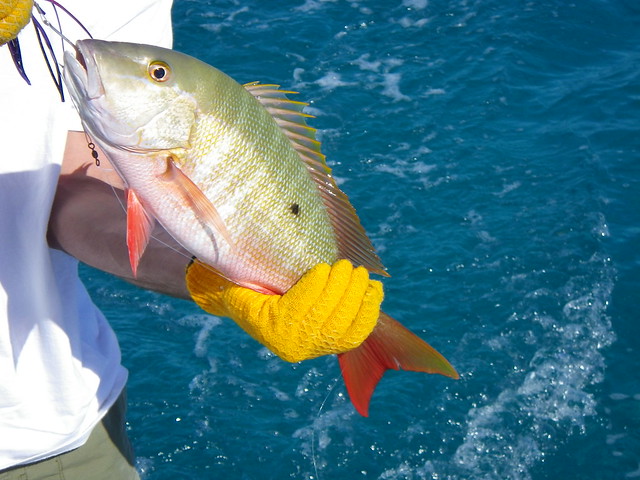
It was the same story between the Abacos and Eleuthera. I did put Ken’s lure in the water on the banks between Eleuthera and the Exumas.  It yielded a very nice snapper, followed by two very angry barracuda, the last of which bit through the wire leader and stole the hook.

Mutton Snapper

We went offshore a third time between Big Farmer’s Cay and Elizabeth Harbor.  I put a new hook on the lure, but once again, didn’t feel like putting it in the water.  A boat making the same trip alongside us caught four mahi-mahi on hand lines.  If they were in the fish, so were we.

It isn’t just fishing.  I have a new pole spear that has never tasted blood, and I haven’t bagged any lobster since the last time we went out with Ken.  Technically cruisers aren’t allowed to take conch in the Bahamas, but they were never in much danger from me anyway.

I’m not proud of any of this, and I hope to improve.  We expect that fish will eventually make up a large portion of the meat in our diet.  What we’ve seen available in the stores tends to confirm those suspicions.  Have you ever seen a Bahamian cow?  I haven’t had a good steak since my dad brought some in before Christmas.

Once the fish is cleaned, we can do it justice.  Another boat donated a big hunk of tuna to us.  We marinated it in lemon, soy, sesame, ginger, and garlic, then pan seared it and ate it rare.  Oh, it was good.

It would probably help if we started the trip with a cooler full of ice and could just throw the fish in without having to worry about cleaning it right away.  Hand lines are also probably better for hauling in a fish than reeling in 100 yards of fishing line.  But until I take a more relaxed view of our passages rather than being focused on VMGs and ETAs, I'll probaby never want to fish.

We have three more bodies of deep water to cross before we return to Florida, so I still have an opportunity to redeem myself with a big fish.  I’m not holding my breath.

Anchoring in the Bahamas

We had expected anchoring to be more difficult in the Bahamas.  We’d heard about poor holding in hard bottom scoured by current, and the need to use two anchors in a “Bahamian Moor” to prevent breaking one out of its set with every reversal of the current.  After dropping the anchor 36 times over the last 2 months, we don’t see what the big deal is.

Rock Anchor

We’ve never needed to use two anchors.  Maybe we’re not going to the right places, but if the chart says “strong current”, “surge”, or “poor holding” we don’t go there.  We have seen one place where boats were using two anchors: the Norman’s Cay cut.  We looked at the cut, looked at the boats anchored there, looked at the forecast, and went somewhere else.

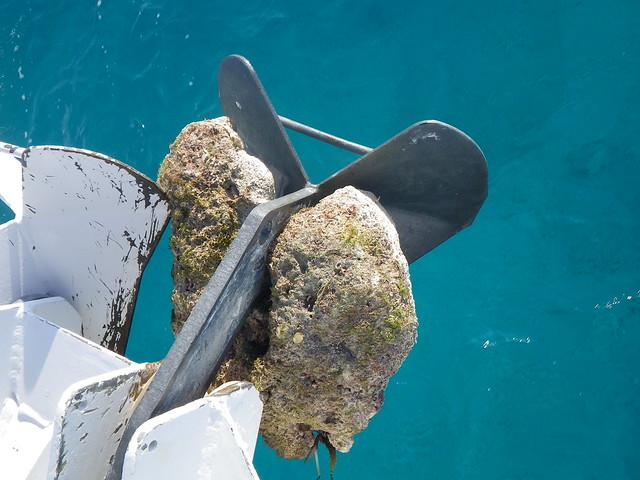
Our primary anchor is a 44# Delta.  For the most part we drop it and forget it.  We try to hit sand, and usually can see a cloudy spot where it lands.  We don’t back down on it, we don’t dive on it.  Sometimes I’ll go look at it with a glass-bottomed bucket, but that is rare.  Knocking on wood, we’ve never had a problem.  Sometimes it comes up clogged with weeds or rock, and sometimes a wind shift breaks it out and it has to reset.  But we’ve never had to re-anchor.

I don’t mean to sound flippant.  I’ve spent plenty of time worrying about my anchor, and many nights curled up with a portable GPS, getting up every hour to check the wind.  We’ve just never had a problem with our anchor holding.

We’ve come across two cases that make anchoring a little bit challenging: close quarters and high winds.  It takes a little practice to figure out where to drop the anchor to make the boat lay where you want it.  This is especially challenging when you’re trying to find shelter, the wind is forecasted to shift, and you want to make sure you remain sheltered without swinging into anything.  Sometimes I’ve ended up a little closer to the rocks after the shift than I planned to be.

When anchoring we let the boat come to a complete stop pointed into the wind before we drop, then we let her fall back as we pay out the chain.  We try to tie on our bridle quickly before the chain comes up short to prevent shock loads on the chain, windlass, and crossbeam.  This gets tricky when it is blowing since the boat is difficult to control when it isn’t moving forward.  We often use the engines to keep from falling back too fast or the bow getting blown off to one side, but it doesn’t always work.  If it were a big problem we could drop the anchor while still moving forward and use a hook for the bridle instead of tying it on.  The hooks aren’t as strong as the chain or are prone to falling off, so we prefer to tie them.

The adverse waves we've complained about before continue to be a mystery.  We've been anchored in this particular part of Elizabeth Harbour for about a week now, and a few days ago we had mystery waves.  The wind had not recently changed directions or strength, we were miles from any cut that would admit surge, and yet soon after the sun went down we started getting waves on our beam.  They are irritating and frustrating because we don't know what causes them, and therefore how to avoid them.  By the time they show up, it is always too late to do anything about it.

All in all, in our experience, anchoring difficulties in the Bahamas are over-rated.  We carry four (not counting dinghy anchors), but one always does the job.  If I had to buy a new anchor today, I might consider a Rocna, but they’re so expensive.  I’m more likely just to stay with Delta, though I’d probably move up to a 55 pounder.

Internet in the Bahamas

While our Internet use doesn't approach anything we'd consider unhealthy, we do use it quite a bit.  I am dependent on it for work, and while I don't necessarily need it all the time, I'm not retired either, and therefore need regular access to high-bandwidth connections for this lifestyle to be possible.  We undertook this trip without knowing exactly what we'd find in terms of Internet availability and quality.  We were pleasantly surprised in the Abacos, but not so much in the Exumas.

There are two Wi-Fi Internet providers in the Abacos, Out Island Internet and Bahamas WiMax, and one or both can be accessed from most anchorages.  If anything, the problem was too much Wi-Fi as the signals were often very noisy due to the number of networks within range.  We found ourselves selecting an access point not only by signal strength, but also by how many others were on the same channel.  We also found it helpful not just to select a network (the Bahamas WiMax APs all use the same SSID), but also to lock to a particular AP’s MAC to prevent us from skipping around.  Rates are $35/week.  We generally favored Bahamas WiMax since we felt they had a better network, but they had fewer APs and sometimes we had to use OII.  On several occasions while in the Abacos we were able to watch movies streamed from Netflix.  

The only settlement we visited in Eleuthera is Spanish Wells.  It did not have any public Wi-Fi signals and the harbor was also not big enough for us to enter with the big boat.  We parked outside, but could not hear any signals from there because of the topograhy.  I eventually found an open network by putting around in the dinghy, which allowed me to at least send and receive email.

The northern Exumas are uninhabited until you get to Highborne Cay.  The Highborne Cay Marina has Internet for its guests, but we never got close enough to see the signal.  Norman’s Cay is next.  I heard that there was an open network that could be used inside Norman’s Pond, but we never went inside and did not find any open networks on the West side.  The first network we actually saw was at Warderick Wells.  It is $10/day and is limited to 100MB, but is only for boats on moorings.  We were not on a mooring, so did not use it.  Next was at Staniel Cay.  We were anchored at Big Majors and could not get a signal there, but took a laptop ashore on Staniel.  The Exumas WiFi network at Staniel was so bad that we couldn’t even log in.  The Staniel Cay Yacht Club also offers Wi-Fi for guests, but we were not.  Next was Black Point settlement on Great Guana Cay, where a couple restaurants and bars offer Wi-Fi.  We did use the Internet here, after going 12 days without, but it was difficult at best.

The Warderick Wells, Staniel, and Black Point networks we found were all satellite-based.  That means signals had to travel about 100,000 miles round-trip through space.  The laws of physics prevent this type of connection from ever being considered fast by general standards.  By comparison, for terrestrial networks the max roundtrip is about 25,000 miles, even if the computers are on opposite sides of the planet.

We were hoping the availability in George Town would be better, since more people live there.  It was better, but we were still disappointed.  There are only two public Wi-Fi access points, each on different networks, and on opposite sides of the harbor.  

Harbour Wi-Fi broadcasts from the town side, and offers unlimited access for $15/week or $50/month.  One must go to Exuma Pets and pay cash for a username/password.  The pet store is left from the Exuma Markets dock, past the intersection and on the left.  The other network is Gaviota Bay and they broadcast from somewhere near Hole #1 behind Volleyball Beach.  They are very careful about their bandwidth.  One must buy “tickets” at the St Francis Resort for $2.  Each ticket is good for 25MB or 80min (your choice), but you can only buy two tickets a day.

Quality of each network varies.  Usually one of them is barely decent at any given time.  With a booster and some luck, both networks can be used at either the Volleyball Beach or Kidd Cove anchorages.  The Gaviota network is better both for speed and signal strength, but the bandwidth limitations prevent this from being a single solution for us.  However, Gaviota internet is free (and unlimited) for boats on St. Francis moorings.  Mooring rates are $20/day or $300/month.

There are several businesses ashore that offer either free or paid Wi-Fi, but we did not try those since they did not meet our needs.  I want the Internet all day for work.  Tanya wants it at night after the kids are in bed.  For both of these cases, we want Internet access on the boat, not in a café.

We have a Ubiquiti Bullet with an omni-directional antenna to pull wi-fi signals into the boat.  The Bullet is connected to a Cradlepoint wi-fi router, which constitutes our onboard network.  The Cradlepoint router supports a USB cellular modem, so when 3G/4G cell networks are available we can use those seamlessly.  For our next cruise, we’ll carry a directional Yagi antenna to help pull in weaker wi-fi signals.

Lessons Learned

We’ve talked about it before: our philosophy is to do everything in small increments, making progress one little “baby step” at a time.  We like goals, milestones, checkpoints, and measurable results.  We might be a little bit weird that way.  We also like being totally within our comfort zone.

We moved aboard the boat in the following progression: one night aboard, weekends aboard, a month aboard, then living aboard full time at the dock.  When we knew how to live on the boat, we left the dock and hung on a mooring ball in Marathon for 5 months.  Weaned of the dock, we were ready for a cruise and left Florida for three months in the Bahamas.  At each step we made progress in a one particular area so that we were completely at ease for the next step.  

Sometimes we make mistakes, or something unexpected happens to shake things up, but otherwise our day-to-day existence is pretty normal.  It is certainly different than if we lived ashore, but to us it has the same sense of normalcy.  While we may not notice it all the time, and we probably wouldn’t have described our goals in any such terms, that kind of normalcy in itself is a major success.  This is our life, and it works.

Much of the reason for our return to Florida is to gain perspective on our time away, compare the reality to our expectations, reset the expectations that weren't met, and make any necessary changes before setting out again.  We already have a pretty good list of lessons learned and hope to address them directly in individual posts.

The Fountain of Youth

Jay and I have been trying to solve the mystery of George Town ever since we arrived here. Why does everyone flock here to Elizabeth Harbour every year? They are expecting nearly 400 boats during the peak, Regatta time in early March. And many of the folks here have been here every year for the last decade, or more. Because Jay and I are people who like to explore new places and rarely retread the same paths, this mystifies us.

So we’ve been here for ten days or so, and quietly observed, and have discovered a thing or two.  First, most of the people here come from Northern climes. There are some Florida boats, but even that region has been cold (for those who live on a boat) the last couple of years. So the warm weather is a big draw for sure. We are right at the line of the Tropic of Cancer, so this is technically a tropical paradise. Second, the summer-camp atmosphere lends itself well to people enjoying a second youth. Most of the people we see are our parents’ age, but you’d never know it from the way they act. They’re kayaking, windsurfing, snorkeling, spearfishing, playing volleyball and doing yoga on the beach. Every day. Plus there are basket-weaving classes, Bocce Ball, Regatta committees, choir practice, art classes, dances, poker games, and other social events too numerous to name.

For as freely as we live, with homeschooling and self-employment, our lives still revolve around the necessary routines of mealtimes, laundry, schoolwork, bread-winning and bread-baking, and bed times for small children. We aren’t exactly footloose and fancy-free. So we go to the beach every afternoon after the work is done, but so far I haven’t felt compelled to join a pick-up volleyball game, though I do love the game. Really, I just want to sit with my feet in the sand and read my book. Maybe it’s the pregnancy, or maybe because my energy ebbs by 4 o’clock, but I feel a bit of role reversal. The Sixty-Somethings are out at the bar until the wee hours and Jay and I collapse shortly after the children go to bed.

I was, at first, a bit critical of people who keep coming back to the same place year after year (yawn) but, who knows, maybe after we’ve tired of always looking for a new place, we will look back on this place fondly, or some other like it, and want to call it home for part of every year. By the time our chicks have fledged, we will be looking for that second wind, and hopefully we will find the Fountain of Youth that the cruisers who come to George Town seem to have discovered.

Tropics

Our return to Florida is looming.  We can stay here only a few more weeks and still have Tanya back in time for her midwife to oversee the last 2 months.  I think we’re ready to go in all respects, except one.  It’s friggin’ cold in Florida.  Lows have been in the 30's in Bradenton for the last few nights.  Was winter this cold when we lived in a house and we just didn’t notice, or have the last two been especially bad?  

Here it is in the 70’s pretty consistently.  We’ve figured out that is the charm of George Town.  We’re in the tropics.  That’s why there are 150 boats here now, more arrive every day, and there will probably be 400+ by March.  I’d almost rather be cold than see 400 boats here.  Just kidding.  

I plotted a route back to Tampa Bay the other day and it came to 561 nautical miles.   Man, that’s a long way.  I don’t remember going that far to get here.  It will probably take 3-4 days of non-stop travel to get back.  So far we haven't spent more than one night underway at a time, and we're generally exhausted afterward.  The good news is that the prevailing winds should push us the whole way.

The bad news is that the boat is not set up for the cold weather we'll find when we get there.  We were miserable last winter, running electric space heaters and sleeping upstairs.  We can’t reasonably supply enough power for the space heaters; we'd need to be plugged into a dock to stay warm.  We haven’t been plugged in for over 6 months and we’re not really in a hurry to be again.

We don’t really want to be anywhere it is cold enough that we’d need heaters anyway.  But Florida is proving too cold for us, and we’re not ready to say we’re going to flee Florida every winter, so the boat needs heat.  
Therefore, the first order of business when we get back will be to put in a forced air diesel heater in the main cabin.  It should only use about a gallon a day and will help us cope with the cold when away from the dock.  Replacing the air conditioners might be on the summer project list, and we’ll be sure to put in reverse cycle units to use when we are plugged in.

We’ll still have to put away the bathing suits and get out the long pants and jackets.

Favorite Place

I have a new favorite place on Planet Earth. There are many lovely places, of course, and among my favorites are Rocky Mountain National Park, Corkscrew Swamp, the Loire Valley in France, the Mediterranean island of Sardinia, and others too numerous to name. But the current favorite is a small anchorage in Red Shanks off of Crab Cay in the Exumas, near Georgetown. It is the favorite of many “Old Timers,” folks who come back year after year to the Bahamas and have found its quiet beauty and protection from winter blows an enviable spot. Where we were, it is shallow and trickier to get into than some places, so it doesn’t fill up with boats. There was only one other boat near us when we dropped the hook. It also boasts a small but pristine beach at Moss Cay, and is home of the “Red Shanks Yacht and Tennis Club,” of which we have met several card-carrying members.

We were cordially invited by Fred and Elaine, previously of Clearwater, Fl, to join the Red Shanks club members for drinks and hors d-oeuvres one evening. If you are picturing a posh, private clubhouse with folks our parents’ age chatting about golf or tennis, abolish the idea immediately. The “Club” is a sandy beach which barely fits all the members (a couple dozen with standing room only) furnished with a few broken down chairs and a plank table. There may have been a tiki hut there at one point, but a storm has long since blown it down. Meetings are sporadic and can only be held at low tide and before sunset, when the bugs come out. The people are unpretentious and welcoming and the drinks and snacks simple and unassuming. We were greeted by friendly faces and warm welcomes. (Bringing freshly-baked cookies probably helped.) We sometimes tire of answering the same questions, but once the formalities were put aside, we had great conversations that did not necessarily follow the standard formula.

The Red Shanks Anchorage itself is beautiful—with its crystal-clear cerulean water, rocky cliffs topped with a profusion of greenery and palm fronds, small islands and white-sand crescent beaches. We found a little cove into which we tucked for five nights (our longest stay anywhere since Boot Key Harbor), and where we could swim, kayak, and zip to Moss Cay beach, where the kids and I built an enormous sand castle, played in water that looks like a giant swimming pool, and sat around in the shade of the Australian Pines (Casuarinas) reading books. We were also able to get to town by a back route that made the anchorage convenient as well, and I stopped at the Exuma Markets, one of the best grocery stores I’ve seen since Publix.

In fact, the only drawback to Red Shanks was that Jay couldn’t access high-speed internet, so it isn’t a good place for him to work. We are moving the boat today to try to find a protected spot where he can work, but where we don’t necessarily have to be in the middle of a boat parking lot. In the end, I see that we are hard to please. We want seclusion, paradisiacal beauty, protection from unpleasant weather, pristine water, a nice grocery store, a place to meet friends and high speed internet. In short, we want it all. Instead, we will have to settle for a few of those things at a time. Although we are surrounded by folks living the retired lifestyle, we are still young, ambitious and hard-working, so lounging around and exploring every day doesn’t suit us long-term. Jay funds this expedition and I use the internet to educate the crew, so we must find a spot where we can work at least some of the time! And keeping in touch with friends and family is important, too. Since you are reading this right now, you can assume we have found a spot where we can get connected, and maybe even stay awhile.

Galleons

[01-02-2011]

We saw a lot of the same boats in the Abacos, many of them charters.  The Sea of Abaco is like a swimming pool.  People occasionally get in or get out, but otherwise they just swim around with no particular destination.  The Exumas are like a river and there are only two directions: north or south.  I guess it’s inevitable that packs would form.

At Warderick Wells there is a hill covered with driftwood monuments left by passing boats.  One piece that caught our eye had, along with the boat name, “2004 05 06 07 08 09 10”.  We were struck not only that this boat had returned six years in a row to the same place, but also that he routed his graffiti into a piece of hardi-plank.  Tanya and I have been to several places where we’ve said, “this is nice, let’s come back sometime,” but we never do.

When we got to Staniel Cay we were amazed and dismayed at the number of boats already there.  Our anchorage contained no less than six 100+ foot megayachts.  Apparently Staniel was the place to be for New Year’s.  We later learned that Johnny Depp was in attendance at a pirate-themed party at the yacht club.  Apparently he owns one of these islands, so many of which seem to be private.

That wasn’t quite what we were looking for, so we spent one night, did some shopping, snorkeled in the Thunderball Grotto and moved on.  The chart described Black Point as “an excellent example of a real out-island ‘non-touristy’ settlement”, which sounded promising.  There were six boats anchored at Black Point when we arrived, which was still a bit much.  Up until Warderick Wells we hadn’t shared an anchorage with a single boat, but six was at least better than fifty.

We had an excellent night’s sleep at Black Point, and then went ashore to find groceries and an Internet connection, all rarities in the northern Exumas.  So far when we have found Internet, it has been via satellite uplink, meaning a 44,000 mile round-trip.  The laws of physics prevent this type of connection from ever approaching what we are used to calling “high speed”.  It is also very pricey, and thus well-protected, and we hadn’t previously been able to avail ourselves of it.  We eventually found usable Internet and lunch at a café, which also had a bulletin board absolutely packed with cruisers’ boat cards, a few of which we recognized as friends.  In talking to the proprietress, we learned that she hosts a very popular Super Bowl party.  

It is now dawning on us that the boat card board was another pile of driftwood presaging an inundation of the boats we left behind at Staniel Cay.  When is the Super Bowl?  We don’t know, but we have already lost count of the boats that have arrived today from the direction of Staniel Cay, and there is another group on the horizon.

We now see that we are near a large fleet of boats that are on something of an itinerary.  We heard them on the radio jockeying to reserve moorings in the Land and Sea Park for Christmas.  We saw the whole armada at Staniel Cay for New Year’s Eve, complete with megayacht galleons.  Now we can only assume this place is next for the Super Bowl.

We are not completely anti-social, but we don’t cruise to be a part of any group.  We don’t subscribe to any herd mentality.  We prefer to celebrate holidays by ourselves and in our own way, and we don’t even know who is playing in the Super Bowl.  Finally, we don’t want to compete with these boats for scarce resources like food or sheltered anchorages.

We’re thinking it is better to lead them than follow.  We’re also starting to hatch a plan to return by a different route.  Originally, we assumed we would work down the Exumas to George Town, stay there until time to return, and them work back up the chain, across to Nassau, and then back to Florida.  Now we’ve had the idea to go down the Exumas, then east to Long Island, north to Cat Island, back to Eleuthera, through the Berry Islands, and then to Florida.  That will keep us moving, and give us a broader taste of the Bahamas.

Gimme Shelter

[12-26-2010]

It seems that I was far too hasty in declaring my disdain for George Town.  I now find myself looking forward to it and planning to accelerate our pace in that direction.  The change of heart is due to the weather and the shape of these northern Exuma islands that provide so little shelter from it.  

Over the last five days we have experienced strong winds from every point of the compass.  So far we have moved every single day, and our destinations are not our own choosing but those which provide the best degree of protection.  In truth, we have not moved today and expect to spend a second night in our current location, but only because there is no other place within range that offers better shelter from the sustained 25-30 knots with prolonged gusts higher, even to 40, that we’ve had for the last 24 hours and are forecast to continue through the night.

Protection we do find is never perfect.  We learned this the hard way on our first night in the Exumas, where waves wrapped completely around the island we were sheltered behind to hit us on our beam.  It completely defied logic and made for a frustratingly miserable night.  As a catamaran, we do not roll, but instead suffer from a shorter and quicker motion, like a violent rocking, when hit sideways by these sneaky waves which would otherwise be unfelt if approaching honestly from the bow.

After that experience we select our anchorages even more carefully than usual, and so far have not shared one with a single other boat.  It seems that most cruisers gravitate to the anchorages marked on the charts, which I assume must be based on the prevailing winds, rather than considering the actual forecast.  From where we sit in moderate comfort I can see five masts rolling wildly in an anchorage the chart claims has “all-around protection”, while our location is not mentioned at all.  I have seen only two Exuma anchorages on the charts that meet my definition of “all-around” and they are over 50 miles apart.

The wind is actually the easy part to guard against.  We are receiving excellent forecasts from Chris Parker; by email when we have that and the radio when we don’t.  Wind protection is easy to see by looking at the chart and considering the forecasted direction and any overnight shift.  Protection from the waves is much harder since the forces that shape them are not always visible.  In a perfect world they would proceed straight from the direction of the wind, but it is rarely that simple.  When there is deep water around, one must consider swells that may approach from the direction of a completely different weather system hundreds of miles away.  Then there is the current, which can be considerable, and may prevent a boat from laying into the wind and thus cause it to take otherwise orderly waves on its beam.  But the last, and most insidious factor, is that the shape of an island and its surrounding reefs can very effectively bend waves around into its lee.  I can see a small island with explosions of spray erupting on all sides.

After a week of running from one poor shelter to another, I am tired.  Restful nights have been rare due to uncomfortable motion, concerns about the anchor, and watching for early signs that our position is becoming untenable.  I long for a protected harbor.  I could also wish for the weather to moderate a little.  Right now it is taking a lot of effort to remind myself that this is paradise and I would not find better conditions any place in our wake.