Abacos to Eleuthera

[12-20-2010]

The passage from the Abacos to Eleuthera turned out to be a bigger ordeal than we expected.  It was short, but still rather trying.  It was only our second “big water” crossing, but unlike our trip across the Gulf Stream, this time we picked weather for sailing instead of motoring.

We were planning the trip around a cold front that came through on Sunday morning.  The first idea was to beam reach on the 20-25 knot west winds behind the front for the 50 miles south to Eleuthera.  The boat loves this point of sail, and we even found a St Francis 44 with the same plan that would have made a worthy competitor companion.  However, the Sunday idea was abandoned on Saturday afternoon as being just a tad ambitious.  The pre-frontal weather on Saturday was uglier than expected and I was having trouble contemplating a departure the next day without seeing something bearing a closer resemblance to the forecast.  Timing was also a problem since I didn’t know when the front would pass Sunday morning and I only wanted a day trip, requiring we leave nice and early.  Tanya unknowingly put a nail in it when she observed that we would probably have big beam seas.

This would be our first exposure to real Atlantic ocean waves.  The area we were to cross is 2 miles deep and has a very long fetch.  While potentially much larger, ocean waves tend to have a longer period between them, allowing the boat to rise and fall with them slowly.   It is really the steepness of a wave that causes the most danger and discomfort, especially when they get steep enough to break.  Nevertheless, I didn’t want our first taste of Atlantic waves to be on the beam.

By Monday, the winds (and seas) would have clocked North and give us a ride straight South.  If we did get big waves, we could possibly surf them.  Wind strength was forecasted at 15-20, which I felt was enough to make a dead downwind run acceptable.  Tanya is always suggesting that we sail wing-and-wing (main on one side, jib sheeted to the rail on the other side), but I have a strong distaste for this configuration.  Real boats fly spinnakers, but we’ve never tried ours in 20 knots and fear our crew isn’t up to it.

The front moved through Sunday morning and the scheduled west winds settled in by 10am.  Instead of putting miles under the keel, we went for a snorkel/kayak exploration in Old Robinson’s Bight and had a thoroughly good time.  The snorkelers found a lionfish, and the kayakers found a blue hole, both Take Two firsts.  On the way out we got a good look at the cut, which I perceived at that time to be the biggest hurdle of our trip.  The cuts are where the big ocean waves pile up and crash as the water shoals, and boats have to navigate through the narrow openings in the reef to transit to or from the ocean.  The Little Harbor cut was pretty ugly with the outgoing tide and west wind opposing the latent Atlantic swells, and I was perfectly content not to be trying to get out.  Instead, the rest of the day was spent cleaning the boat, resting, and getting mentally prepared to travel Monday.

Monday dawned clear with our expected wind from the North.  We dropped our mooring and hit the cut at the 7am slack tide.  It was perfect.  Two other boats had the same idea, a big Hunter and a little PDQ powercat. The powercat was gone almost immediately.  Once outside the cut, we turned upwind to put up the main and never saw him again.  The Hunter headed way offshore.  I assumed he was headed to the top or around the west side of Eleuthera.

Initially, the wind was 330 degrees and 13kts.  We went with a reef in the main because we expected that to build.  Our rhumb line was due south so we tried deep reaching with the jib, but with unsatisfactory results.  The wind did soon build to 15 with gusts to 20, but we were only getting about 6 knots of boat speed and it was looking to be a long day.  By 9am the wind had clocked around directly behind us.  I initially planned to tack downwind, but the deep reach was proving difficult because the seas were pushing us around and making it hard to hold a course.

The seas were… awkward.  I think overall it was “rougher” than I was expecting and not much unlike the 6-8 footers in the shallow Gulf of Mexico.  They were longer, but not really long enough to be comfortable.  They were about one boat length in fact.  As we were on the face of one, we’d be staring down at the back of the one ahead.  The troughs were barely long enough for us to fit in and the following wave could not always lift the sterns, sometimes causing the waves to crawl up one or two of our transom steps before the boat lifted free.

Occasionally the following waves would break under the boat and roll along the bottom of our bridgedeck, creating a very strange sound.  The first time this happened I thought a toolbox had fallen and the contents were clattering around on the floor below.  Actual slamming was minimal though, with only the occasional slap from converging waves bursting upward, and we never rang the bell.  

Particularly interesting were the waves that rushed under the boat and filled the aft-facing scallops over the cockpit drains, which then shot water 6 feet high in the cockpit.  Driving the boat was like being in one of those synchronized fountains.  Of course this was happening elsewhere than just the cockpit, which became clear when our propane alarm went off.  Those propane alarms, by the way, are also very effective at detecting saltwater.

Eventually I gave up and ran wing-and-wing.  It is really nice being able to do that without a pole.  The boat was actually pretty happy that way, and so were the occupants.  We were still getting slapped around by the sloppy seas and we backwinded the sails a few times.  We always sail with a preventer on the main, even when going upwind, since we find it better for controlling sail shape than using the traveler, and it saved us from a few accidental gybes.  Usually it was just a shift or a wave that the autopilot couldn’t counter fast enough, but our worst one came when the autopilot silently went into standby mode (meaning it stopped driving).  Unfortunately, this isn’t an isolated incident and I think it is some type of software flaw in the unit’s brain.  

We were about a knot faster with the wing-and-wing than deep reaching with the jib.  Wind speed averaged about 14-18 all day but varied from 10 knots up to 25 knots.  Boat speed averaged between 7 and 9 knots, roughly half of wind speed.  We only managed a few sustained surfs over 10 knots, maxing out at 13.6 knots.  To do more surfing, I think we needed either longer waves or more speed.

At times, I felt trapped with the wing-and-wing setup.  I had very little maneuverability within the angles that kept the sails from collapsing.  There were several ships about and there were a few tense moments when my bearing to a large tanker wasn’t changing.  Thankfully, he changed course and passed well off my stern.  I had the right-of-way, but generally find it better to stay as far away from ships as I can.  

The wind continued to clock east throughout the day and steered us west of our line.  Eventually, I had to gybe the main over and reach back east across the waves to my waypoint.  It was fast, and the boat handled it well, but the ride was not comfortable.  By this point, the wave tops were about level with the cabintop, so that would make them about 10 feet trough to crest.  It felt very unnatural to have the boat at that angle as the waves went under.  I’m glad we didn’t do that the whole way the day before.

The beam reach lasted for about an hour before we were in the lee of Egg Reef.  Then we were on the bank, through our cut, and anchor down in Royal Island in about 30 minutes.  The powercat was there, and probably had been for hours.  The Hunter came in right behind us.  He had gone way offshore to the east and then gybed back.  I think he did remarkably well all things considered.  In retrospect, I probably should have tried shallower angles like his before giving up on reaching.

We have little to compare this experience to, and therefore don’t know whether it is typical.  If so, we can’t imagine doing it day after day while crossing an ocean.  We tend to think that it isn’t.  Sometimes the weather, or the seafloor, or a current can make the waves worse.  With this cold front, the winds had gone from East to South to West to North and subsequently clocked back East again.  That probably contributed to a lot of the sea state confusion.  We may think twice before riding the tail of a cold front again.

Happy Birthday Tanya
Absentee

The Exumas are living up to our expections for being remote.  To that end, we haven't had Internet access for 11 days.  We still don't have it on the boat and I'm typing this in a cafe.  Fear not!  We are still writing and taking pictures, but the posts may be a little bit delayed.  So bear with us.  Our location can still be viewed real-time on the Where Are We? page.  The situation should improve as we move further south.

On to the Exumas

I realize we’ve been out of touch for several days, but that’s what “remote” and “rugged” mean, two words that describe very well the island chain we are now exploring. Other words that might describe the Exumas are “unpredictable” and “lumpy.” We were looking for a bit more of a challenge and it seems we have found one—it is a challenge to get a good night’s sleep here, between planning for wind shifts, currents and waves that wrap themselves around islands to hit you just as the sun sets and you can’t see where they’re coming from. It feels as if the elements are conspiring against us. It started with the trip over, when we had seas as high as our cabin top at times (10 feet from trough to crest), and our first night, when we had similar motion in the lee of an island. We like to find our own place to anchor and tend to avoid crowded anchorages, but here even the boats in the designated anchorages seem to be experiencing similar, or worse, discomfort. We have not been here long enough to ascertain whether this is normal for winter in the Bahamas or just a fluke. We’ll keep you posted.

Here’s a run down of what we’ve been up to for the last week or so:

December 17 In transit to Little Harbor. Stopped to investigate conditions at Sandy Cay (third time’s a charm), where we snorkeled in the “Coral Gardens,” part of the Pelican Cays Land and Sea Park. It was spectacular, if a bit chilly. In the afternoon, upon arrival at Little Harbour, we toured the foundry where Pete Johnston does beautiful lost wax sculptures in bronze, enjoyed the fare (again) at Pete’s Pub and had a great time talking with locals and fellow cruisers.
December 18  Rainy day, Little Harbor. Perfect day for movie and popcorn, in this case, the classic George C. Scott version of Charles Dickens’ A Christmas Carol, which we had finished reading aloud the day before.
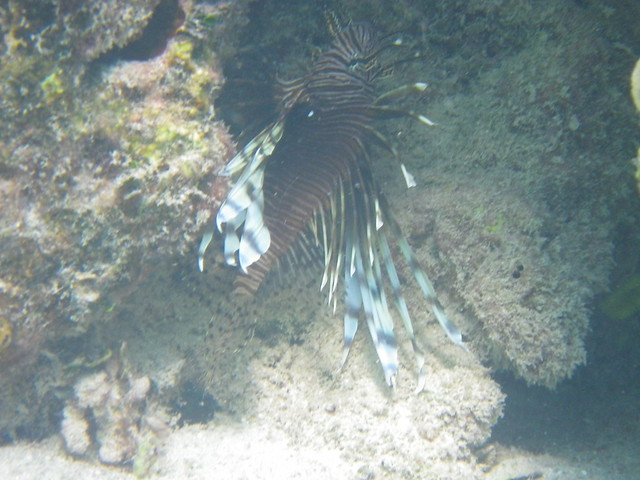
December 19 Little Harbor.  This is one of the few places we have visited more than once and loved better. We delayed our trip south to the Exumas to wait for a better ride (hoping for a downwind sail to Eleuthera) and spent the day exploring the Bight of Old Robinson. We had been told by a local where to find a blue hole, a deep underwater passageway connected to the ocean and carved prehistorically out of limestone. He also mentioned that there were lionfish (a beautiful, though venomous and invasive species) on a reef insight the bight. We split up, with Mom, Sarah and Aaron taking the kayak to look through the shallows for the blue hole, and Dad, Eli and Sam looking for good snorkeling by dinghy. Found said blue hole—it was bottomless and beautiful, and found said good snorkeling, complete with lionfish.

Lionfish


December 20 Northeast Providence Channel to Royal Island. We left the Abacos at dawn with calm and beautiful weather, wind and waves behind us. Seas large, but not too uncomfortable as they were following most of the day. Anchored in the afternoon and baked pineapple upside-down cake for my birthday.

December 21 Spanish Wells. Anchored outside harbor, explored by dinghy. Went ashore to buy provisions for Christmas dinner. Found quiet and peaceful anchorage near Meeks Patch, and an uninhabited island. Brought picnic dinner ashore and built small fire to roast marshmallows for S’mores. Children ran around with colored lights (thank you, Grandma Mary) and had a great time.
December 22 Current Cut to Bush Cay. Got up early to make Current Cut at near-high tide. They don’t call it that for nothing—we had 3 knots of current sweeping us through to the other side; in some places it looked like river rapids. Anchored, safely, if uncomfortably, at Bush Cay. Made sugar cookies and had a fun, messy time decorating them after dinner.

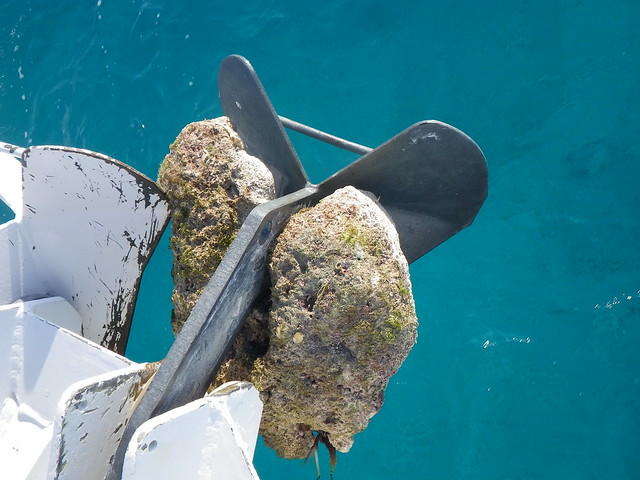
Rock Anchor
Dragging anchor in the night at Bush Cay, we were saved by this rock…


December 23 Allen’s Cay/Leaf Cay. As soon as the sun was up, we headed to Allen’s Cay and passed through a cut between Allen’s and SW Allen’s Cay to anchor on the lee side of Leaf Cay. The anchorage in the lee of Allen’s was crowded and looked rolly. We were much happier to have a small space of our own, and spent a much more comfortable night. Met some other folks with children at the beach on Leaf Cay. Rested and relaxed.
December 24 Norman’s Cay. Again, found the anchorage in Norman’s Cay crowded and uncomfortable, so we anchored all by ourselves on the west side of the island. A peaceful Christmas Eve.
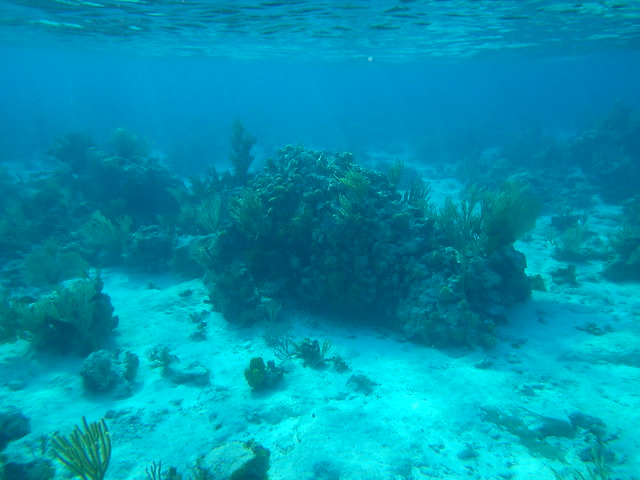
December 25 Ate cinnamon rolls and read the Christmas story from Luke. Snorkeled in the Octopus’ Garden at Highbourne Cay. Worked on jigsaw puzzle and ate Christmas chocolate. A fun day…

Octopus's Garden

That about sums it up so far. We are missing our friends and family, but obviously enjoying ourselves. This is the best Christmas present we’ve ever given our children. They knew not to expect anything wrapped under the tree (heck, we don’t even have a tree!), but to take the lesson the Grinch learned: Christmas doesn’t come from a store. We wish you all a (belated, by now) very Merry Christmas and Happy New Year!

Forces of Nature

We’re in Little Harbour again, and the week with my parents is behind us.  We revisited some old places and saw a couple new ones, but nothing that compels us to stay in the Abacos.  We did spend four days in Hope Town (our favorite place, beating Little Harbour because it has grocery stores), but it felt good to leave even there.  We want to keep moving.

So we’ll spend the next couple months moving further south down the Exumas chain.  We seek warmer weather and quieter anchorages in more remote areas.  The Exumas are also a bit trickier than the Abacos and we expect the rewards to increase commensurate to the challenge.

George Town is a cruising mecca at the southern end of the Exumas and we will probably end up there, though we don’t consider that our destination — possibly just because everyone else does.  George Town feels inevitable in the Exumas, the way Marsh Harbour does in the Abacos.  We managed to avoid MH pretty well, only making a couple short visits.  George Town is on the ocean-side and therefore harder to get into and out of, meaning most people get there and stay.  These population centers mean availability of groceries and coin laundry, but so far we haven’t seen a lot of benefit from these get-there-and-stay communities.  We plan to take our time.  We worry more about getting there too soon, and having nowhere else to go, than not getting there at all.

We’ve decided after that we’ll return to Florida.  This trip was to give us all a taste for cruising and trial the boat and ourselves.  Done.  While it didn’t have a specific destination, the trip wasn’t intended to be open-ended.  We also feel like we’re suffering a little bit from a lack of perspective and direction.  So, like Inigo Montoya, we’ll go back to the beginning.  They say home is where your stuff is, and we still have stuff stored in Sarasota/Bradenton.  Tanya fears getting stuck, but I don’t.  We’ll do some projects, make some money, welcome another crewmember, and then do something bigger.  A circumnavigation of the Caribbean perhaps?

The timing of our Florida return may be a bit problematic.  Tanya tells me she needs to be back mid-February, but it was still awfully cold in Florida that time last year.  In fact, a post from Feb 15 last year laments that we weren’t in the Bahamas.  There may not be much we can do about that, and we’ll just have to wait and see.  It seems we’re stuck between two forces of nature.

FAQ: Do You Homeschool the Children?

This is the second most common question I receive when I am in public with the children—the first being “Are they all yours?”  No doubt this question is a logical one for people who see a group of related kids playing in a park on a school day. Really, for the cruising family, there aren’t many other ways to handle schooling, but home-schools, or in our case, boat-schools, are as different as the families who choose this way of life.

There are only a few options when it comes to educating children: public school, private school, home-school and no school. On one extreme, you trust the raising of your precious humans to complete strangers (or, more cynically, the whims of the State), and on the other, you irresponsibly allow your child to raise himself (also called truancy). Somewhere in between you find private schools, which may be large or small, sacred or secular, live-in or correspondence, and home-schools, which range from Classical to Montessori, from-a-box to outside-the-box, and even a kind called “unschooling” whereby the education of the child is curiosity-driven, but still parent-directed.

Even before we decided to travel, we wanted our children to have an education directed by us, and not by the state of Florida. We like the holistic nature of homeschooling, where all aspects of human development are addressed. The curriculum can be designed to integrate all the subject matter in a way that makes sense and flows logically, instead of in a disjointed, contrived fashion. And with its rising popularity, home-schooling does not mean social isolation—there are a myriad of co-ops, classes, web-sites and support groups—so many that it requires discipline to actually stay home to do school.

We fall into the semi-Classical, outside-the-box category, I guess.  That means I design interdisciplinary unit studies, generally history-based, and come up with creative ways to teach the content and help kids produce meaningful projects to show what they’ve learned (often by publishing their work in the form of hand-bound books). They do math in work books, but also learn through games, flash cards, real world problems and other teaching aids. Science is typically on-the-go, often driven by what we find around us, though it often plays a role in a unit study as well (for example, a study of the renaissance painters might also include anatomy lessons). Spelling and writing are usually related to whatever book we are reading in whatever history period we find ourselves. The kids do their own assigned reading and reading for pleasure, a recent addition as everyone is now up to speed. Happily, we are finding that they love to read and are reading books assigned to much older children, but which are certainly within their grasp.

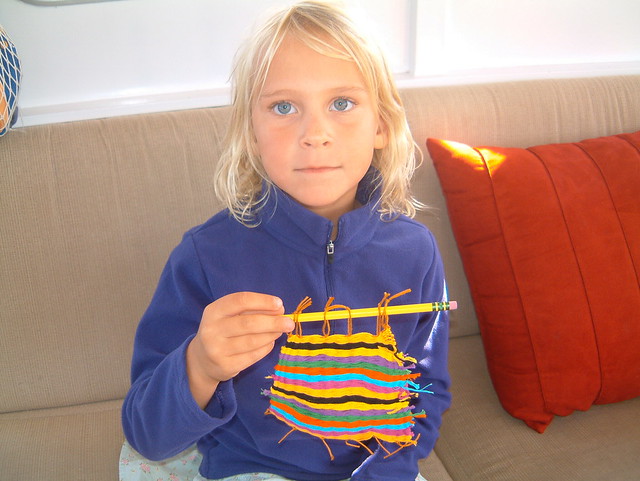
 Tapestry

Sarah, holding up a tapestry she wove on a home-made loom for a Middle Ages project

When we decided to buy our boat, we were able to maintain some semblance of normal routine despite the disruption to our environment. When we were doing half-time on the boat, we did school in the car—spelling tests, flash cards and books on CD. When we moved aboard at the dock, the library and museum were a block away, so we often did home-school-away-from-home. And now that we are cruising, the school routines that were firmly established before leaving continue despite constantly changing surroundings.

Another hidden benefit to home-schooling is the multitude of teachable moments that present themselves. We can actively seek out field trips that fit into what we are studying, but there are other spontaneous happenstances, like snorkeling on a reef, settlement museums in the Bahamas, collecting seaweed and invertebrates while wading in shallows or investigating a microcosm in floating seaweed with the help of our microscope, watching meteor showers and identifying constellations in dark skies, going to a foundry to learn how lost-wax sculptures are made, exploring a cave, talking to the welder who installed our arch and bimini about how his equipment works, and countless other opportunities to learn in real-life settings. Not to mention learning life skills like baking, typing, fishing, carpentry, engine repair, navigation, and sewing, to name a few. The children are required to do schoolwork and housework weekday mornings all year round, but have time in the afternoons for art, music, exercising or exploring, reading, and playing. For gutsy parents, it is the perfect solution, providing both structure and freedom.

Please Note: Parent-directed curriculum and teaching is not for the faint of heart. It is not easy to spend all day every day with one’s progeny, especially if they have inherited a stubborn streak of human nature from one or both parents. A teacher who wants a day off cannot call a substitute (unless Walt Disney counts), and without the direct accountability of a school, it would be pretty easy to drop the ball, a mistake for which both kids and parents would pay dearly. We are surely not doing a perfect job, and I am, as most homeschooling moms, fraught simultaneously with pride and self-doubt, but we are generally happy with our children’s progress and are eager to give them the world as a classroom.

Duty Paid

I learned an expensive lesson about Bahamian customs and “duty” yesterday.  Previously, all I knew about duty was that it had something to do with advertising liquor and jewelry in airports.  Now I know that it is a form of taxation.  The Bahamas don’t have an income tax, so I guess this duty business is like a national sales tax.  The effect is that it makes things imported to the Bahamas ridiculously expensive.  I now risk making political statements about things I don’t understand, so I’ll stop.  I only note that when my watermaker needed parts shipped in from the US, the economic geniuses here determined that those parts should cost an additional 45% more than I already paid.  Thanks guys.

Update: 2011-02-01

I have since learned that I shouldn't have had to pay the duty.  Apparently with a valid Cruising Permit boat repair and replacement parts can be imported duty-free.  The local FedEx office in Marsh Harbour did not seem to know this.  I think what I should have done is instructed the sender put "boat parts" on the invoice and include a copy of my Cruising Permit.

Book Review: Bumfuzzle, Just Out Looking for Pirates

Three years ago, when we drove to Fort Lauderdale to look at Take Two, the broker tried to draw Jay’s attention another boat on the same dock. She had a funny name, Bumfuzzle, which somehow stuck in our minds. Jay dismissed her easily, as she was too small for a family of six to be comfortable, and was missing key features we liked about Take Two. But later we looked her up, intrigued by the ridiculous name, and discovered she had recently returned from a circumnavigation, and that her previous owners had kept a blog of their journeys online at www.bumfuzzle.com. As Bum’s journey was ending, ours was just beginning.

I just finished reading the first book of which I have never owned a paper copy—having downloaded it onto one of our Kindles—Patrick Schulte’s Bumfuzzle, Just Out Looking For Pirates: A Sail Around the World (©2008, Book Bums Publishing, available at Amazon.com for the Kindle). I laughed out loud through the whole thing, and thoroughly enjoyed it. It is a compilation of the blogs he kept throughout their journey as well as his keen observations about weather, passage-making, other cruisers, places they visited and the family of the human race.

The book, and the Bums themselves, are not received without controversy, however, so I cautiously recommend the book. If you are a dreamer, one unafraid to take a few risks to live a life of adventure or excitement, to live without regrets, you will love this book. If you are a cruiser, one who has planned your whole life to buy a boat and go cruising, who has, in preparation for this plan, studied everything from knot-tying to celestial navigation, you will probably hate it. The cruiser’s forum that Jay sometimes looks at when looking for advice on how to fix some thing or another reviles the Schultes as being irresponsible and downright foolish, as is anyone who might follow in their footsteps. Their main complaint seems to be that they didn’t know what they were doing when they sailed across oceans and might encourage others to do the same thing.

I would like to point out, though I admit to being biased, the fact that they made it, changed but unscathed, should give them some credibility. Also, being young cruisers ourselves, we realize that the only way to do this thing while you’re still young is to do it without knowing how. Although we’re just getting started, having only recently left U.S. waters, we are already frustrated at not finding anyone younger than our parents out here sharing anchorages. We have seen only two boats with children—one a charter that sailed away the same day it dropped the hook, and the other we met yesterday, which looks promising. I know why the Schultes felt that they did not fit in with the cruiser crowd, and am beginning to understand some of Pat’s criticism, which he does not hide in the book.

Still, anyone who likes a good sea story, sailor or no, would enjoy Bumfuzzle. If you think that sailing around the world is an impossible journey, but you’d like to do it anyway, reading this book could inspire you do try it. Reading his opinions has certainly opened our minds to a different way of thinking, and while they are strong and possibly offensive, they do have merit and the cruising community would be a better place if we were all a bit more like the Bums.

The First Day of the Rest of Your Life

You may not have known it when you woke up that morning—the day that was different from all the rest. If you had somewhere important to be, you may have suspected its significance, but without the benefit of hindsight, you may not have known that it was one of those pivotal, life-changing days. Later, you’ll look back and point to that day as the day it all started.

December 8, 2007 was just such a day for our family. We drove to Fort Lauderdale to look at a boat. Just that, nothing more. We had convinced ourselves that it was risk-free to go look. Anybody can fill their gas tank and drive across Alligator Alley. We don’t have to actually buy a boat, we said, or sell any of our belongings, or take any big chances. These are the white lies that dreamers tell themselves. 

What we did not know then, but can see looking back over the last three years, was that that day began a chain of events that led to all the major changes we have documented here. Three years after we innocently went to look at a boat, we are living aboard full time and cruising in another country. It all seemed so slow while it was happening; sometimes we seemed to make so little progress it even felt like we were moving backwards. But if hindsight is twenty-twenty, then it is also compressed. We see perfectly how very quickly that one day began to change everything.

From the moment we stepped aboard her, Take Two began to work on us. She has endeared herself more and more with each passing day, with each memory we make as we become more and more at home on the water. It is true that anyone can “just go look”—anyone can have a dream, but not everyone follows through. We did, and we have no regrets.

Bucket List

Yesterday I got to do something I have always wanted to do. I can’t say that I keep a “bucket list” per se (i.e. things I want to do before I kick the bucket), but I definitely have an unwritten list of things I want to accomplish in my life. Some are realistic goals, some fantasies.

I have always wanted to go kayaking. It seemed like something mysterious and difficult, something done by adventuresome people who climb mountains and go backpacking. Our friends Amy and Ken in Marathon found a leaky kayak adrift and left it in a trash/recycle pile on their property until they could figure out what to do with it. It was Amy who first demystified kayaking for me—it’s pretty simple, as long as you have the right equipment. She will be happy to know that the discarded kayak has found new life aboard Take Two.

Jay towed the kayak behind the dinghy and dropped Eli and me inside a shallow bay to go exploring and we met up with them later a couple miles further south. It was hard work at first, as we were paddling against a current on an outgoing tide, but after awhile it got easier. Aside from dropping the camera overboard at some point—an irretrievable loss—it was a beautiful and perfect day. Eli and I saw lots of upside-down jellyfish, starfish, rays, hermit crabs, and miles of lovely wilderness. The best part was at the end, when we found the exit. The current that we fought at the start carried us right out—we drifted silently over a shallow garden of coral and multi-colored seaweed. Jay was waiting at the other side and we enjoyed an effort-free ride back to the boat.

Today after my chores were done, I launched the kayak by myself (usually Jay helps) since the kids were off with their dad exploring a cave. I had a great time puttering around in Little Harbour, going places a dinghy with an outboard cannot. It is so quiet here, so peaceful, and so beautiful. I feel so unbelievably thankful for the opportunity to be here. And for that old, leaky kayak!

Fears and Dilemmas

I may be playing a little “he said, she said” here, but I just read Jay’s post about future plans (see "Go South?") and was simultaneously writing my own post.

My greatest fear at the moment is not shipwreck or shark attack. Ironically, all my fears before going cruising have turned out to be silly, and the things I thought were trivial have turned out to be important. Connecting with people has turned out to be a big one. I never realized how much a place is about the people and not the geography. What if we don’t make  any friends here? (And why are most cruisers middle-aged—having grown children or none at all?) I knew I would miss friends and family, but didn’t know how much, especially when there is some kind of crisis going on at “home.” What if something happens while we’re away and I can’t be there when I need to be? The big one, though, is about going backwards. We’ve made so much progress in so many areas. We see the children’s growing sense of responsibility, the closeness of our family as we go exploring together, and our own expanding competence and confidence. Plus, we've covered a lot of miles. What if we allow the birth of this baby to ground us, and we never make it back out here?

These “what ifs” have answers. Usually they never come to pass. Of course we’ll make friends; we always do. We just have to commit to sticking around long enough to do so (as Jay already said). The second fear is a very real one, as we do have family members in crisis, and I can’t be there to help. It’s very frustrating. There are other family members who can pick up the slack, and I can do some very important “prayerful work” as my friend Betty used to say. But I have to choose. Saying “yes” to one thing always means saying “no” to a thousand others. We are following a dream, and that costs something. Nobody said it would be easy.

The last fear, and most often on my mind these days, is that if we go back to Florida, we may never leave again. Life has a way of sticking it to you, and we barely escaped last time. How can one ever be truly ready to leave on an open-ended voyage? And how much more difficult can that be with a baby in tow? But it we’re already out here and add a new crew member, we’ll be forced to adjust. Ironically, I am not really afraid of having a baby in a foreign country without friends or family present. I probably should be, but I’m not. Maybe as delivery draws near and I have to figure out the logistics, that will hit home, but maybe not.

The truth is, we’ve been so busy basking in the success of buying the boat, living on the boat and actually cruising (not to mention getting used to the idea of a new baby) that we haven’t thought much about the big picture in a long time. We used to talk about sailing around the world, but that was back when this whole boat thing was a pipe dream. Now we’re just happy to be out here, but adding a crew member adds urgency to our future planning. We have a dilemma: go back where it’s comfortable and we have a support network, where we speak the language and can find anything we want in stores, and risk getting stuck; or travel indefinitely, have a baby on the go, and possibly do great things we might not otherwise do.

Fears are not easily dismissed. I manage to get a good night’s sleep because I refuse to worry—allowing God to take my days’ worries and giving Him tomorrow’s as well. Only He knows all the answers, anyway. But fear has a way of nagging when you least expect it. The dilemma we face is one we will pray about, think about, talk about—and write about—for some time to come. Who knows how it will turn out? Like many what-ifs, time usually reveals the answer. In the meantime, peace comes in daily doses, and that’s something for which I am grateful.