Bahamian Independence Day |
Spanish Wells Haulout |
Into the Rabbit Hole |
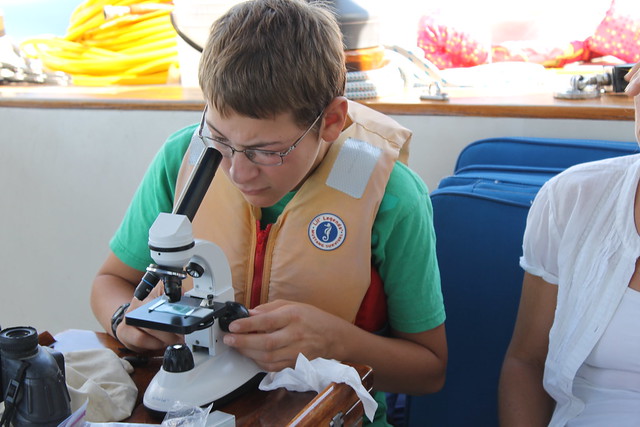
Oh, how I look forward to long, boring passages. Really. Time seems to telescope as the instruments count the tenths of nautical miles to the destination. And what shall we do with all this time? Eat very slowly? Talk? Read aloud by the hour? Fish? Watch the fabric of the ocean for the interruption of flying fish or the dolphins of Happiness—or, maybe, if we’re lucky, a whale? Stare lovingly into the deep-blue water and wonder, "what are those specks floating all over the place?" This morning, as we glided over the glassy surface of the Gulf Stream, for lack of anything better to do, I grabbed a bucketful of water, dug the microscope out of the science bin, found some slides, a petri dish, and an eyedropper and opened the Ocean Lab.
This morning’s victim was what I might call a “Floating Puffball from Inner Space.” I suspected it to be algae of some sort. It was a globe of greenish-brown with fine hair sticking out in all directions, about the size of a poppy seed. I sucked it up into the eyedropper and deposited it on a slide in a drop of water. At 40X, it looked like a mass of very fine tangled hair. At 100X, I began to see other, smaller things moving in and out among the hairs, and at 400X, the thing looked like a forest with small animals running in and out of the trees, changing direction mid-stream, diving and flying between the foliage. Each tree trunk was a hair—it was only a few cells thick, and it was clear from the cellular structure that it was plant-kind, but there was movement within each stalk and each moved like a tree waving slowly in a breeze. The tiny one-celled creatures within the forest of algal stems moved with incredible speed and energy. I felt like I was looking at Horton’s Whos down in Whoville. It was mesmerizing.
Once, at a local farmer’s market, I bought a head of heirloom broccoli, not because I wanted to eat it, but because I wanted to look at it up close: its stalk was a perfect spiral staircase of florets, with each floret a perfect spiral of buds, and each bud, in turn, a spiral. It was a perfect fractal repeating to the microscopic level. We have, for school and for fun, looked at inner cheek skin cells (animal), onion skin (vegetable), salt crystals (mineral), a honey bee’s stinger (barbs on barbs!), tiny brine shrimp (with compound eyes), the statue of Lincoln inside his Washington D.C. Memorial (on a penny), no-see-ums (look at those jaws!), hairy spider legs, fleas, and anything else we could capture and study. The C & A Scientific “My First Lab” Duo-Scope portable microscope with battery-operated LED bulbs (allowing you to look at both opaque and translucent objects) is probably the best science purchase we have ever made. It is so easy to use that even the youngest of our children has been able to view the tiny things on the slide—with the instant reward of discovering something strange and new.
The more I stare at that bright circle at the bottom of the dark tube into the magical world of the unseen things, the more I wonder how deep the rabbit hole goes. If a tiny alga can be home to animals as numerous as squirrels in the woods, what else can be possible? I read that we are, by genetic material, only one percent human. That makes me a planet-home to microbes more numerous than the population of humans on earth. Is everything a microcosm—a world inside a world? I feel like a peeping Tom peering in at a Creation too great for my limited intellect. This is usually the point at which I have to put the microscope away and look at the horizon because I suddenly feel a bit dizzy.
Bird Brains |
One of the fun things about living on a boat is you never know what problems you’re going to face. Maybe it’s keeping your boat from sinking, and maybe it’s keeping your hammock in the shade. Every day is an adventure.
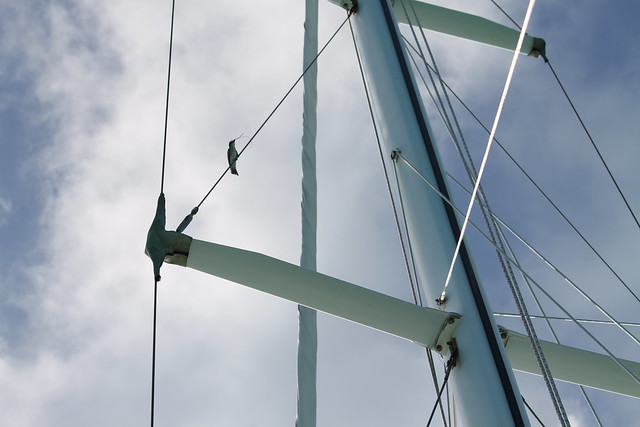
This morning we woke up to the twittering of little birds, and soon realized that they were building a nest in our rigging. Cute, right? How about baby birds falling on the deck during the next strong breeze? Or rotten eggs up on our mast because we’ve moved the boat and mom & dad can’t find their nest? And what about the poop? Not so cute.
So we spent a significant part of the day trying to get the point across to these little birds that our mast is not a good place for a nest.
We started by sending Sam to remove the nest-in-progress from the second spreader, and to sit up there for a while and play scarecrow. The birds were quite perturbed by Sam’s presence and wanted to peck him, but he’d shout and scare them off each time they tried. They gave up, but it was only temporary.
They’d go away and come back, go away and come back. Eli took a turn playing scarecrow. We tried Nerf guns. We tried an air horn. They weren’t getting the point. Itty bitty birdy brains.
Eventually the female gave up and only the male would return periodically. He’d alight on the mast and chirp an “all clear” to his mate, which simultaneously alerted me to his presence. I’d go out and shake the rigging until he went away again.
Finally, I managed to whack him by swinging a halyard. There was a small puff of feathers and he fluttered away, beaten but unharmed, to the distant trees. He fell victim to one of the classic blunders, the most famous of which is "never get involved in a land war in Asia", but only slightly less well-known is this: "Never go in against a Sailor when his deck is on the line"!
Chore Chart |
Jay and I are both hard workers, and come from families that value hard work, but this value doesn’t appear to pass to the next generation through the genes; work has to be taught, and to people who really would rather lounge around and play all day with toys someone else paid for, eating food someone else prepared, wearing clothes someone else bought in a home that someone else keeps tidy. But to enter into the life of a family one has to do the work of the family. And real life doesn’t reward sluggards, either. To the best of our ability, we will raise people who can leave our home able to do a myriad of jobs, efficiently and with expertise.
One way we do this is with the chore chart. People ask us how we can have five children on a sailboat, and one answer is that everybody has to pull their own weight. Of course, a 3-year-old “helping” with the dishes is hardly the same thing as a nearly-13-year-old scrubbing down the cockpit, but the principle is the same: if you don’t work, you don’t eat.
A lot of training is required to get the kids to be actually helpful, so that Jay and I don’t feel the need to go around behind them “fixing” things. For a while at least, it is harder to help a kid learn a chore than to just do the chore yourself, but doing it for them or cleaning up after them would be shooting yourself in the foot long-term. A kid who is given a token chore will quickly learn to slack off—if they know you’re going to go back and do it better later, why bother doing it at all? But teaching a kid to do a task and requiring it to be done to your satisfaction is an investment that pays off pretty quickly. I read recently about the Amish expectations of children: a child is a net “loss” for the first six years, but a seven year old “breaks even” (contributes as much as he costs) and by ten, an Amish girl can do all the tasks her mother can, a boy can work a full day on the farm, and they are giving back to the family—a net “gain.” We’re not Amish, but we do have high expectations for our children—we‘re banking on the principle that early training equates to later independence.
A crew member on Take Two gets his or her first official duties at three years old. Rachel just made the chart for the first time. She helps with groceries, sets the table, washes windows, folds kitchen towels, and puts away forks and spoons. The older kids are used to hard work at this point, although they still complain from time to time (complaining usually earns them an extra job). They vacuum the whole boat, do dishes, load and unload the dinghy, take trash ashore, scrub decks, set up for and clean up after meals, and stay on top of the laundry. One would think that I would have time to sit in my hammock more often now that I have such able helpers, but actually, their taking some of the cleaning chores frees me up to do other tasks, like reading with Rachel and schooling Sam, making homemade tortillas or baking bread, writing, or helping Sarah with her quilting project.
For years we have used a monthly rotation with each person getting four or five jobs (some require teamwork) because we found that a month is long enough to get really good at a chore, but not long enough to grow bored with it. We’re doing an experiment this summer with quarterly chores; the kids had more input as to which chores they like to do and I got to assign some chores according to who is the most capable at each task. We’ll have another family meeting in the fall to decide if that system is working.
If someone shirks a chore, there are real and immediate consequences. A chore half-done must be re-done, a chore forgotten costs one a “reminder fee” of 50 cents, and a chore done with a bad attitude earns one more chores. We do offer a monthly allowance to teach money management, but that assumes that the kids are meeting expectations—keeping their cabins tidy, folding and putting away their own laundry, helping with meals, and doing assigned chores “immediately, cheerfully, and quickly.”
Another of our favorite sayings is “Work hard, play hard.” When the work gets done quickly, there’s time left over for skating at the park, snorkeling on the reef, surfing at the beach, riding horses, kayaking, and lots of other adventures, the natural rewards of a job well done.
Terns of Endearment |
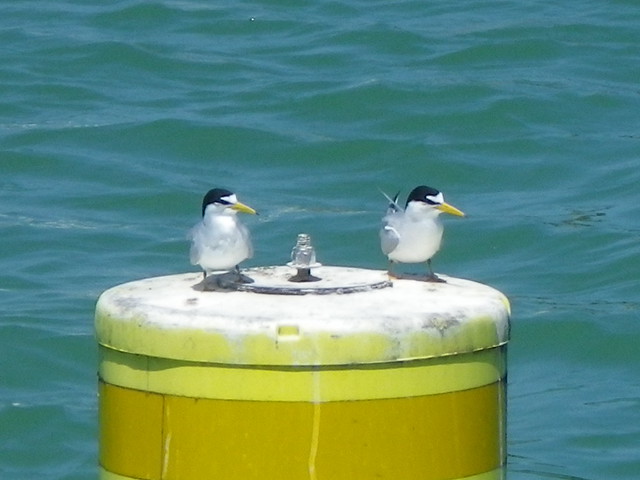
It is Tern mating season. Here in the Keys, we have Lesser Terns, and their “hotel room” of choice is the yellow E or J bouy that marks the extremity of the mooring field, usually off of one of our sterns. Imagine trying to teach astronomy or Greek mythology and being constantly interrupted by a sound not unlike squeaky bedsprings—my lessons are relegated to basic “birds and bees” biology.
We’ve had lots of time to observe mating behavior as we homeschool in the cockpit on these lovely spring mornings. Their routine goes something like this: the male and female bird stand side by side on the poo-encrusted buoy, bobbing wildly in the wind and chop and fishing-boat wakes. They begin by bowing politely and singing a squeaky little song back and forth to each other. Then the male bird disappears for a few minutes and comes back with a small bait-fish (still wiggling) in his beak, which the female bird tries to grab, but which he successfully keeps just out of reach. They then bow and chirp a few more times, after which she ruffles her feathers as a sign of assent and he responds by flapping wildly and trying to balance while reenacting that timeless dance of love—getting her to hold still by offering the fish at just the right moment. It lasts mere seconds, and then he flies away. She cries disconsolately. (Pardon my anthropomorphism, but doesn’t it sound familiar?)
But this is not the end of it! She continues to call for him, and, sure enough, he comes back—with another fish in his maw, which he offers this time without requiring anything in exchange. He does this not once, but over and over and over again. One morning we noted a male who came back to his sweetheart with a dowry of 19 little fishes before they flew off together, ostensibly to their waterside nest somewhere to start a family. Now here’s a strange wooing-in-reverse; usually the male must prove his worthiness before the wedding night, not after!
One morning, as we watched the process for the umpteenth time, Rachel looked at me sadly and said, “Why did the daddy fly away?” I was startled by her response, but Jay’s recent travel schedule has made her sensitive to separation. She was on the verge of tears, so I had to come up with a reassuring answer quickly. “He’s not gone-gone. He’ll come back in a minute with a little fish. Just wait and see.” The relief was visible in her face when, just as I promised, the daddy came back and offered his prize. I asked her, “Doesn’t your daddy fly away on the airplane? And doesn’t he always come back with money to buy food? He’s just like the daddy bird.” Satisfied, she toddled off to play with her Legos while we continued with school and chores. If only all of life were that simple.
The Grass is Greener |
The Grass is Greener on the Other Side of the Hill: a Poem for Jay's 39th Birthday
You’re at the peak of the hill,
You’re at the top of your game.
And after the climb,
I still feel the same:
So much to look back on,
So much still to do,
I’m right where I should be,
On the hill-top with you.
No regrets lurk behind us
No fears lie ahead—
(We made it this far!
We did what we said.)
No matter what the future holds,
Be it joy or sorrow,
I’ll gladly go down-hill with you
On into tomorrow.
Sailing Promise: A Book Review |
Every couple living aboard a small boat who spends any time on the ocean will recognize that there are circumstances which test the relationship. We know lots of single-handers whose spouse jumped ship after a long passage. In her book, Sailing Promise, Alayne Main tells the story of her circumnavigation with husband Alec in the 90s aboard a Prout 33 named Madeline. While the book chronicles their travels—new places, new friends, new cultures—it also tells the inside story of how the journey affected their relationship. The following is a quote which sums up, for many, what it’s like to live in close quarters on a small boat with a spouse who may or may not handle stress well.
Despite my seasickness and the uncomfortable ride, it was only three days. Although many of the same fears plagued me, I could tough it out for a short passage…I thought of a girlfiriend of mine who had spent a year backpacking with her husband, spending 24 hours a day together, every day. She had said there wasn’t one moment when she wanted to be away from him. Envious as I was, our circumstances were vastly different. All my possessions, my lover, and I were contained inside a tiny 33-by-15-foot boat, which was put to the mercy of the wind, waves, and weather. The only certainties were that things would break and the wind would change. With an added dash of seasickness, a little thunderstorm or a ripped sail, a kind of stress was created that would cause even the most pleasant of people to get irritable. Alec and I dealt with stress differently and this often aggravated things even at the best of times (from the chapter entitled "Wild Horses").
Anyone considering a life aboard would be wise to read the book, whether they have dreams of circumnavigating or not. It is an honest look at a side of the sailing life you seldom see in a cruiser’s blog or travel book. Most of the people who buy a boat to travel the world think long and hard about what kind of boat they want, which of their belongings they want to keep and which to get rid of, where they want to go, how they will provision, what tools and gadgets they want aboard, and so forth and so on. But less thought is given to something that may have the greatest impact on whether the people going will be happy at all.
It is important to think about what isolation might do to your marriage, how each of you responds in a crisis, how well you communicate, what kind of outlets you or your spouse needs to reduce stress, how to find contentment in a difficult setting, and how to overcome fears and surmount obstacles so that you can strengthen your close relationship instead of tearing it apart. Through Alayne’s thought-provoking inner journey, it’s possible to envision how good communication and compassion can help two people pass the tests they will surely encounter on their adventures.
The First Ski Trip |
Rooted |