Charging Challenges

The electrical system is arguably the most important system on Take Two.  When docked at a marina, the electricity we use comes to us through a shore power cord just like it would in a house.  The power is virtually unlimited and we can run heavy loads like air conditioning without giving a thought to how much we’re using.  But away from the dock, the only constant supply of power we have is from batteries with a limited capacity, and we have to use intermittent sources like generators and solar panels to recharge them.  Thinking about power is part of our daily life.

Our current setup is four Lifeline 8D absorbed glass mat (AGM) lead-acid batteries providing a 510 amp-hour (theoretical) capacity at 24 volts.  We charge the batteries through a pair of Trace PS 2524 inverter/chargers with a combined charging current of 130A.  The chargers are supplied by a split-phase 12kW Northern Lights diesel generator burning 0.4 gallons/hour.  

The generator is set up to be controlled by a GSCM from Atkinson Electronics.  We send start and shutdown signals to the GSCM from a Flexcharge programmable timer.  Automating the generator this way allows us a degree of flexibility to leave the boat unattended, but also helps keep things on schedule in case we aren’t paying attention.

We can monitor the battery state of charge with a Victron battery monitor.  It measures the current flowing in and out of the batteries and attempts to calculate how much capacity remains, and how much time until we have to charge.  The monitor also has relay outputs that we can use to manage the GSCM.  

For a while, we had things set up so the battery monitor decided when to start and stop the generator based on battery state of charge, and we used the timer to institute quiet times when the generator wasn’t allowed to run.  Practice showed that generator runs were longer and more consistent than we anticipated, and the monitor did not remain accurate for more than a couple days without a full recharge to synchronize it.  The straight timer approach proved simpler and more predictable.  

When you live on a boat you get tuned in to every sound and motion.  It can be a little nerve-wracking to have a big generator starting and stopping at random times.  Besides, we like being able to plan activities like running the vacuum cleaner and clothes washer for times when the power is “free”.

For the health of the batteries, they should never be discharged below 50% and really should always be charged back up to 100%.  But due to internal resistance, all lead-acid batteries heat up and accept less current as they approach a full charge.  So recharging to 100% takes a lot of time, about six hours for us.  This isn’t a generally a concern when unlimited shore power is available, but is impractical to do with a generator.  

Instead, we stop the big generator after charging for an hour and a half.  Typically the current being accepted by the batteries is below 40A by that point, which is about 80% full.  This is not great for the batteries, and we’re probably significantly decreasing their advertised life span (measured in discharge cycles).

We had hoped when we installed our 750W solar panel array that they would provide enough power to top up the batteries after the generator does the bulk charging, but it doesn’t really work out that way.  After the refrigeration and water maker loads, there isn’t much left for the batteries.

We would like to add a pair of wind generators to help out with this.  We’ve observed other boats’ turbines spinning away on cloudy days and dark nights with envy (and irritation).  But wind generators are not subtle things, and we have yet to figure out how to mount them unobtrusively on Take Two.

Instead, about once a week we fire up our little Honda 1000 gas generator to get a full charge on the batteries.  The Honda is inverter-based, meaning it is a DC generator that uses an inverter to form its AC output.  The boat’s chargers then turn that AC back into DC for the batteries.  While there is some loss from all these conversions, a DC generator is able to reduce its engine speed when demand is low, which saves fuel and makes it perfect for finish charging a lead-acid battery during its low-acceptance phase.  

AC generators like our big diesel must run at a constant speed regardless of load in order to make the correct line frequency.  And diesels like heavy loads.  So a light load on an AC diesel generator wastes fuel and wears on the engine.

The dilemma we face now is what to do with this situation.  We don’t particularly want to bite off any huge projects, so the answer may simply be that we keep on as we have been.  By far the cheapest option is to continue burning diesel.  But we may not have that option for long.  The generator is 13 years old and the inverter/chargers are 10.  

So as we near the end of life on some of our more expensive pieces of equipment, we need to at least have a strategy in mind for how we’re going to manage our power needs in the future.  And it would be really nice to replace something before it fails.  If our big generator were to die today we’d be in a real pinch to replace the power it provides.

The primary focus of our next electrical system will be to reduce our dependency on diesel and the machines that convert it to electricity.  That doesn’t necessarily mean that we expect to be rid of diesel entirely, but we want to use less of our fuel capacity for daily power, and we never want the failure of a single device to be catastrophic.  If we’re going to depend on a diesel generator, it will need some kind of equivalent backup.

I think there are several aspects to a full solution:

*  We should reduce our daily power usage.  We have no desire (and little ability) to become misers.  If anything, our personal usage is only going to go up as our kids get bigger; more food, more laundry, and more showers.  Our best opportunity to use less power is probably to upgrade our current AC-powered refrigeration to more efficient DC-powered units.  This would also reduce our need to have an inverter powered up 24/7.

*  We should increase our ability to charge from alternative (non-diesel) sources.  We already have a decent amount of solar, so wind seems like a logical next step.  

*  When our current batteries die, we should change to batteries that we can charge on our own terms without risk of damaging them.  I want the bank to have enough capacity that we don’t have to charge them every day, and can afford to wait for the sun to shine or the wind to blow.  When a generator is running, I want those batteries to take max charge current until they’re full.  No more of this acceptance rate business.  I think Lithium-Ion (LiFePO4) makes this possible.  

*  Finally, any future generator should be sized (and the corresponding chargers also), so that the engine operates at a healthy load and uses fuel efficiently.

Hopefully we have a while yet to ponder all of this, and won't have to do it all at one time.

Paddling Upstream

Some people are content to float downstream, happy to “go with the flow,” accepting wherever it takes them. I sometimes I wish I could be like that. For better or worse, I tend to paddle upstream, fighting my way toward some nearly-impossible goal, sometimes hurting myself or others in the process. I don’t doubt that my sense of purpose and perseverance takes me far, but it also lands me in a heap of trouble.

When I left for Paris during college, my dad warned me to pack light and take a taxi from the airport. I packed heavy and got off the airplane ready to try my hand at public transportation in a foreign country, surrounded by strangers speaking a language I had not mastered. Right…you can guess how that ended. I reached my destination safely, but with no small loss of blood, sweat and tears. Once I got some “free mulch” from a neighbor, and all I had to do was go get it. It seemed so easy at the outset—but the shovel and wheelbarrow weren’t getting the job done fast enough. So I used my minivan as a truck and loaded up the back. Six hours later and with a terrible mess in the back of my mom-car, I finished what I had started. But that mulch was decidedly not free. And Jay ended up cleaning up my mess.

Today I set out in the kayak to explore in Sister’s Creek. It was a bit blustery, and I lost my kayak partner to a mysterious rash. So I went alone, and after twenty minutes of fighting, I finally got into still water and had a moment to breathe and think about what I was doing. I realized that the way I approach kayaking is a great illustration for life. Sometimes paddling upstream has paid off beautifully—in the Bahamas, my fearless crew and I fought hard to get past the pull of the tide to find the blue hole in the Bight of Old Robinson, and after our explore, we simply drifted back the way we had come earlier, over upside-down jellyfish beds and shallow coral reefs—the breathtaking beauty and relaxation well worth the hard work. Other times, I have fought a hard battle against the pull of water and wind for very little reward. I should have turned the kayak around early on and admitted that we weren’t having fun. I mean, isn’t that what it was for to begin with?

Once I get that tunnel-vision about a project or a relationship, I seem to lose sight of what the thing was for. In my rush upstream, I leave all caution behind and my wake is littered with misery and madness. As I contemplate the year’s end and make goals for the next one, I realize I learned a lesson in my kayak this morning. Once I reached the still water, I decided I didn’t want to fight anymore, and turned around to head for home, wind and waves at my back. I think I’m coming to a place in my life where I don’t need to try so hard, but to rest and trust more. I see this in my relationships with my children especially. As they get older, a heavy hand can crush the relationship it was trying to create. It might be time to turn that kayak around and enjoy a downwind run.

It Takes Two to Make a Thing Go Right

A man who is not afraid of the sea will soon be drowned…for he will be going out on a day he shouldn’t. But we do be afraid of the sea, and we do only be drownded now and again. –John Synge

When we bought Take Two, she already had her name, and even though we’re not particularly superstitious, we decided not to rename her. She was the second boat we thought seriously about buying—the first having slipped through our fingers as we dawdled and debated—so in many ways, she represented a second chance at success. Since that time, some folks suggested that we should have renamed her “Take Six,” but then we added another crew member. It’s too much work to keep scraping off the old number and applying a new one, so that’s out. Besides, it only took two to make the rest of the crew.

Last week as we attempted to leave Fort Pierce, a new meaning for the name of our vessel became apparent. We headed out the pass against the current (we had been trying to make it out at slack tide, but missed), and then slammed straight into 6-9 foot confused waves that wreaked havoc on our interior. Oops, forgot to duct-tape the refrigerator door…and take everything off of the galley counters. We’re a catamaran, so we sometimes forget that sort of thing. Actually, we make it a point to never set sail in weather that rings our ship’s bell or causes the drawers to fly open. The fact is, we didn’t know what we were going to find, so we decided to take an exploratory look. Needless to say, we did not like what we saw, so we headed back to anchor and wait for better conditions. This is a familiar scenario. When we left Bradenton, the same thing happened. It seems to always take two tries for us to leave.

The first try requires a colossal amount of energy and courage, for whatever reason. Once we get entrenched in a place, we really struggle to untie the boat. Once that first hurdle is overcome, we spend at least one night at anchor to acclimate and help us get an earlier start. Then, with trepidation, we head out after sunrise to find out what kind of travel day we’re going to have. If it looks like a long, miserable day, we turn around. That’s why we never sail on a schedule. After the harrowing experience of take one, take two usually finds us more prepared, less nervous, and relieved when our patience pays off and we get the conditions we were waiting for.

So after a week of waiting on the hook in Fort Pierce, we tried our luck again on Sunday and were happy to find calmer seas. By the time we reached the Keys, the wind was cooperating and we had a great sail to Marathon, where Take Two will be moored for the winter months.

Pots and Pans

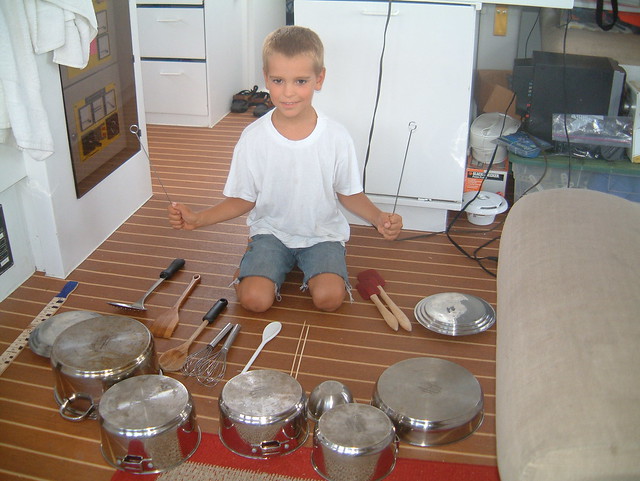
Very few pieces of gear on our boat get as much use as the pots and pans in the galley. In addition to my treasured cast iron skillet set, I have nesting stainless steel pots by Galleyware. I’ve had them for several years now, and aside from a few dings (from kids using them as drums), they are in good shape. The detachable handles aren’t doing so well, though, and when I looked at the replacement parts at www.galleyware.com , I saw that they had improved the design of the set and the way the handles attach/detach, so I decided to replace the pots and pans entirely. And boy, am I glad I did!

Drums

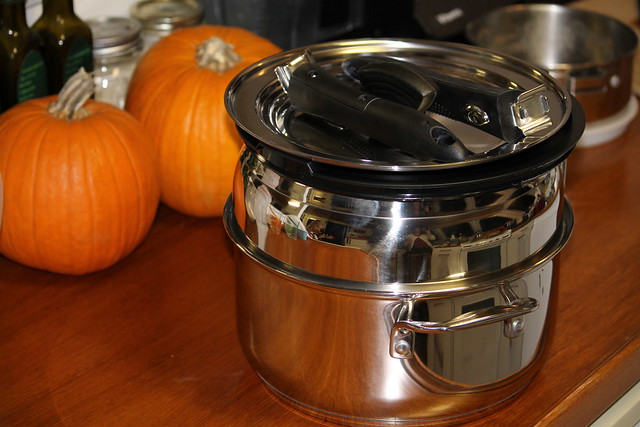
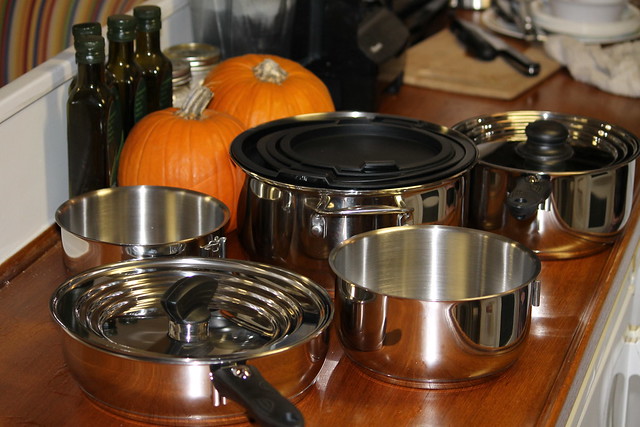
I love these pots and pans. There are 12 pieces in the $138 set: a stock pot, a skillet (which can also serve as a cover for the stock pot), a 3-qt. pot, a 2 1/2-qt. pot, a 2 quart pot, 2 detachable handles, a large universal lid, and 4 plastic covers for storing leftovers. I also bought a small universal lid which fits the three smaller pots. They are made of heavy, marine-grade stainless steel, with an aluminum core for good heat distribution. The whole set nests neatly in the stock pot and fits in a drawer. One of my favorite features of this particular brand is the plastic storage lids; you can detach the handle, cover the pot and stick it in the fridge for tomorrow’s lunch, making leftovers easy to warm up.

IMG_1520

IMG_1531

This product is tried and tested—one I can recommend wholeheartedly to those who own boats or RVs or who simply want to reduce clutter and save space. For what it’s worth, these pots and pans get the Take Two seal of approval.

Riders on the Storm

Weathering storms is not only something our family has gotten used to, it is something that actually excites us. I admit that sometimes this excitement is not a pleasant sensation, but whether at anchor or tied to a dock, a storm never fails to add a bit of the unexpected to our daily lives. Jay called me a “storm junkie” last night when I suggested we walk in the wind instead of do dinner dishes, but I would argue that he is the not-so-secret admirer of wild weather. I remember a year just after we moved back to Florida, during one of the many hurricanes that season, Jay took our two boys (2 and 3 at the time) outside to “play” in the wind and rain. I am sure I objected (“a tree could fall on all of you”), but he initiated them anyway, and every storm that has approached since then, I’ve noticed that gleam in their eyes—a mixture of nervous excitement and pleasure.

Hurricane Sandy

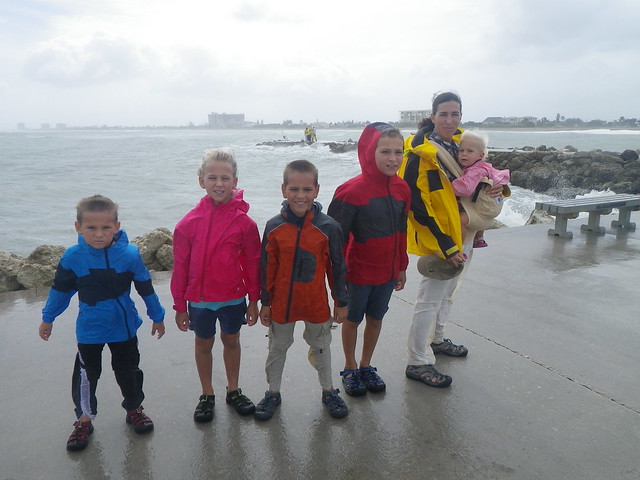
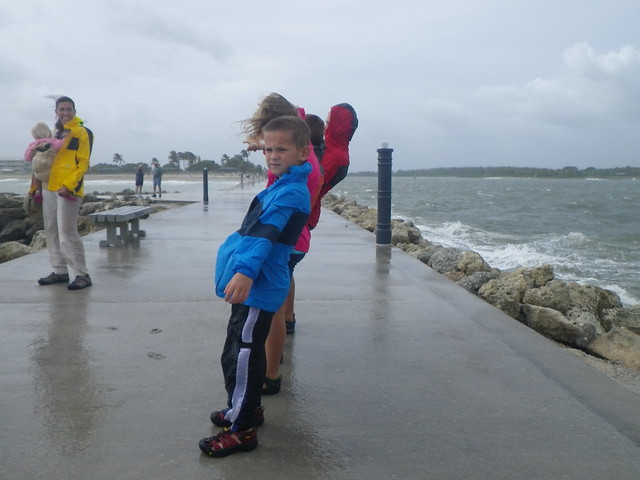
We took all five of our little adventurers out to the jetty today to observe the effects of 48 hours of steady breeze from Hurricane Sandy, sometimes gusting in the 50-knot range. The waves were crashing up over the sidewalk that skirts the rocks and the wind was so full of salt spray that we could actually taste it. There were the ubiquitous storm surfers out there fearlessly enjoying kite boards and windsurfers, but everybody else looked a little anxious. I had Rachel in the carrier, and though she kept asking to get down and walk, I said no—I was actually afraid she would blow away! Even the big kids couldn’t walk straight.

Lean Into It

There were a group of manatees hiding out in a protected corner created by a right angle in the south jetty, and it looked like they would be stuck there for awhile. It made me wonder—did they go there looking for shelter, or did they get trapped there by the surge? Do manatees have enough warning to escape heavy weather? I would have expected to see them in intracoastal waters, maybe up Taylor Creek where we see them all the time, or in the mangroves, but sometimes storms catch one unprepared.

We’ve seen several incidents over the years of humans on boats being caught in that state, whether from lack of know-how or good sense I can’t say. Someone had their jib shredded last night in the early stages of the storm and it was only because of the kindness of strangers that they didn’t lose their whole rig. Another acquaintance who was out of town for the storm will have to deal with the sad fate of his vessel when he returns—she dragged anchor and is currently lying on her side in the muck on the other side of the channel.

We do the best we can to prepare Take Two for storms, and to brief the crew so that they will be mentally prepared, but we are not arrogant enough to believe we are immune to the damage caused by the tantrums Mother Nature throws each year in Florida. We have scoped out a couple of hidey-holes nearby where we could tie the boat up in the mangroves if we felt that the storm would be too strong to weather in a marina. But even with all the planning, sometimes by the time you decide the weather is bad enough to take drastic measures, it’s too late. You do the best you can to get ready, and then all that’s left to do is go outside and bow before the sheer power of wind and water. One lesson storms have taught us over the years, and which our children will no doubt remember for the rest of their lives: don’t mess with Mama Nature.

Rig Inspection

We had our rig inspected recently, something we try to have done every year.  The mast and standing rigging passed with flying colors.  The rigger was really impressed with how good they looked for their age, and said we might get five more years before having to re-rig the mast.

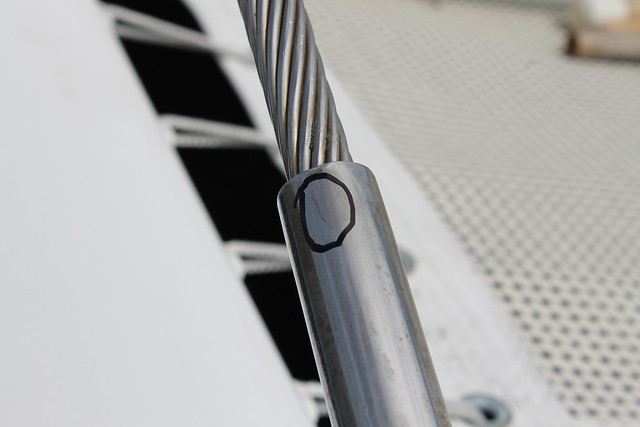
But the crossbeam bridle has a boo-boo.  This tiny little crack is a risk to the mast.

Crack

The crossbeam goes across our bows and keeps them pointed in the same direction.  It also creates a place to tack the forestay, which holds the mast up and carries the headsail.  To oppose the upward pull of the headstay, the crossbeam depends on a wire bridle raised in the center by a strut to create a big triangle.  The bridle is 5/8” wire with 1” forks on both ends and a turnbuckle to tighten it.  Pretty big stuff.  Replacing it is not going to be cheap.

But we really can’t ignore it.  Take Two’s mast fell down about 12 years ago when a minor fitting broke.  The problem probably showed up first as a little crack just like this one, but nobody noticed.  The rigger has seen two crossbeam failures in his career, and both resulted in the mast coming down.  For a variety of reasons, that is something we’d rather avoid.

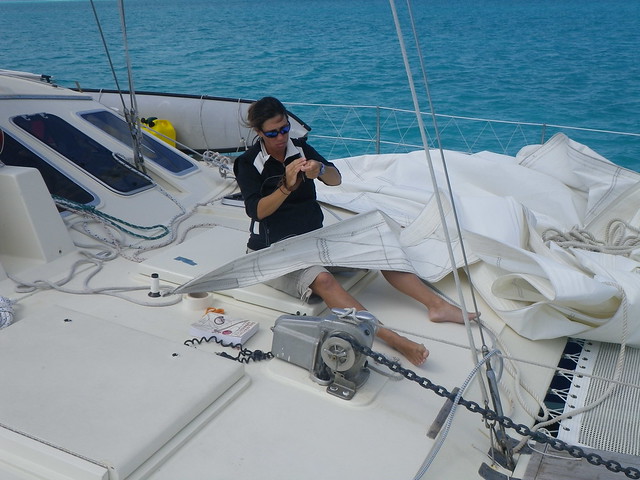
Of course nothing is guaranteed, but we do what we can to mitigate risks like that.  We try not to push the boat (or ourselves) too hard, and we fix problems when they come to our attention.  So we'll have some rigging work done in the coming weeks.  The inner forestay chainplate has already been repaired, but not yet reinstalled.  After that is done and the crossbeam bridle is replaced, we'll give the rig a good static tune.  In the meantime, we'll replace the spare jib halyard and get the sail itself to the loft for a professional repair of the patch Tanya made in the Bahamas.

Seamstress

Purple Job

When I’m away, boat maintenance falls on Tanya’s shoulders — like she doesn’t have enough to do.  But sometimes things happen unexpectedly and just can’t wait for me to get back. 

Recently she had to diagnose an air conditioner problem and make a temporary repair.  I’m proud of her for that, but when I went back to make a more permanent fix, I had to laugh out loud. 

[flickr: 8054249296]

Purple electrical tape?  I don’t even know where she got that.  Maybe she has a toolbox somewhere with flowers painted on it.

Haulout 2012, Day Twenty-Seven

Well, it’s over.  Take Two is safely back in the water and another epic haulout is behind us.  We shouldn’t have to worry about that again for a few years, and future haulouts should be much simpler.

We’re all eager to get back to life aboard now, probably none moreso than the cat.  Spice stayed in the boat for the duration, which was probably the least traumatic option for her.  But between swinging in the air, days on end of noisy power tools powering away beneath her, the thrice-a-day freight train passing by within 50 feet, and just plain loneliness, she got pretty tired of it toward the end.  I fed her out of guilt and I think she put on about a pound, so she didn’t have it all bad, but she’s definitely happy to have her family back.

We really enjoyed living ashore for a while, and more than once commented that we should remember this.  Living on a boat isn’t always sunsets and umbrella drinks, and maybe it’s good for us to take a break every once in a while.

What are Grandparents Made of?

I never knew my grandparents. That isn’t to say I never met them—only that we saw each other seldom because they lived far away. I have memories of visits and fond thoughts about the places they lived, but to say we had a relationship would be a stretch. Some of that, of course, is my own fault, as old fashioned letter-writing is easy and inexpensive and I did not write regularly, something I now regret. When we moved back to Florida, leaving the rat race of Atlanta far behind, part of the hope we had was that our children would really get to know their grandparents because they would live so close. Since I didn’t really know my grandparents, I wasn’t exactly sure what that would look like. I can now honestly say that the children do have good relationships with all their grandparents, and our parents have often pleasantly surprised us.

Jay’s folks split when he was ten, and both are remarried. When we lived in Clearwater, his mom and stepdad, a.k.a. “Mimi and Pappy,” used to stop by at least once a week to hang out, and often took one of the children on an outing, usually for a lunch date, but sometimes for something special, like a show at the theatre in Tampa. Since we moved aboard Take Two, they have hosted all seven of us in their home several times now—and twice during this September haulout—so to say they are doing a good job is an understatement. They even watched all five children and gave Jay and me a whole afternoon to ourselves! Pappy has taken the boys to his golf club several times, to play a round or drive the golf cart, and Mimi has taught Sarah how to knit—something that will serve her well the rest of her life. This is what we had always hoped for.

Jay’s dad, affectionately known as “Skipper,” along with “Grandma Mary,” is the boating contingent in the family. They met us for a week in the Bahamas a couple years ago aboard their catamaran and we cruised the Abacos in tandem, having a terrific time. We would raft up or anchor nearby and the kids would be able to go over for a visit one at a time, a rare treat in a big family. Grandma Mary is a pilot, so she often borrows a plane and flies to wherever we are for a visit, which has been lots of fun. Skipper sends emails which usually include a link to some wild and crazy Lego YouTube video, which our boys love, of course. We don’t see them as often as we would like, but when we do, it is always fun, and our kids adore them.

My parents are also divorced, so when we go to Naples, we have to split our time between my brother’s family, Jay’s parents and aunts and uncles, my dad and his wife, and my mom. It’s a challenge, and we often have to make tough choices since time is limited. My dad, “Papa,” built me and my sister a dollhouse when we were little, and it has been renovated several times over the years. When Sarah turned five, he lovingly restored it and gave it as a gift. Of course, a giant Victorian house doesn’t fit on a 48-foot sailboat, so it’s a gift that stays with the giver, and we have to go visit the dollhouse. I admit that I enjoy these visits as much as Sarah. The boys love to take Papa’s neurotic Great Dane for a run around the lake, and Papa always has something sweet to share. He never forgets a birthday or anniversary, and he always gives the perfect gift.  Who wouldn’t love him? He and Grandma Gail have been sailing with us several times, and have always been extremely supportive of our travel dreams.

My mom, “Nana,” is not much of a boat person, but has probably been aboard more than any of the other grandparents. When we were on the west coast of Florida, it wasn’t unusual for her to pop up for a day trip once or twice a month. She is a very creative person, and the children have many hand-made keepsakes, like hoody-towels made to look like animals, personalized satchels, and a Noah’s ark quilt she partnered with Mimi to make for each of the children when they were babies. She has kept alive some of the traditions from my childhood—like sending Valentines, something my children will never forget. When she lived with my brother, she was always on hand to play a game with the kids or read aloud, two of her fortes.

What are grandparents made of? Old stories and photos, secret stashes of chocolate, outings, bubble baths, handmade gifts, fishing trips, Christmas memories, birthday shopping trips, toaster waffles, secrets about your parents from when they were little, Dominoes and card games, the smell of coffee and bacon, and, in a word, happiness. While I enjoy being a parent, it is really hard work, and not all fun and games—I have to say “no” to so many things in order to raise decent human beings.  A grandparent, on the other hand, has earned the privilege of saying “yes” and of spoiling children with love, gifts, and treats your parents would never give you.

Haulout 2012, Day Twenty

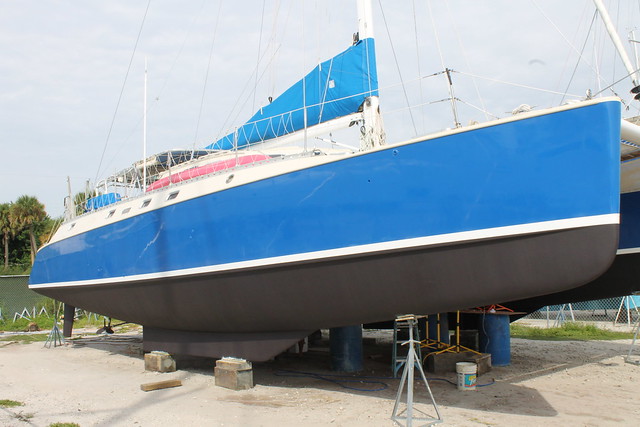
We have anthems on Take Two.  Songs (and movies, stories, poems, etc.) that we identify with for one reason or another and give frequent airtime.  Today’s song is “Back in Black” by AC/DC.  While we play this one pretty often anyway, it has special importance today because we’ve finally finished the bottom job portion of this haulout.  Blasting, filling, fairing, four coats of epoxy barrier paint, and three coats of black bottom paint.  Twenty days of work.  Three hundred man-hours.  Twelve thousand dollars.  Smoke ‘em if you’ve got ‘em, folks.  'Cause we’re back.  Yes, we’re back.  Well, we’re back.  Yes, we’re back.  We're back in black.

Back in Black

But we're still not finished, no.  We have yet to repair the damaged bridgedeck strake, finish drying the bridgedeck and fill all the holes we drilled, barrier coat, and paint it.  We're going red again.  Toreador Red.  Sounds awesome, doesn't it?  Olé!  We'll also repaint the bootstripe while we're at it.

Splash date is Day 27 when we'll give up our spot in the yard to the Tag 60 Tang.