All Play and No Work

While our intrepid captain has been working around the clock on the boat and at his job, I have been driving all over Florida, packing and unpacking the car, doing laundry as we go, and trying to help with cooking and cleaning in our host homes (trying not to be a parasite). It’s a lot of work to be on vacation! The kids, on the other hand, seem to be suffering from vacationitis—all play and no work is just as bad as all work and no play. I never thought we would be so excited about getting back to a “regular” schedule of school and chores.

We spent the last week or so visiting good friends in the keys. They live and work at a state park, homeschooling their three children and supplementing their diet with fruits de mer—fruit from the sea. That means, at this time of the year, lobster. We went out twice looking for “bugs”—at the beginning and end of the trip. The first day was too windy and the water was choppy with limited visibility. The day before we left, the wind had finally died down and we spent the day going from hole to hole in the Florida Bay, out beyond the traps in clear water, searching for nice-size lobster. I got in the water twice, but encumbered with a toddler, didn’t see much more than sea grass and a few small fish before I had to get back in the boat. It was a really fun day, though, and a successful one—we took home three dozen lobsters, and Eli earned dinner for our family! The other kids snorkeled, measured lobster, helped with gear, and jumped off the boat and swam around when not busy.

One of the coolest things for me was seeing how our friends work as a team: Ken or Amy drive the boat (while wearing baby Kai in an Ergo carrier), Mia (10) searches for lobster in their hidey-holes while the grownup not driving helps bag the big ones. When they come up with a specimen, Max (7) swaps the full net for an empty one, empties the lobster on deck and measures the carapace. If it’s big enough, he plops it into the live well to join the others. It’s a smooth operation, and reminds me why we love to homeschool—to be on our own schedule and live and work as a family, learning in real-world situations.

Our friends took us on other fun excursions—bridge jumping, the Dolphin Research Center, dinner at the Hurricane, Homeschool P.E. at the local city park, and walking through the state park. You’d never know that school is in session! But even school can be fun when you have a class of six buddies working together. Homeschoolers aren’t used to that kind of setting, but it seemed to work well, with everyone finished by lunchtime and back to LEGO building, knitting, drawing, frog-collecting, game-playing and all the other creative things homeschool kids think up to fill the time they aren’t on a school bus.

[flickr: 8017856520]

After a week or so of fun, we returned to the beach condo to visit Dad and recuperate from sleepless nights and get ready for yet another week on the road…more play in store for the crew of Take Two. Phew!

Haulout 2012, Day Seventeen

Progress lately has been a lot like watching paint dry, with a daily thunderstorm thrown in just to keep it interesting.  The fairing is done and we’ve put on three barrier coats so far.  We’ll do one more, but the first coat of anti-fouling needs to be done on the same day and finding a weather window for that may be difficult.  Otherwise, we could be finished with the bottom paint as soon as Day 19.

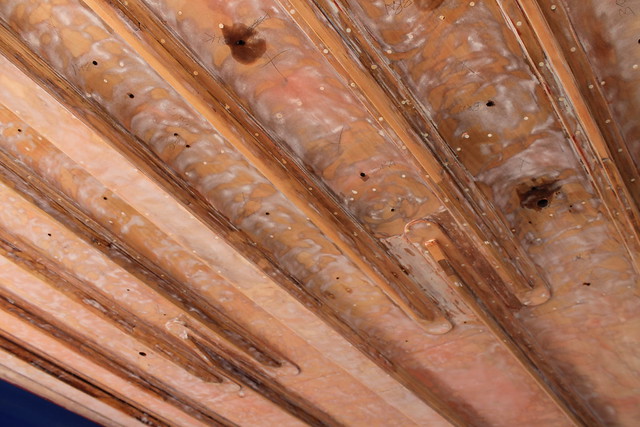
We want the bridgedeck to dry out as much as possible before we begin painting it, but the damp weather plays havoc with our efforts.  Sometimes an area that was dry the day before is dripping wet again in the morning.  At first we thought it was weeping out of the wood itself, but that no longer seems likely since we can’t find a source.  Now we think it must be coming from the air, but don’t understand how that could be the case either.  Maybe it’s little green men.  We had a dead serious conversation about setting up a time lapse camera to record what happens in the boatyard overnight.  That’s where we are mentally.

The moisture meter isn’t helping things either.  It gives a lot of false positives.  It will say an area is wet and we’ll drill into it only to find it completely dry.  It will say an area is dry, except for a small spot about an inch square that is completely soaked.  Of course it isn’t.  We have a second meter that gives similar readings, so we can at least rule that out.  The meter helped initially and we were able to find many pockets of standing water, but at this point I think it’s just making us crazy.

Haulout 2012, Day Fourteen

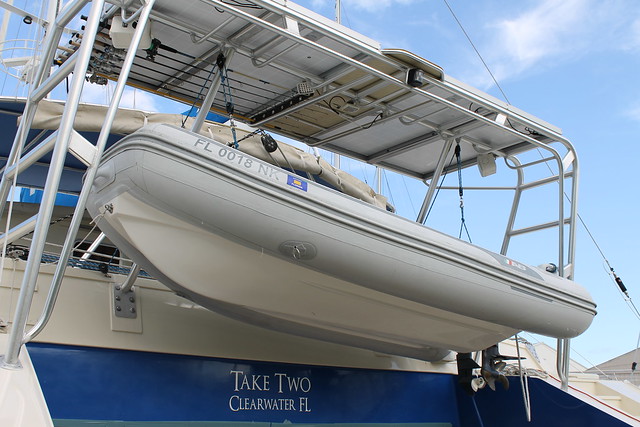
As I stood beneath Take Two and surveyed the destruction around me, I happened to glance up, and my gaze fell upon the underside of our trusty dinghy, our waterborne SUV.  Frankly, it’s been carrying around a little bit of Marathon for about two years now.  Everybody else takes their dinghy to the beach every once in a while and flips it over for a good scrubbing.  Ours is a bit too large for flipping over on the beach, and I’m a bit too lazy for scrubbing underwater.  But standing underneath it I realized that if I just lowered it a little bit, I’d be at the perfect height to give it that good scrubbing.  Without flipping it over.  Without being underwater.  And the boatyard was the perfect place to use some nasty chemicals that you’re not supposed to get in your eyes.  So that’s what I did.  And now the dinghy is much cleaner.  And so are my eyes.

Clean Dinghy

The barrier coating has begun!

Haulout 2012, Day Twelve

The novelty of this haulout thing has worn off and the days are running together.  Mudding and sanding, sanding and mudding.  Progress is measured in percentages.  

But the end is in sight.  Tomorrow we’re hoping to start the barrier coat.  It may reveal some spots that need more fairing, but I’m okay with that.  Just give me something I can check off the list.

The bridgedeck is still a question mark.  How long do we let it dry?  We’ve got 3,600W of lights pointed at it now, and it’s making a difference, but it’s slow.

The guy who runs the TraveLift here has been doing it for twenty-something years.  He’s very good at it.  Sure, he’s dropped a couple boats.  But how do you learn not to drop them if you never have, right?  So he’s the guy you want lifting your boat.  But he somehow got it in his head that boats must be blocked at a five degree incline.  I watched him block Take Two this way, and thought it was weird, but didn’t immediately see a problem.  Well, it’s been rainy recently and I can tell you, it’s a problem.  Think five degrees isn’t much?  Jack one end of your dining room table up six inches and see how you like that.  You’ll have gravy in your peas for sure.  God intended dining room tables and catamarans to be flat.  Anything else is just wrong.  

Apparently, Take Two’s port-side mast chainplates leak.  Thank you Billy, I never would have had the joy of discovering that if you hadn’t blocked my boat so they sat an inch deep in rainwater.

Haulout 2012, Day Ten

Let the record show it was Day Ten when I started losing my mind.  First we ran into a bad batch of fairing epoxy.  There was none good anywhere in town, so we had to have it shipped in from Miami.  Then the brand-new "heavy duty" air file (a pnuematic longboard) took a dump after only about 30 minutes of work.  Nope, can't get that locally either.  So we resorted to circular sanders, just to get something done.  This is the same tool we would have used to get the paint off in the first place if we hadn't used the fancy stripping process that took all our old fairing away.

To distract myself, I continue trying to figure out the bridgedeck.  I happened to have half a dozen 100W clamping worklights on the boat, specifically for drying out wet places.  I set those up on some of our worst spots to try and speed things up.  If that looks promising, I'll go get some 500W halogens.

The port stern repair is complete.  The starboard keel repair got done too.  We were able to cut away enough of the block to expose the damage without having to pick the boat up.

Haulout 2012, Day Nine

Who am I kidding?  We won’t be out of here in a week.  Fairing started today.  That’s going to be a slow process.  Then it gets two coats of barrier epoxy and three coats of bottom paint.

We took a bit more scientific approach to evaluating the water collected from bridgedeck.  We learned that all the water collected was indeed salty to some degree.  It ranged from 5,000 parts per million, which equates to mildly brackish water, all the way up to 1 million parts per million (salt crystals).  The darkest nastiest stuff was drained from under the generator space and actually contained oil.  

I think the salt water came in through the conduit system.  The watermaker is our only source of salt water and the conduit runs through a little sump area in that compartment.  I believe at some point the sump drain was plugged and salt water flooded into the conduit and then traveled all over the place.  The oil clearly seeped through the floor, and we have moisture in a couple other places where we've had standing water problems in the past.

The upside is that the water in the bridgedeck all seemed old.  If we can plausibly explain how it got there, and I think we’re close, then I can feel better that it isn’t going to come back.  The drain idea kind of died when I started to count how many I’d need.  Probably better just to go down there with a moisture meter whenever I start to lose sleep worrying about it. 

Haulout 2012, Day Eight

The family has left again for the next leg of their road trip.  This time down to the Keys.

The sanding of the bridgedeck is finally finished and we’re taking twice-a-day moisture readings to monitor drying progress.  We’re going to seal the wood, but first we want to make sure all the moisture is out. I’m beginning to wonder if this dry time might keep the boat in the yard for awhile.

Bridgedeck

Otherwise, things are going well.  We just crossed the 1-week mark, and it looks like we have a fighting chance at hitting our 2-week outside estimate.  There’s only one spot in the DIY area of the yard for a boat our size and it’s popular with catamarans, so running behind schedule would normally be a problem.  But we discovered awhile back that the woman who manages the boatyard schedule has a weak spot for Tanya’s cookies, and we began bribing her with goodies early on.  So when I asked for two weeks in the yard, she gave me four.  Maybe that was just pessimism on her part, but I prefer to think she was being nice.  In either case, we’re in no immediate danger of being rushed back into the water.  

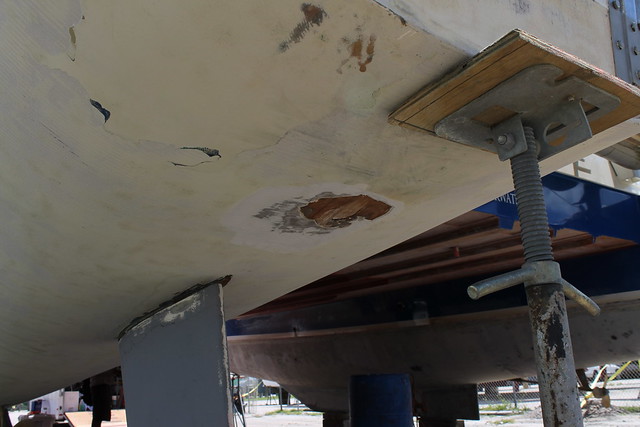
The port keel repair is completed.  The jackstand damage under the port stern has been ground back, the broken planks cut out, and a piece of plywood chamfered in.

Haulout 2012, Day Seven

I had to go out of town today, so did not get to witness the draining of the bridgedeck first-hand.  I’m told it was impressive.  Not just the quantity of water, but also the variety.  Apparently it was a panoply of colors and smells.  The crew took pictures and saved samples for my later enjoyment.  Our human test kit reported that the brown liquids burn mightily in open cuts.  Interesting.  For my own sanity, I think we’re going to have to consider permanent drains in these areas.

Repairs of the port keel and stern were begun. There's an area on the bottom of the starboard keel that needs attention, but will have to wait until we shift the blocks.

Haulout 2012, Day Six

Sanding the bridgedeck continues, though today I did none myself.  The family was in town and I spent the morning at the beach with the big kids, where we got sanded ourselves.  The surf was up.  We had a serious talk about safety beforehand, and everyone did real well.  There were some scrapes and bruises, but it was great fun.  Alas, my phone has gone missing after several years of faithful service.  I think it swims with the fishes.

In the afternoon, Eli and I went to the boat and he helped me change the backstay chainplate bolts.  He had the inside job, which required crawling way back under the transom steps to tighten the nuts.  Kids are great for that kind of work.  Several of the old bolts had corroded and the heads broke off when I tried to remove them.  I’m sure the new ones are stronger, but I’m paranoid now that they might leak.

Holes from the removed thru-hulls and sonar transducer have been plugged.  Bad wood has been cut out around the cockpit drains.  Bootstripe has been cleaned in preparation for fairing the hulls.  That's going to be the next big job.

Haulout 2012, Day Five

Sanding overhead is a hard, messy job.  It is a painfully awkward position, and the machine has to be held – no, pressed – up to the work.  Depending on the machine being used, dust mask and eyewear is somewhere between a good idea for safety’s sake and necessary for survival.  My sander of choice is a Festool RO 150 FEQ, which puts me solidly in the survival category.  The thing is a beast and tears off paint at an incredible rate… if you can hold it up.  For every one minute I can hold it, I probably have to rest for two.

Now for the Surprise of the Day:  At some point in the last couple years, I noticed some hull damage on the inside of the port transom aft of the rudder.  The wood was broken, thrust upward like tectonic plates.  It was dry, so I assumed that whatever had happened, it had been repaired from the outside.  It wasn’t a high stress area, so I wasn’t too worried about it.  I repaired the inside to the best of my ability at that time, and promptly forgot about it.

But then during this haulout I noticed the spot looked a little funny on the outside, remembered my inside repair, and we decided to dig into it.  It turns out it wasn’t repaired from the outside at all.  I now think that a boatyard worker, probably at our last haulout, over-tensioned a jackstand and didn’t tell anyone.  The planks of the hull were broken, but the fiberglass skin held its shape, and the water out, for many hard miles.

Surprise of the Day

Another spot repaired at the same yard, where our keels were damaged while hauling out on their rail, we found was not done correctly and will have to be redone.

That was at a “full-service” yard, where I was supposed to turn over my baby and wait until they’re finished billing me.  They tolerated my daily visits, but I wasn’t allowed to do any work.  I had to rely on their personnel for everything.  It was not an experience I’m in a hurry to repeat.  

This time we’re at a yard that allows Do-It-Yourself work, and the difference is huge.  Nothing happens unless I do it or arrange to have it done.  I’ve hired a crew that I trust, and we work on the boat as a team.  Mistakes can always happen, but at least this time they’ll be my mistakes.